
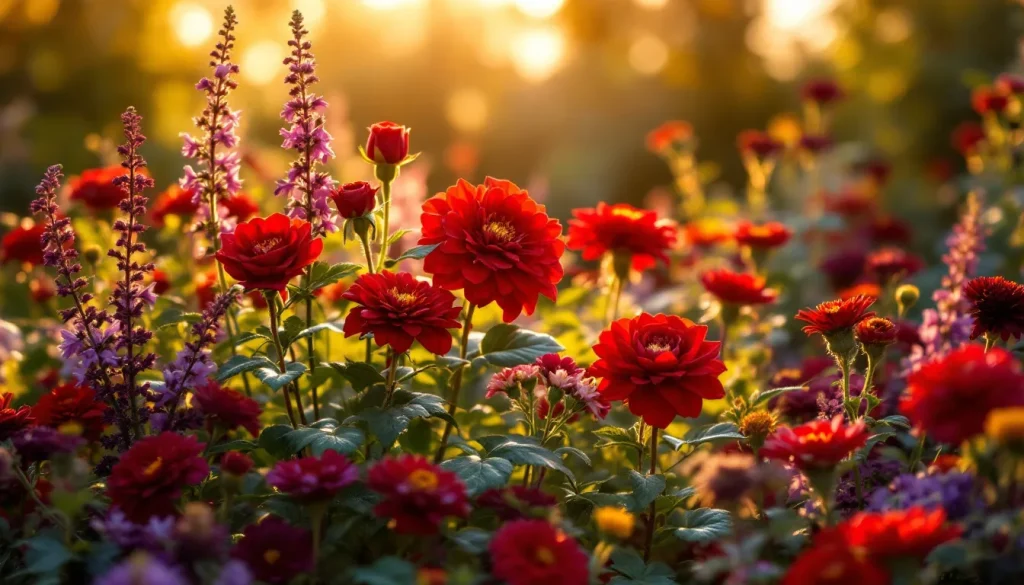
Red flowers at a glance: 35 named types with zones and bloom times
Red flowers range from the flagship rose (Rosa) to tiny scarlet pimpernel and near-black dahlias, and the 35 types below are grouped by plant type (annual, perennial, bulb, shrub) so you can pick by what you can actually grow. Every entry pairs the common name with its botanical name, plus the four facts most lists omit: USDA hardiness zone, bloom season, sun need, and mature height.
By: HMNDP Editorial Team, independent reporting on lawn care and landscaping.
Last reviewed: June 2026
Use the table first to shortlist, then read the numbered profiles for form and named cultivars. If you are matching plants to a bed, start with your growing conditions, not the color: check your soil type and drainage before you buy anything.
| Red flower | Type | USDA zones | Bloom time | Sun | Mature height |
|---|---|---|---|---|---|
| Rose (Rosa) | Shrub | 3-11 | Late spring to frost | Full sun | 2-6 ft |
| Oriental poppy (Papaver orientale) | Perennial | 3-7 | Late spring | Full sun | 2-3 ft |
| Dahlia (Dahlia) | Tender tuber | 8-11 | Midsummer to frost | Full sun | 1-5 ft |
| Tulip (Tulipa) | Bulb | 3-8 | Spring | Full sun | 6-24 in |
| Chrysanthemum (Chrysanthemum) | Perennial | 5-9 | Late summer to fall | Full sun | 1-3 ft |
| Amaryllis (Hippeastrum) | Bulb | 9-11 | Winter (forced) to spring | Bright indirect | 1-2 ft |
| Peony (Paeonia) | Perennial | 3-8 | Late spring to early summer | Full sun | 2-3 ft |
| Zinnia (Zinnia elegans) | Annual | 2-11 (annual) | Summer to frost | Full sun | 1-4 ft |
| Geranium (Pelargonium) | Tender perennial | 10-11 | Spring to frost | Full sun | 1-2 ft |
| Begonia (Begonia) | Tender perennial | 9-11 | Summer | Part to full shade | 6-12 in |
| Gerbera daisy (Gerbera jamesonii) | Tender perennial | 8-11 | Spring to fall | Full sun | 10-18 in |
| Hardy hibiscus (Hibiscus moscheutos) | Perennial | 4-9 | Mid to late summer | Full sun | 3-7 ft |
| Canna lily (Canna) | Tender rhizome | 7-11 | Summer to fall | Full sun | 3-6 ft |
| Scarlet salvia (Salvia splendens) | Annual | 10-11 (annual) | Summer to frost | Full sun | 1-2 ft |
| Carnation (Dianthus caryophyllus) | Perennial | 3-9 | Late spring to summer | Full sun | 1-2 ft |
| Poppy anemone (Anemone coronaria) | Tuber | 7-10 | Spring | Full sun to part shade | 8-18 in |
| Aster (Symphyotrichum) | Perennial | 3-8 | Late summer to fall | Full sun | 1-4 ft |
| Crocosmia (Crocosmia ‘Lucifer’) | Corm | 5-9 | Mid to late summer | Full sun | 2-4 ft |
| Bee balm (Monarda didyma) | Perennial | 4-9 | Summer | Full sun to part shade | 2-4 ft |
| Cardinal flower (Lobelia cardinalis) | Perennial | 3-9 | Late summer | Part shade, moist | 2-4 ft |
| Nasturtium (Tropaeolum majus) | Annual | 2-11 (annual) | Summer to frost | Full sun | 1-10 ft (vining) |
| Snapdragon (Antirrhinum majus) | Annual | 7-11 | Spring and fall | Full sun | 1-3 ft |
| Camellia (Camellia japonica) | Evergreen shrub | 7-9 | Winter to spring | Part shade | 6-12 ft |
| Wood anemone (Anemone nemorosa) | Perennial | 4-8 | Early spring | Part to full shade | 4-8 in |
| Fuchsia (Fuchsia) | Tender perennial | 10-11 | Summer | Part shade | 1-3 ft |
Popular red flowers, named and profiled (1-25)
These 25 red flowers cover the plants shoppers ask for by name, from the rose everyone pictures first to the salvia and canna that anchor a summer bed. Each profile gives the botanical name, the shade and form of the red bloom, and where it fits by plant type, so you can tell a spring bulb from a frost-tender annual before you buy.
- Rose (Rosa). The flagship red flower and the one most searchers picture. Hybrid teas like ‘Mister Lincoln’ and ‘Chrysler Imperial’ carry velvety deep-red blooms on 3-to-5-foot canes, hardy in zones 5-9 and flowering from late spring to frost in full sun.
- Poppy (Papaver). Oriental poppy (Papaver orientale) opens crepe-paper scarlet cups with a black center in late spring, a hardy perennial in zones 3-7. The field poppy (Papaver rhoeas) is the annual “remembrance” red.
- Dahlia (Dahlia). A tender tuber with dozens of red forms, from the single scarlet of ‘Bishop of Llandaff’ to dinner-plate blooms. Plant after frost in full sun; lift tubers below zone 8.
- Tulip (Tulipa). Spring bulb with clean, waxy red goblets. ‘Red Impression’ and lily-flowered ‘Pretty Woman’ bloom in zones 3-8 and read as pure fire-engine red in a mass planting.
- Chrysanthemum (Chrysanthemum). The fall mainstay. Garden mums carry rusty-red to burgundy button and decorative blooms from late summer into fall, perennial in zones 5-9 in full sun.
- Amaryllis (Hippeastrum). The big red trumpet of the holiday windowsill. ‘Red Lion’ forces indoors in winter; outdoors it is a zone 9-11 bulb reaching 1 to 2 feet.
- Peony (Paeonia). Long-lived perennial with lush, ruffled blooms. ‘Karl Rosenfield’ and ‘Red Charm’ flower deep crimson in late spring, hardy to zone 3 and reliable for decades.
- Zinnia (Zinnia elegans). The easiest red annual from seed. ‘Cherry Queen’ and the Benary’s Giant series bloom scarlet all summer to frost and cut cleanly for bouquets.
- Geranium (Pelargonium). The classic red pot plant. Zonal geraniums throw bright scarlet flower clusters spring to frost in full sun, grown as annuals outside zones 10-11.
- Begonia (Begonia). One of the few reliably red shade bloomers. Wax and tuberous begonias carry red flowers over glossy foliage in part to full shade all summer.
- Gerbera daisy (Gerbera jamesonii). Big, flat scarlet daisies on bare stems, a florist favorite. A zone 8-11 tender perennial that flowers spring through fall in full sun.
- Hibiscus (Hibiscus). Hardy hibiscus (Hibiscus moscheutos) opens dinner-plate red flowers in zones 4-9, while tropical Hibiscus rosa-sinensis gives glossy red blooms in zones 9-11.
- Canna lily (Canna). Bold tropical vertical color. ‘President’ carries fire-red flowers on 4-to-6-foot stems from summer to fall, a tender rhizome hardy in zones 7-11.
- Salvia (Salvia splendens and Salvia coccinea). Scarlet sage packs spikes of red tubular flowers loved by hummingbirds, blooming summer to frost. Grown as an annual in most of the country.
- Carnation (Dianthus caryophyllus). Clove-scented, ruffled red flowers on gray-green stems. A short-lived perennial in zones 3-9, long-lasting as a cut flower.
- Anemone (Anemone coronaria). Poppy anemone opens jewel-red flowers with a dark eye in spring. ‘Hollandia’ is the classic red; the woodland Anemone nemorosa is its shade-loving cousin.
- Aster (Symphyotrichum). Late-season daisies for fall color. Named reds like ‘Royal Ruby’ and ‘Jenny’ bloom rosy-red into October, perennial in zones 3-8.
- Crocosmia (Crocosmia ‘Lucifer’). Arching sprays of blazing scarlet flowers over sword-shaped leaves in mid to late summer, a hardy corm in zones 5-9 and a hummingbird magnet.
- Bee balm (Monarda didyma). Shaggy, whorled red flowers on aromatic stems. ‘Jacob Cline’ is the mildew-resistant scarlet, perennial in zones 4-9 and a top pollinator plant.
- Cardinal flower (Lobelia cardinalis). Spikes of intense true-red flowers in late summer, native to North American wetlands. Hardy in zones 3-9 and happiest in moist part shade.
- Nasturtium (Tropaeolum majus). An easy edible annual with spurred scarlet flowers and round leaves. Trails or climbs in full sun and blooms until frost.
- Snapdragon (Antirrhinum majus). Upright spikes of red dragon-mouth flowers for cool-season color, blooming spring and fall. Grown as an annual or short-lived perennial in zones 7-11.
- Petunia (Petunia). Trumpet-shaped red flowers that mound and spill from containers all summer. Grown as an annual, thriving in full sun with regular deadheading.
- Camellia (Camellia japonica). An evergreen shrub that flowers red in winter and early spring when little else does. ‘Bob Hope’ carries deep-red blooms in part shade, zones 7-9.
- Fuchsia (Fuchsia). Pendant red-and-purple flowers for hanging baskets in shade. A tender perennial in zones 10-11, prized for its hummingbird traffic.
Small red flowers: 6 tiny scarlet blooms for edges and pots
Small red flowers are among the most-searched red-flower sub-queries, yet most lists ignore them. These six stay under about 18 inches and produce petite red blooms ideal for border fronts, rock gardens, and container edges. Each is named with its botanical name plus its zone and light needs so you can slot it into a small space.
- Red verbena (Verbena). Flat clusters of tiny red florets on trailing stems, blooming spring to frost in full sun. Grown as an annual or a zone 8-10 tender perennial, staying 6 to 12 inches tall.
- Scarlet pimpernel (Lysimachia arvensis). A low wildflower with 6-inch stems and small orange-red star flowers that close in cloud. Common in fields and disturbed ground, treated as an annual weed in much of the country.
- Cyclamen (Cyclamen). Swept-back red flowers over marbled leaves, blooming in cool seasons. Florist types brighten winter windowsills; hardy Cyclamen coum flowers red in zones 5-9 shade.
- Coral bells (Heuchera). Airy wands of tiny bell-shaped red flowers above evergreen foliage in late spring. A shade-tolerant perennial in zones 4-9, usually under 18 inches.
- Sweet William (Dianthus barbatus). Dense heads of small red and bicolor flowers on 12-to-18-inch stems in late spring. A short-lived perennial or biennial in zones 3-9.
- Pentas (Pentas lanceolata). Clusters of tiny red star flowers that butterflies favor, blooming all summer. A heat-loving annual or zone 10-11 tender perennial, roughly 1 to 2 feet.
Dark red and near-black flowers: 5 burgundy and blackish reds
Dark red flowers, the true burgundy and near-black shades, are the other big related search competitors skip. These five push red to its deepest edge, reading almost black in low light and pairing well with silver foliage. They span a rose, a cosmos, a dahlia, a tulip, and a scabious, so you can find a dark red in nearly any plant type.
- ‘Black Baccara’ rose (Rosa). The darkest widely grown red rose, a hybrid tea with dense, near-black crimson buds that deepen in cool weather. Hardy in zones 6-9 in full sun.
- Chocolate cosmos (Cosmos atrosanguineus). Velvety maroon-black flowers that smell of dark chocolate, blooming summer to fall. A tender tuber in zones 7-11, around 18 to 24 inches.
- Dark dahlia (Dahlia ‘Chat Noir’ / ‘Arabian Night’). Cactus and decorative dahlias in blackened burgundy, the deepest reds in the tuber world, flowering midsummer to frost in full sun.
- ‘Black Parrot’ tulip (Tulipa). Fringed, twisted petals in deep maroon-black, blooming late spring in zones 3-8. One of the moodiest reds a bulb can produce.
- ‘Black Knight’ scabious (Scabiosa atropurpurea). Pincushion flowers in dark blood-red on wiry stems, blooming all summer. Grown as an annual or short-lived perennial in zones 7-10.
How to identify a red flower you saw
To identify a red flower, work through four features in order: bloom shape, petal count, leaf shape, and where and when it was growing. A large single cup in spring points to a poppy or tulip; a spike of tubular red flowers in a wild spot suggests salvia, bee balm, or cardinal flower. These clues narrow most red blooms to a small shortlist fast.
Start with bloom shape. Flat daisies (gerbera, zinnia, aster), tubular spikes (salvia, cardinal flower, bee balm), trumpets (amaryllis, hibiscus, canna), and layered ruffles (rose, peony, carnation) each rule out large groups at once.
Next, count and read the petals and center. A dark central eye on a red cup is a strong poppy or anemone signal, while many overlapping petals with no visible center point to roses, peonies, or double dahlias.
Then check the leaf and stem. Sword-like leaves mean canna, crocosmia, or gladiolus; deeply cut ferny foliage suggests cosmos or dahlia; round shield leaves signal nasturtium. Leaf shape often settles a tie the flower alone cannot.
Finally, note the setting and season. A cultivated bed in June reads differently from a red bloom in a wild meadow. Wild or roadside reds in North America are frequently field poppy, scarlet pimpernel, bee balm, or cardinal flower, while showy doubles almost always come from a garden. Season matters too: winter red usually means camellia or amaryllis, spring means tulip or poppy, and late summer means salvia, canna, or aster.
What red flowers symbolize and where to use them
Red flowers most often symbolize love, passion, courage, and remembrance, and their best use depends on the setting: roses and carnations for bouquets, zinnias and salvia for beds, and tubular reds for pollinators. Matching meaning and use-case matters more than color alone when you are planning a gift, a border, or a habitat planting.
Symbolism. A red rose signals romantic love in most Western traditions, while the red poppy carries remembrance and honors fallen soldiers. Red carnations often mean admiration, and red chrysanthemums can signal love or, in some East Asian customs, are reserved for funerals, so context matters when giving them.
Best red flowers for bouquets. Roses, carnations, gerbera daisies, zinnias, and dahlias hold up in a vase for days and cut with long, straight stems. For a dramatic near-black accent, add a few ‘Black Baccara’ roses or dark dahlias.
Best red flowers for beds. For mass color in the ground, salvia, zinnia, geranium, canna, and hardy hibiscus give the longest bloom windows in full sun. Perennial red that returns every year comes from peony, bee balm, crocosmia, and aster. Group them by bloom time so the bed carries red from spring bulbs through fall mums.
Best red flowers for pollinators. Red tubular flowers are hummingbird magnets: cardinal flower, bee balm, crocosmia, salvia, and fuchsia rank at the top. Pentas and zinnia pull in butterflies. A pollinator strip of these plants works well at the edge of a lawn, softening the line between turf and border. If you are converting worn turf into a bloom bed, our guide to choosing the right grass type helps you plan the surrounding lawn, and understanding how bare soil erodes matters on any slope you replant.
Whatever red you choose, healthy blooms start below ground. Amending for good drainage and organic matter (see our primer on common soil types) does more for flower performance than any fertilizer, and pairing beds with the right shade or specimen trees sets the light conditions that decide which reds will thrive.
Frequently Asked Questions
What are the most popular types of red flowers?
The most popular red flowers are the rose (Rosa), poppy (Papaver), tulip (Tulipa), dahlia, peony, geranium (Pelargonium), zinnia, gerbera daisy, chrysanthemum, and hibiscus. The red rose leads by a wide margin as the flower most people picture and buy. Salvia, canna lily, and carnation round out the reds gardeners most often plant and florists most often sell.
What are the names of small red flowers?
Small red flowers include red verbena (Verbena), scarlet pimpernel (Lysimachia arvensis), cyclamen (Cyclamen coum), coral bells (Heuchera), sweet William (Dianthus barbatus), and pentas (Pentas lanceolata). Most stay under 18 inches and produce petite scarlet blooms suited to border fronts, rock gardens, and container edges. Scarlet pimpernel is a true wild miniature, while verbena and pentas bloom all summer in pots.
What is the darkest, near-black red flower?
The darkest red flowers include the ‘Black Baccara’ rose, chocolate cosmos (Cosmos atrosanguineus), and dark dahlias like ‘Chat Noir’ and ‘Arabian Night’. These read almost black in low light while staying technically deep crimson or maroon. The ‘Black Parrot’ tulip and ‘Black Knight’ scabious add near-black reds among bulbs and annuals. None are truly black; all are very dark burgundy or blood-red.
What red flowers bloom all summer or year-round?
For red flowers that bloom all summer, plant salvia, zinnia, geranium, petunia, begonia, and pentas, which flower from late spring to frost with deadheading. Canna lily and hardy hibiscus carry red through mid and late summer. No single red flower blooms year-round outdoors in cold climates, but combining spring tulips, summer salvia, and fall mums gives continuous red across the seasons.
Which red flowers are perennials that come back every year?
Red perennials that return each year include peony (Paeonia), bee balm (Monarda didyma), crocosmia, aster, cardinal flower (Lobelia cardinalis), carnation (Dianthus), and hardy hibiscus. Roses and camellias are woody perennials that also come back annually. In colder zones, tender favorites like dahlia and canna survive only if you lift and store their tubers over winter.
What do red flowers symbolize or mean?
Red flowers most commonly symbolize love, passion, courage, and remembrance. A red rose signals romantic love, the red poppy represents remembrance for fallen soldiers, and red carnations often express admiration or deep affection. Meaning can shift by culture: red chrysanthemums mean love in some places but are reserved for funerals in parts of East Asia, so consider the recipient’s traditions.
What are the best red flowers to attract hummingbirds and pollinators?
The best red flowers for hummingbirds are tubular bloomers: cardinal flower (Lobelia cardinalis), bee balm (Monarda didyma), salvia, crocosmia, and fuchsia. Hummingbirds are strongly drawn to red tubular shapes. For butterflies, pentas and zinnia perform best. Grouping several of these plants in a sunny strip creates a reliable nectar source from early summer through fall.
What red flowers grow well in shade versus full sun?
For red flowers in shade, choose begonia, fuchsia, cyclamen, coral bells (Heuchera), camellia, and cardinal flower, which tolerate part to full shade. For full sun, plant rose, zinnia, salvia, geranium, canna, dahlia, and hardy hibiscus. Most red bloomers flower best with at least six hours of direct sun, so shade options are more limited and often depend on consistent moisture.