
By the HMNDP Editorial Team, independent reporting on lawn care, landscaping, and the green industry.
Last reviewed: June 2026
Do you dilute vinegar to kill weeds? The answer depends on strength
Whether you dilute vinegar to kill weeds depends entirely on the concentration in the bottle. Standard 5% household vinegar should not be diluted, because it is already weak and cutting it with water makes it useless. Horticultural or industrial vinegar at 20%, 30%, or 45% acetic acid can and usually should be diluted, most often 1:1 with water.
The active ingredient is acetic acid, and its percentage is the only number that matters. Grocery vinegar and cleaning vinegar sit at 4 to 6% acetic acid. Weed-killing horticultural vinegar starts around 20% and runs to 45%.
Below is the fast decision table, then the reasoning, recipes, safety steps, and the honest limits behind each.
| Vinegar you have | Acetic acid | Dilute? | What to do |
|---|---|---|---|
| Grocery / cleaning vinegar | 4 to 6% | No | Use full strength; expect weak, patchy results on young weeds only |
| Horticultural vinegar | 20% | Optional | Often used neat; light 4:1 cut possible for tender weeds |
| Horticultural vinegar | 30% | Yes | Dilute 1:1 with water (final strength around 15%) |
| Industrial vinegar | 45% | Yes, always | Dilute roughly 2 parts water to 1 part vinegar; never handle neat without full PPE |
Household 5% vinegar vs horticultural strengths (20%, 30%, 45%)
Household 5% vinegar and horticultural vinegar are not the same product with a different label. They differ by a factor of four to nine in acetic acid. That gap decides whether dilution helps or hurts. Diluting 5% vinegar drops it toward salad-dressing territory; diluting 30% brings a corrosive concentrate down to a usable, still-potent spray.
Household vinegar (Heinz, store brands, cleaning vinegar) burns only the softest new growth on a hot day, and even then results are inconsistent. Horticultural products like 20% and 30% acetic acid sold by brands such as Green Gobbler and Harris are formulated specifically to scorch foliage fast.
If you want a broader view of natural and chemical options before committing, HMNDP covers the full range in what actually kills weeds.
How to dilute 30% vinegar to kill weeds (the 1:1 recipe)
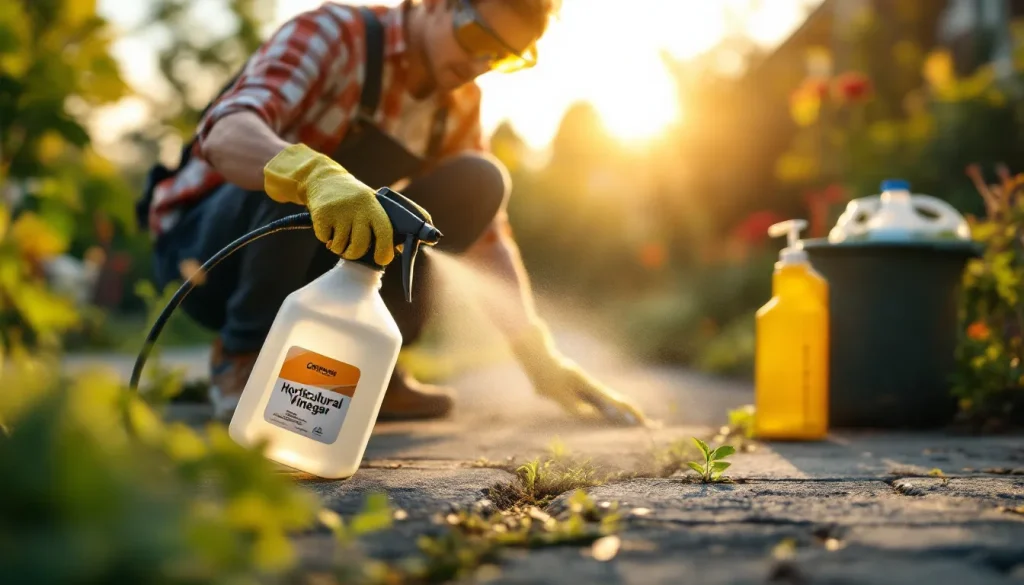
To dilute 30% vinegar for weeds, mix one part vinegar to one part water, which yields roughly 15% acetic acid. That is strong enough to burn most annual weeds within hours yet stretches the concentrate and reduces splashing hazard. Add a surfactant so the spray sticks. Use a plastic sprayer, never metal, which acid corrodes.
- Put on nitrile gloves and eye protection before opening the bottle.
- Pour 500 ml water into a clean plastic pump sprayer.
- Add 500 ml of 30% vinegar (the 1:1 ratio).
- Add 1 teaspoon of dish soap as a wetting agent and swirl gently.
- Spray until leaves are wet but not dripping, on a dry, sunny day.
For 20% vinegar, many gardeners skip dilution and spray it neat. For 45% industrial vinegar, cut it further, closer to 2 parts water to 1 part vinegar, and treat it as a hazardous chemical.
20% vs 30% vinegar: cost and potency compared
20% and 30% vinegar both kill young weeds, but 30% acts faster, needs fewer repeat sprays, and costs more per bottle. Because you dilute 30% roughly 1:1, a gallon of 30% concentrate effectively makes about two gallons of spray, which often makes it cheaper per treated square foot than 20% used neat.
| Factor | 20% vinegar | 30% vinegar |
|---|---|---|
| Typical use | Full strength | Diluted 1:1 |
| Final spray strength | ~20% | ~15% |
| Speed of burn | A few hours | Faster, often under 2 hours in sun |
| Spray yield per gallon | 1 gallon | ~2 gallons after dilution |
| Handling risk | High | Higher (must dilute) |
Neither strength reaches the potency of a systemic commercial herbicide, so factor in repeat trips when comparing true cost.
How vinegar kills weeds: acetic acid burns the foliage
Vinegar kills weeds by contact desiccation. Acetic acid strips the waxy cuticle and ruptures leaf cell membranes, so the plant loses water and the top growth browns and collapses. Higher acid percentages destroy more cells faster. This is a burn, not a poison the plant absorbs and carries downward.
Heat and sunlight speed the reaction, which is why timing matters so much (covered next). The damage stays where the spray lands, so it never travels to the roots of established perennials.
Spray on a hot, sunny, dry day
Apply vinegar weed killer on a dry day above 21C (70F) with strong sun and no rain forecast for 24 hours. Heat accelerates the acid reaction and sunlight amplifies leaf scorch, so a midday summer application works far better than a cool, cloudy morning. Rain within hours washes the acid off before it finishes the job.
Wind matters too. Acetic acid drift can scorch nearby ornamentals and grass, so spray on still air and shield desirable plants with cardboard.
Why vinegar kills the top growth but not the roots
Vinegar reliably kills young annual weeds but usually fails on established perennials, because it burns only what it touches and never reaches the root system. Dandelion, bindweed, thistle, and dock store energy in deep taproots or spreading rhizomes and simply push out new leaves within one to two weeks.
Expect to reapply every 1 to 2 weeks on stubborn perennials, sometimes all season, while a systemic commercial product often needs a single pass. For persistent root-driven weeds, digging or targeted systemic control tends to win. HMNDP compares those approaches in how to get rid of weeds, and for driveways, patios, and paths, clearing weeds from a large area covers scaling up.
Should you add dish soap or salt to a vinegar weed killer?
Add a small amount of dish soap, yes; add salt only with caution. Dish soap acts as a surfactant that breaks surface tension so the vinegar coats and clings to waxy leaves instead of beading off. One teaspoon per liter is plenty. Salt boosts kill but poisons soil for months, so keep it away from planting beds.
Salt (sodium chloride) draws water out of plants and sterilizes the ground where it lands, which can be useful on gravel driveways but ruinous near a lawn or garden bed. A common cracks-and-paving mix is one gallon vinegar, one cup salt, and one tablespoon dish soap, used only where you want nothing to grow again.
Vinegar is non-selective: it kills everything it touches
Vinegar is a non-selective weed killer, meaning it damages any green tissue it contacts, including grass, flowers, and vegetables. It cannot tell a weed from a prized plant, so overspray on a lawn leaves brown patches. Spot-treat with a shielded nozzle rather than broadcasting it across turf.
If you are treating weeds inside a lawn and worry about the grass, first confirm your turf type using HMNDP’s guide to identifying what grass you have, then spot-spray individual weeds only.
Is high-strength vinegar safe to handle, and does it harm soil?
High-strength vinegar at 20 to 45% acetic acid is corrosive and requires personal protective equipment, unlike the 5% bottle in your kitchen. It can cause serious skin burns and permanent eye damage, and repeated use can acidify soil and harm soil life. This is the part Reddit and Facebook snippets routinely skip.
Treat 20%+ vinegar as an industrial chemical:
- Skin and eyes: 30% acetic acid causes chemical burns on contact and can blind on eye splash. Wear chemical-resistant gloves and sealed goggles, not sunglasses.
- Lungs: The vapor is sharp and irritating. Mix and spray in open air, not a closed garage.
- Storage: Keep it sealed, labeled, upright, and locked away from children and pets, separate from food.
- Soil: Frequent spraying can drop surface pH and harm earthworms and beneficial microbes. The effect is usually shallow and temporary in open beds but adds up with heavy repeat use.
Vinegar does not build up the way some synthetic residues can, but a short-term acid spike near roots can stress nearby plants you wanted to keep.
A note for UK gardeners
In the UK, high-strength horticultural vinegar is far less freely available than in the US, and using acetic acid as a weed killer sits under pesticide rules. Products sold for weed control must be authorised, and acetic acid weed killers are marketed within that framework rather than as generic vinegar. Concentrations above cleaning-vinegar strength are harder to buy off the shelf.
UK shoppers more often find ready-to-use acetic acid weedkillers or pelargonic-acid products (such as Weedol brands) than a 30% concentrate. Check the product label for approved use before spraying, and treat any concentrate with the same PPE and drift precautions described above.
Frequently Asked Questions
Do you dilute vinegar to kill weeds, or use it full strength?
It depends on strength. Do not dilute 5% household vinegar, since diluting an already weak product makes it useless. Do dilute strong horticultural vinegar: 30% acetic acid is typically cut 1:1 with water, and 45% industrial vinegar is cut further. The 20% grade is often used full strength. Match the choice to the acetic acid percentage on the label.
Do you dilute 30% vinegar to kill weeds, and at what ratio?
Yes. Dilute 30% vinegar 1:1 with water, one part vinegar to one part water, giving roughly 15% acetic acid. That strength scorches most annual weeds within a couple of hours on a hot day while stretching the concentrate and reducing splash hazard. Add one teaspoon of dish soap per liter as a surfactant, and always wear gloves and goggles when mixing.
Should you dilute regular 5% household vinegar for weeds?
No. Regular 5% household or cleaning vinegar is already at the low end for weed control, so diluting it with water only weakens it further and wastes your effort. Use it full strength on young, tender annual weeds on a hot, sunny day. Even then, expect patchy results and regrowth, because 5% acetic acid rarely does lasting damage.
What strength or percentage of vinegar kills weeds best?
Around 20% acetic acid is the sweet spot for reliable weed burn, with 30% (diluted to about 15%) acting fastest. Below 10%, results turn inconsistent, which is why 5% grocery vinegar disappoints. Higher strengths kill top growth quicker but never reach perennial roots. No vinegar strength gives permanent, root-deep control the way a systemic herbicide can.
How fast does vinegar kill weeds after spraying?
On a hot, sunny day above 21C (70F), horticultural vinegar visibly wilts and browns leaves within 2 to 24 hours, and stronger 20 to 30% grades act fastest. Weak 5% vinegar may take a day or longer and often only partly burns the foliage. Cool, cloudy, or damp conditions slow the reaction sharply, so timing your spray for peak heat matters.
Should you add dish soap or salt to a vinegar weed killer?
Add dish soap, roughly one teaspoon per liter, so the spray sticks to waxy leaves instead of running off. Add salt only where you want to kill all future growth, such as gravel or paving cracks, because salt sterilizes soil for months and harms nearby plants. Keep salt-based mixes well away from lawns, beds, and anything you plan to keep.
Does vinegar kill weeds permanently or do they grow back?
Vinegar does not kill weeds permanently. It burns the top growth by contact but never reaches the roots of established perennials like dandelion, bindweed, and thistle, so they regrow within one to two weeks. Young annual weeds may die outright. Expect to reapply every one to two weeks, unlike a systemic commercial herbicide that often clears roots in a single pass.
Is high-strength (20 to 30%) vinegar safe to handle, and does it harm soil?
High-strength vinegar is corrosive and needs care. At 20 to 30% acetic acid it can cause skin burns and permanent eye damage, so wear chemical-resistant gloves and sealed goggles, mix in open air, and store it locked away from children and pets. Repeated spraying can lower surface soil pH and stress nearby plants and soil life, though the effect is usually shallow and temporary in open beds.