
The question of whether to hire a lawn repair service or renovate yourself comes down to four variables: lawn size, the underlying cause of the damage, whether grading or drainage work is involved, and how much your weekends are worth. Full lawn renovation in 2026 runs $1,500 to $5,000 contractor-installed for a quarter-acre property, and $300 to $900 in materials for a DIY of the same area (excluding your labor). The crossover point isn’t a flat dollar figure, it depends on what’s actually broken. This guide walks through where the pro makes sense, where DIY wins, and the warning signs that mean you should not DIY no matter how cheap it looks.
The short version
- DIY wins for: bare spots under 500 sq ft, thin lawn overseeding, simple aeration, single-season patch work.
- Pro wins for: compaction needing deep tine, grading/drainage corrections, properties over 8,000 sq ft of damage, hydroseeding slopes.
- Contractor full renovation: $1,500 to $5,000 for a quarter acre (10,000 sq ft).
- DIY materials only: $300 to $900 for the same area, plus 25 to 60 hours of your time.
- Real warning signs to hire: standing water, sloped failed areas, severely compacted clay, herbicide damage covering large area.
- Hybrid approach often best: pro handles aeration and grading, you handle seeding and watering.
What a “lawn repair service” actually does
The term “lawn repair service” covers everything from a chemlawn applicator dropping a bag of seed on bare spots, up to a landscape contractor doing a full renovation with regrading, drainage, slit seeding, and follow-up care. Pricing varies wildly because the work varies wildly. When you call for a quote, you need to know which type you’re getting.
| Service tier | Typical scope | 2026 price for quarter-acre |
|---|---|---|
| Spot repair visit | Topdress + seed bare spots, walk-around | $200 to $500 |
| Overseeding service | Aerate + overseed full lawn, no soil amendment | $400 to $900 |
| Full lawn renovation | Kill existing turf, till or slit-seed, amend soil, reseed with starter fert | $1,500 to $4,000 |
| Renovation with grading | Above plus regrade low spots, French drain or surface grading | $3,500 to $8,000 |
| Full sod replacement | Demo old turf, prep, lay new sod, irrigation start-up | $5,000 to $12,000+ |
The cheap end is largely cosmetic and rarely solves the underlying issue. The middle tier (full renovation with proper soil prep) is where most “my lawn is shot, redo it” calls land. The grading and drainage tier is where pros earn their fee, because that’s the work that’s genuinely hard to DIY and where mistakes are expensive.
Where DIY genuinely wins
For most homeowners with bare-spot problems, a thin lawn, or moderate seasonal damage, DIY beats hiring a service on cost without losing much on quality. The conditions that favor DIY:
Bare spots under 500 sq ft total. Whether scattered across the lawn or concentrated in one area, this is hand-rake-and-spreader work. Materials run $50 to $100 (compost, seed, starter fertilizer, mulch). Our bare-spot 7-step process walks through the exact method.
Thin lawn overseeding. If the existing lawn is alive but sparse, overseeding with a slit seeder rental ($75 to $120 day rate from Home Depot or Sunbelt) plus 4 to 6 lbs of seed per 1,000 sq ft and a starter fertilizer application takes a single fall weekend. Cost for a quarter-acre overseed: $250 to $400 in materials plus rental. Versus $400 to $900 for a service.
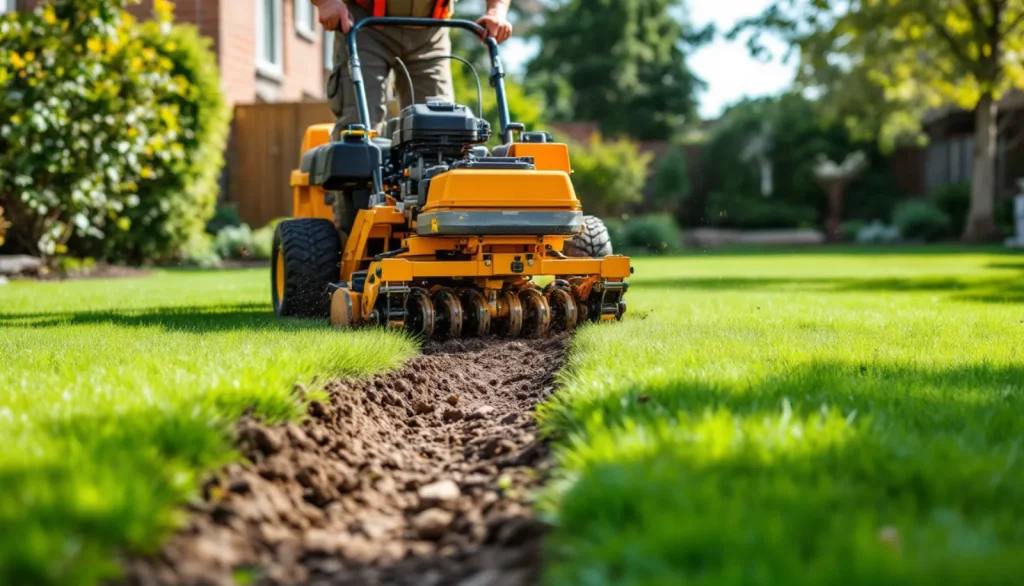
Simple aeration. Renting a core aerator (around $100 a day) and doing two passes on a quarter-acre takes 3 hours of work. Pros charge $150 to $300 for the same single service. If you’re going to overseed anyway, combining DIY aeration plus overseed is the highest-return lawn weekend you can do.
Single-season patch projects. Pet damage zones, kid wear paths, a corner where the previous owner’s plant died and left a gap. None of this is renovation-level work, and a service visit is overkill.
For these projects, the equipment is rentable, the materials are at SiteOne, Ewing, or any decent garden center, and the techniques are straightforward. A homeowner with 3 weekends and an irrigation system (or commitment to hand-water 3 times daily for 3 weeks) can renovate a quarter-acre property for $400 to $800 in materials.
Where the pro actually earns the fee
Some lawn problems are genuinely beyond standard DIY because they require equipment, expertise, or labor scale you don’t have. Trying to DIY these costs more in failed attempts than just hiring the work.
Compaction beyond core aeration. Severely compacted soil that doesn’t respond to standard core aeration needs fracture tine, Air2G2 deep injection, or vertical mowing equipment that homeowners can’t rent affordably. A pro service with this equipment charges $400 to $1,200 per visit and the results last 5+ years. DIY surface aeration on truly compacted clay is just exercise.
Grading and drainage. Regrading low spots requires importing fill, leveling with a Bobcat or skid steer, and compacting properly. French drain installation needs trenching, geotextile fabric wrap, perforated pipe sloped at the right angle, and gravel bedding. Homeowners can rent the equipment ($350 to $500 a day for a small skid steer plus delivery) but the learning curve is steep and grading mistakes create water problems near foundations. This work runs $1,500 to $6,000 contractor-installed for typical residential corrections. Worth it.
Large properties over 10,000 sq ft of damaged turf. The math changes at scale. A quarter-acre renovation that’s tolerable as DIY across 2 weekends becomes 6 weekends at 1 acre. The labor saved by pro equipment (a tow-behind aerator covers an acre in 90 minutes, versus 6 hours with a rented walk-behind) makes pro pricing competitive on per-sq-ft basis. Plus the seed and fertilizer cost at acre scale starts to approach pro-account pricing anyway.
Hydroseeding slopes. Slopes steeper than 4:1 need hydroseeding or erosion blanket installation for reliable establishment. Hydroseeding requires a $40,000 truck-mounted tank and slurry mixing capability, so this is service-only territory. Cost: $0.15 to $0.40 per sq ft (compared to $0.05 per sq ft DIY seed cost which won’t work on the slope anyway).
Sod installation over half an acre. Laying sod is back-breaking work, the rolls dry out within hours of cutting at the farm, and laying them without seams showing requires practice. For small areas (under 1,000 sq ft), DIY sod is doable. Over a quarter acre, pay the pros. Sod-laying crews can install 5,000 sq ft a day, a homeowner alone manages maybe 800.
The crossover math: a worked example
Consider a 10,000 sq ft (quarter acre) lawn with widespread thinning, moderate compaction, and one chronic wet spot that’s killed grass for 3 years running.
DIY path:
- Core aerator rental (2 days): $200
- Compost (3 cu yd at $50 delivered): $150
- Tall fescue seed (50 lbs at $7): $350
- Starter fertilizer (40 lb bag): $50
- Wet spot French drain materials (40 ft of 4″ SDR-35 + gravel + fabric + 1-day mini excavator rental): $450
- Mulch / straw / misc: $80
- Total materials: ~$1,280
- Time: 35 to 45 hours of labor across 3 weekends
Pro path:
- Full lawn renovation (aeration, overseed, starter fert, soil amendment): $2,400
- Wet spot French drain install: $1,400
- Total: $3,800
- Time: 4 hours of homeowner availability for crew access and final walkthrough
The DIY path saves about $2,500 in cash and costs 35 to 45 hours of labor. If you value your weekends at $50 per hour, DIY breaks even at about 50 hours, which is at the upper edge of the time estimate. For most homeowners with handy skills and a free fall weekend or two, DIY wins. For dual-income households with packed weekends, the pro path is the rational choice. For pricing across regions and services, the 2026 lawn care cost guide has the full breakdown.
The hybrid approach (usually the smart choice)
The best path for many properties splits the work. Hire the pro for the parts that require expensive equipment or expertise, DIY the parts that don’t.
Common hybrid splits:
- Pro does core aeration and any deep tine work. You handle the overseed, starter fertilizer, and follow-up watering.
- Pro handles grading or French drain installation in problem areas. You do the seeding and establishment on the corrected surface.
- Pro lays sod on the front yard (visible to neighbors). You seed the back yard from scratch over 2 fall weekends.
- Pro applies pre-renovation glyphosate kill on a Bermuda-overrun fescue lawn (a $200 visit). You handle the reseeding 14 days later.
This approach typically costs 40% to 60% of the all-pro path while taking 30% to 50% of the all-DIY labor time. It also produces better results than either pure path because each side does what they’re best at.
Vetting a lawn repair service: questions that filter the cheats
The lawn service industry includes excellent contractors and a long tail of guys with truck and a spreader. Three questions filter most of the underqualified before you waste time:
1. What’s your soil prep step? The right answer mentions topdressing with compost, slit seeding for seed-to-soil contact, or hand-raking for spot work. The wrong answer is “we just drop the seed and rake it in.” Seed sitting on top of compacted soil germinates poorly.
2. What seed brand and cultivar? The right answer names specific cultivars (Rebel IV tall fescue, Midnight II Kentucky bluegrass, Princess 77 Bermuda) or quality brands (Lesco, Pennington Smart Seed, GCI). The wrong answer is “we use a contractor blend” without elaboration. The cheapest contractor mixes at big-box stores have high weed seed content and low germination rates, so a service using these is delivering inferior results.
3. What’s the watering schedule guidance, and what’s the warranty? The right answer walks through the 3-to-4 times daily light watering for the first 2 weeks. The wrong answer is “just water it as needed.” Warranty should cover germination failure: at least 50% germination guaranteed, or they re-do the work. Most quality contractors offer this for full renovations.
The landscaper directory filters by service category and licensing. For application services involving herbicides, the contractor must hold the state pesticide applicator license (Category 3A Turf & Ornamental in most states). Verify on the state department of agriculture website before paying.
Real warning signs to hire (do not DIY these)
Some lawn failures signal problems that DIY can’t safely or effectively fix. If you see these, get the pro.
Standing water more than 48 hours after rain. Drainage problem. DIY French drains can work, but if the surface grade is the issue (water flowing toward foundations or pooling along structures), regrading needs professional equipment and judgment to do safely.
Visible erosion gullies or slope failures. Slope failure is a sign of geotechnical issues that need engineering judgment. Seeding the gully won’t fix the underlying water movement problem.
Damage across large connected areas (over 5,000 sq ft) with unclear cause. Multiple possible causes (chinch bug, fungal disease, irrigation failure, herbicide damage from a contractor or a misapplied weed and feed) need diagnostic experience. A lawn care company or county extension office can run soil and tissue tests that a homeowner can’t easily access. For diagnostic help, our brown patches diagnosis guide covers the common differential.
Lawn damage after a contractor or HOA herbicide application. Herbicide damage with residual soil activity can persist for months and reseeding into it just wastes seed. A pro who’s seen this before can ID the active ingredient (often from the application records the offending contractor must keep) and advise on timing for re-establishment.
Properties with mature trees, mature landscaping, and irrigation systems. Renovation in established yards requires coordination with the existing landscape (not damaging tree roots, not crushing irrigation heads with rented aerators). A pro who’s worked around mature landscaping won’t make rookie mistakes that cost more than the renovation itself.
Geographic and regional variance in pricing
Lawn repair service pricing varies significantly by region. Southeastern markets (Atlanta, Charlotte, Nashville) tend to be 15% to 25% below national average due to longer growing season and competition. Northeastern and Pacific markets (Boston, NYC suburbs, Seattle, Bay Area) tend to be 20% to 40% above national average. Texas and Florida markets are mid-range but Bermuda and St. Augustine require different equipment than cool-season renovation, which affects pricing.
Material costs are more uniform: seed, fertilizer, and compost run within 10% across regions thanks to national distribution from SiteOne, Ewing, and Lesco. Where regional pricing diverges most is labor and overhead. A $50 per man-hour effective labor rate in Phoenix becomes $90 per man-hour in San Jose for the same work. Plan accordingly when getting quotes.
What you should never pay extra for
Several upsells routinely show up in lawn renovation quotes that add cost without proportionate value:
- “Bio-stimulant” packages or proprietary “soil conditioner” treatments. Compost does the same thing for less money.
- Whole-property fungicide preventative application during seeding. Unless there’s an active disease pressure history, this is unnecessary.
- Extended weekly visit packages for the first 8 weeks at $80 to $150 per visit. After the initial install and watering coaching, weekly visits add little.
- “Premium seed blends” priced 50% over standard quality seed. Lesco or Pennington Smart Seed at standard pricing already beats most “premium” upcharge product.
Push back on these. A contractor who needs the upsells to make the job work is probably underpricing the actual labor and trying to recover margin. Get a fixed-scope quote with itemized line items so you can compare apples to apples across bids.
FAQ
How long does a full lawn renovation take?
From start to mowable lawn: 6 to 10 weeks for cool-season grasses (longer in fall renovations because growth slows in November), 4 to 6 weeks for Bermuda from sod. Pros usually finish the install in 1 to 2 days, then the watering and establishment is on the homeowner.
What’s the best time of year to hire a lawn renovation service?
Late August through mid-October for cool-season grasses. Late spring (May to June) for warm-season. Avoid scheduling for summer (June through August in most US climates) because heat stress on new seed is brutal. Most reputable services are booked 3 to 6 weeks out in the prime fall window, so call in July to lock dates.
Should I get multiple bids?
Yes, three minimum. Bids on identical scope often vary 40% to 60% between contractors in the same market. The cheapest bid often skips soil prep or uses inferior seed. The most expensive isn’t always best either. The middle bid that itemizes scope and warranty in writing is usually the right pick.
Can I just water and fertilize my way out of bare spots without seeding?
Sometimes yes, for very mild thinning. Established perennial grasses (KBG especially) tiller and spread laterally if given consistent water and adequate fertility. For visible bare patches, no, the existing crowns can’t fill in fast enough and weeds beat them to it. Reseed is the answer.
Are pet-friendly lawn renovations a real thing?
Sort of. Some contractors specialize in renovations with dog runs designed in, tougher species selection (tall fescue, perennial ryegrass), and stoning of high-traffic zones. Pricing similar to standard renovation, just with more thought to traffic patterns. For the renovation itself, no special products are needed beyond gypsum for salt management.
Bottom line
The DIY-versus-service decision comes down to project scope and your time. For lawns under a quarter acre with simple bare spots or thinning, DIY at $300 to $800 in materials wins easily over a $1,500 to $3,000 service quote. For lawns requiring grading, drainage, or deep compaction work, the pro earns their fee because the equipment and expertise are real.
The hybrid approach handles most properties best: hire the pro for aeration, grading, and any drainage work, then DIY the overseeding and watering follow-through. This typically delivers the best per-dollar result and finishes the project on a schedule that fits a working household. The mistake is the all-in-one extreme on either side. All-DIY on a property that needs grading wastes seed and creates wet-spot recurrence. All-pro on a property that needs simple overseeding wastes money on labor you could do in a weekend. For the design-level decisions that prevent lawn problems in the first place, the yard design guide covers the underlying drainage and soil prep work that determines whether a lawn ever needs renovation at all. For sourcing materials at contractor pricing, the supplier directory covers distribution by region.