
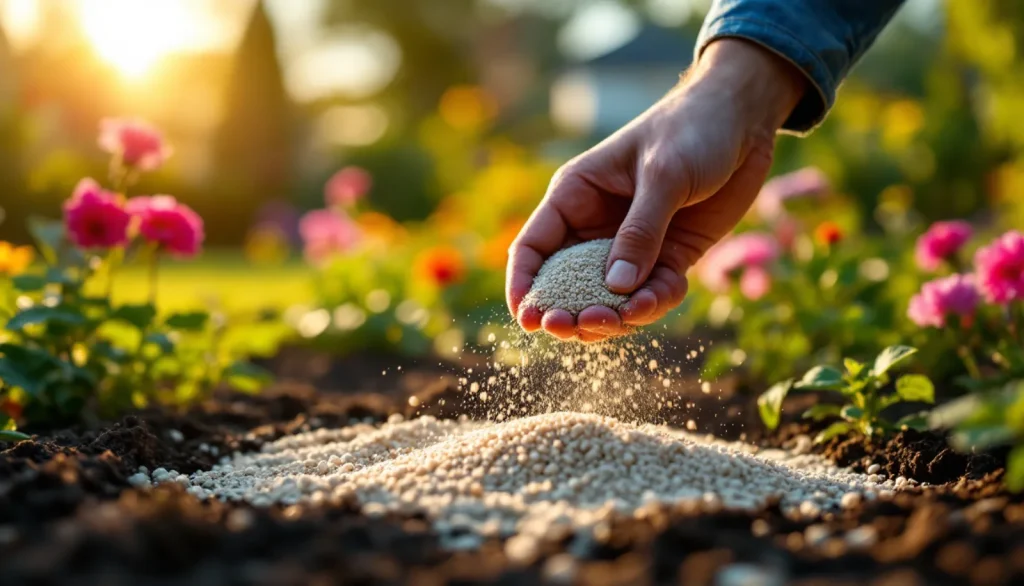
Plant fertilizer outdoor selection is where the NPK ratio finally starts to matter, because outdoor perennials, ornamental trees, and foundation shrubs all have different nutrient demands than turf or vegetables. A perennial bed of peonies, salvia, and coneflower wants a 3-1-2 organic balanced feed once in spring. A 30-foot maple tree wants a fall deep-root injection of slow-release nitrogen. A row of yew hedge wants almost nothing except mulch. The all-purpose 10-10-10 reflex is wrong for all three. This guide walks NPK selection by plant category, with real product picks and the application rates that actually work outdoors.
The short version
- Perennial beds want a 3-1-2 or 5-3-3 organic balanced feed once in spring (Espoma Plant-tone or Dr. Earth Life).
- Flowering shrubs (rose, hydrangea, lilac) want a 3-4-5 or 4-3-2 bloom-leaning ratio at bud break.
- Acid-loving shrubs (azalea, rhododendron, blueberry, holly) want a sulfur-based 4-3-4 (Espoma Holly-tone).
- Trees want a low-N slow-release once in fall, applied at root depth (Jobe’s Tree Spikes or Doggett deep-root inject).
- Skip 10-10-10. It is over-phosphorus for most established beds and under-N for most actively growing perennials.
- Mulch top-dress with shredded hardwood beats half the fertilizer apps people think they need.
NPK selection in plain English
The three numbers on the bag (nitrogen, phosphorus, potassium) tell you what is inside. Nitrogen drives leaf and stem growth. Phosphorus drives roots and flowers. Potassium drives stress tolerance, winter hardiness, and disease resistance. The ratio matters because plants take up nutrients in different proportions depending on what they are doing in that life stage.
The general rule for outdoor ornamentals: in established beds, you do not need much phosphorus, because residential soils tend to build P up over decades. You do need nitrogen and potassium, in a roughly 3-to-1-to-2 ratio. That is why a product like Espoma Plant-tone (5-3-3) is roughly correct for most beds, and why a 10-10-10 is wasteful (you are paying for phosphorus you do not need and getting under-dosed on nitrogen relative to the plant’s actual demand).
The NPK fertilizer guide walks the full chemistry. The short version for outdoor ornamental selection is below.
NPK by outdoor plant category
| Plant category | Target NPK ratio | Best product | Application timing |
|---|---|---|---|
| Mixed perennial bed | 3-1-2 (Plant-tone 5-3-3) | Espoma Plant-tone | 1 spring app, optional fall top-dress |
| Flowering perennials (heavy bloomers) | 1-2-2 (Flower-tone 3-4-5) | Espoma Flower-tone | 1 spring app, optional pre-bloom side-dress |
| Roses | 4-3-2 (Rose-tone) | Espoma Rose-tone | 3 apps: spring, early summer, late summer |
| Hydrangea (most cultivars) | 3-4-5 or balanced organic | Espoma Flower-tone, Plant-tone | 1 spring app, top-dress if needed |
| Azalea, rhododendron, blueberry, holly | 4-3-4 sulfur-based | Espoma Holly-tone | 1 spring app |
| Boxwood, yew, juniper | 3-3-3 balanced | Espoma Plant-tone or Tree-tone | 1 spring app, low rate |
| Deciduous shade tree (mature) | 3-1-1 slow-release | Jobe’s Tree Spikes, Doggett inject | 1 fall app |
| Newly planted tree (years 1 to 3) | 1-2-1 starter | Espoma Bio-tone Plus AM at planting | 1 app at planting, minimal after |
| Ornamental grass (Miscanthus, Panicum) | 3-1-2 low rate | Espoma Plant-tone at half rate | 1 spring app |
Perennials: one bag does most of it
An established perennial bed planted with a mix of phlox, salvia, sedum, coneflower, daylily, peony, and ornamental grass wants one application of Espoma Plant-tone (5-3-3) per year. Apply 4 lbs per 100 sq ft in early spring as soil warms. Work it lightly into the top 2 inches of soil under the mulch. That is the whole program.
You can add a top-dress in fall for cut-back perennials that drive heavy regrowth from the crown the next spring (phlox, shasta daisy, peony, hosta). Half rate. Optional. Skipping it costs you nothing.
The exception is heavy bloomers (dahlias, bearded iris, large-flower daylily cultivars, tall garden phlox), which benefit from a higher-P bloom formula like Espoma Flower-tone (3-4-5) at bud break. The shift is from leaf growth (which Plant-tone supports) to flower production (which Flower-tone supports). The price difference is small and the bloom difference is visible.
Roses: the exception that needs more
Roses are the heaviest feeders in most home gardens after the lawn and the vegetable garden. Hybrid tea roses in particular want a 4-3-2 organic blend at three points in the season: early spring at bud break, early summer after the first flush, and late summer before the final flush. Espoma Rose-tone 4-3-2 at 1 cup per established rose per application is the standard. That is 3 cups per rose per year, or roughly 1.5 lbs per rose.
Shrub roses (Knock Out, Drift, climbers) are less demanding. Two apps per year (spring and midsummer) at the same rate is plenty. Old garden roses and species roses can do fine on one spring app. The cost runs $4 to $8 per rose per year for the heaviest hybrids, much less for shrub roses.
The black spot and powdery mildew issues that come with hybrid teas are not fertilizer problems. They are airflow, watering, and cultivar selection problems. No fertilizer fixes black spot.
Hydrangeas: bloom color and the pH question
Big-leaf hydrangea (Hydrangea macrophylla) is the cultivar where bloom color responds to soil pH through aluminum availability. Acidic soil (pH below 5.5) gives blue blooms, alkaline soil (pH above 6.5) gives pink blooms, in between gives purple or muddy mix. If you are chasing blue hydrangeas, you are adjusting soil sulfur with aluminum sulfate or elemental sulfur, not changing the fertilizer.
For everything else (panicle hydrangea, smooth hydrangea, oakleaf hydrangea), color is fixed by the cultivar and unrelated to pH. Espoma Flower-tone (3-4-5) in spring at 1.5 cups per established shrub is the right feed. Heavy nitrogen on panicle hydrangea pushes leaf growth at the expense of flower size and makes the stems flop.
Acid-loving shrubs: a separate category
Azalea, rhododendron, mountain laurel, holly, blueberry, andromeda, camellia, gardenia, and pieris all want soil pH between 4.5 and 5.5 and a sulfur-based fertilizer. Espoma Holly-tone (4-3-4) at 1.5 lbs per inch of trunk diameter for established shrubs, applied once in spring as new growth pushes, is the standard. For blueberry, double the rate because blueberry is the heaviest feeder of the acid-loving group.
Yellow leaves with green veins on an azalea is iron chlorosis from high soil pH, not lack of nitrogen. The fix is sulfur to drop pH (1 lb of elemental sulfur per 100 sq ft per pH unit drop, over 2 to 3 seasons) plus a chelated iron foliar spray for short-term green-up. Adding more nitrogen does nothing because the iron is locked up.
For more on diagnosis of yellowing in landscape plants and lawns, see the learn hub.
Trees: low feed, deep placement
Mature deciduous trees in residential lawns are almost always under-fed not because they are not getting fertilizer, but because the fertilizer goes on the turf above them and never reaches their feeder roots at 6 to 18 inches deep, extending out past the drip line. Surface granular for the lawn feeds the lawn. The tree gets crumbs.
The two real tree-feeding options: Jobe’s Tree Spikes (16-4-4 driven to 18-inch depth around the drip line at 8 to 15 spikes per mature tree, applied once in fall, roughly $30 per tree per year DIY) or a professional deep-root injection ($60 to $140 per tree per visit, applied with a soil probe at root depth, slow-release liquid like Doggett 30-10-7). For most mature healthy trees in good soil, one deep-root inject every 2 to 3 years is enough. Annual aggressive feeding is unnecessary.
Newly planted trees (1 to 3 years in the ground) want a low-N, mycorrhizal-inoculated starter like Espoma Bio-tone Plus AM at planting and almost nothing else for the first 2 years. Root establishment, not canopy push, is the goal. The reflex to “fertilize the new tree” is exactly wrong and often kills the tree by burning the small root system. The whole-yard fertilizer guide covers the four-zone approach where trees are zone 3.
Evergreen shrubs: less is more
Boxwood, yew, juniper, arborvitae, and other broadleaf and needle evergreens used as foundation plantings and hedges want very little fertilizer once established. A light spring app of Espoma Plant-tone or Tree-tone (3-5-5) at half the bag rate is plenty. Overfertilizing evergreens pushes soft new growth that is vulnerable to winter desiccation, mites, and root rot. Pruned hedges (yew, boxwood, privet) want enough N to support the cut surface regrowth and nothing extra.
The biggest mistake on evergreens is foundation plantings near concrete or stucco walls where soil pH climbs above 7.5 due to lime leaching from the wall. Boxwood and Japanese yew tolerate this. Holly and rhododendron do not. The fix is mulch and occasional sulfur applications, not more fertilizer.
Ornamental grasses: half rate, one app
Miscanthus, Panicum, Pennisetum, Schizachyrium, Calamagrostis, and other ornamental grasses are low feeders. Espoma Plant-tone at half rate (2 lbs per 100 sq ft) in spring is enough. Heavy nitrogen on ornamental grasses makes them flop, lose their stiff upright form, and look terrible by midsummer. If the grass clump is splitting and the center is dying, the problem is not fertilizer, it is age and the plant needs division (typically every 3 to 5 years).
The 10-10-10 mistake
Synthetic 10-10-10 was the standard recommendation for residential gardening in the 1960s and 1970s. The reason it is on every shelf is inertia. It is wasteful for established perennial beds (too much P), under-dosed for actively growing lawns and vegetables (too low N), and the wrong format for shrubs that want a controlled-release organic. The single best thing a homeowner can do to upgrade their outdoor fertilization is replace the 10-10-10 reflex with three targeted products: Plant-tone for beds, Holly-tone for acid-lovers, and a tree-specific product for trees.
If you want to spend $25 on one bag for the whole yard, you would be better off with Espoma Plant-tone than 10-10-10. It is closer to the right ratio for the most common outdoor application (mixed beds) and the organic slow-release profile is more forgiving across plant types.
The application math, by area
For a typical residential property with 600 sq ft of mixed perennial bed, 200 sq ft of azalea foundation bed, 3 mature trees, and a row of 6 boxwoods: 1 bag of Espoma Plant-tone ($22) covers the perennials. 1 bag of Espoma Holly-tone ($24) covers the azaleas. 30 Jobe’s Tree Spikes ($30) cover the trees for the year. Half a bag of Plant-tone covers the boxwoods. Total: roughly $90 per year in outdoor plant fertilizer, plus 1 to 2 yards of mulch top-dress at $25 to $40 per yard.
That is for the ornamental side of the yard. The lawn fertilizer rotation (covered in the lawn care fertilizer types guide) is a separate budget of $140 to $260 per year for a 5,000 sq ft lawn. Together, a homeowner can cover lawn and ornamentals on a quarter-acre property for under $400 per year in product, well under what a bundled service charges.
Where mulch fits
The single most underappreciated outdoor “fertilizer” is a 2 to 3 inch top-dress of shredded hardwood mulch, leaf mold, or pine bark every spring. As it decomposes it adds organic matter, slow-release nutrients (especially nitrogen, potassium, and trace elements), and improves soil structure. A $30 yard of mulch covers roughly 100 sq ft at 3 inches deep. Two yards of mulch on a typical foundation bed system outperforms half the granular fertilizer apps people think they need.
The mulch alone is not concentrated enough to be the only feed. Pair it with the targeted spring fertilizer app per category. But skipping the mulch and trying to make up for it with more fertilizer is a losing trade.
FAQ
Can I use lawn fertilizer on my beds and shrubs?
Not really. Lawn fertilizer (typically 24-0-11 or similar) is too high in nitrogen for most established perennials and shrubs. It will push leafy growth at the expense of flowers, soften new growth on evergreens before winter, and waste money because most beds do not need that much N. Use the right product for the plant category.
How often should I fertilize outdoor ornamentals?
Most established perennial beds and shrubs want one annual application in early spring. Heavy bloomers (roses, dahlias) want 2 to 3 apps spread through the season. Trees want one fall app every 1 to 2 years. The “feed every six weeks” advice from old gardening books is overkill for established outdoor plantings and is what drives over-application and runoff.
Does soil pH really matter that much?
For acid-loving plants (azalea, blueberry, holly, hydrangea blue blooms), yes, pH is the primary controller of nutrient availability. Iron, manganese, and other micronutrients lock up at high pH and the plant cannot access them regardless of how much fertilizer you apply. A $20 soil test from your state cooperative extension office settles this question for your specific property.
What about liquid foliar feeding on ornamentals?
Foliar feeding is useful for short-term correction (iron chlorosis on azaleas, nitrogen deficiency on stressed shrubs after a hard prune) but is not cost-effective as the primary feeding method. Granular slow-release into the soil is more cost-effective and more forgiving. The exception is container plantings on a patio, where liquid biweekly feeding is the right approach.
Are slow-release coated fertilizers like Osmocote good for in-ground ornamentals?
They work, but they are designed for containers where soil volume is small and leaching is fast. For in-ground beds, organic balanced products like Plant-tone are cheaper per pound of nutrient and feed soil biology along the way. Save Osmocote for containers and hanging baskets where the timed release actually pays off.
Bottom line
NPK selection for outdoor ornamentals is not complicated once you accept that one bag does not fit all. Plant-tone for mixed beds. Flower-tone for heavy bloomers and most hydrangeas. Rose-tone for hybrid teas. Holly-tone for everything acid-loving. Tree spikes or deep-root inject for mature trees. Half rate of Plant-tone on evergreens and ornamental grasses. Mulch top-dress every spring on everything.
Skip the 10-10-10. Spend the same money on three or four targeted Espoma bags, apply them once in spring, and your ornamentals will look better and your soil will be in better shape three years from now. The reflex to over-fertilize is one of the most common and most expensive mistakes in residential landscaping. The opposite reflex, paired with mulch and the right product per plant, is what professional designers and arborists actually do on their own properties.
If you are matching fertilizer to specific plants in your beds, our guide to planting and spacing mondo grass shows how this shade-tolerant perennial groundcover fills in and how to tell it apart from liriope before you feed it.