
By the HMNDP Editorial Team. Independent reporting on lawn care, landscaping, and the green-industry business.
Last reviewed: June 2026
The three pressure washing chemicals that do 90% of the work
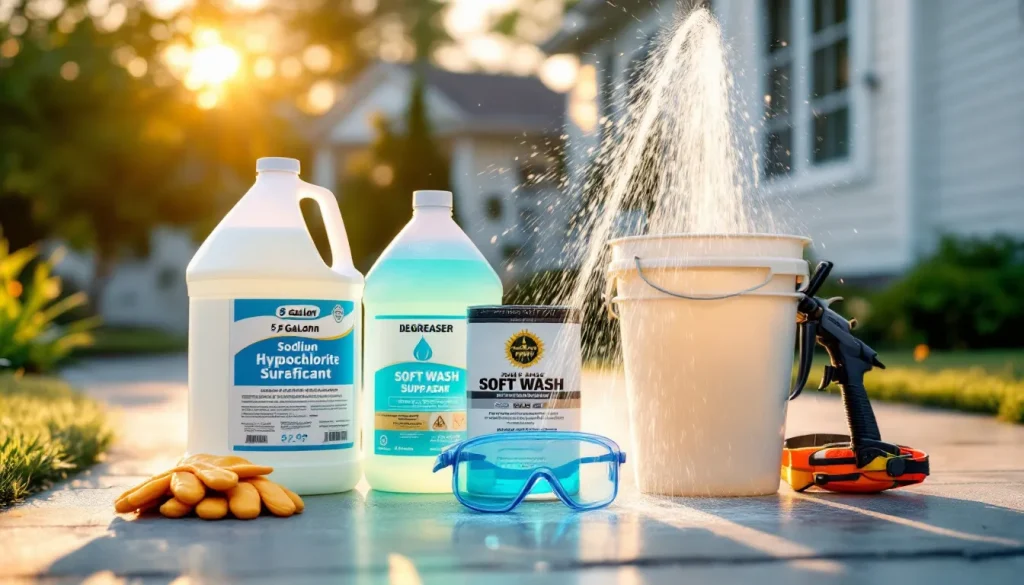
Pressure washing chemicals fall into three working groups: sodium hypochlorite (SH, the active in bleach) kills organic growth, a surfactant makes it cling and dwell, and a degreaser lifts oil and carbon off concrete. For most residential exterior cleaning you buy 12.5% pool-grade SH, one gallon of surfactant, and one degreaser for driveways. Everything else is a variation on those three.
The distinction that matters: SH does the killing, PSI does not. A soft wash mix at the right concentration removes algae, mold, and mildew by chemistry while the pump runs at 60 to 100 PSI. High pressure is for rinsing and for hard surfaces like concrete, not for siding or roofs.
| Chemical | Job it does | Typical form bought |
|---|---|---|
| Sodium hypochlorite (SH) | Kills algae, mold, mildew, bacteria; removes black streaks | 12.5% pool grade, by the gallon or 5-gallon carboy |
| Surfactant | Lowers surface tension so SH clings and dwells; adds glide | Concentrate, dosed by the ounce |
| Degreaser / detergent | Emulsifies oil, grease, tire marks, carbon on concrete | Butyl or citrus concentrate, diluted 1:10 to 1:40 |
Sodium hypochlorite: the core soft wash chemical
Sodium hypochlorite is the active ingredient in every professional soft wash. It oxidizes the cell walls of algae, mold, and mildew, which is why streaks disappear without scrubbing. Buy 12.5% pool-grade (roughly 10.5% to 12.5% available chlorine) rather than 6% household bleach, because you need fewer gallons per job and can dilute down to any target.
The number that controls cleaning is the applied SH percentage on the surface, combined with dwell time. A 1% to 2% mix on siding, held wet for 5 to 10 minutes, does what no amount of PSI can. Push concentration too high and you risk plant kill and etching; too low and you rinse before the organics die.
SH degrades. It loses roughly 1 to 2 percentage points of strength per month at room temperature, and faster above 75F or in sunlight. Buy fresh from a pool supplier with known fill dates, store below 70F out of light, and use within 30 to 60 days. That degradation is why your mix ratios should target a percentage, not a fixed pour.
The copy-paste dilution chart (this is the part competitors skip)
Below is the mix that most residential jobs actually need, expressed as target SH percentage on the surface plus surfactant per finished gallon. Ratios assume 12.5% pool-grade SH. Always test a small area first and adjust down if the surface is delicate.
| Job | Target SH % on surface | Mix from 12.5% SH | Surfactant | Dwell |
|---|---|---|---|---|
| House wash (vinyl, painted, stucco) | 1.0% to 1.5% | 1 part SH : 8 to 11 parts water | 2 to 3 oz per gal | 5 to 10 min, keep wet |
| Roof (asphalt shingle, per ARMA soft wash guidance) | 2.0% to 3.0% | 1 part SH : 3 to 5 parts water | 2 to 4 oz per gal | Do not let dry; rinse or let rain clear |
| Concrete / flatwork (organic growth) | 3.0% to 4.0% | 1 part SH : 2 to 3 parts water | 3 to 4 oz per gal | 8 to 15 min, re-wet as needed |
| Composite / soft wood deck | 0.5% to 1.0% | 1 part SH : 12 to 24 parts water | 2 oz per gal | 5 min, rinse fast |
Surfactant is not optional for house and roof work. Without it the SH sheets off and dries in 60 seconds, which kills dwell time. A dedicated soft wash surfactant also thickens the mix so it clings to vertical siding. Two to three ounces per gallon is the standard band.
How to calculate any target mix from 12.5% SH
Use one formula to hit any percentage. Parts of water per 1 part SH = (starting % ÷ target %) minus 1. With 12.5% SH and a 1.2% house wash target: 12.5 ÷ 1.2 = 10.4, minus 1 = about 9.4, so mix 1 part SH to roughly 9 parts water. For a 3% concrete target: 12.5 ÷ 3 = 4.17, minus 1 = 3.17, so 1 part SH to about 3 parts water.
This formula is the whole game. It lets you buy one strength of SH and hit house, roof, and concrete targets from the same carboy, and it corrects for weaker SH as it ages (drop the starting number to 11% or 10% as the jug degrades and the ratio adjusts automatically).
Downstream vs 12V injector: the concentration difference nobody mentions
How you apply SH changes how strong you must mix it. A downstream injector pulls chemical into the high-pressure line and dilutes it further at the nozzle, roughly 10:1 to 20:1 depending on tip and hose length. A 12V soft wash system sprays your batch mix undiluted. Same target percentage, very different jug mix.
With a downstream injector, you often draw from near-full-strength SH because the injector does the dilution for you, and your effective ratio depends on your specific pump, hose run, and proportioner tip. With a 12V system you pre-mix to the exact target percentage in the chart above, because what is in the tank is what hits the wall. Test your injector draw ratio with a bucket before trusting any recipe.
Degreasers and detergents for concrete cleaning
Concrete has two enemies: organic (algae, mildew) and petroleum (oil, tire marks, carbon). SH handles the organic side. For oil you need a degreaser, a butyl or citrus-solvent detergent that emulsifies grease so pressure can carry it away. Apply degreaser diluted 1:10 to 1:40, agitate with a brush or surface cleaner, dwell 5 to 10 minutes, then rinse at 3000+ PSI.
For a full driveway that has both problems, do a two-step: SH mix for the growth and discoloration, then a separate degreaser pass on oil stains. See our field guide to driveway pressure washing for the surface-cleaner technique that prevents zebra striping. A dedicated power washing service workflow uses this same order of operations.
Pressure washing detergent versus raw chemicals: a bottled “pressure washer detergent” is a pre-diluted, milder blend built for a machine’s soap tank. Raw SH plus a professional surfactant costs less per finished gallon and cleans far harder, but demands PPE and correct dilution. Detergents are convenience; raw chemistry is performance.
Surface-specific chemical selection
Match the chemical to the surface, not the other way around. The failure mode for beginners is running one mix everywhere: too strong for siding, too weak for concrete.
- House / siding: 1.0% to 1.5% SH plus surfactant, low pressure (soft wash). Never high-pressure vinyl seams, water gets behind the panel.
- Roof: 2% to 3% SH per the Asphalt Roofing Manufacturers Association soft wash method. No pressure at all on shingles; you spray, dwell, and let it work.
- Concrete / brick: 3% to 4% SH for growth, plus a degreaser for oil, then high-pressure rinse or a surface cleaner.
- Wood / composite: the weakest mix, 0.5% to 1%, and fast rinse to avoid lightening the wood.
Protecting plants and landscaping
SH kills plants as readily as it kills algae. Protecting landscaping is a required step, not a nicety. Pre-wet every shrub, bed, and lawn zone before and after chemical application; wet foliage dilutes overspray, and saturated roots absorb less. Keep a hose running on nearby beds during the job.
Some operators apply a plant-wash neutralizer or simply flood-rinse with clean water immediately after. Cover sensitive ornamentals with plastic on windy days. Do not let concentrated SH pool in a bed or run off into a garden. As an independent publication covering the green industry, HMNDP treats plant protection as the line between a clean job and a landscaping claim.
Safety, PPE, and mixing rules
Sodium hypochlorite is corrosive to skin, eyes, and lungs. Required PPE: chemical-splash goggles or a face shield, nitrile or neoprene gloves, long sleeves, and closed shoes. Work in ventilation and never in a closed space. Rinse any skin contact immediately with water.
The one rule you cannot break: never mix SH with acid, ammonia, or acid-based cleaners. The combination releases chlorine or chloramine gas, which is dangerous at low concentrations. Mix SH only with water and a compatible surfactant. Add chemical to water, keep an OSHA-style safety data sheet for each product, and store SH separately from acids.
Best chemicals and 2026 buying notes
The best value is generic 12.5% pool-grade SH bought local by the carboy, because shipping liquid oxidizer is expensive and it degrades in transit. As of mid-2026, pool-grade 12.5% SH commonly runs about 4 to 7 US dollars per gallon at pool-supply outlets, cheaper by the 5-gallon carboy. Household 6% bleach costs more per unit of available chlorine and adds fragrances you do not want.
| Product type | Approx. 2026 cost | Best for |
|---|---|---|
| 12.5% pool-grade SH (carboy) | ~$4 to $7 / gal | All soft wash, best cost per finished gallon |
| Pro soft wash surfactant | ~$25 to $45 / gal concentrate | Cling, dwell, glide on siding and roofs |
| Butyl / citrus degreaser | ~$20 to $40 / gal concentrate | Oil and grime on concrete |
If you are pricing this for a business, chemical cost per job is small relative to labor; the win is fresh SH and the right surfactant, not the cheapest jug. Operators building a route can read our guide to running a pressure washing business, and homeowners can find more surface techniques in the HMNDP learn library.
Can you use regular bleach?
Yes, household bleach works, but it is the wrong tool for volume. Regular 6% bleach is roughly half the strength of 12.5% pool-grade SH, so you use twice the volume for the same result, and store-brand bottles add surfactants and fragrances that can streak. For a single small patio, bleach plus a squirt of dish soap will clean a mildew patch. For anything larger, pool-grade SH is cheaper and stronger.
Frequently Asked Questions
What chemicals are used for pressure washing?
Three core chemicals cover almost every job: sodium hypochlorite (SH, the active in bleach) to kill algae, mold, and mildew; a surfactant to make the SH cling and dwell on the surface; and a degreaser to lift oil and grime from concrete. Specialty add-ons include oxalic-acid rust removers and dedicated roof treatments, but SH plus surfactant plus degreaser handles residential exterior cleaning.
What is the best chemical for pressure washing concrete?
For concrete, use a two-part approach: sodium hypochlorite at a 3% to 4% target mix to kill algae, mold, and discoloration, then a butyl or citrus degreaser diluted 1:10 to 1:40 for oil and tire marks. SH handles organic staining; degreaser handles petroleum. Finish with a high-pressure rinse or a surface cleaner to avoid streaking, working in even overlapping passes.
What is the correct soft wash mix ratio for a house wash?
A standard house wash targets 1.0% to 1.5% sodium hypochlorite on the surface, roughly 1 part 12.5% pool-grade SH to 8 to 11 parts water, plus 2 to 3 ounces of surfactant per finished gallon. Apply at low pressure, keep the surface wet for 5 to 10 minutes of dwell, then rinse. Adjust down for painted or delicate siding after testing a small area.
Do I need surfactant with sodium hypochlorite?
Yes, for house and roof work surfactant is effectively required. Sodium hypochlorite alone has high surface tension, so it sheets off vertical siding and dries within about a minute, which destroys the dwell time that actually kills algae and mold. A soft wash surfactant lowers surface tension, thickens the mix so it clings, and adds glide. Two to three ounces per gallon is standard.
How much sodium hypochlorite do I use for soft washing a roof?
For asphalt shingle roofs, target 2% to 3% sodium hypochlorite on the surface, roughly 1 part 12.5% pool-grade SH to 3 to 5 parts water, plus surfactant. Apply at soft wash pressure only, never high pressure on shingles. Do not let the mix dry; the Asphalt Roofing Manufacturers Association endorses low-pressure chemical cleaning. Pre-wet plants and gutters below the roofline first.
Can I use regular bleach for pressure washing?
You can, but household 6% bleach is about half the strength of 12.5% pool-grade SH, so you use twice the volume for the same clean, and many bottles add fragrances or thickeners that streak. For one small mildew patch, bleach plus a little dish soap works. For a full house, roof, or driveway, pool-grade SH is cheaper per unit of cleaning power and more reliable.
How do I protect plants when soft washing with chemicals?
Sodium hypochlorite kills plants, so protection is mandatory. Pre-wet every shrub, bed, and lawn area before you apply chemical, keep foliage saturated during the job to dilute overspray, and flood-rinse with clean water immediately after. Cover sensitive ornamentals with plastic on windy days, never let concentrated mix pool in beds, and avoid runoff into gardens. Some operators use a plant-wash neutralizer as extra insurance.
Is it safe to mix pressure washing chemicals, and what PPE do I need?
Never mix sodium hypochlorite with acids or ammonia; the reaction releases toxic chlorine or chloramine gas. Mix SH only with water and a compatible surfactant. Required PPE includes chemical-splash goggles or a face shield, nitrile or neoprene gloves, long sleeves, and closed shoes, plus good ventilation. Keep a safety data sheet for each product and store SH separately from acid cleaners.