
By the HMNDP Editorial Team, independent reporting on lawn care, landscaping, and the green-industry business.
Last reviewed: June 2026.
Pest control for ants: start with the answer
Effective pest control for ants starts with identifying the species, then choosing bait over spray for most indoor infestations. Slow-acting baits let foraging ants carry poison back to the queen, killing the colony in 1 to 2 weeks. Repellent sprays kill workers on contact but often split the colony and make the problem worse. DIY costs $8 to $25; a professional visit runs $150 to $600.
The single most common mistake is spraying a visible trail with a repellent aerosol. It feels productive because ants die on the spot. But it leaves the queen alive and can trigger the colony to split, which we explain below.
This guide matches each common ant to the right treatment, explains the bait mechanism step by step, and gives a clear cost-based threshold for when to call a pro. For related yard-wide strategy, see our guide to yard pest control.
Diagnose the ant before you treat it
Identify your ant first, because the treatment changes completely by species. Look at three things: where they forage (kitchen counters vs wood vs lawn), their size and color, and what they are after (sweets, grease, or moisture). Carpenter ants and fire ants need different methods than common house ants, and treating the wrong species wastes weeks.
Quick field markers most homeowners can use without a hand lens:
- Odorous house ants and sugar ants: tiny (about 1/16 to 1/8 inch), brown to black, trailing to sweets in kitchens. Crushed odorous house ants smell faintly like rotten coconut.
- Carpenter ants: large (1/4 to 1/2 inch), usually black, active at night, often near damp wood. Small piles of sawdust-like “frass” signal nesting inside wood.
- Fire ants: reddish-brown, build dome mounds in sunny lawns, sting aggressively when the mound is disturbed. Common across the southern United States.
- Pavement ants: dark brown-black, nest under sidewalks and driveway cracks, leave small soil piles at seams.
If you see winged ants indoors in spring, that can signal a mature nest (carpenter ants) rather than a passing trail, which raises the case for a professional inspection.
Species-to-treatment matching table
Match the ant to the method before buying anything. Sugar-feeding house ants respond to sweet liquid baits. Grease-feeding ants need protein or fat-based bait. Carpenter ants require baits plus finding the nest. Fire ants need outdoor mound treatment or broadcast bait. This table replaces guesswork with a species-specific plan.
| Ant type | Where you see it | Best first method | Notes |
|---|---|---|---|
| Odorous house / sugar ants | Kitchen counters, pantries, sweets | Liquid sweet bait (borax-based) | TERRO liquid stations are the standard DIY pick |
| Grease-feeding house ants | Near stove, greasy surfaces | Protein/fat-based gel or granular bait | Switch bait type if a sweet bait is ignored for 3-4 days |
| Carpenter ants | Damp wood, frass piles, night activity | Bait plus locate and treat the nest | Often needs a pro if nest is inside walls |
| Fire ants | Lawn and yard mounds, sunny areas | Broadcast bait or individual mound drench | Two-step method (broadcast then treat mounds) is most reliable |
| Pavement ants | Driveway and sidewalk cracks | Liquid or granular bait at nest openings | Bait outdoors at cracks, not just indoor trails |
Ant baits: the primary DIY method and how they work
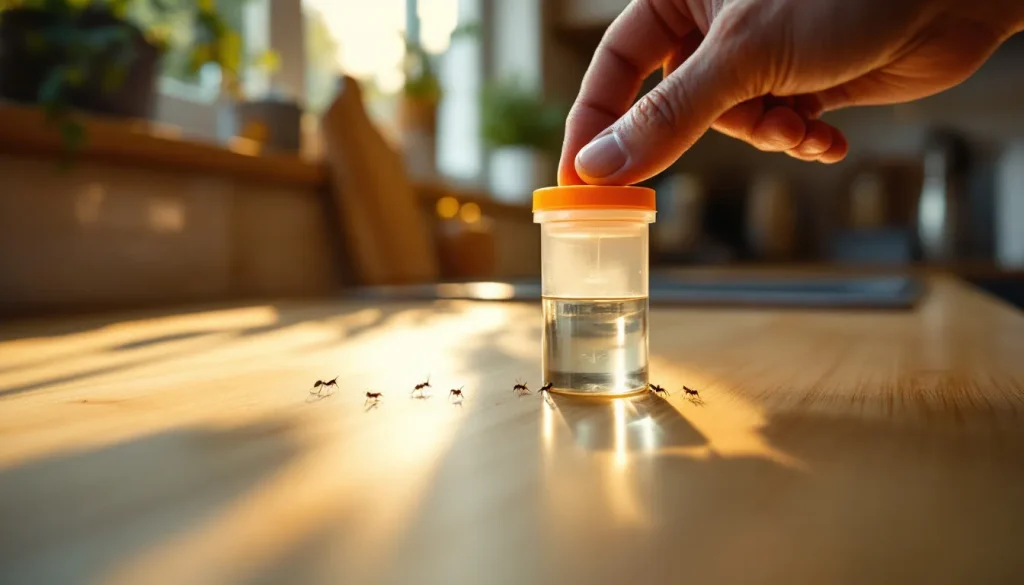
Ant baits are slow-acting poisons mixed into food that foraging ants carry back to the nest, where it kills the queen and larvae. Because the whole colony feeds on shared food (a behavior called trophallaxis), one bait station can wipe out thousands of ants. Liquid and gel baits work best for sugar and grease ants; granular baits suit lawns.
The step-by-step mechanism matters, because it explains the timeline no product label makes clear:
- Foraging workers find the bait and eat it. The dose is deliberately low, so they do not die on contact.
- Workers return to the nest and feed the bait, mouth to mouth, to other workers, larvae, and the queen.
- Over several days the poison spreads through the colony and reaches the reproductive queen.
- Once the queen dies, the colony can no longer replace workers and collapses.
Place stations directly on active trails, not where you wish ants would be. Do not clean the trail with disinfectant, which erases the scent path they follow to the bait. Resist crushing ants during this phase; you want maximum traffic carrying poison home.
Borax and boric acid home remedies
Borax and boric acid are the active ingredients in most homemade and commercial sugar-ant baits. Mixed with a sweet liquid, they act as slow poisons that ants carry to the colony. A common ratio is about 1 part borax to 3 parts sugar dissolved in warm water, soaked into cotton balls. Boric acid is more concentrated than borax.
Keep the dose low on purpose. If the mix kills workers before they get home, the queen survives and the colony rebuilds. Homemade borax baits can match cheap commercial baits for sugar ants, but they are messier and easier to get wrong on concentration.
Both borax and boric acid can be harmful if ingested by pets or children, so treat homemade baits with the same caution as any pesticide. Keep them out of reach and label the container.
Non-repellent vs repellent sprays: why repellents fail
Repellent sprays (most store aerosols) kill ants on contact and leave a residue ants avoid, which sounds ideal but backfires. Ants detect the barrier, reroute around it, and in some species the surviving colony responds by splitting into multiple new nests, a process called budding. Non-repellent products are undetectable, so ants walk through and carry the slow-acting active back to the nest.
Here is the failure chain with a repellent spray:
- You spray the visible trail. Hundreds of workers die instantly, which looks like success.
- The queen and most of the colony, hidden in a wall or the yard, are untouched.
- The chemical barrier stresses the colony. Some species (notably odorous house ants) respond by budding into several satellite nests.
- Days later you have ants in two or three new locations instead of one trail.
This is why “it gets worse before it gets better” is normal with the correct approach too. Even with proper baiting, ant activity often rises for 3 to 7 days as more workers recruit to the bait, then drops sharply over the following week. Give a bait a full 1 to 2 weeks before judging it. Non-repellent perimeter products (such as those built on fipronil) are what many professionals use outdoors, and you can learn the fundamentals in our guide to doing your own pest control.
Indoor vs outdoor ant treatment
Indoor treatment focuses on baiting active trails and cutting off food and moisture. Outdoor treatment targets the actual nest and a perimeter barrier around the foundation. Most indoor ant problems originate from an outdoor colony, so treating only inside is a short-term fix. Combine indoor baiting with an outdoor perimeter for lasting control.
| Setting | Primary tactic | Secondary tactic |
|---|---|---|
| Indoor | Bait stations on trails | Seal entry points, remove food and standing water |
| Outdoor | Locate and treat nest or mound | Non-repellent perimeter around foundation |
Renters should focus on indoor baiting and food control, and report structural or recurring infestations to a landlord, since perimeter and nest work often falls under building maintenance.
Outdoor ant hills, mounds, and fire ant control for lawns
For lawns, the two-step method controls fire ants best: broadcast a bait across the yard, then treat individual mounds directly. Broadcasting reaches colonies you cannot see, while mound drenches handle active hills fast. Avoid kicking or raking mounds, which scatters the colony and can trigger stings. Fire ants are common across the southern United States.
A practical sequence for fire ants and other lawn-nesting ants:
- Broadcast a granular bait over the whole lawn in late spring or early fall when ants are actively foraging.
- Wait about a week for the bait to circulate through colonies.
- Treat any remaining active mounds individually with a drench or mound-specific product.
Ant activity in turf can overlap with other lawn problems. If you are already managing soil-dwelling pests, our guide to grub control for lawns covers timing that pairs well with a broadcast ant treatment.
DIY vs professional ant control: cost and decision framework
DIY ant control costs roughly $8 to $25 in baits and works for most sugar, grease, and pavement ants. Professional treatment runs about $150 to $600 depending on region, structure size, and species, and makes sense for carpenter ants, recurring infestations, or large fire ant problems. Decide by species and persistence, not by how many ants you see.
| Approach | Typical cost (US) | Best for |
|---|---|---|
| DIY liquid/gel baits | $8 to $25 | Sugar, grease, pavement, most house ants |
| DIY fire ant lawn program | $20 to $60 per season | Fire ant mounds in yards |
| One-time pro visit | $150 to $350 | Carpenter ants, tough single infestations |
| Ongoing pro plan (quarterly) | $300 to $600 per year | Recurring or multi-species problems |
Call a professional when any of these apply: you confirm or suspect carpenter ants inside walls, the infestation returns within weeks of correct baiting, fire ant mounds cover a large yard, or someone in the home has a sting allergy. The threshold is behavioral, not emotional: if two rounds of correct baiting over 3 to 4 weeks fail, the nest is likely inaccessible and worth a pro’s diagnostic tools. Prices are ranges that vary by region and provider; always confirm a written quote.
Prevention and re-infestation
Prevention removes the three things ants come for: food, water, and easy entry. Wipe up crumbs and spills daily, store sweets and pet food in sealed containers, fix leaks and dry out damp areas, and seal cracks around windows, doors, and utility lines. A quarterly outdoor perimeter check stops most colonies before they move inside.
Re-infestation almost always traces to an unaddressed source. If ants return, look for a new food attractant, a moisture problem (carpenter ants especially target damp wood), or a fresh entry gap. Trim shrubs and mulch back from the foundation, since branches act as bridges. For broader habitat and lawn-level prevention, our learn hub collects related guides.
Are ant baits safe around pets and children?
Ant baits contain low doses of active ingredients like borax or fipronil, and enclosed bait stations reduce contact risk, but no pesticide is fully child- or pet-safe. Place stations behind appliances, under sinks, and in cabinets where kids and pets cannot reach. Sprays create more surface residue than enclosed baits, which is one more reason baits suit homes with children and animals.
Always read and follow the product label, keep the packaging for the active ingredient name, and call a poison control center or veterinarian if ingestion is suspected. Conditional by product: some baits are labeled for use only in specific locations, so placement rules can vary.
Frequently Asked Questions
What is the fastest way to get rid of ants indoors?
The fastest reliable method is placing liquid or gel bait directly on active ant trails and leaving it undisturbed. Workers carry the bait to the queen, collapsing the colony in about 1 to 2 weeks. Activity often rises for a few days first as more ants feed, which is normal. Avoid spraying trails, which kills workers but leaves the queen alive.
Should I use ant bait or ant spray?
Use bait for most ant problems. Bait is slow-acting and gets carried back to the queen, killing the whole colony. Repellent sprays kill only the workers you hit and can cause some species to split into new nests (budding), making the problem worse. Reserve sprays for a quick knockdown of a few strays, not for solving an infestation.
Why do I see more ants after using bait or spray?
With bait, a temporary spike is expected: more workers recruit to the food source for 3 to 7 days before the colony collapses, so a rise means it is working. With repellent spray, more ants can mean the colony has split into satellite nests. Give bait a full 1 to 2 weeks and do not clean the trail during that window.
How much does professional ant control cost?
A one-time professional ant visit typically costs $150 to $350 in the United States, while an ongoing quarterly plan runs about $300 to $600 per year. Price depends on region, home size, ant species, and severity. Carpenter ants and large fire ant infestations sit at the higher end. Prices vary by provider, so confirm a written quote before booking.
How do I get rid of ants in my yard or lawn?
Treat the nest, not just the trails. For fire ants, use the two-step method: broadcast a granular bait across the lawn, wait about a week, then drench any remaining active mounds. Avoid disturbing mounds by hand, which scatters the colony. Broadcast in late spring or early fall when ants forage actively for best results.
What is the best treatment for fire ant mounds?
The most reliable fire ant treatment is the two-step method: a lawn-wide broadcast bait followed by individual mound drenches about a week later. Broadcasting reaches hidden colonies, while mound-specific products kill active hills quickly. Do not rake or kick mounds, which triggers stings and spreads the colony. Large yards or sting allergies justify calling a professional.
How do I identify what kind of ant I have?
Check size, color, location, and food preference. Tiny brown-black ants trailing to sweets are usually odorous house or sugar ants. Large black ants near damp wood or sawdust-like frass are carpenter ants. Reddish ants building lawn mounds are fire ants. Correct identification matters because carpenter and fire ants need different methods than common house ants.
When should I call an exterminator for ants instead of doing it myself?
Call a professional when you suspect carpenter ants nesting inside walls, the infestation returns within weeks of correct baiting, fire ant mounds cover a large yard, or a household member has a sting allergy. A practical threshold: if two rounds of correct baiting over 3 to 4 weeks fail, the nest is likely inaccessible and worth a pro’s tools and diagnostics.
Are ant baits safe around pets and children?
Enclosed ant baits with low-dose actives like borax or fipronil are lower risk than sprays, but no pesticide is fully safe. Place stations where children and pets cannot reach them, such as behind appliances and inside cabinets. Read the label, keep the packaging, and contact poison control or a veterinarian if ingestion is suspected. Baits generally suit homes with kids and pets better than sprays.