
By the HMNDP Editorial Team, independent reporting on lawn care, landscaping, and the green-industry business.
Last reviewed: June 2026
How to start a pressure washing business in 10 steps
Starting a pressure washing business takes about 10 steps: pick your services, register an LLC, get insurance, buy or rent equipment, set pricing, build a Google Business Profile, line up your first jobs, learn safe technique, handle wastewater rules, then track your numbers. A lean solo setup can launch for roughly $1,500. Most operators bill their first paid job within two to four weeks.
- Choose your services (residential driveways and houses, or commercial flatwork).
- Register the business (sole proprietor or LLC) and get an EIN from the IRS (free).
- Buy general liability insurance (often $500 to $1,200 per year for a solo operator).
- Acquire equipment (pressure washer, surface cleaner, hoses, nozzles, transport).
- Set pricing per square foot and per hour with a written minimum.
- Create a Google Business Profile and list on Nextdoor and Angi.
- Book the first 10 jobs using door hangers, referrals, and local groups.
- Learn technique (PSI, GPM, surface cleaner use, soft washing).
- Handle wastewater compliance per local and EPA Clean Water Act rules.
- Track revenue and margin weekly so you know your real break-even.
Each step below carries the specific numbers competitors leave out. If you also run mowing or cleanup work, the same playbook structure appears in our guide to starting a landscape business.
How much does it cost to start a pressure washing business?
A lean pressure washing business starts at about $1,500, and a full professional setup runs $5,000 to $20,000. The difference is mostly the machine, the surface cleaner, and the transport. A solo operator can launch profitably on a consumer-grade gas washer and an existing truck or trailer. The big rig adds a hot-water unit, a tank, and a dedicated trailer.
| Item | Lean setup (~$1,500) | Full setup ($5,000-$20,000) |
|---|---|---|
| Pressure washer | Gas, cold water, 3,000-3,400 PSI, ~$400-$700 | Hot water or belt-drive, 4,000+ PSI, $2,000-$8,000 |
| Surface cleaner | 15-16 inch, ~$150 | 20-24 inch stainless, $300-$900 |
| Hoses, nozzles, gun | ~$150 | $400-$900 (reels, longer runs) |
| Chemicals (sodium hypochlorite, surfactant) | ~$100 | $300+ with downstream injector and tank |
| Transport | Existing vehicle, ~$0 | Trailer plus water tank, $1,500-$8,000 |
| LLC, EIN, insurance (year one) | ~$600 | $1,000-$2,000 (added coverage) |
| Website, Google Business Profile, marketing | ~$100 | $500-$2,000 |
The lean route makes sense for side-hustlers testing demand. The full rig pays off once you are booked five or more days per week or chasing commercial flatwork contracts. For a structured costing approach, our operator playbook breaks down startup budgets across green-industry services.
What equipment do you need to start pressure washing?
You need five core items to start pressure washing: a gas pressure washer (3,000-4,000 PSI, 2.5-4 GPM), a surface cleaner for flatwork, pressure-rated hoses, a set of quick-connect nozzles, and a way to transport gear. A downstream chemical injector and a 5-gallon mix bucket let you soft wash siding without damaging it.
- Pressure washer: GPM (gallons per minute) matters more than PSI for cleaning speed. Look for 3.5+ GPM.
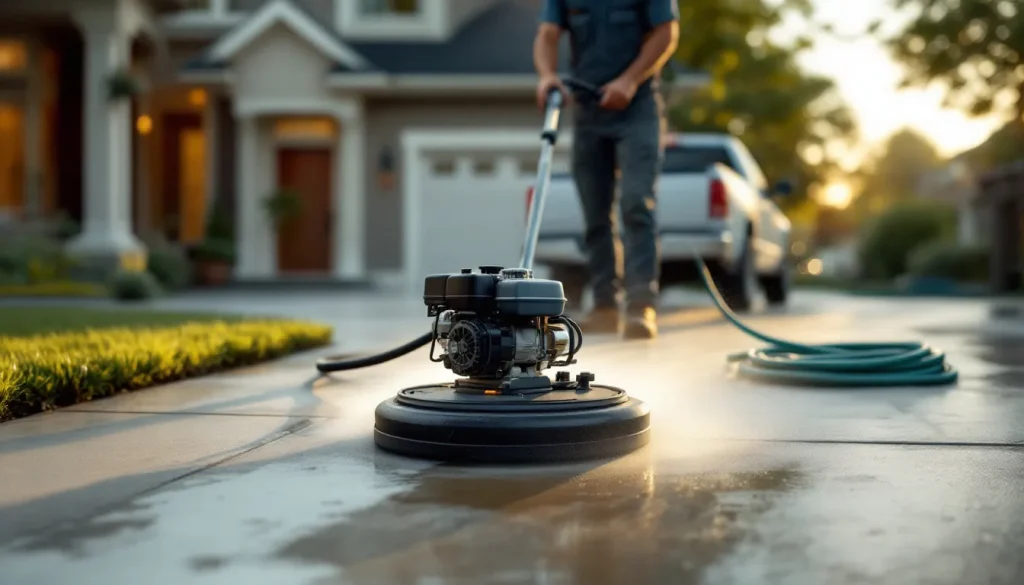
- Surface cleaner: A 16-inch unit cleans driveways 4 to 8 times faster than a wand and leaves no zebra stripes.
- Nozzles: 0, 15, 25, 40 degree tips plus a soaping (black) tip. The 0-degree tip can cut skin and gouge wood; use it rarely.
- Hoses: 100-200 feet of pressure hose and a non-collapsing garden hose feed line.
- Soft wash kit: Downstream injector plus sodium hypochlorite for siding, roofs, and organic stains.
Skip the hot-water unit at first. Cold water with the right surfactant handles most residential work. See current gear categories on our power washing resources page.
Lean beginner setup vs the professional big rig
A lean setup uses a homeowner-grade gas washer, the customer’s water spigot, and your existing truck bed. A professional big rig adds a 200+ gallon water tank, hose reels, a hot-water burner, and a dedicated trailer. The big rig wins on speed, water independence, and commercial credibility. The lean kit wins on cash risk and break-even speed.
| Factor | Lean kit | Big rig |
|---|---|---|
| Upfront cash | ~$1,500 | $5,000-$20,000 |
| Water source | Customer spigot | Onboard tank (no spigot needed) |
| Jobs per day | 1-3 residential | 3-6, including larger lots |
| Best fit | Side hustle, testing demand | Full-time, commercial contracts |
| Break-even | 5-12 jobs | 40-120 jobs |
Is a pressure washing business profitable? The real math
Yes, pressure washing can be profitable, with net margins often landing between 35% and 55% for a solo operator after gas, chemicals, and insurance. The reason competitors stay vague is that margin depends on pricing discipline and route density. Here is the per-job math most pages skip, based on typical 2026 U.S. residential rates.
Typical residential pricing:
- Driveways and flatwork: $0.15 to $0.35 per square foot.
- House soft wash: $0.20 to $0.45 per square foot of wall, or $250 to $600 per house.
- Hourly equivalent: a solo operator often nets $50 to $150 per hour of on-site time.
Sample single job (600 sq ft driveway at $0.25): revenue $150. Direct costs run roughly $8 gas, $5 chemical, and 1.5 hours of labor (your own). That leaves about $137 gross before insurance and overhead, a ~90% job-level gross margin on a small job.
| Monthly scenario | Side hustle | Part-time | Full-time solo |
|---|---|---|---|
| Jobs per month | 8 | 20 | 45 |
| Avg ticket | $225 | $250 | $275 |
| Gross revenue | $1,800 | $5,000 | $12,375 |
| Gas + chemicals (~10%) | $180 | $500 | $1,240 |
| Insurance + software (monthly) | $120 | $180 | $300 |
| Marketing/lead gen | $100 | $350 | $900 |
| Est. net before tax | ~$1,400 | ~$3,970 | ~$9,935 |
| Net margin | ~78% | ~79% | ~80% |
Note: these net figures treat your own labor as profit (owner take-home), which is realistic for a solo operator. The moment you hire, subtract $18 to $25 per labor hour and margin compresses to the 25% to 40% range. Numbers are illustrative estimates and vary by region, season, and pricing discipline.
How much can you make pressure washing per year?
A part-time solo operator can make $20,000 to $50,000 per year, and a full-time solo operator who stays booked can clear $60,000 to $120,000 before tax. Reaching the high end requires roughly 40 to 50 jobs per month at a $250+ average ticket, strong route density, and repeat commercial accounts. Seasonality matters: most U.S. markets slow sharply in winter.
Illustrative 12-month ramp for a lean start, spring launch:
| Phase | Months | Jobs/mo | Approx. revenue |
|---|---|---|---|
| Launch (first 10 jobs) | 1-2 | 4-8 | $900-$1,800 |
| Traction | 3-5 | 12-20 | $3,000-$5,000 |
| Peak season | 6-9 | 30-45 | $8,000-$12,000 |
| Off-season | 10-12 | 8-15 | $2,000-$4,000 |
Break-even timeline: a $1,500 lean kit is typically recovered in 5 to 12 jobs, often inside the first month of active booking. A $10,000 rig usually needs 40 to 80 jobs, or 2 to 4 months of full-season work.
Do you need a license to start a pressure washing business? Licensing, LLC, and EPA rules
Most U.S. states do not require a specific pressure washing license, but many require a general business license, and a few regulate it as contracting. You will also need an EIN, likely a sales tax permit, and you must follow Clean Water Act rules on wastewater. Always confirm with your city and state, because requirements vary and change.
- Business registration: Form an LLC (often $50 to $500 depending on state) to separate personal assets. A sole proprietorship is cheaper but offers no liability shield.
- Contractor licensing reality: States like California (CSLB) and Oregon may require a contractor license for certain exterior work above a dollar threshold. Florida and Texas generally do not license pressure washing specifically, though local permits may apply.
- Insurance: General liability is widely expected by commercial clients, often $1 million per occurrence, commonly $500 to $1,200 per year for a solo operator.
- EPA and wastewater: Under the federal Clean Water Act, you generally may not let wash water (with detergents, oil, or sediment) enter a storm drain. Many municipalities require berming, vacuum recovery, or directing runoff to a sanitary sewer or landscaped area.
Penalties for storm-drain violations can reach thousands of dollars in some jurisdictions. Confirm specifics with your local stormwater authority. Our learning hub tracks green-industry regulatory basics in plain language. This is general information, not legal advice.
What training and skills do you need to start?
You can start pressure washing with no formal training, but you should learn three things first: how PSI and GPM affect surfaces, when to soft wash instead of high-pressure, and basic chemical safety with sodium hypochlorite. A few practice runs on your own driveway and a weekend of free YouTube technique videos are enough to begin safely.
- Surface knowledge: Wood and soft siding need low pressure (soft wash). Concrete tolerates high pressure with a surface cleaner.
- Chemical safety: Sodium hypochlorite kills nearby plants and bleaches fabric. Wet vegetation first and rinse after.
- Technique: Keep the nozzle moving and consistent to avoid stripes and etching.
- Optional credentials: Groups like the UAMCC offer certifications that can help win commercial bids.
Choosing your services: residential vs commercial
Residential pressure washing (driveways, patios, house soft washing, decks) is the easiest entry point: low equipment needs, quick cash, and homeowners who book fast. Commercial work (storefronts, parking lots, fleet, gum removal) pays steady recurring revenue but usually demands a big rig, water reclamation, and $1 million liability coverage. Most operators start residential and add commercial later.
| Residential | Commercial | |
|---|---|---|
| Entry cost | Low (lean kit works) | High (rig, reclamation) |
| Payment speed | Same day | Net 30-60 |
| Revenue type | One-off, seasonal | Recurring contracts |
| Best first move | Yes, start here | Add once established |
How do I get my first 10 pressure washing customers?
The fastest way to get your first 10 pressure washing customers is a free Google Business Profile, 200 door hangers in one neighborhood, and posts in local Nextdoor and Facebook groups. Offer a launch discount, photograph before-and-after results, and ask every customer for a review and a referral. Customer acquisition, not equipment, is the real bottleneck for new operators.
- Google Business Profile: Free, ranks in local map results, and collects reviews. Set it up before your first job.
- Door hangers: ~$80 per 500 printed. Drop them on the same street where you just worked so neighbors see fresh results.
- Nextdoor and Facebook groups: Post real before-and-after photos. Neighborhood proof converts.
- Lead-gen apps: Angi and Thumbtack sell leads at roughly $15 to $60 each; use them to fill gaps, not as your core channel.
- Referral offer: Give $25 off for every neighbor referred. Word of mouth is the cheapest acquisition you have.
Track cost per acquired job. If a $40 lead turns into a $250 ticket, that is healthy. If you are paying $40 to land $90 jobs, change channels.
Can you start a pressure washing business with no experience?
Yes, you can start a pressure washing business with no experience. It is one of the lowest-barrier service businesses to launch: minimal equipment, no degree, and skills you can learn in a weekend. The main risks for beginners are damaging surfaces with too much pressure and underpricing jobs. Practice on your own property, set a written price minimum, and start with concrete flatwork.
Once your pricing and startup budget are set, the next line item most new operators forget is coverage that protects your gear, your clients, and your income. Our breakdown of what service-business insurance costs and how to get quoted walks through the same liability and equipment policies a pressure washing crew needs before the first paying job.
Frequently Asked Questions
How much does it cost to start a pressure washing business?
A lean solo pressure washing business starts at about $1,500, covering a gas washer, surface cleaner, hoses, nozzles, basic chemicals, an LLC, and first-year insurance. A full professional setup with a hot-water unit, water tank, reels, and a dedicated trailer runs $5,000 to $20,000. Most side-hustlers begin lean and reinvest profit into a bigger rig once demand is proven.
Is a pressure washing business profitable?
Pressure washing is typically profitable, with solo operators often keeping 35% to 55% net margin after gas, chemicals, and insurance once their own labor is counted as a cost. On small jobs, job-level gross margins can exceed 80%. Profit depends on pricing discipline and route density. Underpricing and long drive times between jobs are the two fastest ways to erase margin.
How much can you make pressure washing per year?
A part-time solo operator can make $20,000 to $50,000 per year, while a full-time solo operator who stays booked can clear $60,000 to $120,000 before tax. Hitting the top end usually requires about 40 to 50 jobs per month at a $250-plus average ticket, strong route density, and repeat commercial accounts. Most U.S. markets slow significantly in winter, so plan for seasonality.
Do you need a license to start a pressure washing business?
Most U.S. states do not require a specific pressure washing license, but many require a general business license and a sales tax permit. A few states, such as California through the CSLB, may require a contractor license for certain exterior work above a dollar threshold. You must also follow Clean Water Act wastewater rules. Confirm requirements with your city and state, since they vary.
What equipment do you need to start pressure washing?
You need five core items: a gas pressure washer (3,000 to 4,000 PSI, 2.5 to 4 GPM), a surface cleaner for flatwork, pressure-rated hoses, a set of quick-connect nozzles, and transport. Adding a downstream chemical injector and sodium hypochlorite lets you soft wash siding and roofs safely. GPM affects cleaning speed more than PSI, so prioritize flow rate when buying.
How do I get my first pressure washing customers?
Set up a free Google Business Profile, drop 200 door hangers on a single neighborhood, and post before-and-after photos in local Nextdoor and Facebook groups. Offer a launch discount and ask every customer for a review and a referral. Lead apps like Angi sell jobs at roughly $15 to $60 each to fill gaps. Track cost per job so acquisition stays profitable.
Can you start a pressure washing business with no experience?
Yes. Pressure washing is one of the lowest-barrier service businesses, requiring no degree and skills you can learn in a weekend. The main beginner risks are damaging surfaces with excessive pressure and underpricing jobs. Practice on your own concrete and siding, learn when to soft wash versus high-pressure, set a written price minimum, and start with driveway flatwork before taking on delicate surfaces.
How much should I charge for pressure washing jobs?
Charge $0.15 to $0.35 per square foot for driveways and flatwork, and $0.20 to $0.45 per square foot of wall (or $250 to $600 per house) for soft washing. Always set a written minimum, often $150 to $200, so small jobs stay worth your drive time. A solo operator who prices well typically nets $50 to $150 per on-site hour.