
By the HMNDP Editorial Team, independent reporting on lawn care, landscaping, and the green industry.
Last reviewed: June 2026
What wood chip mulch is and how it differs from bark mulch
Wood chip mulch is shredded or chipped woody material, usually a mix of bark, wood, leaves, and small twigs left over when arborists prune or fell trees. It differs from bagged bark mulch, which is a single, uniform product (pure bark) screened and often dyed. Wood chips are coarser, free or cheap, and decompose into soil-feeding humus faster than pure bark.
The “arborist chip” most permaculture and no-dig gardeners use is a heterogeneous blend. That mix of particle sizes and the leaf content is exactly what makes it good soil food, not a defect.
Bagged products like cedar mulch or pine bark mulch are sold for looks and consistency. Raw wood chips trade that tidy appearance for biology and a much lower price.
| Feature | Wood chips (arborist) | Bagged bark mulch |
|---|---|---|
| Composition | Wood, bark, leaves, twigs (mixed) | Screened pure bark, often dyed |
| Typical cost | Free to about $20 per yard delivered | $35 to $80 per yard, or $3 to $6 per 2 cu ft bag |
| Decomposition | Faster, builds humus and feeds soil life | Slower, mostly cosmetic |
| Appearance | Rustic, uneven | Uniform, controlled color |
| Best for | Paths, trees, perennial beds, food forests | Formal beds, front-yard display |
How wood chips feed the soil as they decompose
Wood chips break down through fungal and microbial activity, turning over months and years into dark, crumbly humus that improves soil structure, water-holding capacity, and nutrient cycling. The process feeds earthworms, fungi, and bacteria, which in turn feed plant roots. This slow conversion is the main reason wood chips outperform inert mulches for long-term soil health.
A 2007 Washington State University extension review by Dr. Linda Chalker-Scott found arborist wood chips outperformed most other mulches for moisture retention, weed control, and soil improvement in landscape settings. The decomposing layer steadily releases nutrients back to the surface.
Expect a fresh chip layer to thin by roughly half within a year as it composts in place. That is the chips doing their job, not disappearing wastefully.
Do wood chips steal nitrogen from the soil? The myth, quantified and settled
No, wood chips used as a surface mulch do not starve established plants of nitrogen. Nitrogen tie-up is real but happens only in the thin zone where chips contact soil, typically the top quarter inch. Microbes decomposing the wood borrow nitrogen there, then release it back as they die. Roots of trees, shrubs, and perennials sit well below that layer and are unaffected.
Dr. Linda Chalker-Scott of Washington State University, who has published peer-reviewed work on mulch, describes the effect as a self-limiting surface phenomenon. The depletion is confined to the contact interface and does not migrate down into the root zone of established plants.
Tie-up only becomes a genuine problem in two situations: when you till or dig fresh chips into the soil (mixing wood throughout the root zone), or when chips sit directly against shallow-rooted seedlings. The fix is the same in both cases. Keep chips on top as a mulch, never incorporate them.
| Scenario | Nitrogen risk | What to do |
|---|---|---|
| Chips as surface mulch around established plants | None of consequence | Apply 2 to 4 inches, leave on top |
| Chips tilled into soil | High, real deficiency | Do not till in; if you must, add nitrogen |
| Chips around tender seedlings | Moderate | Keep chips off the seed row until plants establish |
Top-dressing vs mixing into soil
Always use wood chips as a top-dressing laid on the soil surface, never dug or tilled into it. On top, chips suppress weeds, hold moisture, moderate temperature, and decompose slowly from the bottom up, feeding roots without competing with them. Mixed into soil, the same chips trigger the nitrogen deficiency that gives wood mulch its bad reputation.
This single rule resolves most confusion about wood chips. The no-dig and permaculture methods popularized by growers like Charles Dowding rely on exactly this principle: build soil from the surface, let biology do the mixing.
Why aged chips beat fresh chips (and when fresh is fine)
Aged or partially composted wood chips work better than fresh ones for most planting situations because they have already passed the early high-carbon stage, smell earthy rather than sour, and carry beneficial fungi. Fresh chips are still fine as a surface mulch around established trees and on paths. They only cause trouble when placed against tender new growth or dug into beds.
Let fresh chips sit in a pile for 3 to 6 months if you plan to use them around vegetables or young plants. A sour or ammonia smell signals anaerobic chips that can harm plants; spread them out to air before use.
Smaller, older chips break down faster and look tidier in beds. Coarse fresh chips last longer and suit walkways where slow breakdown is an advantage.
Best use cases: beds, paths, trees, and perennials
Wood chips suit perennial beds, paths, walkways, the area around trees and shrubs, and food-forest plantings. They are weakest in annual vegetable seedbeds, where you replant and disturb soil constantly, and around acid-loving plants only if the wood is alkaline. Match the chip to the job and wood chips outperform most bagged mulches at a fraction of the cost.
- Around trees and shrubs: the ideal use. Spread 3 to 4 inches in a wide ring, pulled back from the trunk.
- Paths and walkways: 4 to 6 inches of coarse chips for a soft, weed-suppressing surface; top up yearly.
- Perennial and ornamental beds: 2 to 3 inches, kept off plant crowns.
- Vegetable gardens: excellent on permanent paths between beds; use sparingly and aged within beds.
How deep, how to apply, and how often to replenish
Apply wood chip mulch 2 to 4 inches deep on beds and 4 to 6 inches on paths, keep it 3 to 6 inches clear of stems and trunks, and top up roughly once a year as it decomposes. Depth below 2 inches lets weeds through; depth above 4 inches against trunks invites rot and pests. The clearance rule prevents the most common and damaging mistake.
- Clear existing weeds and water the soil if dry.
- Lay cardboard or several sheets of newspaper first if smothering heavy weeds (the no-dig approach).
- Spread chips evenly to 2 to 4 inches, raking level.
- Pull chips back to leave a clear collar around every trunk and stem.
- Top up by an inch or two each year as the layer thins.
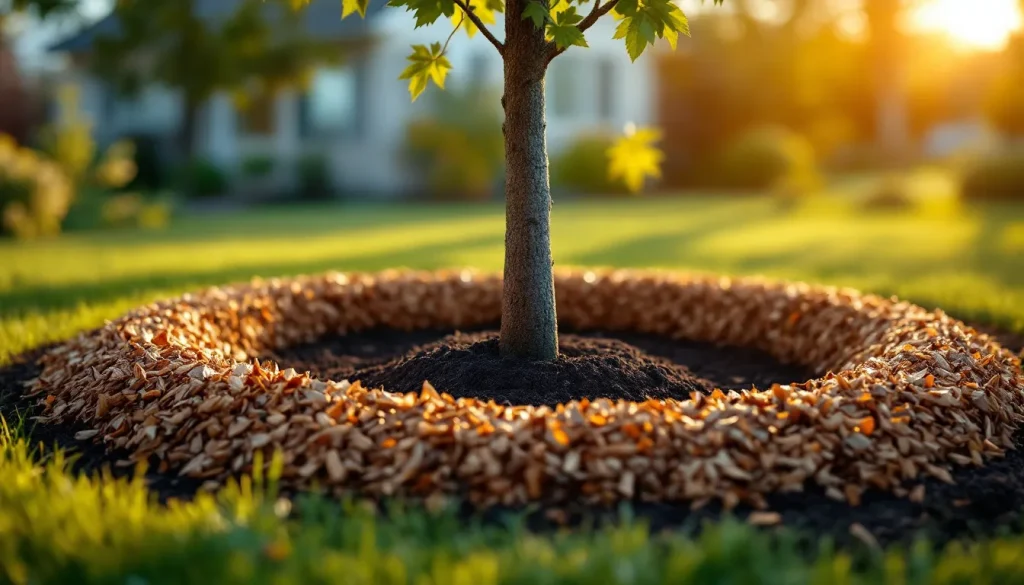
Avoid volcano mulching. Piling chips in a cone against a tree trunk traps moisture against the bark, invites rot, rodents, and disease, and can kill the tree over time. A flat, donut-shaped ring with a bare center is correct.
Where to source wood chips: free, bulk, and bagged
The cheapest wood chips are free arborist chips. Tree crews pay to dump loads, so many will deliver to you at no charge. ChipDrop connects homeowners with local arborists for free or low-cost drops. Bulk landscape suppliers sell screened wood chips by the cubic yard, and garden centers sell bagged chips for small jobs at the highest per-unit price.
| Source | Typical cost | Best for |
|---|---|---|
| Local arborist / tree crew | Free | Large volumes, paths, food forests |
| ChipDrop | Free to about $20 tip | Free delivery, but you take what arrives |
| Bulk landscape supplier | $15 to $40 per yard | Known, screened material |
| Bagged at garden center | $3 to $6 per 2 cu ft bag | Small beds, exact color |
One cubic yard covers about 100 square feet at 3 inches deep. A pickup truck bed holds roughly 2 to 3 cubic yards. Free arborist loads often arrive as 5 to 10 yards at once, so have space ready.
Safety and sourcing risks: which wood chips to avoid
Avoid black walnut chips (they contain juglone, toxic to tomatoes, peppers, and many plants), chips from diseased trees, pressure-treated or painted lumber, and dyed mulch of unknown origin. Watch for weed-seed contamination in roadside or storm-debris loads, and keep deep chips away from house foundations to reduce termite and moisture concerns. These are the real reasons gardeners hesitate, and most are easily managed.
| Risk | Why it matters | Mitigation |
|---|---|---|
| Black walnut (juglone) | Toxic to many vegetables and ornamentals | Ask the source; compost suspect chips 6+ months, which degrades juglone |
| Diseased wood | Can spread pathogens (rare in surface mulch) | Avoid known-diseased loads; surface fungi rarely infect healthy plants |
| Treated / painted lumber | May leach chemicals | Never use construction or CCA-treated wood chips on gardens |
| Dyed mulch | Dye is usually safe, but base wood may be recycled pallets/treated | Use only from a named, reputable supplier |
| Weed seeds | Can introduce new weeds | A 2 to 4 inch layer smothers most; avoid obviously seedy loads |
| Termites near foundations | Moisture and wood attract pests | Keep mulch 6+ inches off siding and below the foundation sill |
Wood type and use-case matching
For most gardeners, mixed arborist chips are the best all-round choice and the wood species barely matters once chips are used as surface mulch. Hardwood chips decompose into richer humus and suit beds and trees; softwood and bark-heavy chips (pine, cedar) break down slower and excel on paths. Aromatic woods like cypress mulch and cedar resist decay longer but feed soil less.
| Wood type | Decomposes | Best use |
|---|---|---|
| Mixed arborist (hardwood + leaves) | Moderate, builds humus | Beds, trees, food forests |
| Hardwood (oak, maple) | Moderate | Beds and perennials |
| Softwood / conifer (pine) | Slow | Paths, slopes |
| Cedar / cypress | Slow, decay-resistant | Display beds, longevity over soil-feeding |
The long-standing worry that pine or conifer chips acidify soil is overstated for surface mulch. The pH effect of decomposing chips on the surface is minimal and short-lived. For deeper material on choosing mulches, see the HMNDP learning hub.
Pros and cons of wood chip mulch
Wood chip mulch retains soil moisture, suppresses weeds, moderates soil temperature, builds humus, and is often free, making it one of the best-value mulches available. Its drawbacks are a rustic look, the need for occasional replenishment, the surface nitrogen effect if mixed into soil, and sourcing uncertainty with free loads. For most gardeners the benefits clearly outweigh the manageable downsides.
- Pros: excellent moisture retention; strong weed suppression at 3+ inches; feeds soil life; free or cheap; insulates roots.
- Cons: uneven appearance; must top up yearly; nitrogen tie-up only if tilled in; variable quality from free sources; not ideal in annual seedbeds.
Frequently Asked Questions
Do wood chips steal nitrogen from the soil?
Not when used correctly. Wood chips laid on the surface only cause nitrogen tie-up in the top quarter inch where wood touches soil, and that nitrogen returns as microbes die. Established plant roots sit far below this zone and are unaffected. Real deficiency happens only if you till fresh chips into the soil or pile them against seedlings.
Are wood chips better than bark mulch?
For soil health and cost, usually yes. Arborist wood chips feed soil biology, decompose into humus, and are often free, while bagged bark mulch is mostly cosmetic and costs $35 to $80 per yard. Bark mulch wins on uniform appearance for formal front-yard beds. For trees, paths, and productive gardens, wood chips are the stronger and cheaper choice.
Where can I get free wood chips for mulch?
Local tree-care companies are the best source because they pay to dispose of chips and will often deliver free. The service ChipDrop matches homeowners with arborists for free or low-tip drops. You receive whatever load is available, frequently 5 to 10 cubic yards at once, so prepare space. Bulk suppliers sell screened chips for $15 to $40 per yard.
How deep should wood chip mulch be?
Apply 2 to 4 inches deep in garden and perennial beds and 4 to 6 inches on paths. Less than 2 inches lets weeds push through; more than 4 inches against trunks or stems traps moisture and invites rot. Keep mulch 3 to 6 inches clear of all stems and tree trunks, and top up about an inch each year.
Can you use fresh wood chips as mulch or do they need to age?
Fresh wood chips are fine as a surface mulch around established trees, shrubs, and on paths. They only need aging if you plan to use them around vegetables or tender young plants, where 3 to 6 months of composting reduces the early nitrogen draw and any sour smell. Never dig fresh chips into soil regardless of age.
Can wood chips be used in a vegetable garden?
Yes, with care. Wood chips are excellent on permanent paths between vegetable beds and as mulch around established, taller crops. Keep them off freshly sown seed rows and tender seedlings, and use aged chips within beds. Avoid tilling chips into vegetable soil, which causes real nitrogen deficiency. The no-dig method uses chips and compost layered on the surface.
What are the pros and cons of wood chip mulch?
Pros: strong moisture retention, weed suppression, soil-building as chips decompose, root insulation, and low or zero cost from arborists. Cons: a rustic uneven look, yearly topping up, nitrogen tie-up if mixed into soil, variable quality from free loads, and poor fit for annual seedbeds. For most beds, trees, and paths, the benefits outweigh the drawbacks.
Which wood chips should you avoid using as mulch?
Avoid black walnut chips, which contain juglone toxic to tomatoes, peppers, and many plants, and never use chips from pressure-treated, painted, or construction lumber. Be cautious with dyed mulch of unknown origin and with diseased-tree debris. Keep deep chip layers at least 6 inches away from house foundations to limit termite and moisture problems near siding.