
By the HMNDP Editorial Team, independent reporting on lawn care, landscaping, and the green-industry business.
Last reviewed: June 2026
What cedar mulch is
Cedar mulch is shredded or chipped bark and wood from cedar trees, sold in a natural reddish-brown to tan color with no dye added. It comes from species like western red cedar (Thuja plicata) on the West Coast and eastern white cedar (Thuja occidentalis) in the Midwest and Northeast. Bags labeled “cedar blend” may mix cedar with cheaper softwoods.
The wood holds aromatic oils, mainly thujone and thujaplicin, which give cedar its signature scent and its mild insect-deterrent reputation. These oils are why cedar resists rot longer than most wood mulches.
Texture varies by grind. Finely shredded cedar knits into a mat that resists wind and stays put on slopes. Coarser cedar chips drain faster and last longer but blow around in open beds.
Cedar tone and aesthetic appeal
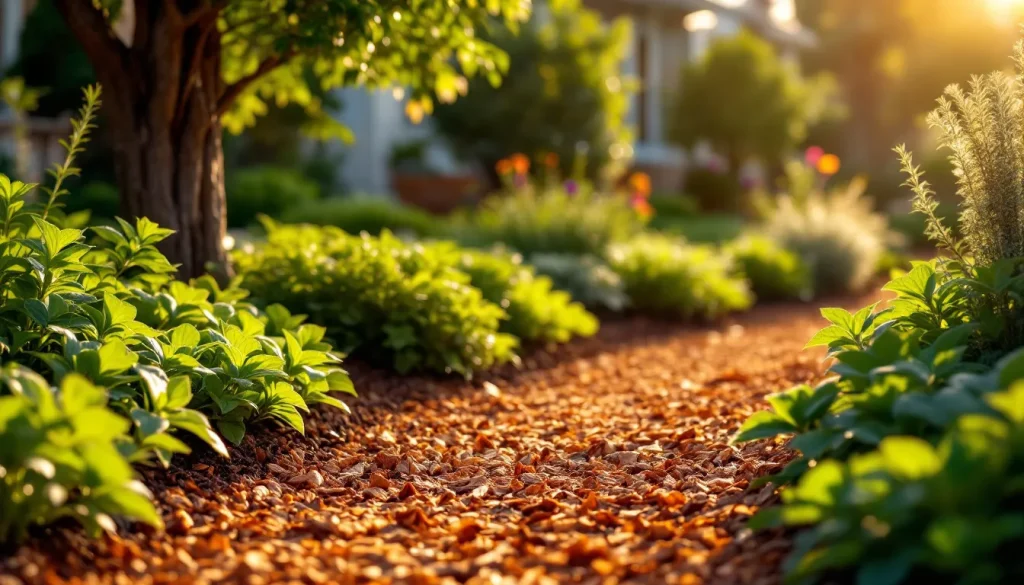
Cedar mulch reads as a warm, natural reddish-brown when fresh, fading to a soft silver-gray over 6 to 12 months of sun exposure. That undyed tone suits flower beds, garden paths, and the base of trees where dyed black or red mulch can look artificial. Because the color comes from the wood itself, there is no pigment to rub off on hands, pets, or concrete.
The gray patina is not rot. It is surface oxidation, and a light raking each spring lifts the buried, still-brown material back to the top to refresh the look without buying new mulch.
The aromatic cedar scent
The cedar smell is the product’s defining feature and comes from volatile oils in the heartwood, the same compounds used in cedar closets and chests. The scent is strongest in the first few weeks after spreading and is noticeable after rain or in summer heat. Most people find it pleasant. It fades as the oils evaporate, which is also why cedar’s insect-deterring power is temporary, not permanent.
Cedar mulch pros and cons
Cedar mulch lasts longer and looks cleaner than most wood mulches, and it carries a natural scent that deters some insects. The trade-offs are a higher price, a slower breakdown that returns less to the soil short-term, and oil and nitrogen concerns that make it a poor pick for vegetable beds. Here is the honest balance sheet.
| Pros | Cons |
|---|---|
| Lasts 4 to 7 years before needing full replacement | Costs roughly 30 to 60 percent more than hardwood mulch |
| Natural color, no dye to fade or stain | Decomposes slowly, so it adds little to the soil in the first few years |
| Aromatic oils deter moths, fleas, and some beetles | Scent and bug deterrence fade within months as oils volatilize |
| Resists wind and slope washout when shredded fine | Fresh cedar can tie up surface nitrogen, a problem for seedlings and veggies |
| Resists fungal rot and matting better than hardwood | Can deter beneficial insects and is debated for edible beds |
How long cedar mulch lasts (with real numbers)
Cedar mulch typically lasts 4 to 7 years before it fully breaks down, compared with 1 to 3 years for dyed or undyed hardwood and 4 to 6 years for cypress. The natural oils that resist rot are what stretch its working life. Expect to top-dress a thin layer every 1 to 2 years to keep depth and color, even though the base layer persists far longer.
| Mulch type | Typical lifespan | Relative cost | Soil benefit as it breaks down |
|---|---|---|---|
| Cedar (western red or eastern white) | 4 to 7 years | Higher | Low to moderate, slow release |
| Cypress | 4 to 6 years | Higher | Low, slow release |
| Hardwood (bark or shredded) | 1 to 3 years | Lower | Moderate to high, faster |
| Pine bark | 2 to 4 years | Moderate | Moderate, mildly acidifying |
| Straw or leaf mulch | Less than 1 year | Low | High, fast |
The longevity is a feature for permanent plantings and a drawback for annual beds. Slow breakdown means cedar feeds the soil less per year than hardwood, so gardeners chasing rich, fast-improving soil get more from cheaper, faster-rotting options.
Does cedar mulch repel bugs, and which insects?
Cedar mulch repels some insects but not the ones most homeowners care about. The oils thujone and thujaplicin deter clothes moths, fleas, cockroaches, silverfish, ants, and certain beetles in close contact. There is no reliable evidence cedar mulch repels mosquitoes or ticks at outdoor scale. The effect is also short-lived, weakening over a few months as the oils evaporate from the surface.
The confusion comes from cedar closets, where concentrated oil in an enclosed space does deter moths. Outdoors, the oil disperses, rain washes it down, and sun cooks it off. By the second season, a cedar bed has roughly the same insect activity as any other mulch.
Does cedar mulch repel beneficial insects or harm plants?
The same oils that bother pest insects can also discourage beneficial ones, including some ground beetles and pollinators that nest at soil level, though research here is thin and effects fade with the scent. Fresh cedar is mildly allelopathic in lab settings, meaning its compounds can slow nearby seed germination. In established beds with mature plants, real-world harm is rare. The risk concentrates on seedlings and direct-sown seeds.
Is cedar mulch safe for vegetable gardens?
Cedar mulch is generally safe around established vegetable plants but is a poor choice for seed-starting beds or rows you direct-sow. Two real concerns drive this. First, fresh cedar can temporarily tie up nitrogen at the soil surface as microbes break down the wood. Second, cedar oils are mildly allelopathic and may slow germination of small seeds. Established transplants with deep roots are largely unaffected.
The nitrogen issue is surface-level and short-term. Cedar is a top mulch, not a soil amendment, so as long as you keep it on the surface and do not till it in, it draws little nitrogen from the root zone. If you mulch a vegetable bed with cedar, pull it back a few inches from stems and avoid burying seeds under it.
For pure edible beds, faster-breaking options like straw, leaf mold, or composted hardwood usually serve better because they feed the soil within one season. Reserve cedar for perennial herbs, asparagus rows, and the pathways between vegetable beds where its longevity and clean look pay off. To size any of these correctly, run the numbers in our mulch calculator before buying.
Cedar mulch vs hardwood and cypress
Cedar beats hardwood on lifespan and looks but costs more and feeds soil slower. Cedar and cypress are close cousins: both carry aromatic rot-resistant oils, both last 4 to 7 years, and both cost a premium. Cedar generally has a stronger scent and lighter color, while cypress trends grayer. Choose cedar or cypress for permanence, hardwood for soil-building on a budget.
- Pick cedar when you want a long-lasting, low-maintenance, naturally colored mulch for trees, shrubs, and paths and do not mind paying more.
- Pick hardwood when you are mulching annual beds, want to improve soil faster, or are covering large areas on a budget.
- Pick cypress when you want cedar-like longevity and rot resistance, though sourcing raises sustainability questions in some regions.
Hardwood also breaks down into richer humus faster, so vegetable and annual flower beds that you replant yearly usually do better under hardwood or compost than under cedar.
How much cedar mulch you need and what it costs
Cedar mulch is sold mostly in 2 cubic foot bags. One 2 cubic foot bag covers about 12 square feet at 2 inches deep, or about 8 square feet at 3 inches deep. To cover 100 square feet, you need roughly 8 to 9 bags at 2 inches or 12 to 13 bags at 3 inches. At a typical bagged price of 4 to 7 dollars per bag, that is about 32 to 63 dollars per 100 square feet at 2 inches.
| Depth | Coverage per 2 cu ft bag | Bags per 100 sq ft | Approx cost per 100 sq ft (at $4 to $7/bag) |
|---|---|---|---|
| 2 inches | ~12 sq ft | 8 to 9 | $32 to $63 |
| 3 inches | ~8 sq ft | 12 to 13 | $48 to $91 |
Bulk cedar by the cubic yard (1 yard equals 13.5 bags of 2 cu ft) runs cheaper per unit, often 35 to 60 dollars per yard at local yards, plus delivery. For our full breakdown of bagged versus bulk pricing, see how much mulch costs.
The premium payback: cedar may cost 30 to 60 percent more upfront than hardwood, but if it lasts 5 years versus hardwood’s 2, you re-mulch less than half as often. Over a 6-year window, two cedar applications can cost less in material and labor than three hardwood applications, even at the higher per-bag price. Cedar wins on total cost only where you keep the bed long-term and value low maintenance.
Where to buy cedar mulch
Cedar mulch in 2 cubic foot bags is stocked at Home Depot, Lowe’s, and Menards, usually under house brands like Vigoro or Scotts plus regional cedar suppliers. Local composting yards and landscape supply yards sell it in bulk by the cubic yard, often fresher and cheaper per unit than bagged. Big-box stores run spring and Memorial Day sales where bag prices drop noticeably.
Read the bag. “Cedar” should mean cedar; “cedar blend” or “cedar enhanced” often mixes in cheaper softwood and dilutes the scent and longevity you are paying for.
Where to use cedar mulch and where to avoid it
Use cedar mulch where longevity, looks, and low maintenance matter most: garden paths, large perennial flower beds, and the area around trees and shrubs. Avoid it in vegetable seed beds, around acid-loving plants if pH-sensitive, and anywhere you want fast soil enrichment. Its slow breakdown and aromatic oils make it a finishing mulch, not a soil builder.
- Best uses: walkways and paths, foundation plantings, tree and shrub rings, slopes (shredded cedar mats well), and low-maintenance perennial borders.
- Avoid or use with care: vegetable seed rows, freshly seeded beds, annual flower beds you replant yearly, and right against tender stems.
Keep any mulch 2 to 3 inches deep and pulled back from trunks to avoid the “mulch volcano” that invites rot and rodents. If wind or rain keeps displacing your cedar on a slope or in an open bed, a binding product can help; see our guide to mulch glue. For more landscaping fundamentals, browse the HMNDP learn hub.
Frequently Asked Questions
Does cedar mulch repel bugs, and which insects does it actually work against?
Cedar mulch deters moths, fleas, cockroaches, silverfish, ants, and some beetles thanks to thujone and thujaplicin oils. It does not reliably repel mosquitoes or ticks outdoors. The effect is also short-lived, fading within a few months as the oils evaporate in sun and wash down in rain. Cedar’s closet reputation comes from concentrated oil in enclosed space, not open beds.
What are the pros and cons of cedar mulch?
Pros: cedar lasts 4 to 7 years, keeps a natural undyed color, resists rot and wind, and deters some insects. Cons: it costs 30 to 60 percent more than hardwood, breaks down slowly so it feeds soil less per year, its scent and bug deterrence fade in months, and fresh cedar can tie up surface nitrogen, making it a weak choice for vegetable seed beds.
Is cedar mulch safe for vegetable gardens?
Cedar mulch is generally safe around established vegetable transplants but a poor choice for seed-starting or direct-sown rows. Fresh cedar can temporarily tie up nitrogen at the soil surface, and its oils are mildly allelopathic, which can slow small-seed germination. Keep it on the surface, pull it back from stems, and never bury seeds under it. Straw or compost serves edible beds better.
How long does cedar mulch last compared to hardwood or cypress?
Cedar mulch lasts about 4 to 7 years, far longer than hardwood at 1 to 3 years and similar to cypress at 4 to 6 years. The natural rot-resistant oils drive its longevity. Expect to top-dress a thin refresh layer every 1 to 2 years to maintain depth and color, even though the base layer keeps performing for several seasons.
How much cedar mulch do I need and how much does it cost per area?
One 2 cubic foot bag covers about 12 square feet at 2 inches deep. To cover 100 square feet at 2 inches you need 8 to 9 bags, costing roughly 32 to 63 dollars at 4 to 7 dollars per bag. At 3 inches deep, plan on 12 to 13 bags. Bulk cedar by the cubic yard (about 35 to 60 dollars per yard) is cheaper per unit for larger areas.
Cedar mulch vs hardwood mulch: which is better and when?
Cedar wins on lifespan (4 to 7 years vs 1 to 3) and looks, and is best for trees, shrubs, paths, and long-term perennial beds. Hardwood wins on price and soil-building speed, making it better for annual beds, vegetable gardens, and budget coverage of large areas. Choose cedar for permanence and low maintenance, hardwood for faster soil improvement and lower upfront cost.
Does cedar mulch repel beneficial insects or harm plants?
Cedar oils can discourage some beneficial soil-level insects and are mildly allelopathic, meaning they can slow nearby seed germination in lab tests. In established beds with mature plants, real harm is rare, and effects fade as the scent does. The genuine risk concentrates on seedlings, direct-sown seeds, and tender stems, so keep cedar pulled back from young plants.
Where should you use cedar mulch, and where should you avoid it?
Use cedar mulch on garden paths, large perennial flower beds, slopes, and around trees and shrubs where its longevity and clean color shine. Avoid it in vegetable seed rows, freshly seeded areas, annual beds you replant yearly, and tight against tender stems. Cedar is a finishing mulch for permanent plantings, not a fast soil builder for edible or replanted beds.