
By the HMNDP Editorial Team, independent reporting on lawn care, landscaping, and the green-industry business.
Last reviewed: June 2026
What yard pest control actually means
Yard pest control is the treatment of your outdoor lawn, garden beds, and the perimeter of your home to kill or repel insects like mosquitoes, ticks, ants, fleas, grubs, and spiders. It differs from indoor pest control, which targets crawling and flying pests inside the house. Outdoor work covers two zones: the open lawn surface and a barrier band around the foundation.
Most homeowners treat both zones because pests move between them. A mosquito breeds in standing water in the yard, then bites you on the patio. A tick rides in on a pet from tall grass. An ant colony nests in the lawn and trails into the kitchen. Treating only inside chases the symptom while the source stays in the yard.
The two-zone approach is the backbone of every section below: knock down what is living in the turf, then build a chemical or physical barrier where the yard meets the house.
Common yard pests and what they need
The pests driving most DIY yard pest control fall into eight groups, and each responds to a different control. Mosquitoes and ticks are biting threats. Ants, fire ants, and fleas spread and bite. Grubs, centipedes, spiders, and chiggers are nuisance or turf-damage pests. Matching the pest to the product matters more than buying the strongest bottle on the shelf.
| Pest | Where it lives | Primary DIY control |
|---|---|---|
| Mosquitoes | Standing water, shrubs, shade | Eliminate water, barrier spray on foliage, larvicide dunks |
| Ticks | Tall grass, leaf litter, yard edges | Mow, clear leaf litter, perimeter granules or spray |
| Ants / fire ants | Soil mounds, lawn, foundation | Broadcast bait, mound drench, perimeter spray |
| Fleas | Shaded turf, pet rest areas | Yard insecticide with insect growth regulator (IGR) |
| Grubs | Below the turf, root zone | Granular grub control, beneficial nematodes |
| Centipedes | Mulch, damp soil, debris | Reduce moisture and debris, perimeter barrier |
| Spiders | Eaves, woodpiles, foundation | Perimeter spray, remove harborage |
| Chiggers | Tall grass, weedy edges | Mow short, granules on edges and shaded areas |
For grubs specifically, timing and product chemistry decide success. Our guide to grub control for lawns covers preventive versus curative formulas. For biting flyers, the mosquito pest control breakdown goes deeper on source reduction.
DIY yard pest control products and supplies
Consumer yard pest control comes in three formats: insecticide granules, liquid concentrates, and ready-to-spray products. Granules go down dry with a spreader and water in. Concentrates mix with water in a tank or hose-end sprayer. Hose-end and pump sprayers apply liquids fast. Brands like Spectracide, Ortho, and BioAdvanced sell all three at Home Depot, Lowe’s, and DIY pest supply retailers online.
| Format | Best for | How it goes down | Typical coverage |
|---|---|---|---|
| Granules | Full lawn surface, grubs, ticks, fleas, ants | Broadcast spreader, then water in | One 10 to 20 lb bag covers about 5,000 to 10,000 sq ft |
| Liquid concentrate | Custom-mixed perimeter and foliage | Tank or hose-end sprayer | Varies by mix ratio, often 5,000 to 16,000 sq ft per bottle |
| Hose-end / ready-to-spray | Fast barrier sprays, spot treatment | Attach to garden hose, walk and spray | One 32 oz bottle treats roughly 5,000 sq ft |
Combined lawn-and-home kits bundle a granular for the turf plus a liquid for the foundation, which is how most season-long programs are built. You can buy single products or full programs online and have them shipped, which is common with specialty DIY pest supply retailers that sell the same active ingredients pros use.
Professional-grade vs consumer products
Professional-grade products usually carry a higher concentration of the same active ingredient and cover more square footage per bottle. Consumer products from Spectracide or Ortho are pre-diluted for safety and ease. Pro concentrates like bifenthrin or lambda-cyhalothrin are sold to homeowners online and require you to measure and mix, but they often cost less per treated square foot.
The active ingredient matters more than the label tier. A consumer bottle of bifenthrin and a pro bottle of bifenthrin kill the same pests. The pro version simply asks you to dilute it correctly, which is where the step-by-step process below earns its place.
Read every product label before buying. The label is the legally binding instruction set under U.S. EPA pesticide rules, and it states the target pests, mix ratio, and re-entry interval.
How to apply yard pest control step by step
A correct DIY yard pest control treatment follows a fixed order: measure, prep, mix, treat the lawn, treat the perimeter, then re-enter safely. Skipping the measuring step is the most common reason treatments fail, because the wrong dose either wastes product or leaves pests alive. Plan about one to two hours for an average suburban yard.
- Measure your yard. Multiply length by width for each section to get square footage. A typical quarter-acre lot has roughly 8,000 to 10,000 sq ft of treatable lawn. Note this number; every product dose depends on it.
- Mow and prep. Mow two to three days before treating so spray reaches the soil and grass blades. Pick up toys, bowls, and debris. Do not mow right after applying granules.
- Mix to the label ratio. For concentrates, measure the exact ounces per gallon stated on the label. A common bifenthrin ratio is about 1 oz per gallon to cover roughly 1,000 sq ft. Do not eyeball it.
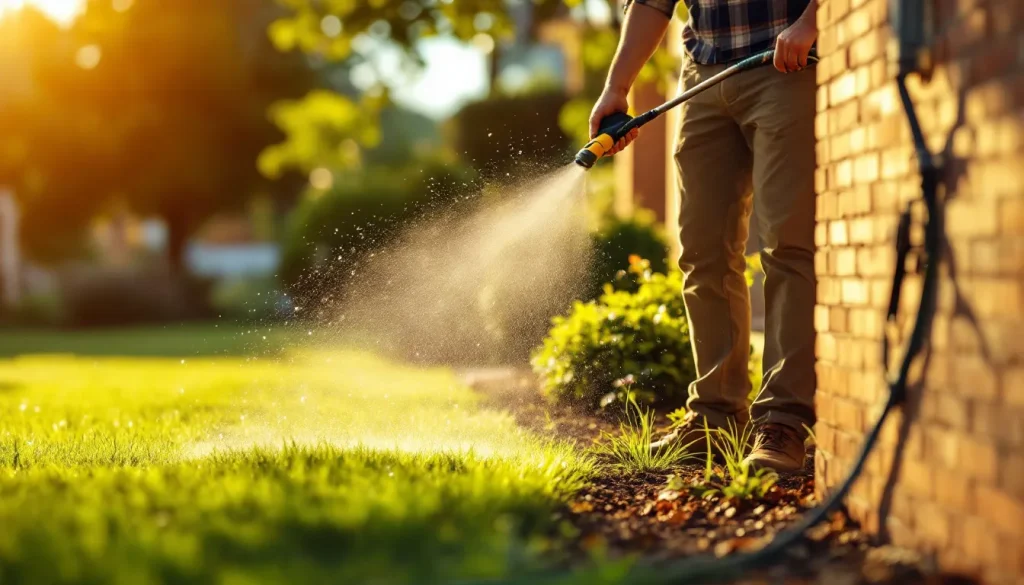
- Treat the lawn surface. Broadcast granules with a spreader or spray liquid in even passes across the open turf. Walk a steady line and overlap slightly.
- Build the perimeter barrier. Spray a band 2 to 3 feet up the foundation and 2 to 3 feet out onto the ground around the entire house. Hit door frames, weep holes, and the base of exterior walls. This barrier stops pests moving from yard to home.
- Water in granules. Most granules need about 0.25 inch of irrigation to activate and move into the soil. Liquids should dry on their own; check the label for whether watering helps or hurts.
- Observe the re-entry interval. Keep people and pets off treated areas until surfaces are dry, typically 1 to 2 hours for sprays. Granules watered into the soil are generally safe once the lawn is dry.
When to apply: a yard pest control timing calendar
Yard pest control works on a seasonal schedule, not a one-time spray. Apply the first treatment in early spring when soil warms past about 50°F, reapply through the warm season, and put down grub control by mid to late summer. Most barrier sprays last 4 to 8 weeks, so plan to reapply rather than expecting one application to last all year.
| Season | What to do | Why |
|---|---|---|
| Early spring (March to April) | First perimeter and lawn treatment; ant baits | Overwintering pests become active as soil warms |
| Late spring (May to June) | Reapply barrier; start mosquito and tick control | Biting season ramps up; reapply every 4 to 8 weeks |
| Mid to late summer (July to August) | Apply curative grub control; reapply barrier sprays | Grubs are actively feeding near the surface |
| Early fall (September to October) | Preventive grub granules; final perimeter pass | Cuts next year’s grub population and fall invaders |
| Winter (November to February) | Source reduction: clear leaf litter, drain water | Removes overwintering tick and mosquito habitat |
Reapply more often in hot, rainy regions and after heavy rain washes product off. In the South, fire ants and mosquitoes may need treatment nearly year-round.
Natural and organic yard pest control options
Natural yard pest control uses non-synthetic products and habitat changes to reduce pests without conventional insecticides. The proven options are beneficial nematodes for grubs and fleas, diatomaceous earth for crawling insects, cedar oil and essential-oil sprays for mosquitoes and ticks, and Bti mosquito dunks for standing water. Removing standing water and tall grass is the single most effective free control.
- Beneficial nematodes: microscopic worms watered into the soil that attack grubs and flea larvae. Apply to moist soil in the evening; they are living organisms and die in direct sun.
- Diatomaceous earth (food grade): a fine powder that damages the exoskeleton of ants, fleas, and chiggers. Dust dry areas; it stops working when wet.
- Bti mosquito dunks: a bacterial larvicide dropped into ponds, birdbaths, and clogged gutters to kill mosquito larvae before they fly.
- Cedar oil and essential-oil sprays: plant-based repellents for mosquitoes and ticks. They break down faster than synthetics, so reapply more often.
- Habitat control: drain standing water weekly, mow to 2.5 to 3 inches, clear leaf litter, and keep mulch thin. This denies pests breeding and hiding spots.
For a wider look at low-toxicity approaches and product picks, see our non-toxic pest control guide.
DIY vs professional: cost and when to call a pro
DIY yard pest control is cheaper but takes your time and judgment; a professional costs more but handles diagnosis, equipment, and repeat visits. A DIY season often runs $80 to $200 in products. A professional mosquito or general pest program commonly runs $50 to $100 per visit, or roughly $400 to $1,200 per year depending on yard size, region, and visit frequency.
| Factor | DIY | Professional |
|---|---|---|
| Typical annual cost | $80 to $200 in products | $400 to $1,200 for a season program |
| Your time | 1 to 2 hours per treatment, several times a year | Minimal; they apply |
| Equipment | Spreader and sprayer you buy once | Included |
| Diagnosis | You identify the pest | Trained technician identifies and adjusts |
| Best for | Routine prevention, mild problems | Infestations, recurring or hard-to-treat pests |
Call a professional when a problem is beyond routine prevention. Clear triggers include an established fire ant infestation with many mounds, a tick problem in a yard near woods where Lyme disease is a concern, grubs that return year after year despite treatment, or any large nest near the home. Pros can also apply restricted-use products that consumers cannot buy.
Many homeowners run a hybrid model: DIY routine barrier sprays and granules, plus one or two pro visits a year for the hard pests. To go deeper on products, timing, and turf health, browse the HMNDP lawn care learning hub.
Frequently Asked Questions
How do I get rid of pests in my yard myself?
Measure your yard, then treat in two zones. Broadcast insecticide granules or spray a liquid concentrate across the lawn surface, then spray a barrier band 2 to 3 feet up and out around the foundation. Water in granules, remove standing water, and reapply every 4 to 8 weeks through the warm season. Match the product to your specific pest.
What is the best yard pest control product?
There is no single best product; the right one depends on the pest. Bifenthrin-based granules and sprays from Spectracide, Ortho, or BioAdvanced handle a broad range of lawn and perimeter pests like ants, ticks, and fleas. For grubs, use a dedicated granular grub control. For mosquitoes, pair a foliage barrier spray with Bti dunks in standing water.
When should I apply yard pest control, and what time of year?
Start in early spring when soil warms past about 50°F, then reapply through the warm season. Most barrier sprays last 4 to 8 weeks, so plan repeat treatments from spring through early fall. Apply curative grub control in mid to late summer and preventive grub granules in early fall. In the South, fire ants and mosquitoes may need near year-round attention.
How often should I treat my yard for bugs?
Reapply most yard insecticides every 4 to 8 weeks during the active season, since rain, sun, and mowing break products down. Hot, rainy regions need more frequent treatment, and heavy rain may require an early reapplication. Grub control is different: apply it once preventively in early fall or once curatively in late summer rather than on a recurring schedule.
What are natural or organic ways to control yard pests?
Use beneficial nematodes for grubs and flea larvae, food-grade diatomaceous earth for crawling insects, Bti mosquito dunks in standing water, and cedar or essential-oil sprays for mosquitoes and ticks. Habitat control is the most effective free method: drain standing water weekly, mow to 2.5 to 3 inches, and clear leaf litter that shelters ticks and chiggers.
Is DIY yard pest control as effective as a professional, and which is cheaper?
DIY is cheaper, often $80 to $200 a year in products versus $400 to $1,200 for a pro program, and it works well for routine prevention if you measure, mix, and reapply correctly. Professionals are worth the cost for infestations, recurring grubs, fire ants, or tick-heavy yards near woods, because they diagnose accurately and can use restricted products.
How much area does one bag of insect granules cover, and how do I apply it?
A typical 10 to 20 lb bag of insect granules covers about 5,000 to 10,000 sq ft; check the label for the exact rate. Measure your lawn, set a broadcast spreader to the labeled setting, and walk even, slightly overlapping passes. Then water in with about 0.25 inch of irrigation to move the active ingredient into the soil.
Is yard pest treatment safe for pets and children, and how long until they can go back outside?
Most consumer yard treatments are safe once they dry. Keep people and pets off sprayed areas until surfaces are fully dry, usually 1 to 2 hours. Granules are generally safe once watered in and the lawn surface is dry. Always follow the re-entry interval printed on the product label, which is the legally binding instruction under EPA rules.