
By the HMNDP Editorial Team, independent reporting on lawn care, landscaping, and the green-industry business.
Last reviewed: June 2026
Artificial grass installation, start to finish
Artificial grass installation follows one fixed sequence: excavate the old surface, build and compact a crushed-rock base, lay a weed barrier, roll out and trim the turf, secure seams and edges, then brush in infill. Installed cost runs roughly $9 to $13 per square foot through a contractor. A confident DIY homeowner can cut that to about $5 to $7 per square foot in materials, saving close to $3,000 on a 500-square-foot yard.
The job is physical but not technically hard. The two things that separate a flat, long-lasting lawn from a wrinkled one are base preparation and compaction. Get those right and the rest is patience.
This guide gives the full step sequence, exact base depths and drainage slope, a real material cost breakdown, and the failure modes most retailer pages leave out. For a deeper product-side view, see our overview of artificial grass as a lawn replacement.
The step-by-step installation process
Artificial grass installs in seven ordered steps: excavate, grade, lay base aggregate, compact, add weed barrier, lay and secure turf, then apply infill. Each step depends on the one before it. Skipping compaction or rushing the grade is what causes dips and wrinkles later. Plan on one to three days for a typical residential yard.
- Excavate. Remove existing grass and soil to a depth of 3 to 4 inches (4 inches in cold or clay-heavy regions). A sod cutter rental speeds this up on lawns over 200 square feet.
- Grade for drainage. Slope the exposed soil away from the house at about 1 inch of fall per 8 to 10 feet (roughly a 1% grade).
- Lay base aggregate. Spread 3 to 4 inches of crushed rock (Class II road base or 3/4-inch minus), raking it level.
- Compact. Run a plate compactor over the base in two passes, wetting lightly to settle fines. Target 90% compaction.
- Add weed barrier. Roll geotextile weed fabric over the compacted base and overlap seams by 4 to 6 inches.
- Lay and secure turf. Roll out the turf with all blades facing the same direction, let it relax for 1 to 2 hours, trim to fit, seam, then nail the edges.
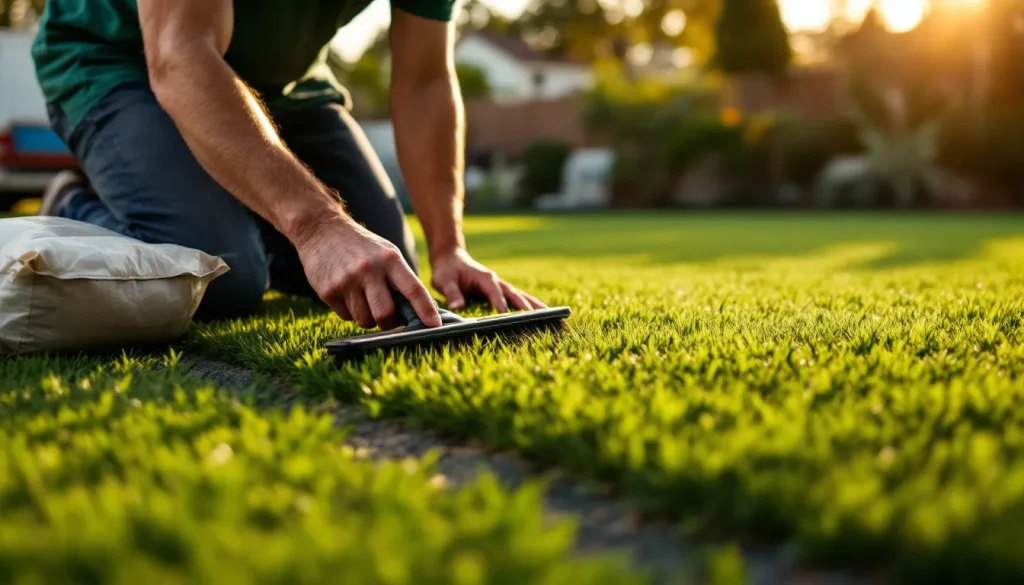
- Apply infill. Brush silica sand or coated sand into the fibers and power-broom to stand the blades up.
Base and subbase preparation on soil or dirt
The base under artificial turf is a compacted layer of crushed rock, not soil. On bare dirt, excavate 3 to 4 inches down, then fill that void with 3 to 4 inches of Class II road base or 3/4-inch crushed aggregate. The rock gives the turf a firm, free-draining, weed-resistant foundation. Skipping it is the single most common cause of a lawn that dips and puddles within a year.
Use a sharp grade so water drains. A fall of about 1 inch per 8 to 10 feet, sloping away from buildings, keeps the surface from holding water after rain. Rake the aggregate, then check it with a long screed board or a level on a straightedge.
Layer the base correctly: a coarse drainage rock can go on the bottom in wet regions, topped with a finer decomposed-granite or rock-dust layer (about 1 inch) that screeds smooth. The fine top layer is what gives you a flat surface; the coarse layer is what drains.
What changes for pet areas
Pet zones need a more permeable base and an odor-resistant infill. Many installers swap standard base for a pet-grade system: a thicker drainage rock bottom plus a permeable top layer, sometimes over a drainage panel, so urine flushes straight through. For infill, use a coated antimicrobial sand or zeolite product (zeolite traps ammonia) instead of plain silica. Rinse pet turf weekly in hot weather.
Compacting the base layer
Compaction turns loose rock into a solid slab that will not settle. Rent a vibratory plate compactor (about $60 to $90 per day from Home Depot or Sunbelt) and run it over the base in at least two passes, in different directions. Mist the aggregate lightly before compacting so the fine particles lock together. The finished base should not show a footprint when you walk on it.
Aim for roughly 90% compaction. An undercompacted base is the root cause of base settling and surface dips, the defect that shows up months after the install looks perfect. For tight corners and edges a compactor cannot reach, use a hand tamper.
Laying and securing the turf
Lay turf with every roll facing the same blade direction, let it acclimate 1 to 2 hours so it lies flat, then trim and fasten. Cut from the back with a sharp utility knife, slicing between stitch rows so blades are not chopped. Mismatched blade direction creates a visible color seam, so confirm the “nap” runs the same way across the whole lawn before you cut anything.
Join seams with seaming tape and outdoor turf adhesive, not by butting two raw edges and nailing them. Trim 3 stitches off each mating edge, lay the tape (shiny side down) under the joint, apply adhesive, then press both edges together with the blades pulled up out of the glue line. A tight, glued seam is nearly invisible; a nailed butt joint splits open.
Secure the perimeter and seams with 5 to 6 inch galvanized or non-galvanized landscape nails (galvanized resist rust) or staples, spaced every 3 to 4 inches around edges and every 12 to 24 inches across the field. Drive nails flush and brush blades over the head so it disappears. For more on professional-grade methods, see our guide to artificial turf installation.
Applying infill
Infill is the weighted sand (or sand-rubber blend) brushed into the turf after it is secured. It holds the turf flat, keeps blades upright, protects the backing from UV, and adds ballast so the lawn cannot ripple. Most residential turf needs about 1 to 2 pounds of infill per square foot, so a 500-square-foot lawn takes roughly 500 to 1,000 pounds.
Spread infill with a drop spreader in two or three light passes rather than one heavy dump. After each pass, power-broom or stiff-broom against the grain to drive sand to the base and lift the fibers. Rounded silica sand is the standard; coated sand or zeolite suits pet areas; crumb rubber adds cushion for play surfaces.
Installation cost per square foot
Professional artificial grass installation runs about $9 to $13 per square foot installed, materials included, in 2026 US pricing. A 500-square-foot yard therefore costs roughly $4,500 to $6,500 turnkey. DIY materials for the same yard land near $5 to $7 per square foot, or about $2,500 to $3,500, with the labor savings being the difference. See our breakdown of artificial turf cost for regional ranges.
The number that matters is your all-in DIY total, not the per-foot turf price retailers quote. Here is the line-by-line math for a 500-square-foot install, the part most guides leave out.
| Line item | Unit basis | DIY cost (500 sq ft) |
|---|---|---|
| Turf (mid-grade, ~$2.50/sq ft) | Material | $1,250 |
| Class II base aggregate (~5 tons) | Material + delivery | $300 to $450 |
| Weed barrier fabric | Material | $60 to $100 |
| Landscape nails / staples | Material | $60 to $120 |
| Seaming tape + adhesive | Material | $80 to $150 |
| Infill (silica sand, ~750 lb) | Material | $120 to $250 |
| Plate compactor rental | 1 to 2 days | $70 to $180 |
| Sod cutter + power broom rental | 1 day | $100 to $180 |
| DIY total | ~$2,040 to $2,680 | |
| Pro quote, same yard | $9 to $13/sq ft | $4,500 to $6,500 |
| DIY savings | ~$2,500 to $3,800 |
DIY versus hiring a professional
DIY artificial grass installation saves roughly $2,500 to $3,800 on a 500-square-foot yard but costs you a hard weekend and the risk of a settled or wrinkled base. A pro charges that premium for excavation labor, calibrated compaction, clean seams, and usually a workmanship warranty. The decision turns on yard size, soil, and how flat you need the result.
| Factor | DIY | Hire a pro |
|---|---|---|
| Cost (500 sq ft) | ~$2,000 to $2,700 | ~$4,500 to $6,500 |
| Time | 1 to 3 days, your labor | Up to 700 sq ft per crew per day |
| Best for | Small, flat, square yards | Large, sloped, complex or pet yards |
| Main risk | Base settling, visible seams | Cost |
| Warranty | Turf manufacturer only | Workmanship + manufacturer |
Lean DIY if the area is under about 600 square feet, mostly rectangular, and the soil drains. Lean pro if the yard slopes, has many curves or obstacles, or is a heavy-use pet zone where drainage mistakes get expensive.
Project timeline and daily capacity
A professional crew installs up to about 700 square feet per crew per day, so most residential yards finish in one to two days. DIY runs slower: budget a full day for excavation and base, and a second day for turf, seaming, and infill. Allow extra time if you are renting equipment and learning the compactor on the job.
Weather matters. Install on a dry stretch; wet base aggregate is harder to grade and compact, and adhesive needs dry conditions to cure on seams.
Tools and materials needed
Artificial grass installation needs excavation tools, a plate compactor, cutting and seaming supplies, and the materials themselves. Renting the compactor, sod cutter, and power broom for one to two days keeps the DIY budget down versus buying. Here is the full checklist.
- Excavation: sod cutter (rental), flat shovel, wheelbarrow, hard rake, landscape rake
- Base and compaction: Class II road base aggregate, vibratory plate compactor (rental), hand tamper, screed board, 4-foot level, hose
- Turf and securing: artificial turf rolls, geotextile weed barrier, utility knife with spare blades, seaming tape, turf adhesive, 5 to 6 inch landscape nails or staples, hammer or staple gun, carpet kicker for stretching
- Infill and finish: silica sand (or coated sand / zeolite for pets), drop spreader, power broom (rental) or stiff push broom
Installing on soil or dirt versus a hard surface
On soil or dirt, you excavate 3 to 4 inches and build a compacted crushed-rock base for drainage and stability. On an existing hard surface like a concrete patio, you skip excavation entirely: clean the slab, confirm it drains or drill weep holes, then either glue the turf down with full-spread adhesive or lay a thin shock pad plus turf. The base philosophy flips from “build drainage” to “use existing drainage.”
On concrete, glue is the primary fastener since you cannot drive nails. Use a foam underlayment if you want cushion underfoot. On soil, nails and infill do the holding. Both cases still need turf laid in one blade direction with glued seams.
Common mistakes and failure modes to avoid
Most artificial grass installs fail in predictable ways: base settling, wrinkling from heat expansion, visible seams, weed regrowth, and infill migration. Every one traces back to a skipped or rushed step, and every one is preventable. This is the section retailer guides omit, and it is where DIY projects are won or lost.
| Failure mode | Cause | Prevention |
|---|---|---|
| Dips and settling | Undercompacted base | Two compactor passes, wet base, target 90% compaction |
| Wrinkling / ripples | Turf laid cold, no acclimation, low infill | Let turf relax 1 to 2 hours in sun, stretch with a kicker, add full infill |
| Visible seams | Mismatched blade direction, nailed butt joints | Same nap direction, glue with seam tape, trim 3 stitches per edge |
| Weed regrowth | No weed barrier or gaps | Overlap geotextile fabric 4 to 6 inches, full coverage |
| Infill migration | One heavy infill dump, no brooming | Spread in 2 to 3 passes, power-broom each pass |
| Lifting edges | Nails too sparse | Nail edges every 3 to 4 inches, flush to backing |
Heat, cooling, and where artificial grass underperforms
Artificial grass gets hot. In direct summer sun, turf surface temperatures can reach 140 to 170 degrees F, well above the air temperature and far hotter than natural grass, which cools itself through evaporation. This is the trade-off no install fixes by itself, and it matters most in hot, sunny climates and on south-facing yards.
You can lower surface heat by hosing the turf down (a temporary effect), choosing lighter-colored fibers or heat-reflective infill, and adding shade. Artificial grass underperforms in deep shade where moss can grow, in very large open sun-exposed expanses, and as a cooling ground cover. It performs well for low-water, low-maintenance, high-traffic, and pet areas.
Maintenance and lifespan after installation
Installed artificial grass lasts about 15 to 25 years depending on quality, foot traffic, and UV exposure, with mid-grade residential turf commonly rated for 15 to 20 years. Maintenance is light but not zero: rinse off dust and pet waste, brush high-traffic lanes to keep blades upright, and top up infill every few years as it compacts or migrates.
Keep barbecues, fire pits, and reflected window glare off the turf, since concentrated heat can melt fibers. For broader care and product research, the HMNDP learn hub collects related lawn and turf guides.
Frequently Asked Questions
How much does artificial grass installation cost per square foot?
Professional artificial grass installation costs about $9 to $13 per square foot in 2026, materials and labor included, so a 500-square-foot yard runs roughly $4,500 to $6,500. DIY materials land near $5 to $7 per square foot, about $2,000 to $3,500 for the same yard. The gap is labor, which is why DIY can save close to $3,000.
How do you install artificial grass on soil or dirt?
On soil, excavate 3 to 4 inches, grade a 1% slope away from the house, then spread and compact 3 to 4 inches of crushed-rock base. Lay a weed barrier, roll out the turf in one blade direction, glue seams, nail the edges every 3 to 4 inches, and brush in silica sand infill. Base prep and compaction are the make-or-break steps.
Can I install artificial grass myself, or should I hire a professional?
You can DIY artificial grass on a small, flat, mostly rectangular yard and save roughly $2,500 to $3,800 on 500 square feet. Hire a professional for large, sloped, curvy, or heavy-use pet yards where compaction and drainage errors are costly. The job is physical, not highly technical, but base settling and seams are the common DIY failure points.
What base do you need under artificial turf and how deep should it be?
Artificial turf needs a compacted crushed-rock base, typically 3 to 4 inches of Class II road base or 3/4-inch minus aggregate (4 inches in cold or clay-heavy soil). Grade it to about a 1% slope for drainage, then compact in two passes to roughly 90%. A finer rock-dust top layer about 1 inch thick gives the flat surface the turf sits on.
What tools and materials are needed to install artificial grass?
You need a sod cutter, shovel, rake, plate compactor, and hand tamper for the base; a utility knife, seaming tape, turf adhesive, and 5 to 6 inch landscape nails for laying and securing; and crushed-rock base, weed barrier fabric, the turf rolls, and silica sand infill as materials. Rent the compactor, sod cutter, and power broom to cut DIY cost.
How long does it take to install artificial grass?
A professional crew installs up to about 700 square feet per crew per day, finishing most residential yards in one to two days. DIY usually takes one to three days: roughly a full day to excavate and build the base, and a second day to lay turf, glue seams, and brush in infill. Dry weather speeds curing.
Do you need infill for artificial grass and how much?
Yes, most artificial grass needs infill to hold blades upright, ballast the turf against wrinkling, and protect the backing from UV. Plan on about 1 to 2 pounds per square foot, so a 500-square-foot lawn takes 500 to 1,000 pounds. Use silica sand for general use, coated sand or zeolite for pet areas, and crumb rubber for cushioned play surfaces.
How do you join seams and secure the edges of artificial turf so they don’t lift?
Join seams with seaming tape and turf adhesive, not nailed butt joints: trim 3 stitches off each mating edge, lay tape shiny-side down, glue, then press edges together with blades pulled clear. Secure perimeters and seams with 5 to 6 inch landscape nails or staples every 3 to 4 inches around edges, driven flush so blades hide the heads.
How do you stop weeds from growing through artificial grass?
Stop weeds by laying a geotextile weed barrier fabric over the compacted base before the turf, overlapping seams 4 to 6 inches for full coverage. The compacted crushed-rock base itself also suppresses growth. For occasional weeds that root in surface infill, pull them or apply a turf-safe weed treatment; they cannot establish in properly built layers below.
How long does artificial grass last after installation?
Installed artificial grass typically lasts 15 to 25 years, with mid-grade residential turf commonly rated for 15 to 20 years depending on foot traffic, UV exposure, and install quality. Light maintenance extends life: rinse debris, brush high-traffic areas, and top up infill every few years. Keep heat sources and reflected glare off the fibers, since concentrated heat can melt them.