
By the HMNDP Editorial Team, independent reporting on lawn care, landscaping, water, and the green-industry business.
Last reviewed: June 2026
Artificial Turf Installation in Brief
Artificial turf installation means excavating 3 to 4 inches of existing grass and soil, building and compacting an aggregate base, laying a weed barrier, then rolling out, seaming, edging, and infilling synthetic grass. A professional job runs roughly $9 to $13 per square foot installed. A confident DIY homeowner can cut that to about $4 to $7 per square foot in materials and tool rental.
The job is physical but not technically hard. The two things that separate a professional-looking result from a wrinkled, weedy one are base preparation and seaming. This guide covers both in detail, plus a real line-item budget and three different processes depending on what you are installing over.
What Artificial Turf Installation Actually Costs (Itemized)
Most guides quote $9 to $13 per square foot installed and stop there. That number bundles labor, materials, and markup, so it is useless for budgeting a DIY job. Below is the materials-only breakdown that lets you estimate your own project. For a 500-square-foot lawn, expect roughly $2,000 to $3,500 in materials and rentals if you do the labor yourself.
| Line item | Typical unit cost (2026) | For 500 sq ft |
|---|---|---|
| Synthetic turf (mid-grade, 1.5 in pile) | $2.50 to $5.00 / sq ft | $1,250 to $2,500 |
| Class II road base / decomposed granite | $35 to $55 / cubic yard delivered | $200 to $350 (about 5 to 6 yd) |
| Silica sand infill | $0.30 to $0.60 / sq ft | $150 to $300 |
| Weed barrier / landscape fabric | $0.10 to $0.25 / sq ft | $50 to $125 |
| Seam tape and turf adhesive | $1.50 to $3.00 / linear ft of seam | $50 to $150 |
| Galvanized nails / landscape spikes (5 to 6 in) | $0.10 to $0.20 / nail | $40 to $80 |
| Plate compactor rental (1 to 2 days) | $70 to $110 / day | $70 to $220 |
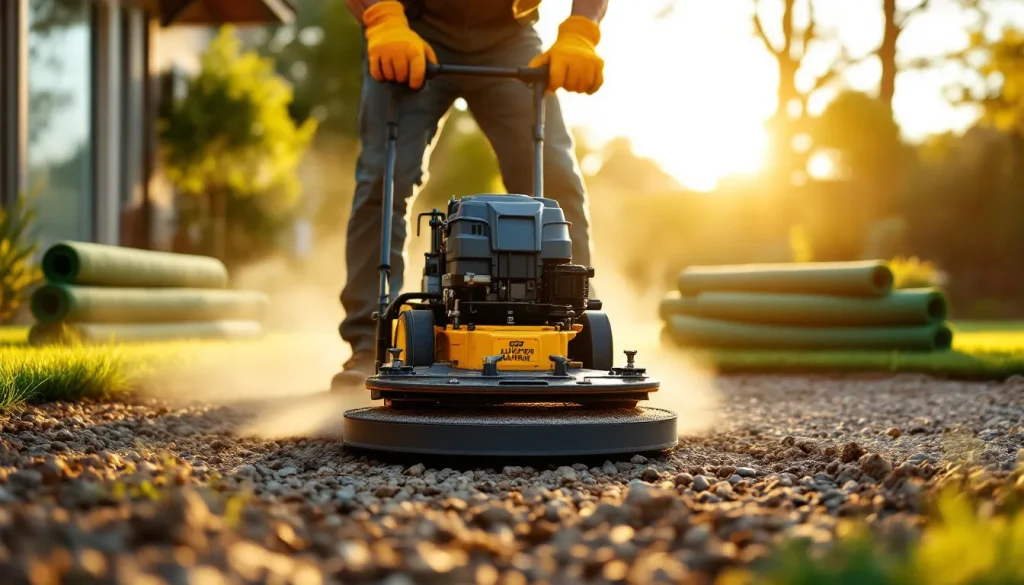
| Power broom rental (optional) | $50 to $80 / day | $50 to $80 |
Turf is the swing factor. Premium landscape-grade turf can hit $5 to $8 per square foot on its own, which is what pushes a professional install toward the top of the $9 to $13 range. Buying turf by the full roll (typically 15 ft wide) rather than cut-to-order also reduces waste and seam count.
DIY vs Hiring a Pro: How the Numbers Compare
For a typical 500-square-foot lawn, DIY materials and rentals land around $2,000 to $3,500, while a professional install at $9 to $13 per square foot runs $4,500 to $6,500. You are trading roughly two weekends of hard labor for $2,000 to $3,000 in savings. The deciding factors are seam quality, base equipment, and your tolerance for moving several tons of rock by hand.
| Factor | DIY | Hire a pro |
|---|---|---|
| Cost (500 sq ft) | $2,000 to $3,500 | $4,500 to $6,500 |
| Time | 2 to 4 days for a first-timer | About 700 sq ft per crew per day |
| Equipment | Rent compactor and power broom | Crew brings everything |
| Seam risk | Higher (most common DIY failure) | Lower, often warrantied |
| Warranty | Turf manufacturer only | Workmanship + product |
Professionals benchmark productivity at roughly 700 square feet per crew per day, so a 1,500-square-foot yard is about two days of crew time. If your project is large, has many curves, or sits on a slope, the pro premium buys real risk reduction. Vetting matters: our guide on how to find a reputable landscaper covers what to check before signing. You can also compare providers in our roundup of the best lawn care services for 2026.
Tools Needed for Artificial Turf Installation
You need digging tools, a plate compactor, cutting tools, and a brush. Most homeowners already own the hand tools and rent the two power items. A plate (vibratory) compactor is non-negotiable: hand tamping does not achieve the density a stable base requires, and a soft base is the leading cause of long-term dips and wrinkles.
- Excavation: flat shovel, mattock or sod cutter (rentable), wheelbarrow
- Base work: vibratory plate compactor, rake, garden hose (to dampen rock before compacting)
- Cutting and seaming: sharp utility knife with spare blades, carpet kicker (optional), seam tape, turf adhesive and a notched trowel or caulk gun
- Securing: 5 to 6 inch galvanized nails or landscape spikes, hammer or rubber mallet
- Finishing: drop spreader or shovel for infill, stiff push broom or rented power broom
How to Prepare the Base for Artificial Turf
Base preparation is 80 percent of a good artificial turf installation. Excavate 3 to 4 inches of grass and topsoil, grade for drainage at a slope of about 1 to 2 percent (roughly 1 inch of fall per 4 to 8 feet), then add and compact aggregate base. A properly compacted base prevents the dips, puddles, and wrinkles that ruin DIY jobs.
- Excavate. Remove existing grass and the top 3 to 4 inches of soil with a sod cutter or mattock. Haul it out; do not try to compact loose organic soil.
- Set the slope. Grade the subsoil to fall away from buildings at about 1 to 2 percent so water runs off rather than pooling. A string line and level help on larger areas.
- Add aggregate. Spread 3 to 4 inches of Class II road base, crushed rock, or decomposed granite in two lifts (layers) rather than one thick pour.
- Dampen and compact. Lightly wet each lift, then run a vibratory plate compactor over it two to three passes until the surface is firm and shows a clear footprint resistance. Aim for roughly 90 percent compaction; the surface should not give underfoot.
- Lay the weed barrier. Roll geotextile landscape fabric over the compacted base and overlap seams by 4 to 6 inches.
Installation by Surface: Soil, Old Lawn, or Concrete
The process changes depending on what you install over. Bare soil and old lawn both need full excavation and an aggregate base for drainage. Concrete and pavers need no base but require a glue-down approach, surface drainage checks, and sometimes a shock pad. Matching the method to the surface is where competing guides fall short.
Installing Artificial Turf on Soil
Installing artificial turf on bare soil is the standard method: excavate 3 to 4 inches, build and compact an aggregate base, lay weed fabric, then install turf. The base is what creates drainage and a stable, level surface. Skipping or under-compacting it is the single biggest cause of failed DIY installs.
Follow the five base-prep steps above, then proceed to laying turf. On heavy clay soils that drain poorly, add an extra inch of base and confirm your slope is at the higher end (closer to 2 percent).
Installing Artificial Turf Over an Old Lawn
You should not lay turf directly over living grass. The grass decomposes, the soil settles unevenly, and weeds push through. Remove the old lawn the same way you would clear bare soil: cut and strip the sod, excavate 3 to 4 inches, then build a compacted aggregate base. Treat persistent weeds like Bermuda grass with care, since they regrow through gaps.
Can You Install Artificial Turf on Concrete?
Yes, you can install artificial turf on concrete or pavers, and it skips the excavation and base entirely. The work shifts to checking drainage, smoothing the surface, and gluing the turf down. This is common for patios, balconies, and rooftop decks. The main risks are trapped water and a hard underfoot feel.
- Check drainage. Confirm the concrete slopes toward a drain or edge. If it holds water, drill weep holes or add a drainage shock pad before the turf.
- Clean and level. Sweep, then patch cracks and grind down high spots so the turf lies flat.
- Add a shock pad (optional). A foam underlay softens the surface and aids drainage, useful for play areas.
- Glue it down. Use outdoor turf adhesive around the perimeter and along seams instead of nails, since you cannot spike into concrete.
- Infill lightly. Use less infill than on a soil base; brush it in to weigh the turf and lift the blades.
Laying, Cutting, and Seaming the Turf
Lay turf with the grain (blade direction) facing the same way and toward your main viewing point. Let rolls acclimate in the sun for 1 to 2 hours so they relax and flatten. Cut from the backing side, butt seams tight without overlapping, and join them with seam tape and adhesive. Seaming is the most common DIY failure, so go slow.
- Acclimate. Unroll the turf and let it sit in the sun for one to two hours; this removes roll memory and reduces wrinkles.
- Set grain direction. Position all pieces so the blades lean the same way and toward where you stand most, which keeps the color uniform.
- Rough cut. Trim each piece to shape from the backing using a utility knife, cutting between blade rows to avoid a visible line.
- Seam. Fold back adjacent edges, center seam tape (shiny side down) under the joint, apply adhesive, then press both edges down tight with no blades trapped in the seam. Weight it while it cures.
- Trim edges. Cut the perimeter to fit borders, leaving a clean tight edge against hardscape.
Securing Edges and Applying Infill
Secure turf edges with 5 to 6 inch galvanized nails or landscape spikes every 4 to 6 inches around the perimeter and every 12 to 18 inches across the field on a soil base. Then spread silica sand or rubber infill at about 1 to 2 pounds per square foot and brush it in. Infill weighs the turf down, supports the blades, and protects the backing.
- Nail the edges first, then the interior, keeping blades pulled free of the nail head so fasteners disappear.
- Spread infill in stages with a drop spreader, brushing between passes so it settles to the base of the blades rather than sitting on top.
- Power broom or stiff-broom against the grain to lift blades upright and lock the infill in place.
For pet areas, use a rounded silica or coated antimicrobial infll such as zeolite-based products, which trap ammonia and cut urine odor. Pet zones also benefit from a slightly deeper, more open base for faster drainage and an enzyme rinse every few weeks. See our broader coverage of artificial grass options and maintenance for product-level detail.
Common DIY Mistakes (and the Time They Cost)
Most failed DIY artificial turf installations trace back to four mistakes: under-compacting the base, ignoring grain direction, overlapping seams, and under-nailing edges. Each is cheap to prevent and expensive to fix after infill is down. Budget 2 to 4 days total for a 500-square-foot first-time job, and do not rush the base and seam stages.
| Mistake | Result | How to avoid it |
|---|---|---|
| Under-compacted base | Dips, puddles, sinking over time | Compact in two lifts, dampen, 2 to 3 passes each |
| Skipping weed barrier | Weeds push through within months | Lay geotextile fabric, overlap 4 to 6 in |
| Mismatched grain direction | Two-tone patchy color | All blades lean the same way |
| Overlapped or loose seams | Visible ridge, lifting edges | Butt tight on seam tape, weight while curing |
| Too few nails / no infill | Wrinkles, shifting, flat blades | Nail every 4 to 6 in at edges, infill 1 to 2 lb/sq ft |
The Long-Term Payoff vs Natural Grass
Artificial turf eliminates mowing, fertilizer, and most irrigation. The EPA estimates landscape irrigation accounts for roughly one-third of residential water use, much of it on lawns. In dry regions, replacing grass can save thousands of gallons per year, and many water districts in states like California, Nevada, and Arizona offer turf-replacement rebates that offset part of the install cost.
Quality turf lasts about 15 to 20 years. Spread over that lifespan, even a $4,500 professional install competes favorably with years of water bills, mowing, and lawn care. For ongoing education on water and lawn-care economics, our learn hub tracks the research and rebate programs as they change.
Frequently Asked Questions
How much does artificial turf installation cost per square foot?
Professional artificial turf installation typically costs $9 to $13 per square foot installed, covering turf, base, infill, and labor. Doing it yourself drops the cost to roughly $4 to $7 per square foot in materials and tool rental. Turf grade is the biggest variable: mid-grade runs $2.50 to $5.00 per square foot, while premium landscape turf can reach $8 per square foot on its own.
How do you install artificial turf on soil?
To install artificial turf on soil, excavate 3 to 4 inches of grass and topsoil, grade for a 1 to 2 percent drainage slope, then add and compact 3 to 4 inches of aggregate base in two lifts. Lay weed barrier fabric, roll out the turf with consistent grain direction, seam and edge-nail it, then spread and brush in silica infill.
Can you install artificial turf on concrete?
Yes. Installing on concrete skips excavation and the aggregate base. First confirm the slab drains (drill weep holes if it holds water), clean and level the surface, and optionally add a foam shock pad. Glue the turf down with outdoor turf adhesive around the perimeter and seams instead of nails, then brush in a light layer of infill to weigh it and lift the blades.
How do you prepare the base for artificial turf?
Excavate 3 to 4 inches, grade the subsoil to a 1 to 2 percent slope for drainage, then spread 3 to 4 inches of Class II road base or decomposed granite in two lifts. Dampen and compact each lift with a vibratory plate compactor for two to three passes until firm, targeting about 90 percent compaction. Finish with overlapping geotextile weed fabric.
How long does it take to install artificial grass?
A professional crew installs about 700 square feet per day, so a typical 500-square-foot lawn is roughly one day. A first-time DIY homeowner should budget 2 to 4 days for the same area, since excavation, base compaction, and seaming all take longer without experience or a full crew. Curves, slopes, and multiple seams add time.
What tools do you need to install artificial turf?
You need a flat shovel or sod cutter and wheelbarrow for excavation, a vibratory plate compactor for the base, a sharp utility knife for cutting, seam tape and turf adhesive for joins, 5 to 6 inch galvanized nails for edging, and a stiff push broom or rented power broom for infill. The compactor and power broom are usually rented.
Is it cheaper to install artificial turf yourself or hire a pro?
DIY is cheaper on cost, professional is safer on quality. For 500 square feet, DIY materials and rentals run about $2,000 to $3,500 versus $4,500 to $6,500 for a pro. You save $2,000 to $3,000 but trade two to four days of hard labor and take on seam and base risk yourself, with only the turf manufacturer warranty rather than workmanship coverage.
Do you need infill and a weed barrier under artificial grass?
Yes to both for a lasting result. Weed barrier (geotextile fabric) over the compacted base stops weeds from pushing through within months. Infill, applied at about 1 to 2 pounds per square foot of silica sand or rubber, weighs the turf down, keeps blades upright, protects the backing, and prevents wrinkles. On concrete you can use lighter infill, but skipping either invites problems.