
By the HMNDP Editorial Team, independent reporting on lawn care, landscaping, water, and the green-industry business.
Last reviewed: June 2026
What an erosion control blanket is and how it works
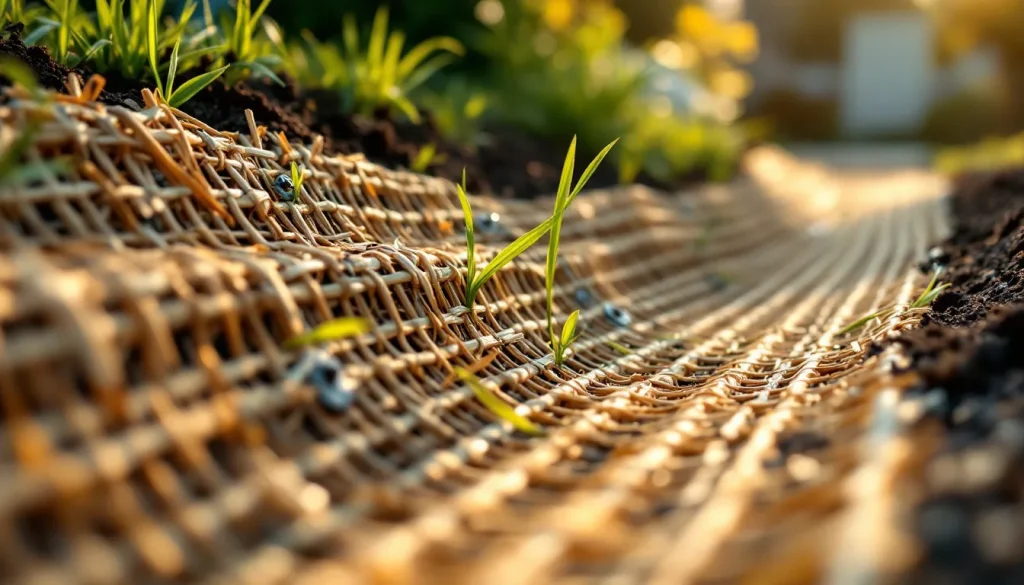
An erosion control blanket is a rolled fabric of natural fiber (straw, jute, burlap, or coconut coir) held together by netting, laid over bare or newly seeded soil to stop rain and runoff from washing it away. It shields soil from raindrop impact, slows surface water, holds moisture for seed germination, and biodegrades as grass roots take over the job of holding the bank.
The blanket buys time. Bare soil on a slope can lose seed and topsoil in a single storm. The blanket keeps seed in place and soil intact for the weeks or months it takes vegetation to establish, which is the permanent fix. For background on why slopes fail in the first place, see our explainer on what erosion is and what drives it.
Erosion control blankets are also called rolled erosion control products (RECPs). Temporary ones biodegrade. Permanent ones, called turf reinforcement mats (TRMs), stay in the soil for the life of the slope.
Erosion control blanket materials: straw, jute, burlap, and coir
The fiber inside an erosion control blanket sets how long it lasts and how steep a slope it can hold. Straw is the cheapest and breaks down fastest. Jute and burlap are open-weave naturals for gentle slopes and quick cover. Coconut coir is the toughest natural fiber and lasts years. Each fiber is sold with single or double netting that changes its strength and price.
| Material | Typical functional life | Best for | Relative cost |
|---|---|---|---|
| Straw blanket | 3 to 12 months | Mild slopes, lawns, seedbed protection | Lowest |
| Jute mesh | 6 to 18 months | Gentle slopes, fast biodegradable cover | Low |
| Burlap (woven jute cloth) | 6 to 12 months | Short-term seed protection, transplant beds | Low |
| Coconut coir (coir or straw/coir blend) | 2 to 4 years | Steep slopes, channels, banks, longer establishment | Higher |
| Synthetic TRM (permanent) | 10+ years (permanent) | Very steep slopes, high-flow channels, spillways | Highest |
Straw blankets
A straw blanket is agricultural straw (often wheat) stitched between netting layers. It is the default budget choice for residential lawns and mild slopes and typically lasts 3 to 12 months, long enough for cool-season or warm-season grass to germinate and root before the straw rots away.
Jute
Jute mesh is an open woven net of natural jute fiber. The open weave lets seedlings push through easily while the fibers slow water. Jute is well suited to gentle slopes and disturbed soil that needs quick, fully biodegradable cover, usually lasting 6 to 18 months.
Burlap
Burlap is a tightly woven jute cloth used for short-term jobs: protecting a freshly seeded bed, holding mulch, or covering transplants. It is inexpensive and fully natural but degrades fast, often within 6 to 12 months, so it is not a steep-slope product.
Coconut/coir blankets
Coconut coir is the strongest natural fiber and resists rot far longer than straw. Coir blankets and engineered straw/coir blends (the kind sold by manufacturers such as Terrafix) handle steep slopes, drainage channels, and stream banks where vegetation needs 2 to 4 years to fully take hold.
Net types: single net vs double net poly netting
Netting holds the fiber together and determines how long and how steep an erosion control blanket performs. Single net straw has fiber stitched to one layer of netting and suits slopes up to about 3:1. Double net straw sandwiches the fiber between two netting layers for added strength on slopes up to roughly 2:1 and in low-flow channels.
Most netting is photodegradable or plastic polypropylene. That netting is the source of the wildlife problem covered later in this guide. Loose-weave and 100% biodegradable netting (jute, cotton, or coir twine) is the safer alternative and is now required in many environmentally sensitive specifications.
Biodegradable vs permanent/synthetic blankets
Biodegradable erosion control blankets (straw, jute, burlap, coir) break down over months to a few years and are designed to disappear once vegetation establishes. Permanent synthetic blankets, called turf reinforcement mats, are non-degrading polypropylene or nylon meshes that stay in place for 10+ years and let grass roots grow through and lock into the matrix.
Pick biodegradable when grass alone will eventually hold the slope. Pick a permanent TRM when flow velocity or steepness exceeds what vegetation can hold on its own, such as drainage channels, spillways, and slopes at 1:1 or steeper.
The selection framework: matching blanket to slope steepness
Match the blanket to your slope ratio and how long vegetation will take to establish. Slope ratio is horizontal run to vertical rise: 3:1 is gentle (3 feet out for every 1 foot down), 2:1 is moderate, and 1:1 is steep. The steeper the slope and the longer grass takes to root, the longer-lived and stronger the blanket you need.
| Slope ratio | Steepness | Recommended blanket | Expected vegetation establishment |
|---|---|---|---|
| 4:1 or flatter | Very gentle | Single net straw or jute | Fast, one season |
| 3:1 | Gentle | Single net straw | One growing season |
| 2:1 | Moderate | Double net straw or straw/coir blend | One to two seasons |
| 1.5:1 | Steep | Coir blanket | Two seasons or more |
| 1:1 or steeper, or any channel | Very steep / flowing water | Permanent synthetic TRM | Reinforced indefinitely |
One practical rule: if you are unsure between two tiers, size up. The cost difference between single and double net straw is small compared with the cost of reseeding a slope that washed out. Grass timing matters too, because the blanket has to outlast germination and rooting. See how long that takes in our guide on how long grass seed takes to grow.
How to install an erosion control blanket
Install an erosion control blanket by preparing and seeding the soil, anchoring the top edge in a trench, rolling the blanket downhill in the direction of water flow, stapling it on a set pattern, and overlapping seams so water runs over the joints, not under them. The whole job is straightforward with a hatchet stapler and biodegradable stakes or steel staples.
- Grade and seed first. Smooth the soil, remove rocks and clumps, then spread seed and starter fertilizer. The blanket goes on top of the seed so it protects germination.
- Dig the top anchor trench. At the crest of the slope, dig a trench about 6 inches deep and 6 inches wide. Bury the top edge of the blanket in it, backfill, and tamp. This is the single most important step, because water that gets under the top edge will peel the whole blanket off.
- Unroll downhill, parallel to water flow. Roll the blanket down the slope, not across it, so runoff travels over the fabric.
- Overlap seams correctly. Overlap side seams 3 to 4 inches and shingle end seams 6 inches so the upslope piece lies over the downslope piece, like roof shingles, so water cannot enter the joint.
- Staple on a pattern. Use 1 to 1.5 staples per square yard on 3:1 slopes and 1.5 to 2 per square yard on 2:1 slopes, with staples every 3 to 4 feet along seams and edges. Use 6-inch staples in firm soil and 8 to 12-inch stakes in loose or sandy soil.
- Finish the toe. Anchor the bottom edge in a smaller trench or with a dense staple row so the lower end stays flat.
Do not stretch the blanket tight. It should sit in full contact with the soil, because air gaps let water channel underneath. Walk the slope after the first heavy rain and re-staple any lifted edges.
Using blankets with seed and on newly seeded areas
Erosion control blankets and seed work together: in almost all cases you seed the soil first, then lay the blanket over the top. The blanket holds the seed against rain and runoff and traps the moisture and warmth that speed germination. Some products come pre-seeded, but separate seeding is more common and gives you control over the mix.
Open-weave blankets (jute, single net straw) let seedlings push through with no trouble. Dense or double-net products are fine over seed too, since young grass threads through the netting. For a newly seeded slope, the blanket can raise establishment success dramatically versus bare seeding, which often washes out in the first storm.
Soil stabilization on slopes, banks, and sediment reduction
On slopes and stream banks, an erosion control blanket reduces sediment loss by shielding soil from raindrop impact and slowing runoff so silt settles instead of washing downstream. On a bank, the blanket holds the face stable while deep-rooted plants establish, and it cuts the muddy sediment that would otherwise foul ditches, ponds, and storm drains.
For drainage features, pairing a blanket with a planted swale or basin works well. Our walkthrough on a backyard rain garden build shows how vegetation plus shaped soil manages runoff at the bottom of a slope.
Construction sites vs residential and bank use
On construction sites, erosion control blankets are usually required by stormwater permits (such as a state SWPPP or NPDES permit) and lean toward double-net straw or synthetic products with documented performance specs. Residential and bank use is voluntary and forgiving: a homeowner stabilizing a backyard slope or a contractor reseeding a customer’s hillside can use single-net straw or coir and skip the engineered paperwork.
The functional difference is documentation and flow. Construction specs cite tested values like C-factor and maximum shear stress. A homeowner mostly needs the right slope-ratio match from the framework above.
The netting safety problem most guides ignore
The plastic netting that holds many straw blankets together (often called C-net or photodegradable poly netting) is a known wildlife trap. Snakes, birds, lizards, and small mammals push into the tight square mesh, cannot back out, and die entangled. Because of this, many state and agency specifications are phasing out plastic netting in favor of loose-weave or 100% biodegradable netting.
If your site has wildlife you care about, or you simply want the safer option, choose a blanket with 100% biodegradable netting: jute, cotton, or coir twine instead of polypropylene. These products are sometimes labeled “wildlife-friendly” or “100% biodegradable” and break down completely with no plastic residue left in the soil.
Disposal matters too. Photodegradable plastic netting only fragments in sunlight, so any netting buried by soil or grass can persist for years as microplastic. Fully biodegradable blankets sidestep this entirely, which is why they are increasingly the default in sensitive watersheds and habitat restoration.
Available sizes and roll dimensions
Erosion control blankets ship in rolls sized for hand-installation. The most common residential and contractor roll is roughly 8 feet wide by 112.5 feet long, covering about 100 square yards (900 square feet). Wider 16-foot rolls exist for large sites and machine installation.
| Roll size | Approximate coverage | Typical use |
|---|---|---|
| 4 ft x 50 ft | ~200 sq ft | Small patches, garden beds |
| 8 ft x 112.5 ft | ~900 sq ft (100 sq yd) | Standard residential and contractor roll |
| 16 ft x 112.5 ft | ~1,800 sq ft | Large slopes, machine install |
Erosion control blanket cost and pricing
Erosion control blanket cost runs roughly $0.10 to $0.60 per square foot for materials, depending on fiber and netting. Single-net straw is cheapest at about $0.10 to $0.20 per square foot, double-net straw runs $0.15 to $0.30, coir blankets run $0.30 to $0.60, and permanent synthetic TRMs run $0.60 to $1.50 or more. Installation labor and staples add to that on contracted jobs.
| Blanket type | Material cost per sq ft | Cost per standard 900 sq ft roll |
|---|---|---|
| Single net straw | $0.10 to $0.20 | ~$90 to $180 |
| Double net straw | $0.15 to $0.30 | ~$135 to $270 |
| Coir / straw-coir blend | $0.30 to $0.60 | ~$270 to $540 |
| Synthetic TRM (permanent) | $0.60 to $1.50+ | ~$540 to $1,350+ |
Sample project: a 1,000 square foot backyard slope at 3:1 using single-net straw at $0.15 per square foot costs about $150 in blanket, plus roughly $30 to $50 in 6-inch staples (about 150 to 200 staples), plus seed and starter fertilizer. Material total: roughly $200 to $250 for a DIY job. The same slope in coir would run $300 to $600 in blanket alone.
The value tradeoff: cheap straw is right when grass establishes in one season and the slope is gentle. Pay up for coir or synthetic only when steepness, water flow, or slow establishment would let a cheap blanket fail before the grass can hold the soil. A washed-out reseed costs far more than the upgrade.
Frequently Asked Questions
What is an erosion control blanket and how does it work?
An erosion control blanket is a rolled mat of natural fiber (straw, jute, burlap, or coir) held by netting and laid over bare or seeded soil. It works by absorbing raindrop impact, slowing runoff, and holding moisture and seed in place. It keeps soil stable for the weeks or months it takes vegetation to root, then biodegrades as the grass takes over.
Which erosion control blanket is best for a steep slope?
For steep slopes, match the blanket to the slope ratio. Use double-net straw on 2:1 slopes, a coconut coir blanket on 1.5:1 slopes, and a permanent synthetic turf reinforcement mat on 1:1 or steeper slopes and in drainage channels. Steeper slopes and slower vegetation establishment both call for a stronger, longer-lasting blanket. When unsure between tiers, size up.
What is the difference between biodegradable and permanent erosion control blankets?
Biodegradable blankets (straw, jute, burlap, coir) break down over months to a few years and are meant to disappear once grass establishes. Permanent blankets, called turf reinforcement mats, are non-degrading synthetic meshes that stay 10+ years and let roots grow through them. Use biodegradable when grass alone will hold the slope, and permanent where steepness or water flow exceeds what vegetation can hold.
How do you install an erosion control blanket?
Grade and seed the soil first, then bury the top edge in a 6-inch trench at the slope crest. Unroll the blanket downhill in the direction of water flow, overlap side seams 3 to 4 inches, and shingle end seams so upslope pieces lie over downslope ones. Staple on a pattern (1 to 2 staples per square yard) and anchor the bottom edge.
How much does an erosion control blanket cost?
Materials run about $0.10 to $0.60 per square foot. Single-net straw is roughly $0.10 to $0.20, double-net straw $0.15 to $0.30, coir $0.30 to $0.60, and permanent synthetic mats $0.60 to $1.50 or more. A standard 900 square foot straw roll runs about $90 to $270. A 1,000 square foot DIY straw slope, including staples, totals roughly $200 to $250.
Do erosion control blankets come with seed, or do you seed separately?
In most cases you seed separately, then lay the blanket over the seed so it protects germination. The blanket holds seed against rain and traps moisture and warmth that speed sprouting. Some pre-seeded products exist, but separate seeding is more common and lets you choose the grass mix. Open-weave and double-net blankets both let seedlings push through.
How long does an erosion control blanket last before it breaks down?
It depends on the fiber and netting. Straw blankets last 3 to 12 months, jute and burlap 6 to 18 months, and coconut coir 2 to 4 years. Permanent synthetic turf reinforcement mats do not break down and last 10+ years. Plastic netting only fragments in sunlight, so choose 100% biodegradable netting to avoid leftover microplastic in the soil.
Single net vs double net straw blanket: which one do I need?
Choose single-net straw for gentle slopes up to about 3:1, such as a typical backyard hillside or seedbed. Choose double-net straw for moderate slopes up to roughly 2:1 and low-flow channels, since the second netting layer adds strength. The price gap is small, so size up to double-net if your slope sits between the two or if heavy runoff is likely.