
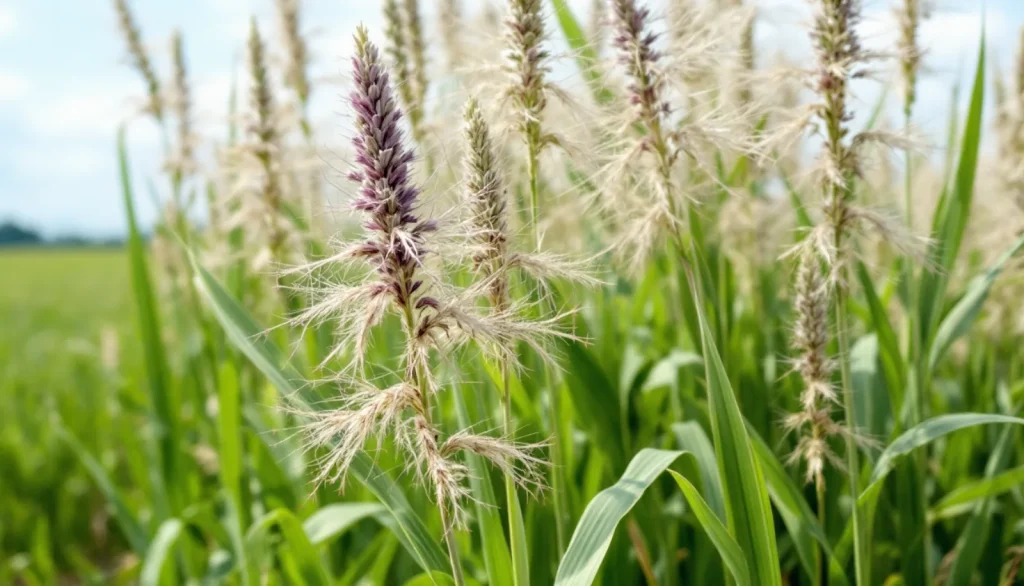
Johnson Grass: ID, Control, and Livestock Toxicity
Johnson grass (Sorghum halepense) is a tall, aggressive perennial grass that spreads by thick underground rhizomes and ranks among the world’s worst weeds. It grows 6 to 7 feet tall, carries a white midrib down each leaf blade, and a single plant can put out 200 to 300 feet of rhizome in one season. It is also a livestock killer: drought-stressed or frosted foliage can produce prussic acid (hydrocyanic acid) and accumulate nitrate, both of which can kill cattle within hours. This guide covers how to identify it, why it is dangerous, and how to control it differently in a lawn bed, a pasture, or along a fence line.
The short version
- Johnson grass is a warm-season perennial (Sorghum halepense), not the annual crabgrass it is often confused with. It returns from rhizomes every year.
- One plant can produce 200 to 300 feet of rhizome per year and tens of thousands of seeds, with seed viable in soil for several years (some sources cite up to 6 to 10 years).
- Drought-stressed or frost-damaged johnson grass can produce prussic acid and accumulate nitrate. Cattle can die within hours.
- Glyphosate at about 2 percent gives a good top-kill but rhizomes often regrow; some populations are glyphosate-resistant. Repeat applications over multiple seasons are normal.
- In ornamental beds, selective grass herbicides like fluazifop (Fusilade, Ornamec) and sethoxydim (Segment) kill johnson grass without harming broadleaf plants.
- It is listed as a noxious or prohibited weed in roughly 19 to 24 states, so control may be a legal requirement, not just a preference.
What does johnson grass look like?
Johnson grass is a coarse perennial grass that stands 6 to 7 feet tall, with a smooth, light-colored midrib running down the center of each leaf blade. Leaf blades reach 6 to 20 inches long. The open, purplish, loosely branched seedhead (panicle) turns reddish to purple-brown at maturity. The give-away is underground: thick, fleshy, segmented rhizomes, often cream-colored with orange or rusty scales.
The white-to-light midvein is the fastest field ID. Run your eye down a single blade. A clear pale rib down the middle, paired with a plant this tall in a leafy clump, is almost always johnson grass rather than a desirable lawn grass.
Stems often show a pink to rusty-red tint near the base. Plants grow in spreading tufts, with new shoots (tillers) sprouting from the crown and from rhizome segments several feet away from the parent plant.
Johnson grass vs crabgrass: how to tell them apart
The core difference is life cycle. Johnson grass is a perennial that returns from rhizomes and survives frost (the top dies back, the roots do not). Crabgrass is an annual that dies completely after the first hard frost and comes back only from seed the next year. Confusing the two leads to the wrong control plan, because pre-emergent timing and herbicide choice differ.
| Trait | Johnson grass | Crabgrass |
|---|---|---|
| Life cycle | Perennial (returns from rhizomes) | Annual (returns only from seed) |
| Spread | Rhizomes plus seed | Seed and surface stolons |
| Height | 6 to 7 feet | Low, sprawling, usually under 2 feet |
| Leaf blade | Wide, smooth, white midrib | Narrow, often slightly hairy, no bold midrib |
| Survives frost | Yes (roots live, top dies back) | No (whole plant dies) |
If you are working on the annual version of this problem, our guide on diagnosing lawn problems and the broader selective vs non-selective herbicide guide cover crabgrass timing and pre-emergent choices.
Why is johnson grass so hard to kill?
Johnson grass is hard to kill because it stores energy in deep, fast-growing rhizomes that a single spray or single mowing rarely reaches. A mature plant can produce 200 to 300 feet of rhizome in one growing season according to University of Florida IFAS Extension. Cutting or spraying the top often leaves the rhizome bank intact, and it resprouts.
Seed adds a second front. The plant is a heavy seeder, and seed can stay viable in the soil for several years (sources cite up to 6 to 10 years), so even after you kill the standing plants, new seedlings appear. This is why one season of control almost never finishes the job.
Some populations are also herbicide-resistant. Mississippi State University Extension reports johnson grass populations in Mississippi that are resistant to glyphosate, so a spray that worked on a neighbor’s stand may underperform on yours.
Is johnson grass dangerous to livestock?
Yes. Johnson grass can poison and kill cattle and other grazing animals through two separate mechanisms: prussic acid (hydrocyanic acid) and nitrate accumulation. Both are triggered by plant stress, mainly drought and frost, and both can kill within hours. This is the part most lawn-focused guides skip, and it is the reason johnson grass is treated as a serious threat on grazed land.
Prussic acid is concentrated in young, fast-growing leaves and the upper leaves of the plant. Oklahoma State University and University of Arkansas extension specialists note that prussic acid forms when plants are stressed by drought or frost, or pushed by heavy nitrogen fertilization. When cattle eat affected foliage, cyanide is released in the rumen, binds hemoglobin, and blocks oxygen delivery to tissues. Death can follow within 15 minutes to a few hours. A diagnostic sign at necropsy is bright cherry-red blood, because the oxygen stays trapped in the bloodstream.
Nitrate toxicity is a related but distinct risk. Drought-stressed johnson grass, especially when fertilized with nitrogen, can accumulate nitrate in the lower stem. Unlike prussic acid, nitrate does not gas off in cured hay, so toxic hay stays toxic. That difference drives the management rules below.
Grazing and haying safety windows
The safe-grazing rules come down to plant height and timing after stress. University of Missouri Extension and Oklahoma State University guidance is to keep animals off stressed sorghum-type forage and to wait specific periods after frost or cutting. The numbers below are general extension guidance; confirm with your local extension office and a veterinarian, because thresholds vary by region and conditions.
| Situation | General guidance | Why |
|---|---|---|
| New regrowth after drought | Do not graze until plants reach about 18 to 24 inches tall | Young leaves hold the most prussic acid |
| After a killing frost | Wait until plants are fully dried down (often 7 days or more); confirm locally | Frost ruptures cells and releases cyanide |
| Cutting for hay | Wait at least 14 days after cutting and baling before feeding | Prussic acid gasses off as hay cures |
| Ensiling (silage) | Wait 60 to 90 days after ensiling begins | Fermentation lowers prussic acid over time |
| Nitrate concern | Test suspect hay before feeding | Nitrate does NOT gas off in cured hay |
Two practical rules from extension specialists reduce risk: never turn hungry cattle onto johnson grass (fill them on hay first and start grazing in late afternoon), and test questionable forage. Veterinarians can treat prussic acid poisoning with intravenous sodium nitrite and sodium thiosulfate, but animals often die before treatment can be given.
How do you get rid of johnson grass?
No single tactic clears johnson grass. Effective control combines a herbicide matched to the setting, repeated treatment over multiple seasons, and a cultural practice (mowing, tillage, or thick competing turf) that drains the rhizome reserves. The right herbicide depends entirely on where the johnson grass is growing, because what is safe in a fence line will kill a lawn or a flower bed.
Choose the control by setting first, then by stand size. The matrix below maps the common situations to the products extension services name. Always read and follow the product label, which is the legal document for any application.
| Setting | Recommended approach | Named options | Notes |
|---|---|---|---|
| Ornamental beds (broadleaf plants) | Selective grass herbicide that spares broadleaves | Fluazifop (Fusilade II, Ornamec); sethoxydim (Segment); clethodim (Envoy Plus) | Will not harm most flowers and shrubs; safe over many ornamentals per label |
| Lawn / turf | Selective sulfonylurea or spot-treat | Sulfosulfuron (Outrider) in tolerant turf; spot glyphosate on isolated clumps | Many lawn grasses are also grasses, so broadcast grass-killers are risky |
| Pasture / hayfield | Selective grass herbicide labeled for forage | Sulfosulfuron (Outrider); nicosulfuron + metsulfuron (Pastora) in bermudagrass | Cattle also graze it down over 2 to 3 seasons |
| Fence lines, gravel, non-crop | Non-selective foliar spray | Glyphosate at about 2 percent | Kills everything it contacts; expect rhizome regrowth and repeats |
| Prevention in clean beds | Pre-emergent on weed-free soil | Prodiamine (Barricade); pendimethalin (Pendulum); indaziflam (Specticle) | Stops seedlings; does not touch existing rhizomes |
The step-by-step control plan
For most homeowners and small landowners, the sequence below gives the best odds. It works because it hits the rhizome reserves when the plant is moving sugars downward (late summer and fall), then catches the survivors.
- Identify correctly. Confirm the white midrib, the 6-to-7-foot height, and the segmented rhizomes so you are not treating crabgrass.
- Time it. Treat actively growing plants 18 inches tall through early flowering, ideally in late summer to fall when sugars move to the rhizomes.
- Match the herbicide to the setting using the matrix above. Spot-treat isolated clumps rather than broadcasting where possible.
- Mow or till between treatments. Repeated close mowing kills seedlings and weakens rhizomes; fall tillage 3 to 5 inches deep brings rhizomes to the surface to dry or freeze.
- Re-treat the regrowth. Plan on two or more applications per season and repeat for two to three years.
- Prevent re-seeding. Keep desirable turf thick, and apply a pre-emergent to clean beds to stop new seedlings.
On a lawn, the cheapest long-term defense is density. A thick, well-fed stand crowds out johnson grass seedlings before they establish rhizomes. Our seasonal grass maintenance schedule and fertilizer selection guide cover the feeding and mowing that build that density.
Does mowing or pulling kill johnson grass?
Mowing and hand-pulling weaken johnson grass but rarely kill an established stand on their own. Repeated close mowing kills seedlings, prevents seed production, and slowly drains rhizome reserves, but mature plants regrow from the rhizome bank. Hand-pulling works only in small gardens and only if you remove the whole rhizome, not just snap off the top.
The reason is energy storage. The rhizome network holds enough carbohydrate to push new shoots after each cut. Mowing helps most as a partner to herbicide: it reduces seed and forces the plant to spend reserves regrowing, so the next herbicide pass lands on a weaker plant. Tillage that severs and surfaces rhizomes (about 3 to 5 inches deep in fall) adds a mechanical hit, though shallow tillage that only chops rhizomes can spread the problem.
How fast does johnson grass spread?
Very fast. A single johnson grass plant can extend 200 to 300 feet of rhizome in one growing season, and the plant is a prolific seeder, with reports of more than 80,000 seeds from one plant in a season. That dual spread (rhizomes plus seed) is why it forms dense colonies and outcompetes crops and native plants.
This growth rate is also why it makes the world’s worst-weeds lists and why USDA estimates tie it to large annual crop losses, with reported yield reductions exceeding 30 percent in corn and 40 percent in soybeans under infestation. On managed lawns and landscapes, the same vigor means a few uncontrolled clumps this year can become a yard-wide problem next year.
Is johnson grass legally a noxious weed?
In many states, yes. Johnson grass is listed as a noxious or prohibited weed in roughly 19 to 24 states, which can make control a legal obligation for landowners, not just a choice. It is present in nearly every state. Where it is listed, county or state weed authorities may require you to control stands, especially along roadsides and field margins.
Check your state department of agriculture or county extension office for your local status before planning control, because listing affects what you must do and which restricted herbicides you may use. For the broader regulatory picture on pesticide use and applicator licensing, see our overview at lawn and landscape regulatory, and if a stand is beyond DIY scale, our guide on finding a reputable landscaper covers how to vet a licensed applicator.
When to call a pro
Call a licensed applicator when the stand covers a large area, sits in a grazed pasture where livestock toxicity is in play, or has survived two or more seasons of your own treatment (a possible sign of glyphosate resistance). Pros can access restricted-use products, calibrate rates, and rotate herbicide modes of action to beat resistance.
For grazed land, loop in your local extension office and a veterinarian before and during control, because killing a stressed stand can briefly raise toxicity in the dying foliage. The combination of a forage-safe herbicide, a grazing plan, and forage testing is the safe path on pasture.
Last reviewed: June 2026
HMNDP Editorial Team, reviewed by HMNDP turf and horticulture editors.
Sources and references
- University of Florida IFAS Extension, Biology and Management of Johnsongrass (EP620/ENH1356): https://ask.ifas.ufl.edu/publication/EP620
- UC Statewide IPM Program, Johnsongrass: https://ipm.ucanr.edu/PMG/WEEDS/johnsongrass.html
- Virginia Tech Weed Identification, Sorghum halepense: https://weedid.cals.vt.edu/profile/261/
- University of Georgia Extension, Johnsongrass Control in Pastures (B1513): https://fieldreport.caes.uga.edu/publications/B1513/johnsongrass-control-in-pastures-roadsides-and-noncropland-areas/
- University of Missouri Extension, Prussic Acid Poisoning: https://extension.missouri.edu/news/cattle-producers-urged-to-watch-for-prussic-acid-poisoning
- Oklahoma State University Extension, Prussic Acid Toxicity: https://extension.okstate.edu/articles/2022/prussic-acid-toxicity.html
- University of Arkansas Cooperative Extension, Nitrate Poisoning in Cattle: https://www.uaex.uada.edu/farm-ranch/animals-forages/beef-cattle/nitrate-poisoning-in-cattle.aspx
- Mississippi State University Extension, Johnsongrass: https://extension.msstate.edu/publications/johnsongrass
- Missouri Department of Conservation, Johnson Grass Control: https://mdc.mo.gov/trees-plants/invasive-plants/johnson-grass-control
Frequently asked questions
What does johnson grass look like?
Johnson grass is a coarse perennial grass 6 to 7 feet tall with a smooth, light-colored midrib down each leaf blade and an open, purplish, loosely branched seedhead that turns reddish-brown. Underground it has thick, fleshy, segmented rhizomes, often cream-colored with orange scales. The white midvein on a tall, clumping plant is the fastest field ID.
Is johnson grass the same as crabgrass?
No. Johnson grass is a perennial that returns from rhizomes and survives frost, with the top dying back while the roots live. Crabgrass is an annual that dies completely after a hard frost and returns only from seed. Johnson grass is also far taller (6 to 7 feet) with a bold white midrib, while crabgrass is low and sprawling with narrower leaves.
Will glyphosate kill johnson grass?
Glyphosate at about 2 percent gives a good top-kill, with best results on plants 18 inches tall through early flowering. But established rhizomes often regrow after a top-kill, so repeat sprays over two to three seasons are normal. Some johnson grass populations, including in Mississippi, are glyphosate-resistant, so it may underperform on certain stands.
Is johnson grass poisonous to cattle?
Yes. Drought-stressed or frost-damaged johnson grass can produce prussic acid (hydrocyanic acid) and accumulate nitrate, both of which can kill cattle within minutes to hours. Cyanide blocks oxygen delivery in the blood, leaving bright cherry-red blood at necropsy. Keep hungry animals off it, avoid young regrowth and frosted plants, and test suspect hay before feeding.
Does mowing kill johnson grass?
Mowing rarely kills established johnson grass on its own because the rhizomes hold enough energy to resprout. Repeated close mowing does kill seedlings, prevent seed production, and slowly weaken rhizomes. Mowing works best as a partner to herbicide: it drains reserves so the next herbicide pass lands on a weaker plant. Fall tillage 3 to 5 inches deep adds a mechanical hit.
How fast does johnson grass spread?
Very fast. A single plant can extend 200 to 300 feet of rhizome in one growing season and produce more than 80,000 seeds, with seed staying viable in soil for several years (sources cite up to 6 to 10 years). This dual spread by rhizome and seed is why it forms dense colonies and ranks among the world’s worst weeds.
How do you kill johnson grass in a flower bed?
Use a selective grass herbicide that spares broadleaf plants. University of Florida IFAS Extension names fluazifop (Fusilade II, Ornamec) and sethoxydim (Segment) as good options, with clethodim (Envoy Plus) as another choice. These kill grasses without harming most flowers and shrubs labeled as tolerant. Read the label for your specific ornamental species, and expect to re-treat regrowth.
Is johnson grass a noxious weed?
In many states, yes. Johnson grass is listed as a noxious or prohibited weed in roughly 19 to 24 states and is present in nearly every state. Where it is listed, county or state weed authorities may require landowners to control stands, especially along roadsides and field margins. Check your state department of agriculture or county extension office for your local status.