
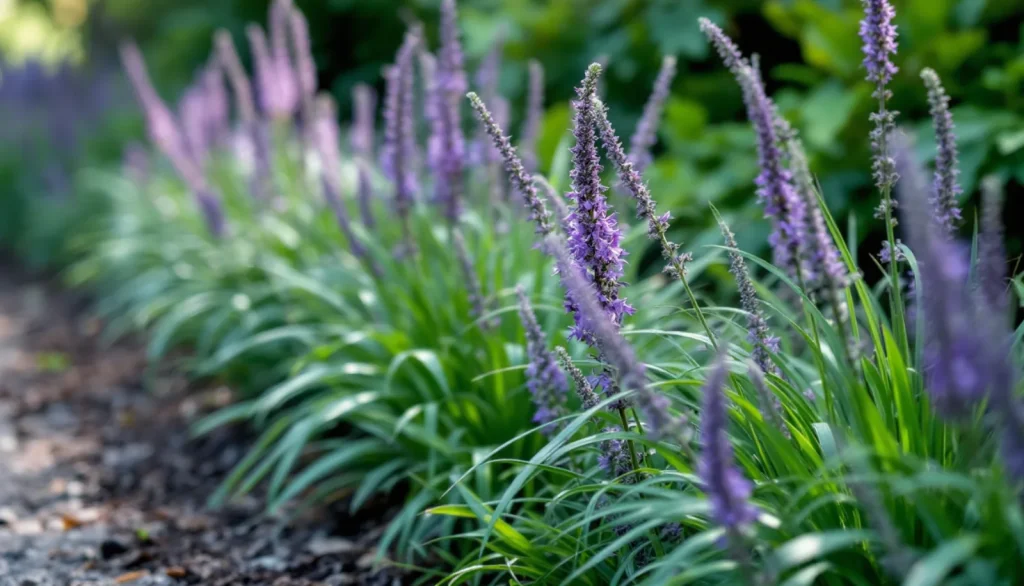
Monkey Grass: Liriope Care, vs Mondo, and Invasive Note
Monkey grass is the common name for Liriope, a shade-tolerant evergreen groundcover in the lily family (Asparagaceae), not a true turf grass. Two species do almost all the work in American yards: clumping Liriope muscari, which stays where you plant it, and spreading Liriope spicata, which runs by underground rhizomes and is listed as invasive in several states. People also call the lookalike Ophiopogon “mondo grass,” and the two get mixed up constantly. This guide sorts out which one you have, how to grow and cut it back, and when to skip it for a native plant.
What is monkey grass?
Monkey grass is a grass-like perennial groundcover in the genus Liriope, hardy in USDA zones 5 to 10, growing 10 to 18 inches tall with strappy arching leaves. It is not a grass at all. It belongs to the lily family and blooms with upright lavender, purple, or white flower spikes from July to August, followed by bluish-black, berry-like fruit. Clemson Cooperative Extension and the University of Florida IFAS both classify it as an ornamental groundcover used for edging, mass plantings, and erosion control.
Gardeners use it for three jobs: a tidy border along walks and beds, a low-care groundcover under trees where grass will not grow, and slope stabilization. It tolerates deep shade to full sun, though it flowers most freely with some sun and scorches pale in harsh all-day exposure. If you are filling shade where turf keeps failing, compare it against the options in our guide to growing grass in shade before you commit.
Spreading vs clumping monkey grass: which do you have?
The two monkey grasses look similar but behave nothing alike. Liriope muscari is the clumping form: it forms tight mounds 12 to 18 inches wide and stays put. Liriope spicata is the spreading (creeping) form: it travels by rhizomes and will colonize a wide area, which makes it useful for erosion control and a problem in mixed beds. The fastest field test is leaf width. Spicata leaves run about 1/4 inch wide; muscari leaves are wider, 3/8 to 1/2 inch.
| Trait | Clumping (Liriope muscari) | Spreading (Liriope spicata) |
|---|---|---|
| Growth habit | Tight clumps, stays put | Runs by rhizomes, colonizes |
| Leaf width | 3/8 to 1/2 inch | About 1/4 inch (narrower) |
| Height | 10 to 18 inches | 10 to 15 inches |
| Flower color | Lavender, purple, white | Pale lavender to white |
| Best use | Borders, edging, mass plantings | Slopes, erosion control, large fill |
| Invasive risk | Low, behaves in beds | High, escapes into wild areas |
The buying rule: if you want a defined edge or a plant that respects its neighbors, buy named clumping cultivars of Liriope muscari such as ‘Big Blue’ (12 to 15 inches), ‘Variegata,’ ‘Monroe’s White’ for shade, or sun-tolerant ‘Silvery Sunproof.’ Reach for L. spicata only when you want fast coverage of a bank and you can contain it with hard edges like a sidewalk or steel edging.
Monkey grass vs mondo grass: the Liriope-vs-Ophiopogon table
Monkey grass (Liriope) and mondo grass (Ophiopogon japonicus) are different genera that get sold under overlapping names. The reliable tell is the flowers and berries: liriope holds its flower spikes above the foliage and sets black fruit, while mondo grass hides its blooms down inside the leaves and sets blue fruit. Mondo grass is also generally shorter and finer. Both are in the lily family, and botanists sometimes use the informal label “liriopogon” because the two are so often confused.
| Trait | Monkey grass (Liriope muscari) | Mondo grass (Ophiopogon japonicus) |
|---|---|---|
| Genus / family | Liriope, lily family | Ophiopogon, lily family |
| Typical height | 10 to 18 inches | 8 to 16 inches (dwarf 2 to 4 inches) |
| Leaf width | 3/8 to 1/2 inch | About 1/2 inch, finer texture |
| Flower position | Spikes held above leaves | Blooms hidden inside foliage |
| Flower color | Lavender, purple, white | White, tinged lilac |
| Berry color | Bluish-black to black | Blue |
| Hardiness | USDA zones 5 to 10 | USDA zones 7 to 10 (less cold-hardy) |
For low edging and tight spaces, dwarf mondo grass (Ophiopogon japonicus ‘Nana’, roughly 2 to 4 inches) reads almost like a moss carpet, while black mondo grass (Ophiopogon planiscapus ‘Nigrescens’, about 6 inches) brings near-black foliage no liriope offers. If you want a taller mounded border with summer flower spikes, liriope wins. Walter Reeves, the Georgia extension horticulturist, advises against planting the two together because they compete and blur; keep each in its own semi-shaded patch.
How to plant and grow monkey grass
Plant monkey grass in spring before summer heat, spacing clumps 8 to 12 inches apart in moist, well-drained soil, in part shade to sun. Tighter 8-inch spacing gives a fast, dense border; 12 inches or more lets each clump show its arching form. It adapts to sand or clay, tolerates drought once established, and crowds out most weeds, which is a big part of why landscapers over-plant it.
- Choose your species first: clumping L. muscari for borders and beds, spreading L. spicata only for contained slopes.
- Loosen the bed and work in compost; liriope is not fussy but establishes faster in friable soil.
- Space clumps 8 to 12 inches apart, set crowns at soil level, and water in.
- Mulch lightly to hold moisture and water consistently the first season until roots take hold.
- After establishment, water deeply but infrequently; the plant is heat and drought tolerant.
Feeding is minimal. A single spring application of a balanced fertilizer is plenty for most beds; over-feeding pushes soft growth prone to scale and disease. If you want to match rates to your soil rather than guess, see our NPK fertilizer guide. Watch for anthracnose (reddish-brown leaf spots) and crown rot from Phytophthora palmivora, both reduced by clearing old foliage each year. Scale insects cause yellowing and are managed with cutback plus horticultural oil.
When and how to cut back monkey grass
Cut monkey grass back once a year in late winter, January through March, before new green sprouts emerge. The cleanest method is a lawn mower set to its highest setting, run across a bed of clumps to shear off tattered old foliage. This removes winter-burned leaves, prevents anthracnose carryover, and lets fresh growth come in clean. The hard rule: look inside the clumps first.
If you see new green shoots already pushing, stop. Do not mow over them. Switch to hedge shears or hand pruners and cut just above the emerging growth instead, because a mower will scalp the tender shoots and leave the planting ragged all season. In coastal zones cut as early as late January; upstate and in colder regions wait until mid-February to March. Cutting back is cosmetic and sanitary; it does not control a spreading L. spicata problem, which is a separate job below.
Is monkey grass invasive, and what should you plant instead?
The clumping form (Liriope muscari) is well behaved, but the spreading form (Liriope spicata) is invasive and is flagged by several state and local authorities, including the Tennessee Invasive Plant Council, the Maryland Invasive Species Council, and jurisdictions in northern Virginia such as Arlington and Alexandria. Indiana extension programs have featured it during Invasive Species Awareness Week. It escapes gardens by rhizome and seed and crowds out native groundcovers that wildlife depend on.
If you are in one of those regions, or simply want to plant responsibly, native sedges give the same fine-textured, shade-tolerant look without the spread. The Northern Virginia Bird Alliance and South Carolina Native Plant Society recommend Carex species (Carex laxiculmis, Carex blanda, Carex jamesii) as direct liriope swaps, plus blue-eyed grass (Sisyrinchium angustifolium) and golden Alexander (Zizia aurea) for sunnier spots. For a fuller list of low-water, climate-fit choices, see our drought-tolerant lawn alternatives.
To remove an existing patch of spreading liriope, expect a multi-season job. Cutting alone will not stop it. Dig out as much rhizome mass as you can, then spot-treat regrowth with a glyphosate product applied in spring, summer, and fall; running liriope is tenacious and usually takes more than one round. A region-specific contractor who knows local invasive rules can help; our directory of vetted landscape contractors is the place to start.
Quick answers on monkey grass
Yes, monkey grass comes back every year. It is a hardy evergreen to semi-evergreen perennial in zones 5 to 10, staying green through winter in warm regions and dying back to the crown where winters are hard, then returning in spring. It tolerates drought, shade, and poor soil, which is why it is one of the most planted edging groundcovers in the South. Just match the species to the job: clumping to behave, spreading only where you can contain it.
Last reviewed: June 2026
HMNDP Editorial Team, reviewed by HMNDP turf and horticulture editors.
Frequently asked questions
Is monkey grass invasive?
Clumping monkey grass (Liriope muscari) stays put and is not considered invasive. The spreading form, Liriope spicata, is invasive: it runs by rhizomes and is flagged by the Tennessee Invasive Plant Council, the Maryland Invasive Species Council, and northern Virginia jurisdictions. Plant the clumping form, or use native Carex sedges instead, where escape into wild areas is a concern.
What is the difference between monkey grass and mondo grass?
Monkey grass is Liriope and mondo grass is Ophiopogon, two different genera in the lily family. Liriope holds its flower spikes above the leaves and sets black berries, while mondo grass hides its blooms inside the foliage and sets blue berries. Liriope is usually taller (10 to 18 inches) and mondo grass is shorter and finer, with dwarf forms near 2 to 4 inches.
Does monkey grass come back every year?
Yes. Monkey grass is a hardy evergreen to semi-evergreen perennial in USDA zones 5 to 10. It stays green through winter in warm regions and dies back to the crown where winters are hard, returning in spring. It tolerates drought, shade, and poor soil, which is why it is one of the most planted edging groundcovers in the South.
How far apart do you plant monkey grass?
Space monkey grass clumps 8 to 12 inches apart in moist, well-drained soil, planting in spring before summer heat. Tighter 8-inch spacing creates a fast, dense border or mass planting, while 12 inches or more lets each clump show its arching, weeping form. Set crowns at soil level, water in, and mulch lightly to hold moisture during establishment.
When should you cut back monkey grass?
Cut monkey grass back once a year in late winter, January through March, before new green sprouts emerge. Run a lawn mower at its highest setting across the bed to shear off old foliage. Always look inside the clumps first: if new shoots are already pushing, switch to hedge shears and cut just above them so a mower does not scalp the tender growth.
How do I tell spreading from clumping monkey grass?
Check leaf width and growth habit. Clumping Liriope muscari has wider leaves, 3/8 to 1/2 inch, and forms tight mounds 12 to 18 inches wide that stay put. Spreading Liriope spicata has narrower leaves, about 1/4 inch, and travels by underground rhizomes to colonize wide areas. Buy named muscari cultivars like ‘Big Blue’ for borders that behave.
Will monkey grass choke out weeds?
Yes. Once established, monkey grass forms a dense mat that crowds out most weeds, which is a main reason landscapers plant it heavily for edging and groundcover. It is heat and drought tolerant and adapts to sand or clay. The trade-off is that the spreading form can also crowd out desirable plants and native groundcovers, so contain it with hard edges.
How do you get rid of spreading monkey grass?
Removing Liriope spicata is a multi-season job because cutting alone will not stop it. Dig out as much rhizome mass as possible, then spot-treat regrowth with a glyphosate product applied in spring, summer, and fall. Running liriope is tenacious and usually needs more than one round of treatment, so plan to monitor and re-treat for at least two seasons.