
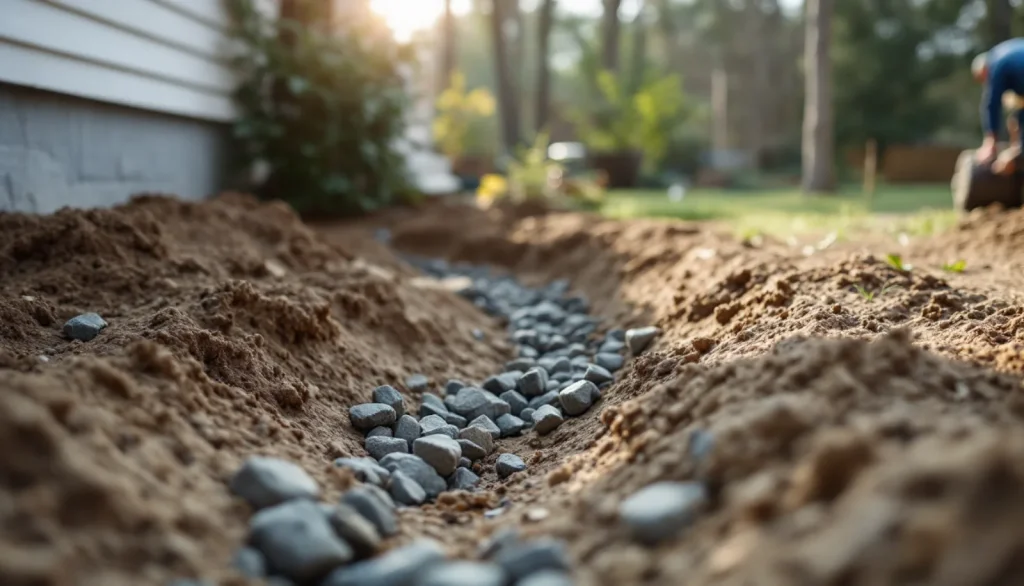
How to Level a Yard: Regrade for Drainage and Settling
To level a yard for drainage, you regrade the soil so it falls at least 6 inches over the first 10 feet away from the foundation, roughly a 5 percent slope, which is the standard written into International Residential Code section R401.3. This is a soil and grading project, not a cosmetic one. It fixes settling, standing water, and water running toward the house. Filling shallow dips in an otherwise flat lawn is a different job done with a topdressing mix and a lawn leveling rake. This guide covers the grading project: how to read the slope, how much fill to move, the exact process, and the point where you stop and call a pro.
Leveling the lawn surface vs. regrading for drainage
These are two different projects that get filed under the same search. Surface leveling smooths small bumps and dips in a lawn that already drains correctly, using a quarter-inch to half-inch topdressing layer and a leveling rake. Regrading reshapes the whole slope of the ground to move water away from the house, and it can require moving cubic yards of fill dirt. Pick the wrong one and you either waste a weekend on sand that washes away, or you leave water pooling against your foundation.
| Factor | Surface leveling (topdressing) | Regrading for drainage |
|---|---|---|
| Problem it fixes | Minor bumps, mower scalping, shallow dips under 2 inches | Water pooling, settling near foundation, slope toward house |
| Material | Topdressing mix (2 parts topsoil, 2 parts sand, 1 part compost) | Fill dirt for the base, topsoil for the final 4 inches |
| Main tool | Lawn leveling rake, push broom | Stakes and string, line or laser level, shovel, tamper or compactor |
| Typical DIY cost | Under $100 in materials | $120 to $500 DIY; $1,000 to $3,000 hired near a foundation |
| When to hire out | Rarely needed | Drop over 2 feet, slope runs toward the house, or basement is involved |
How much slope does a yard need to drain?
The yard should drop a minimum of 6 inches over the first 10 feet measured out from the foundation wall. That figure comes from International Residential Code R401.3, which requires lots to be graded so surface water drains away from foundation walls. Six inches over 10 feet works out to about a 5 percent grade, steep enough to move water but gentle enough to mow.
Hard surfaces follow a looser rule. The same code section requires impervious surfaces like patios and driveways within 10 feet of the foundation to slope at least 2 percent away from the building. Where a property line, retaining wall, or existing slope makes 6 inches of fall impossible, R401.3 allows a swale (a shallow drainage channel) or a drain to carry water away instead.
One more rule sets your finished height: keep the final soil grade at least 4 inches below the top of the foundation and below the bottom of any siding. That visible band of foundation protects the siding from moisture and lets you watch how water behaves after a rain.
What you need before you start
Grading is a measuring job before it is a digging job. The tools below let you set a target slope and hit it, which is the difference between fixing drainage and accidentally making it worse. Buy fill dirt for building up the base and topsoil for the top 4 inches where grass roots live; the two are not interchangeable.
- Wooden stakes and mason’s string to mark your grade lines.
- A line level (clips to the string) or a laser level for larger yards.
- A tape measure and a 4-foot carpenter’s level for short checks.
- A round-point shovel, a steel bow rake, and a wheelbarrow.
- A hand tamper or a rented plate compactor (roughly $80 a day) to firm each layer.
- Fill dirt at $15 to $30 per cubic yard plus delivery, and bagged or bulk topsoil for the finish layer.
- Grass seed or sod to lock the new grade in place immediately after.
How to level a yard for drainage, step by step
Work in dry weather so the soil compacts instead of smearing, and reseed or sod the same day you finish so rain does not erode the fresh grade. The cut-and-fill method below is the same approach grading contractors use: take soil off the high spots and move it to the low spots until the slope runs away from the house.
- Watch the water first. After a rain or with a hose running, note where water pools and which way it flows. If it runs toward the house or sits within 10 feet of the wall, that area is your priority.
- Mark a reference point at the foundation. Drive a stake against the foundation and a second stake 10 feet out. Tie string between them and use the line level to set the string dead level, then measure down from the string at the outer stake. You want the ground there sitting at least 6 inches lower than at the wall.
- Stake out grade lines across the area. Set stakes in a grid every few feet, run string between them, and mark your target height on each stake so the lines step down 6 inches per 10 feet away from the house.
- Strip and save the topsoil. Remove the top 3 to 4 inches of topsoil from the work area and pile it on a tarp. You will put it back as the final layer.
- Cut and fill the subsoil. Shovel soil from the high spots into the low spots, checking against your string lines as you go. Add fill dirt where you need more volume than the cut provides.
- Compact in layers. Tamp or run the plate compactor after every 2 to 3 inches of fill. Loose fill settles later and undoes your slope, so this step is not optional.
- Re-measure the grade. Recheck every string line. Confirm the 6-inch drop over 10 feet near the foundation and a steady fall across the rest of the area, with no new low spots that trap water.
- Spread the topsoil back. Rake the saved topsoil over the compacted base in an even 3 to 4 inch layer, keeping the slope you just set. Confirm the finished grade stays 4 inches below the siding.
- Seed or sod and water in. Plant grass immediately to hold the soil, then water lightly. Check the work during the next real rain and touch up any spot that still pools.
Fixing settling and low spots next to the foundation
Settling near the foundation is the most common reason a yard starts draining toward the house instead of away. Backfill placed during construction compacts over the first several years, leaving a trough along the wall that channels roof runoff straight into the foundation. The fix is to fill that trough with compactable fill dirt, not loose topsoil or mulch, and rebuild the slope to the 6-inch-over-10-feet target.
Pair the regrade with downspout extensions. Carrying gutter water at least 6 feet past the house keeps the volume that caused the settling from landing on your fresh grade. For a low corner that stays wet even after grading, a swale or a rain garden routes the water somewhere useful instead of toward the slab. Our walkthrough on building a backyard rain garden covers that option, and if the wet spot is killing grass, the diagnosis tree in our guide to brown patches in a lawn helps separate a drainage problem from a disease problem.
DIY or hire a pro? Where the line sits
You can grade small areas and shallow settling yourself. The common DIY ceiling is a height difference between about 3 inches and 2 feet across the work area, on ground that already slopes generally away from the house. Past that, or any time the yard slopes toward the foundation or a basement is in play, the job needs heavy equipment and someone who reads grade for a living.
| Scope | Method | Typical cost |
|---|---|---|
| Shallow settling, small low spots, drop under 2 feet | DIY hand grading | $120 to $500 in materials and rental |
| Regrade around a foundation | Pro with skid-steer or mini excavator | $1,000 to $3,000 |
| Level a sloped yard or remove a hill | Pro cut-and-fill, hauled dirt | $1,000 to $5,000 |
| Large or complex grading job | Pro, multi-day, engineered drainage | $2,000 to $15,000 |
Grading crews charge roughly $100 to $300 per hour for a machine and operator, and they use the same cut-and-fill technique on a larger scale, finishing with sod or seed to hold the soil. Before you hire, read our checklist on how to find a reputable landscaper so you can tell a grading specialist from a mow-and-blow crew taking on work outside their lane.
When to level a yard
Grade and level in dry weather, in spring or early fall, when the soil is firm enough to compact and grass can establish before heat or frost. Avoid working soil that is still soggy from snowmelt or spring rain; wet soil smears and will not hold a compacted slope. Correcting the grade during a dry stretch, then checking the result during the next rain, is the pattern that holds up.
Cool-season grasses in the north establish best from late summer into early fall, while warm-season grasses in the south take off as they break dormancy in spring. Time the reseeding step to your grass type so the new grade roots in fast. Our year-round grass maintenance schedule breaks down the right window by cool-season versus warm-season turf.
Last reviewed: June 2026. HMNDP Editorial Team, reviewed by HMNDP turf and horticulture editors.
Frequently asked questions
Can I level my yard myself?
Yes, for small jobs. The common DIY ceiling is a height difference between about 3 inches and 2 feet across the area, on ground that already slopes generally away from the house. Past that, or if the yard slopes toward the foundation or a basement is involved, hire a pro with grading equipment. Always work in dry weather so the soil compacts.
What slope should a yard have away from the foundation?
The ground should drop at least 6 inches over the first 10 feet measured out from the foundation, about a 5 percent grade. That figure comes from International Residential Code R401.3. Hard surfaces like patios within 10 feet need at least a 2 percent slope. Keep the finished soil grade 4 inches below the siding.
What is the best time to level a yard?
Level and grade in dry weather, in spring or early fall, when soil is firm enough to compact and grass can establish. Avoid soil still soggy from snowmelt or spring rain, since wet soil smears and will not hold a compacted slope. Correct the grade during a dry stretch, then check it during the next rain.
What kind of soil should I use to level a yard?
It depends on the job. For regrading, use compactable fill dirt to build the base, then replace the top 3 to 4 inches with topsoil where grass roots live. For surface leveling of an already-draining lawn, use a topdressing mix of 2 parts topsoil, 2 parts sand, and 1 part compost. Never fill a settled trough with loose mulch.
How much does it cost to level a yard?
DIY hand grading runs $120 to $500 in materials and rental. Regrading around a foundation by a pro typically costs $1,000 to $3,000. Leveling a sloped yard or removing a hill runs $1,000 to $5,000, and large complex jobs can reach $15,000. Grading crews charge roughly $100 to $300 per hour for a machine and operator.
How do I fix low spots or settling next to the foundation?
Fill the trough with compactable fill dirt, not loose topsoil or mulch, and rebuild the slope to drop 6 inches over 10 feet. Settling happens as construction backfill compacts over the first few years. Pair the regrade with downspout extensions that carry water at least 6 feet from the house, and add a swale for any corner that stays wet.
What is the difference between leveling a lawn and grading a yard?
Leveling smooths small bumps in a lawn that already drains, using a quarter-inch to half-inch topdressing layer and a leveling rake. Grading reshapes the slope of the ground to move water away from the house and can require moving cubic yards of fill dirt. Grading fixes drainage and settling; leveling only fixes the surface.