
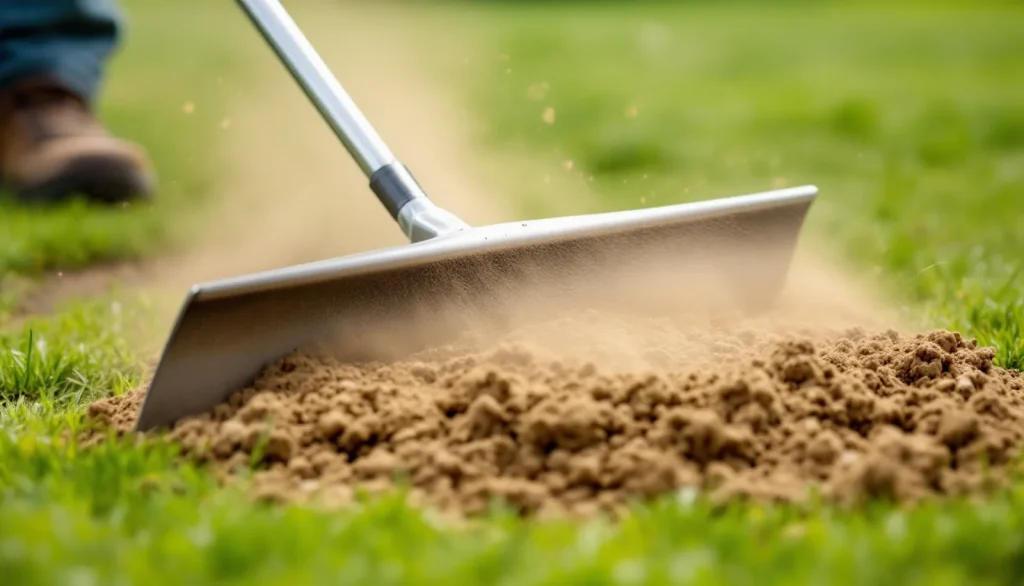
Lawn Leveling Rake: Rake vs Drag Mat vs Lute
A lawn leveling rake is a wide, flat-headed tool (commonly 30 to 48 inches across) built to push and pull a thin topdressing layer of sand or sand-soil mix into the low spots of an established lawn. It is not a dethatching rake and not a soil-grading landscape rake. This guide covers the three tools homeowners confuse (leveling rake, drag mat, and lute), the specs that actually matter, steel versus aluminum, when renting beats buying, and the exact topdressing steps that keep your grass alive while you flatten it.
What a lawn leveling rake actually does
A lawn leveling rake spreads topdressing material across living turf in a thin, even layer so low spots fill and high spots blend, without burying the grass. The working edge is a flat steel or aluminum plate, not tines. You drag and push it back and forth over piles of sand or sand-soil mix until the material disappears into the grass canopy. It works on an existing lawn, not on bare graded dirt.
This is the distinction most buyers miss. A bow rake or tined landscape rake moves bulk soil and combs debris before seeding. A leveling rake (also sold as a “lawn leveler” or “levelawn”) only smooths a shallow topdressing pass over grass that is already growing. Using the wrong one is the most common reason a leveling project tears up the turf.
Lawn leveling rake vs drag mat vs lute
The three tools split by job: a leveling rake moves material into low spots and finishes small to mid-size lawns, a drag mat blends and smooths an already-spread layer across large open turf, and a lute (a UK and sports-turf term for the same flat-plate idea) works material on both the push and pull stroke. Pick by lawn size and how precisely you need to fill specific dips.
| Tool | Best for | How it works | Lawn size | Typical price |
|---|---|---|---|---|
| Leveling rake (lawn leveler / levelawn) | Filling specific low spots, light to moderate topdressing | Flat plate pushed and pulled by hand; rides highs, drops material into lows | Up to ~5,000 sq ft | About $45 to $100 |
| Drag mat | Whole-lawn smoothing after material is spread | Flexible steel mesh dragged behind you or a mower; blends but does not move bulk material into holes | Large open lawns, 5,000 sq ft and up | About $60 to $180 |
| Lute | Working sand on both strokes; sports and golf turf | Stiff metal grate or plate; deep frame moves soil forward and back | Any, common on pro turf | About $80 to $214 |
| Tow-behind / drag lawn level | One-time large-acreage leveling | Pulled by tractor, ATV, or mower | Acreage | Often a rental, ~$500 for a weekend machine setup |
For most suburban yards the answer is a leveling rake plus, if the lawn is large and open, a drag mat to finish. Pros doing whole sports fields reach for a lute or a tow-behind unit. The lawn forums (thelawnforum.com and lawnsite.com) repeat the same workflow: pull material from highs into lows with the rake, then finish the surface with the drag.
What size leveling rake do I need?
A 30 to 36 inch head fits most residential lawns. A 30 inch head is the maneuverable sweet spot for yards with flower beds, trees, and tight corners. A 36 inch head covers ground faster on open turf. Go to 48 inches only for large, obstacle-free lawns above roughly 5,000 square feet where speed matters more than control around edges.
Head depth (front to back) matters as much as width. A deeper plate holds and carries more material per pass, which speeds up filling deep low spots. Most popular models run a 36 inch wide by 10 inch deep plate, for example the VEVOR 36 by 10 inch unit sold at The Home Depot and Lowe’s, and the Landzie 36 inch rake that breaks into two pieces for storage. Wider is not always better: a 48 inch head loaded with wet sand gets heavy and hard to steer.
Steel vs aluminum: which head holds up?
Steel heads (usually powder-coated) resist twisting under heavy wet sand-soil blends and survive rocky, abrasive jobs, so they suit pros and one-time deep leveling. Aluminum heads weigh far less, which saves your back over a long session and resists rust, but they can flex under the heaviest loads. For a homeowner doing a yard once every few years, either works; match the metal to how heavy your mix is.
Two build details separate a good rake from a cheap one. First, a fully welded frame (not bolted) stops the head from racking when you load it with a 70/30 sand-soil mix. Second, an “anti-flip” or hinged head that stays flat against the ground keeps the plate from digging into hollows and pulling material back out. Handles run 60 to 78 inches; a longer handle (72 inches and up) lets taller users work upright instead of stooping.
When to rent vs buy a lawn leveler
Buy a leveling rake if you will topdress your own lawn more than once, which most people do because heavy clay and freeze-thaw heaving bring low spots back. At roughly $45 to $100, a hand rake pays for itself against a single hired job. Rent a tow-behind drag level only for a one-time, large-acreage flattening, where a weekend machine setup can run around $500 and storing equipment makes no sense.
The math is simple. A hand leveling rake is cheap enough to own outright and stores in a garage. Powered grading and tow-behind equipment is what you rent, because maintenance and storage cost more than the few hours you use it. Equipment rental counters at Lowe’s and independent rental yards (for example Pasco Rentals) carry grader and drag rakes for the acreage jobs. A DIY plate (a length of PVC or a 2×4 with metal mesh) can work for a one-off, but it lacks the flat hinged head, so it tends to gouge.
How to level low spots with a topdressing mix
Level an established lawn by spreading a thin sand or sand-soil mix over the low areas, then working it flat with the rake until grass blades poke through. Never bury more than half the grass height in one pass. The hard rule from turf programs: keep each application to a quarter inch up to half an inch deep, and leave at least a third of the grass blade exposed to sunlight, or the turf suffocates.
- Mow short (often called scalping) to roughly 0.5 to 1.5 inches so you can see every dip and the mix reaches the soil. Take care not to damage the grass crowns.
- Dethatch and core aerate if there is heavy thatch. Aeration lets the sand and compost drop into the root zone instead of sitting on top.
- Lightly water so the soil is moist, not muddy. Moist ground settles material more evenly.
- Mix your topdressing. A common blend is about 70 percent washed or masonry sand to 30 percent screened topsoil or fine compost; effective ratios range from 50/50 to 80/20. Sand improves drainage and does not shrink; the soil-compost fraction feeds the grass and helps seed-to-soil contact if you are overseeding.
- Dump small piles onto the lowest spots first, not a blanket layer across the whole lawn. Keep depth under a half inch.
- Work the piles with the leveling rake, pushing and pulling until the mix disappears into the canopy and only the grass tips show. The hinged head keeps the plate flat.
- Water thoroughly right after. This washes the particles down to the soil and settles the surface.
- Wait, then repeat. Apply multiple thin passes over a season or across years rather than one heavy layer. Most lawns only need leveling once every few years.
Timing matters and splits by grass type. Topdress warm-season grasses (Bermudagrass, Zoysia, Centipede, St. Augustine) during active growth, roughly after spring green-up through August. Cool-season grasses level best in early spring or fall when they are growing hard. Coverage runs about one cubic yard of mix per 500 to 1,000 square feet depending on how uneven the lawn is. Need to size your order first? Our guide on how to measure lawn square footage gets the math right.
Do you really need a dedicated leveling rake?
Most homeowners only level once every few years, so a dedicated rake is worth it mainly if you have real low spots, scalping, or standing water, not a couple of minor bumps. A standard garden rake or push broom can spread a light topdressing in a pinch, but neither holds a flat reference, so the finish is uneven. For filling defined dips and channels, the dedicated flat head does a noticeably better job.
If your lawn problem is bare or sunken patches rather than a wavy surface, leveling alone will not fix it. Pair topdressing with reseeding using our walkthrough on how to make grass grow in bare spots. If the issue is poor drainage or chronically wet low areas, leveling helps but you may also want the drainage fixes in our brown patches in lawn diagnosis guide.
Where a leveling rake fits in your lawn program
Leveling is a renovation task, not a routine one. Slot it into spring or fall renovation alongside aeration and overseeding, not into your weekly mow. The same wide flat head that levels topdressing also smooths fresh soil over newly seeded ground, so it earns its garage space during any reseed or renovation. For everything else, leave the surface alone.
For the full seasonal picture of when to aerate, feed, and renovate by grass type, see our year-round grass maintenance schedule. If you would rather hand the whole renovation to a crew, our checklist on how to find a reputable landscaper covers what to verify before you sign.
Last reviewed: June 2026
HMNDP Editorial Team, reviewed by HMNDP turf and horticulture editors.
Frequently asked questions
What is a lawn leveling rake used for?
A lawn leveling rake spreads a thin topdressing layer of sand or sand-soil mix across living turf so low spots fill and high spots blend. The flat steel or aluminum plate (not tines) rides the highs and drops material into the lows. It works on an established lawn, not on bare graded dirt, and is also sold as a lawn leveler or levelawn.
What size lawn leveling rake do I need?
A 30 to 36 inch head fits most residential lawns. A 30 inch head maneuvers around beds, trees, and corners; a 36 inch head covers open turf faster. Step up to 48 inches only for large, obstacle-free lawns above roughly 5,000 square feet, where speed matters more than control. A loaded 48 inch head gets heavy and harder to steer.
Lawn leveling rake vs drag mat: which is better?
They do different jobs. A leveling rake moves material into specific low spots and finishes small to mid-size lawns up to about 5,000 square feet. A drag mat is flexible steel mesh that blends and smooths an already-spread layer across large open turf but does not move bulk material into holes. Many homeowners use the rake first, then the drag mat to finish.
Should I get a steel or aluminum leveling rake?
Steel heads (usually powder-coated) resist twisting under heavy wet sand-soil blends and survive rocky jobs, so they suit pros and one-time deep leveling. Aluminum heads weigh much less, save your back over a long session, and resist rust, but can flex under the heaviest loads. For a homeowner leveling once every few years, either works; match the metal to how heavy your mix is.
How do you use a lawn leveling rake to level low spots?
Mow short, water lightly, then dump small piles of a 70/30 sand-soil mix onto the lowest spots only. Push and pull the rake until the mix disappears into the grass canopy and only the tips show. Keep each pass a quarter to half inch deep, never burying more than half the grass height, then water thoroughly. Repeat in thin passes over time rather than one heavy layer.
Is a lawn leveling rake worth it, or can I use a regular rake?
It is worth it if you have real low spots, scalping, or standing water. A standard garden rake or push broom can spread a light topdressing in a pinch, but neither holds a flat reference, so the finish stays uneven. The dedicated flat hinged head fills defined dips and channels far more evenly. Most lawns only need leveling once every few years.
Should I rent or buy a lawn leveling rake?
Buy a hand leveling rake if you will topdress your own lawn more than once; at roughly $45 to $100 it pays for itself against a single hired job and stores in a garage. Rent only a tow-behind drag level for a one-time, large-acreage flattening, where a weekend machine setup can run around $500 and storing equipment makes no sense.
What sand or mix goes under a leveling rake?
A common topdressing blend is about 70 percent washed or masonry sand to 30 percent screened topsoil or fine compost, though effective ratios range from 50/50 to 80/20. Sand improves drainage and does not shrink; the soil-compost fraction feeds the grass and helps seed-to-soil contact if overseeding. Avoid pure sand, which can dry out and stress the lawn.