
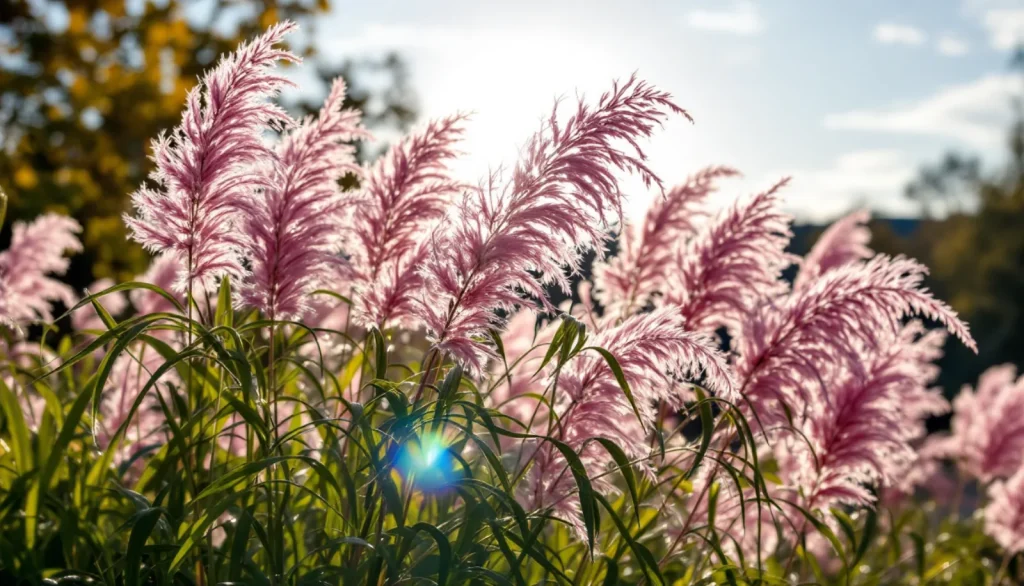
Pink Muhly Grass: How to Grow, Bloom, and Care
Pink muhly grass (Muhlenbergia capillaris) is a clump-forming native ornamental grass that throws a cloud of pink to purple plumes in fall, then holds that display for 4 to 8 weeks. It grows 2 to 3 feet tall and wide, blooms best in full sun on lean, well-drained soil, and asks for almost nothing once it is established. This guide covers where it grows, how to get the plume display every year, why a plant sometimes refuses to bloom, and how the pink form compares to its white cousin.
Is pink muhly grass native, and where does it grow?
Pink muhly grass is native to the United States, with its core range across the Southeastern states and scattered populations into the South Midwest and parts of New England. The University of Florida IFAS Extension lists it as a Florida native found in pine flatwoods, coastal uplands, and along highway corridors. It is not invasive: the plant spreads by fibrous roots roughly a foot deep, with no rhizomes or stolons, so a clump stays where you put it.
Hardiness is the one spec sources disagree on. You will see USDA Zones 5-9, 5-10, and 7-10 cited for the same plant. The honest read: it is fully reliable in Zones 6 through 9, often survives Zone 5 with a sharp-draining site and winter protection, and runs the warm edge into Zone 10 in Florida and the Gulf Coast. Verify your zone against the 2023 USDA Plant Hardiness Zone Map at https://planthardiness.ars.usda.gov before buying.
The short-season caveat matters more than the cold-survival number. In colder zones with a brief growing season, the plant needs full sun to push a strong bloom, because it sets plumes late and a short autumn can cut the display short. Gardeners in Zones 8 and warmer get the most dependable show.
How do you grow pink muhly grass?
Plant pink muhly grass in full sun on well-drained soil, space clumps 2 to 3 feet apart, water through the first season, then leave it mostly alone. Drainage is the single biggest factor in whether the plant lives. It tolerates sandy, loam, rocky, and even clay soils as long as water moves through, and it prefers slightly acidic ground around pH 5.8 to 6.8. Standing water causes root rot.
- Pick a site that gets at least 6 hours of direct sun, ideally 6 to 8. Partial shade still blooms but thins the display.
- Dig a hole as deep as the root ball and twice as wide. Do not amend lean soil with rich compost; this grass blooms better on poor ground.
- Set the crown at grade, backfill, and firm the soil. Space additional plants 2 to 3 feet on center, or 18 to 24 inches for faster fill in mass plantings.
- Water deeply at planting and keep the soil lightly moist (not wet) through the first growing season while roots establish.
- From year two on, water only when the top 2 inches of soil are dry. Established plants are highly drought tolerant.
Skip heavy feeding. Pink muhly grass needs no supplemental fertilizer to bloom, and excess nitrogen produces floppy, weak growth and fewer plumes. If your soil is very poor, a light slow-release feed in early spring is the most you should give it.
When do the pink plumes appear, and how long do they last?
The pink plume display opens in late summer to fall, typically September through November depending on region, and holds for 4 to 8 weeks. The flower stalks rise above the 2 to 3 foot foliage mound and can reach about 5 feet, carrying fine, airy panicles that read as a pink to purplish haze. The effect is why the plant carries the nickname cotton candy grass, and it is strongest when the clumps are backlit by low morning or evening sun.
The plumes fade to a buff tan and persist into winter, giving structure and movement in the cold months. Leave them standing. They feed songbirds and small mammals through fall and winter and add texture to the dormant garden, so cutting too early sacrifices the second half of the plant’s seasonal value.
Why is my pink muhly grass not blooming?
A pink muhly grass that will not bloom almost always traces to one of four causes: too little sun, too much water, compacted or rich soil, or cutting the plant back during the growing season. Diagnose against the table below, fix the cause, and the plant usually blooms the following fall. Plants grown from seed also need a full season to establish and typically bloom in their second year, so a young plant may simply need time.
| Symptom | Likely cause | Fix |
|---|---|---|
| Healthy leaves, few or no plumes | Less than 6 hours of direct sun | Move or transplant to a full-sun spot in early spring |
| Yellowing, mushy crown, no bloom | Overwatering or poor drainage | Cut watering; relocate to sharp-draining soil if the site stays wet |
| Tall, floppy, leafy, sparse plumes | Too much nitrogen or rich soil | Stop fertilizing; lean soil produces more flowers |
| Stunted, slow, weak bloom | Compacted soil | Loosen the bed or move to looser ground; avoid foot traffic |
| No bloom on a new plant | First-year establishment | Wait; seed-grown plants usually bloom in year two |
| Cut hard in summer, no rebloom | Pruned during active growth | Only cut back in late winter or early spring, never mid-season |
How and when do you cut back pink muhly grass?
Cut pink muhly grass back to 2 to 4 inches above the ground once a year, in late winter or early spring, just before new growth pushes. The University of Florida IFAS Extension and most regional extension guidance agree on the dormant-season timing. Pruning while the plant is actively growing in summer or fall removes the developing flower stalks and is the most common self-inflicted reason for a no-bloom season.
Divide clumps every 3 to 5 years in early spring to keep them vigorous, or when the center of a mature clump dies out. Lift the clump, cut the root mass into 2 to 4 sections with a sharp spade or pruning saw, and replant the healthy outer pieces. Division is also the cleanest way to propagate, since seed-grown plants can vary and take longer to flower.
Pink muhly versus white muhly: which should you plant?
Pink muhly and white muhly are the same species displayed in two colors. Pink is the standard form (sometimes sold as Regal Mist), and a white-flowering form (often sold as White Cloud) produces bright white plumes on an otherwise identical plant. Growing requirements, size, zones, and care are the same. The choice is purely a design call: pink reads as a haze and pops against green or burgundy companions, while white glows at dusk and pairs cleanly with formal evergreen backdrops.
| Trait | Pink muhly (Regal Mist) | White muhly (White Cloud) |
|---|---|---|
| Plume color | Pink to purplish haze | Bright white |
| Mound size | 2-3 ft tall and wide | 2-3 ft tall and wide |
| Bloom time | Late summer to fall | Late summer to fall |
| USDA zones | 6-9 reliable | 6-9 reliable |
| Best with | Burgundy sedum, asters, dark foliage | Evergreen hedges, formal beds, dusk light |
For pairings, both forms work in groups of 3 to 5 with rudbeckia (black-eyed Susan), echinacea (purple coneflower), perovskia (Russian sage), and autumn sedum. Mass plantings read as a single field of color, which is the look that made the plant a fixture in commercial and roadside landscapes.
Common problems and pests
Pink muhly grass has few problems, and most trace back to drainage. The main disease is tar spot, a fungus that shows as dark spots on the blades; full sun and good airflow prevent it, so avoid crowding plants in damp shade. Rust and occasional aphids show up rarely and seldom warrant treatment. The plant is deer resistant and rabbit resistant once established, though young seedlings are vulnerable, and it is not listed as toxic to dogs by the ASPCA.
Because it is drought tolerant and adapted to lean ground, pink muhly grass is a strong fit for low-water and xeriscape designs. If you are converting thirsty turf to lower-water plantings, see our guide to drought-tolerant lawn alternatives, and for placing it in a wider planting plan, our yard design guide covers layout and plant selection. Gardeners working shaded sites should note that this is a sun plant; for those spots, read how to get grass to grow in shade instead.
Quick reference: pink muhly grass at a glance
| Spec | Detail |
|---|---|
| Botanical name | Muhlenbergia capillaris |
| Native status | US native (Southeast, into South Midwest and New England; Florida native per UF IFAS) |
| USDA zones | 6-9 reliable; 5 with protection; to 10 in the South |
| Mature size | 2-3 ft mound; flower stalks to about 5 ft |
| Light | Full sun, 6-8 hours; tolerates light shade with fewer blooms |
| Soil | Well-drained, lean, slightly acidic (pH 5.8-6.8) |
| Water | Moist first season, then drought tolerant |
| Fertilizer | None to minimal; excess nitrogen cuts blooms |
| Bloom | Pink to purple plumes, late summer to fall, lasting 4-8 weeks |
| Cutback | 2-4 in. in late winter or early spring only |
| Spacing | 2-3 ft on center (18-24 in. for faster fill) |
Last reviewed: June 2026
HMNDP Editorial Team, reviewed by HMNDP turf and horticulture editors.
Frequently asked questions
What zone does pink muhly grass grow in?
Pink muhly grass (Muhlenbergia capillaris) is reliably hardy in USDA Zones 6 through 9. It often survives Zone 5 on sharp-draining soil with winter protection and runs into Zone 10 along the Gulf Coast and in Florida. Sources cite ranges of 5-9, 5-10, and 7-10 for the same plant, so verify your zone on the 2023 USDA Plant Hardiness Zone Map before buying.
Is pink muhly grass native?
Yes. Pink muhly grass is native to the United States, with its core range across the Southeastern states and scattered populations into the South Midwest and New England. The University of Florida IFAS Extension lists it as a Florida native of pine flatwoods and coastal uplands. It is not invasive: it grows from fibrous roots about a foot deep with no rhizomes or stolons, so clumps stay put.
Why is my pink muhly grass not blooming?
A pink muhly that will not bloom usually has one of four problems: less than 6 hours of sun, too much water or poor drainage, rich or compacted soil, or being cut back during the growing season. Fix the cause and it typically blooms the next fall. Seed-grown plants also need a full season to establish and usually bloom in their second year.
When does pink muhly grass bloom and how long do the plumes last?
Pink muhly grass blooms in late summer to fall, roughly September through November depending on region, and the plumes hold for 4 to 8 weeks. Flower stalks rise above the foliage to about 5 feet and read as a pink to purplish haze, brightest when backlit by low sun. The plumes fade to buff tan and persist into winter, so leave them standing.
When should you cut back pink muhly grass?
Cut pink muhly grass back to 2 to 4 inches above the ground once a year, in late winter or early spring, just before new growth pushes. Never prune during active summer or fall growth, since that removes the developing flower stalks and is a common cause of a no-bloom season. Divide clumps every 3 to 5 years in early spring to keep them vigorous.
How far apart do you plant pink muhly grass?
Space pink muhly grass 2 to 3 feet on center, since each clump matures to 2 to 3 feet tall and wide. For faster fill in mass plantings, set them 18 to 24 inches apart, though closer spacing means earlier division and less airflow. Wider spacing of 3 to 4 feet gives a more meadow-like look with better air circulation and less disease pressure.
What is the difference between pink and white muhly grass?
Pink and white muhly are the same species in two colors. Pink is the standard form, sometimes sold as Regal Mist, and a white-flowering form, often sold as White Cloud, has bright white plumes on an otherwise identical plant. Size, zones, bloom time, and care are the same, so the choice is a design call: pink reads as a haze, white glows at dusk.
Does pink muhly grass need full sun?
Yes, pink muhly grass blooms best in full sun, at least 6 hours and ideally 6 to 8 hours of direct light daily. It tolerates light shade but produces a thinner plume display. Full sun matters most in colder zones with short growing seasons, where the plant needs the extra light and heat to set a strong fall bloom before frost ends the display.