
Perennial Flowers: Best Picks by Sun, Shade, and Zone
Perennial flowers come back every year, and the right pick depends on two things you can check in five minutes: your USDA hardiness zone and how many hours of direct sun the bed gets. Most online lists only cover full sun and quote pre-2023 zone numbers. This guide gives you one comparison table across full sun, part shade, and shade, the corrected zones from the November 2023 USDA map, plus the bloom-succession plan and spacing math that keeps a bed in color from April to frost.
The short version
- Match the plant’s listed zone range to your zone. If your zone number falls inside the plant’s range, it survives winter and returns. Find your zone by ZIP at planthardiness.ars.usda.gov.
- The 2023 USDA map shifted about half the country to a warmer half-zone, so a plant rated to zone 6 that failed for your neighbor a decade ago may now be in range. Check the current map, not an old plant tag.
- Full sun means 6 or more hours of direct sun. Part sun or part shade means 3 to 6 hours. Full shade means under 3 hours. The wrong light is the most common reason a perennial sulks.
- Longest-blooming picks: ‘Rozanne’ hardy geranium and catmint can flower 3 months or more; most perennials bloom 2 to 4 weeks, which is why you stagger bloom times.
- Best planting windows are spring and early fall. Fall planting wants 6 weeks of warm soil before the first hard frost so roots establish.
How to pick perennial flowers for your zone and sun
Start with two numbers: your USDA hardiness zone and the hours of direct sun your bed gets. Match both to the plant’s published range and you have a perennial that survives winter and blooms on schedule. Everything else (color, height, deadheading) is a refinement on top of those two checks.
Your hardiness zone is set by the average annual extreme minimum winter temperature, mapped in 10-degree Fahrenheit zones from 1 (coldest) to 13 (warmest), each split into an ‘a’ and ‘b’ half-zone. Find yours by ZIP code at the USDA map (planthardiness.ars.usda.gov). A plant rated “zones 5 to 9” survives the winters of zone 5 and warmer, so if you garden in zone 6 or 7 it returns reliably.
The November 2023 USDA update matters here. It was the first revision in 11 years, and roughly half of the United States moved up to a warmer half-zone. A perennial that was borderline for your area on an older tag may now sit comfortably inside your range. Use the current map rather than a printed tag that could predate the revision.
Sun is the second filter. Full sun is 6 or more hours of direct light per day. Part sun and part shade both describe 3 to 6 hours, with part sun leaning toward afternoon exposure and part shade toward morning. Full shade is under 3 hours of direct sun, usually dappled light under a tree. Planting a sun lover in shade gives you foliage and few flowers; planting a shade plant in full sun scorches the leaves.
Perennial flowers comparison table: zone, sun, bloom time, height
This table covers the workhorses for each light level, with the zone ranges reflecting current nursery and extension data. “Bloom time” assumes a temperate climate; warmer zones run earlier, colder zones later. Heights are mature ranges across common varieties, so check the specific cultivar tag before you space them.
| Perennial (botanical name) | Sun | USDA zones | Bloom time | Mature height |
|---|---|---|---|---|
| Coneflower (Echinacea purpurea) | Full sun | 3 to 9 | Midsummer to fall | 1 to 5 ft |
| Black-eyed Susan (Rudbeckia) | Full sun | 3 to 9 | Summer to fall | 1 to 9 ft |
| Daylily (Hemerocallis) | Full sun to part shade | 3 to 9 | Late spring to fall | 1 to 6 ft |
| Catmint (Nepeta) | Full sun | 3 to 9 | Late spring to fall | 1 to 4 ft |
| Coreopsis / tickseed (Coreopsis) | Full sun | 3 to 9 | Early summer to fall | 1 to 4 ft |
| Salvia (Salvia) | Full sun | 4 to 9 | Late spring to fall | 1 to 5 ft |
| Yarrow (Achillea millefolium) | Full sun | 3 to 9 | Summer | 1 to 3 ft |
| Hardy geranium ‘Rozanne’ | Full sun to part shade | 5 to 8 | Early summer to frost | 1.5 to 2 ft |
| Blazing star (Liatris) | Full sun | 3 to 9 | Summer to fall | 1 to 5 ft |
| Shasta daisy (Leucanthemum x superbum) | Full sun | 5 to 9 | Early summer to fall | 1 to 4 ft |
| Russian sage (Salvia yangii) | Full sun | 4 to 9 | Early summer to fall | 2 to 4 ft |
| Stonecrop / sedum (Hylotelephium) | Full sun | 3 to 9 | Late summer to fall | 0.25 to 3 ft |
| Garden phlox (Phlox paniculata) | Full sun to part shade | 4 to 8 | Mid to late summer | 2 to 4 ft |
| Peony (Paeonia) | Full sun | 3 to 8 | Late spring | 2 to 3 ft |
| Bee balm (Monarda) | Full sun to part shade | 3 to 9 | Mid to late summer | 1 to 4 ft |
| Astilbe (Astilbe) | Part shade to shade | 3 to 9 | Early to midsummer | 1 to 4 ft |
| Hosta (Hosta) | Part shade to shade | 3 to 9 | Summer (foliage plant) | 0.5 to 3 ft |
| Bleeding heart (Lamprocapnos spectabilis) | Part shade to shade | 3 to 9 | Spring | 1.5 to 3 ft |
| Hellebore / Lenten rose (Helleborus) | Part shade to shade | 4 to 9 | Late winter to spring | 1 to 1.5 ft |
Best perennial flowers for full sun
For beds with 6 or more hours of direct sun, the reliable performers are coneflower, black-eyed Susan, daylily, catmint, coreopsis, salvia, and yarrow. Most are native or naturalized, drought tolerant once established, and hardy across a wide zone band (commonly zones 3 to 9), which makes them low-risk first picks.
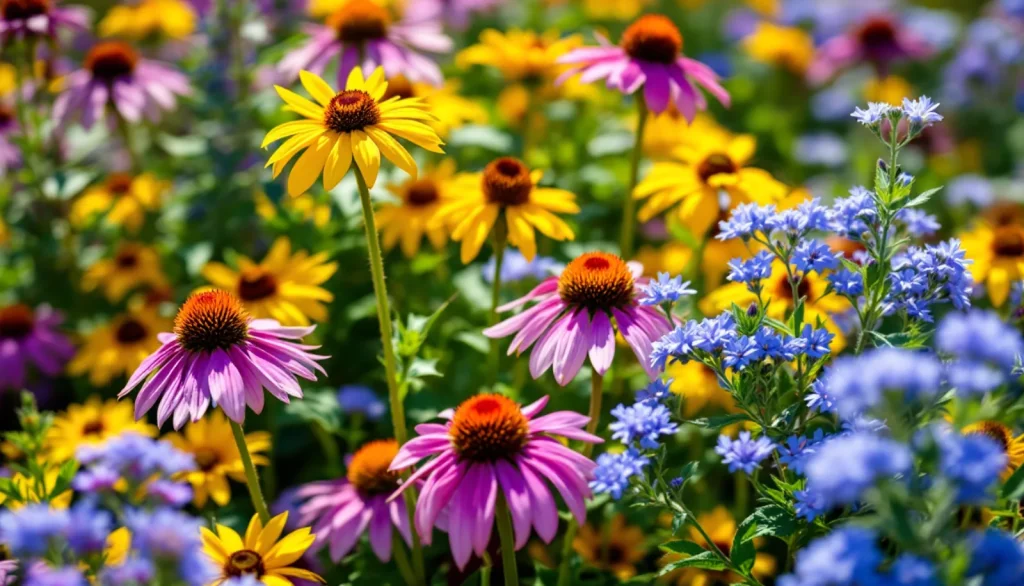
Coneflower (Echinacea purpurea, zones 3 to 9) blooms midsummer into fall and keeps flowering until frost when deadheaded. Black-eyed Susan (Rudbeckia, zones 3 to 9) carries gold daisies from summer to first frost. Both are North American prairie natives and feed pollinators, so they earn their bed space twice.
Daylily (Hemerocallis, zones 3 to 9) is the workhorse: it tolerates full sun to part shade and shrugs off neglect. Catmint (Nepeta, zones 3 to 9) and coreopsis (zones 3 to 9) are the long-bloomers in this group; cut catmint back hard after the first flush and it reblooms until frost. For hot, dry, sun-baked spots, lavender (Lavandula, zones 5 to 9) and Russian sage (zones 4 to 9) want sharp drainage and pay you back with months of silver-blue color.
Best perennial flowers for shade and part shade
Shade beds (under 6 hours of direct sun) call for a different roster: astilbe, hosta, bleeding heart, and hellebore. These are the four most-recommended shade perennials, and most are hardy zones 3 to 9, so they cover nearly every US garden. They lean on foliage and structure as much as bloom, which is what keeps a low-light bed looking full.
Astilbe (zones 3 to 9) sends up feathery pink, red, white, or lavender plumes over fern-like foliage in early to midsummer, and it wants consistently moist soil. Hosta (zones 3 to 9) is grown mainly for its leaves, but its summer flower spikes draw bees and hummingbirds.
Bleeding heart (Lamprocapnos spectabilis, zones 3 to 9) hangs arching rows of heart-shaped spring flowers, then often goes dormant in summer heat, which is why gardeners pair it with hosta and astilbe that fill the gap as it fades. Hellebore (Helleborus, zones 4 to 9) is the earliest of the group, opening in late winter to early spring with glossy, near-evergreen foliage that holds the bed together year round.
What are the longest-blooming perennial flowers?
Most perennials flower for only 2 to 4 weeks, so the long-bloomers are worth knowing. The standouts are ‘Rozanne’ hardy geranium and catmint, which can flower for 3 months or more, plus coneflower, coreopsis ‘Moonbeam’, and betony ‘Hummelo’. These carry a bed while shorter-blooming neighbors come and go.
‘Rozanne’ hardy geranium (zones 5 to 8) holds violet-blue flowers from early summer to frost, more than 3 months in many gardens. Catmint blooms for nearly two months in late spring, then reblooms until frost after a hard cutback. Coneflower and ‘Moonbeam’ coreopsis both run early summer into mid-autumn when deadheaded regularly.
Use these as the backbone of a bed and surround them with shorter-blooming perennials for variety. A handful of long-bloomers means the bed never goes fully bare between flushes.
How to plan a bed that blooms all season
Because most perennials bloom for only a few weeks, season-long color comes from succession: pick plants that flower in spring, summer, and fall so something is always opening as something else fades. This is the design principle the Missouri Botanical Garden uses in its season-long bloom guides, and it is the difference between a bed that peaks for two weeks and one that holds color from April to frost.
Build the layers in this order:
- Anchor with one or two long-bloomers (‘Rozanne’ geranium, catmint, coneflower) that flower for months and tie the bed together.
- Add a spring layer (peony, bleeding heart, hellebore for shade) so the bed opens before summer plants wake.
- Add a summer layer (daylily, Shasta daisy, salvia, yarrow) for the main flush.
- Add a late-season layer (sedum, garden phlox, Russian sage, aster) so color runs into fall.
- Repeat each plant in groups of 3 or 5 rather than singles. Odd-numbered drifts read as intentional and let each variety carry its own moment.
For the planting layout principles behind this (scale, repetition, and how perennials sit against hardscape), see our 2026 yard design guide.
When and how far apart to plant perennials
Plant perennials in spring or early fall, not midsummer. Spacing follows the plant’s mature width, which is on the tag, usually 12 to 24 inches for mid-size perennials. Plant too close and you trade air circulation (and invite disease) for a full look that crowds out in two seasons.
Spring planting gives roots a full season before winter. Fall planting works if you get plants in 6 weeks or more before the first hard frost, while the soil is still warm, so roots establish before the ground freezes. A general rule: set spring and early-summer bloomers in fall, and set late-summer and fall bloomers in spring.
For spacing, read the mature spread on the tag and space plants center to center at roughly that distance. A perennial tagged “18 to 24 inch spread” goes about 18 to 24 inches from its neighbor. Closer spacing fills faster but needs dividing sooner; wider spacing looks sparse the first year but ages better.
Keeping perennials blooming: deadheading and feeding
Deadheading (snipping spent flowers before they set seed) is the single biggest lever on rebloom for many perennials. Coneflower, coreopsis, salvia, and catmint all push more flowers when you remove the faded ones, because the plant redirects energy from seed-making back into bloom. Cut just above the next set of leaves or buds.
Feed lightly. Most established perennials need far less fertilizer than annuals or turf, and over-feeding produces floppy foliage at the expense of flowers. A spring topdress of compost plus a balanced slow-release feed is enough for the season in most soils. Match the nutrient ratio to the plant rather than reaching for lawn fertilizer; our outdoor plant fertilizer guide walks through NPK selection for perennials, trees, and shrubs.
Water deeply and less often once plants are established, the same logic that applies to turf. Drip irrigation delivers water to the root zone and keeps foliage dry, which cuts disease pressure in dense beds; see our walkthrough on installing drip irrigation in garden beds.
Drought, hot zones, and low-water perennials
In hot, dry regions and during water restrictions, lean on perennials that thrive on less: yarrow, Russian sage, lavender, sedum, coreopsis, and blanket flower (Gaillardia) are drought tolerant once established and hold up in full sun. They want sharp drainage more than rich soil, and many fail in wet feet rather than dry.
These low-water perennials pair well with the broader move away from thirsty turf in arid metros. If you are converting lawn to planted beds, our guide to drought-tolerant lawn alternatives covers the conversion math and the state rebate programs that may offset the cost. In desert metros like Phoenix, local extension plant lists matter more than national charts; our Phoenix landscape guide covers desert-adapted choices.
Related coverage
- Yard design in 2026: layout, plant selection, hardscape
- Outdoor plant fertilizer: NPK for perennials and shrubs
- Drought-tolerant lawn alternatives and rebates
- How to install drip irrigation in beds
Last reviewed: June 2026
HMNDP Editorial Team, reviewed by HMNDP turf and horticulture editors.
Frequently asked questions
What are the best perennial flowers?
For full sun, coneflower, black-eyed Susan, daylily, catmint, coreopsis, salvia, and yarrow are reliable across zones 3 to 9. For shade, astilbe, hosta, bleeding heart, and hellebore lead. Best means matched to your zone and sun, so confirm both before buying; a top-rated plant in the wrong light or zone still fails.
What is the longest blooming perennial?
‘Rozanne’ hardy geranium and catmint top the list, flowering for 3 months or more in many gardens. Most perennials bloom only 2 to 4 weeks. Coneflower and coreopsis ‘Moonbeam’ also run early summer into mid-autumn when deadheaded regularly. Use these long-bloomers as the backbone of a bed and surround them with shorter-blooming plants.
When should you plant perennials?
Plant in spring or early fall, not midsummer. Spring planting gives roots a full season before winter. Fall planting works if you get plants in 6 weeks or more before the first hard frost, while soil is still warm. A general rule: plant spring bloomers in fall and late-summer bloomers in spring.
What perennials come back every year?
Perennials return yearly when they are hardy in your USDA zone, meaning your zone number falls inside the plant’s listed range. Coneflower, daylily, hosta, sedum, and peony are dependable returners across most US zones. Annuals die after one season; perennials regrow from the same roots. Check the zone on the tag against your ZIP at planthardiness.ars.usda.gov.
How far apart do you plant perennials?
Space perennials at roughly their mature width, usually 12 to 24 inches center to center for mid-size plants, listed on the tag as spread. Closer spacing fills faster but crowds and needs dividing sooner. Wider spacing looks sparse the first year but ages better and keeps air moving, which lowers disease in dense beds.
How do I find my USDA hardiness zone for perennials?
Enter your ZIP code at planthardiness.ars.usda.gov. Your zone is set by the average annual extreme minimum winter temperature, in zones 1 (coldest) to 13 (warmest), each split into ‘a’ and ‘b’ halves. The November 2023 map moved about half the US to a warmer half-zone, so use the current map, not an old plant tag.
What is the difference between full sun, part shade, and full shade?
Full sun is 6 or more hours of direct sun per day. Part sun and part shade both mean 3 to 6 hours, with part sun leaning to afternoon light and part shade to morning. Full shade is under 3 hours, usually dappled light under a tree. Matching a plant to the right light is the most common fix for poor blooming.
How do I keep perennials blooming all summer?
Combine two tactics. First, deadhead spent flowers on rebloomers like coneflower, coreopsis, salvia, and catmint to push more bloom. Second, plan for succession: plant spring, summer, and fall bloomers so something is always opening. A few long-bloomers like ‘Rozanne’ geranium anchor the bed while shorter-blooming neighbors cycle through.