
Types of Tree: Classifications by Leaf, Size, and Use
The main types of tree split along four practical axes: leaf habit (deciduous vs evergreen), leaf shape (broadleaf vs needle or scale), mature size (small ornamental to large shade), and landscape use (shade, ornamental, privacy, fruit). Botanists also sort every tree into two seed groups, angiosperms (hardwoods) and gymnosperms (softwoods). A 2022 study in the Proceedings of the National Academy of Sciences estimated roughly 73,000 tree species worldwide, so the categories below are a working map, not a tidy set of boxes. Many trees sit in two or three categories at once.
This page sorts trees by category so you can pick the right one for a yard. If you want a list of tree names with their common and botanical labels instead, see our tree names guide.
What are the main types of tree?
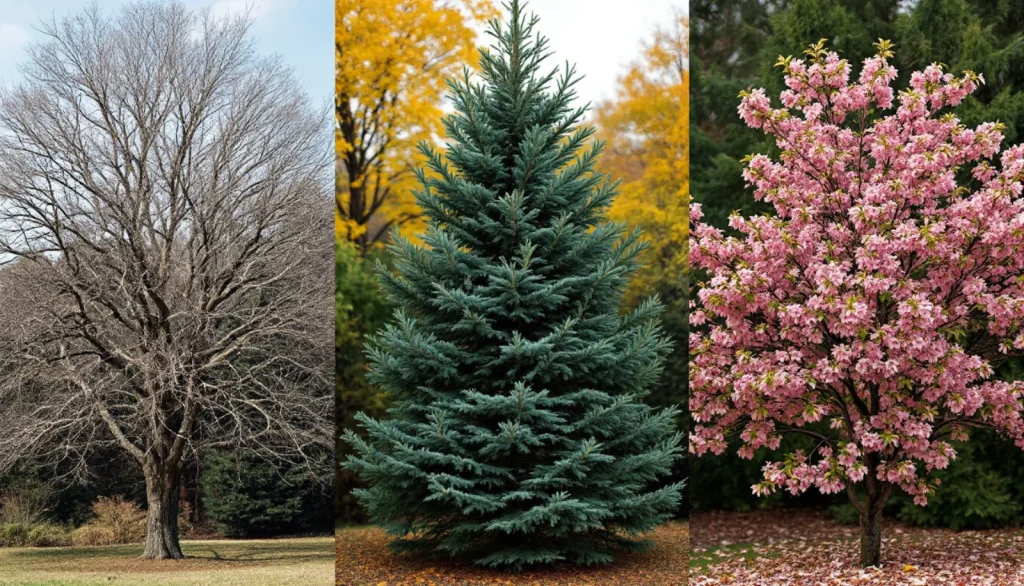
The four kinds of trees most people mean are deciduous, evergreen, coniferous, and broadleaf. Those are not four separate buckets. Deciduous describes leaf drop, evergreen describes leaf retention, and coniferous and broadleaf describe leaf shape and seed type. A single tree carries one trait from each pair, which is why a tree can be both broadleaf and evergreen, or both coniferous and deciduous.
| Category | What it describes | Defining trait | Named examples |
|---|---|---|---|
| Deciduous | Leaf habit | Drops all leaves seasonally, bare in winter | Oak, maple, birch, elm, dogwood, apple |
| Evergreen | Leaf habit | Keeps foliage year round | Pine, spruce, holly, southern magnolia, live oak |
| Coniferous | Leaf shape and seed | Needle or scale leaves, seeds in cones | Pine, spruce, fir, cedar, juniper |
| Broadleaf | Leaf shape and seed | Wide flat leaves, seeds in flowers then fruit or nuts | Maple, oak, ash, cherry, magnolia |
The trap is treating these as airtight. Most broadleaf trees are deciduous and most conifers are evergreen, which is why people pair the words. The exceptions matter for planting decisions, and they appear in the next section.
Deciduous vs coniferous: the differences that matter
Deciduous and coniferous trees differ in leaves, seeds, bark, wood, and climate. Deciduous trees have broad flat leaves, flower and set fruit or nuts, yield hardwood, and dominate temperate regions. Coniferous trees have needle or scale leaves, carry seeds in cones, yield softwood, and tolerate colder and drier sites. Each group has exceptions that break the rule, and those exceptions decide whether you get winter color or bare branches.
| Trait | Deciduous | Coniferous |
|---|---|---|
| Leaves | Broad, flat | Needle-shaped or scaled |
| Winter foliage | Drops, bare branches | Usually held year round |
| Seeds | Flowers, then fruit or nuts | Cones |
| Wood | Hardwood (angiosperm) | Softwood (gymnosperm) |
| Bark | Often smooth when young, furrowed with age | Often scaly or rough early |
| Climate fit | Temperate, warmer zones | Cold, dry, boreal common |
The overlap cases are worth knowing before you plant. Larch, tamarack, bald cypress, and dawn redwood are conifers that drop their needles every fall, so a planted larch hedge goes bare in winter. Going the other way, southern magnolia, American holly, and live oak are broadleaf evergreens that hold wide leaves through winter. Live oak can behave deciduously in colder zones, dropping old leaves only as new ones push in spring.
How does botany classify trees: hardwood vs softwood
Every tree is either an angiosperm or a gymnosperm, and that split is the same as hardwood vs softwood. Hardwoods are angiosperms, flowering plants whose seeds sit inside a fruit or nut. Softwoods are gymnosperms, whose seeds are naked, usually in cones. The terms describe seed structure, not actual wood density. Balsa is a hardwood and yew is a softwood, even though balsa is far lighter.
Angiosperms are the larger group by far, with roughly 300,000 plant species, of which hardwood trees are a part. They divide into monocots like palm and bamboo and dicots like oak and walnut, and nearly all hardwood timber comes from dicots. Gymnosperms number around 1,000 species and cluster in cooler, drier regions such as boreal forests. Sources: Royal Forestry Society and the Genetic Literacy Project summary of the 2022 PNAS species estimate.
Types of tree by mature size
Trees sort into three working size classes that decide where they fit on a property: small or understory, medium, and large or canopy. Size at maturity matters more than size at the nursery, because a tree planted three feet from a foundation or under a power line becomes a problem in a decade. Match the mature spread and height to the planting spot, then check the species, not the pot.
| Size class | Mature height | Typical role | Examples |
|---|---|---|---|
| Small / understory | Under 25 feet | Fits small yards, under power lines, near foundations | Dogwood, redbud, crape myrtle, Japanese maple |
| Medium | 25 to 40 feet | Street tree, mid-yard accent, light shade | Hornbeam, hawthorn, American holly, serviceberry |
| Large / canopy | 40 feet and up | Deep shade, long-term framing, large lots | Red oak, sugar maple, hackberry, tulip poplar |
Mature heights vary by site, soil, and region, so treat these bands as planning ranges. A species at the top of its range in deep Midwestern soil may stay shorter on a thin, dry lot. Local extension offices publish height data for your zone, and that beats a nursery tag every time.
Types of tree by landscape use
For most homeowners the useful question is not the botany, it is the job. Trees fall into four use categories: shade, ornamental, privacy, and fruit. A shade tree cools a house, an ornamental earns its spot with flowers or fall color, a privacy tree screens a view, and a fruit tree feeds you. Picking by use first, then checking size and leaf habit, gives you a tree that fits.
- Shade trees: large canopy species, often 40 to 80 feet, planted to cool a home and yard. Red maple, red oak, hackberry, and honey locust are common picks.
- Ornamental trees: smaller trees, roughly 15 to 35 feet, grown for flowers, bark, form, or fall color. Dogwood, redbud, crape myrtle, and Japanese maple lead the list.
- Privacy and screening trees: dense evergreens that hold foliage all year. Arborvitae, Leyland cypress, eastern red cedar, and holly form living screens.
- Fruit trees: grown for harvest, split into pome fruits (apple, pear) and stone fruits (peach, plum, nectarine, cherry). Many need a pollination partner.
One species can serve two jobs. A southern magnolia is ornamental and evergreen and screens a view. A crabapple is ornamental and bears small fruit. Start with the job the tree must do, then narrow by size and leaf habit.
How to choose a tree type for your yard
Choosing a tree is a short sequence, not a guess. Work from the job the tree does down to the named species, and check mature size against the planting spot before you buy. The steps below keep you from planting a 70-foot oak under a service line or a bare-in-winter larch where you wanted a year-round screen.
- Name the job: shade, ornamental, privacy, or fruit.
- Set the mature size limit for the spot, allowing room from the house, walks, and overhead lines.
- Decide leaf habit: evergreen for year-round screening, deciduous if you want winter sun and fall color.
- Confirm the species suits your USDA hardiness zone and soil. The 2023 USDA Plant Hardiness Zone Map at planthardiness.ars.usda.gov sets the baseline.
- Check the specific species mature height and spread from a local extension office, not the nursery tag.
- For fruit trees, confirm whether the variety self-pollinates or needs a partner.
Soil and watering carry the choice after planting. New trees in compacted or shaded ground struggle the same way turf does, and our guides on growing in shade and compacted soil and installing drip irrigation cover the fixes that keep young trees alive through the first two summers.
Regional notes that change the list
The right tree types shift by climate. Hot, dry regions favor drought-adapted and desert species over thirsty broadleaf canopy trees, while cold northern zones lean on conifers and hardy deciduous hardwoods. Check your zone and water rules before you buy, because some metros restrict turf and high-water plantings outright.
In low-desert areas, shade often comes from desert-adapted trees like palo verde and mesquite rather than maples, paired with a low-water yard. Homeowners converting thirsty landscapes can pair tree choice with our guide to drought-tolerant lawn alternatives, and Phoenix-area readers can find vetted help through our Phoenix landscaper directory. Cooler regions have wider deciduous and conifer options, and selection there turns on mature size and shade goals more than water.
Frequently asked questions
How many types of tree are there? By category, trees sort into a handful of working types: deciduous, evergreen, coniferous, broadleaf, plus size and use groupings. By species, a 2022 study in the Proceedings of the National Academy of Sciences estimated roughly 73,000 worldwide, including about 9,200 not yet described. So the answer depends on whether you mean categories or species.
Are all evergreen trees conifers? No. Most conifers are evergreen, but many evergreens are broadleaf. Southern magnolia, American holly, and live oak hold wide flat leaves through winter and are not conifers. And some conifers, like larch and bald cypress, drop their needles every fall, so they are deciduous conifers, not evergreens.
For naming help, including matching a common name to its botanical name, see our tree names guide.
Last reviewed: June 2026
HMNDP Editorial Team, reviewed by HMNDP turf and horticulture editors.