
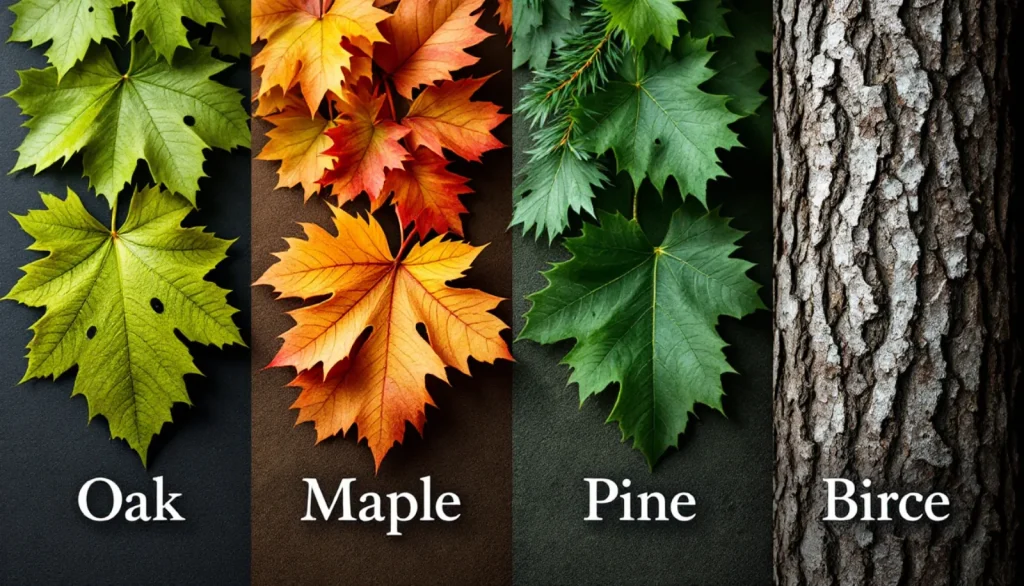
Tree Names: Common and Botanical Names by Type
Tree names come in two forms: the common name you say out loud (oak, maple, pine) and the botanical name botanists and nurseries use (Quercus, Acer, Pinus). The common name is easy but slippery, because one word can point to several unrelated species. The botanical name is exact: every tree on Earth has exactly one. This guide pairs the common and botanical names of the trees you actually see in US yards and streets, sorts them by type, and adds the planting zone and one trait that helps you tell them apart. Scientists estimate roughly 73,000 tree species exist worldwide, about 64,000 of them documented, per a 2022 study in the Proceedings of the National Academy of Sciences, so this is a working shortlist, not the full catalog.
How tree names work: common vs botanical
A tree has one botanical name and often several common names. The botanical name is a two-part Latin label: the genus (capitalized, like Acer) plus the species (lowercase, like rubrum), giving Acer rubrum for red maple. Common names drift by region and language, so the botanical name is the one that prevents mistakes when you buy a tree or hire a contractor.
The gap between the two is not academic. “Cedar” in a US nursery may mean true cedar (Cedrus), Eastern redcedar (Juniperus virginiana, actually a juniper), or Northern white-cedar (Thuja occidentalis, an arborvitae). Three different genera, one shared common name. When you specify the botanical name on a planting plan, you get the tree you meant.
| The naming risk | What “cedar” can mean | Botanical name | Actual genus |
|---|---|---|---|
| True cedar | Atlas or deodar cedar | Cedrus atlantica, Cedrus deodara | Cedrus |
| Eastern redcedar | Native juniper, US East | Juniperus virginiana | Juniperus (juniper) |
| Northern white-cedar | Arborvitae hedge plant | Thuja occidentalis | Thuja (arborvitae) |
| Western redcedar | Pacific Northwest timber tree | Thuja plicata | Thuja (arborvitae) |
The four working categories of trees
Most trees sort into deciduous or evergreen, and a smaller third group bridges both. Deciduous trees drop all their leaves each fall (oak, maple, birch). Evergreen conifers hold needles or scales year-round and bear cones (pine, spruce, fir). The bridge group, deciduous conifers, grows needles and cones like a conifer but drops them every autumn.
- Deciduous broadleaf: wide flat leaves, shed in fall. Oak, maple, birch, elm, ash, dogwood.
- Evergreen conifer: needles or scales held year-round, seeds in cones. Pine, spruce, fir, cedar, juniper.
- Evergreen broadleaf: wide leaves held year-round, common in mild climates. Live oak, Southern magnolia, holly.
- Deciduous conifer: the exception that breaks the rule. Larch, bald cypress, dawn redwood, and the non-conifer ginkgo all drop foliage in fall.
That last group is the one most name lists skip. If someone tells you “all conifers are evergreen,” bald cypress (Taxodium distichum) and larch (Larix) prove otherwise. Ginkgo (Ginkgo biloba) is not a conifer at all and still turns gold and drops every leaf in a few days.
Common deciduous tree names
Deciduous broadleaf trees are the shade and street trees of most US yards, and they cover the genera people name most: oak, maple, birch, elm, ash, and their relatives. The table below pairs each common name with its botanical name, gives the USDA hardiness zones where it grows, and names one trait that separates it from look-alikes.
| Common name | Botanical name | Type | USDA zones | Notable trait |
|---|---|---|---|---|
| Red maple | Acer rubrum | Deciduous | 3 to 9 | Scarlet fall color, reaches near 70 ft, fast growing |
| Sugar maple | Acer saccharum | Deciduous | 3 to 8 | Source of maple syrup, lives 150 to 200 years |
| Northern red oak | Quercus rubra | Deciduous | 3 to 8 | Pointed lobed leaves, fast for an oak |
| White oak | Quercus alba | Deciduous | 3 to 9 | Rounded lobes, lives 200 to 300 years |
| Bur oak | Quercus macrocarpa | Deciduous | 3 to 8 | Largest acorns in North America, lives 300 to 400 years |
| Pin oak | Quercus palustris | Deciduous | 4 to 8 | Drooping lower branches, likes moist acidic soil |
| Paper birch | Betula papyrifera | Deciduous | 2 to 7 | Peeling white bark, cool-climate tree |
| River birch | Betula nigra | Deciduous | 4 to 9 | Salmon-tan peeling bark, tolerates wet soil |
| American elm | Ulmus americana | Deciduous | 2 to 9 | Arching vase shape, vulnerable to Dutch elm disease |
| Hackberry | Celtis occidentalis | Deciduous | 3 to 9 | Warty gray bark, very tough across many soils |
| Tuliptree | Liriodendron tulipifera | Deciduous | 4 to 9 | Tulip-shaped flowers, state tree of three states |
| American sweetgum | Liquidambar styraciflua | Deciduous | 5 to 9 | Star-shaped leaves, spiky seed balls |
| Honey locust | Gleditsia triacanthos | Deciduous | 3 to 9 | Lacy compound leaves, dappled light shade |
| Eastern redbud | Cercis canadensis | Deciduous | 4 to 9 | Pink-purple spring blooms on bare branches, stays small |
| Ginkgo | Ginkgo biloba | Deciduous | 3 to 8 | Fan-shaped leaves, gold fall drop, ancient lineage |
Common evergreen and conifer tree names
Evergreen conifers hold their foliage through winter and carry the names people reach for at the holidays: pine, spruce, fir, cedar. The trick to telling them apart is the needles. Pines hold needles in bundles of two to five, spruce needles are stiff and square and attach singly, and fir needles are flat and soft.
| Common name | Botanical name | Type | Needle or leaf clue |
|---|---|---|---|
| Eastern white pine | Pinus strobus | Evergreen conifer | Soft needles in bundles of five, only five-needle pine east of the Rockies |
| Ponderosa pine | Pinus ponderosa | Evergreen conifer | Long needles in bundles of three, puzzle-piece bark |
| Colorado blue spruce | Picea pungens | Evergreen conifer | Stiff square sharp needles, blue cast, cones hang down |
| Douglas fir | Pseudotsuga menziesii | Evergreen conifer | Not a true fir, cones have three-pointed bracts |
| Balsam fir | Abies balsamea | Evergreen conifer | Flat soft needles, cones stand upright |
| Eastern redcedar | Juniperus virginiana | Evergreen conifer | Scale foliage and blue berries, a juniper despite the name |
| Coast redwood | Sequoia sempervirens | Evergreen conifer | Tallest tree species, Pacific coast fog belt |
| Southern magnolia | Magnolia grandiflora | Evergreen broadleaf | Glossy leaves held year-round, large white flowers |
| Bald cypress | Taxodium distichum | Deciduous conifer | Needles drop in fall, grows in standing water with knees |
| Dawn redwood | Metasequoia glyptostroboides | Deciduous conifer | Drops needles in fall, opposite branching |
What are the most common tree names in the US?
By common name, the trees most planted and most asked about across US yards and streets are maple, oak, pine, birch, and elm, with dogwood, redbud, and magnolia leading the small flowering tree list. The eastern US leans on red maple, white oak, and American elm, while the western US is defined by ponderosa pine, coast redwood, and Douglas fir.
Which name fits your yard depends on climate. USDA hardiness zones, set by the 2023 revised USDA map, tell you whether a species can survive your winter low. A river birch rated zones 4 to 9 handles the South, while a paper birch rated zones 2 to 7 needs a cold summer. If you are matching trees to a hot, dry region, pair the name with the planting conditions, and our guide to drought-tolerant lawn alternatives covers low-water yard design that often replaces turf with tough native trees.
How do you identify a tree by name?
Identify a tree by working from the most stable features to the least: leaf shape and arrangement, bark texture, overall form, then flowers, fruit, or cones. Start by asking whether the leaves are broad or needle-like, whether they sit opposite each other or alternate along the twig, and whether the tree holds them in winter.
- Leaf type: broadleaf points to deciduous or evergreen broadleaf; needles or scales point to a conifer.
- Leaf arrangement: opposite leaves narrow it to maple, ash, dogwood, and a few others (remember MAD: maple, ash, dogwood); alternate covers most of the rest.
- Bark: peeling white means birch, warty gray means hackberry, puzzle plates mean ponderosa pine.
- Fruit or cone: acorns mean oak, winged samaras mean maple or ash, cones mean a conifer.
- Confirm the botanical name against a regional source like a state extension service before you buy or plant.
When a tree is already failing rather than being identified, the symptom matters more than the name. Diagnosing yellowing, dieback, or thin canopy is a different task, and our lawn and plant problem diagnosis guide walks through the common causes that also affect young trees.
Why botanical names matter when you plant or hire
Botanical names protect you from buying or planting the wrong tree. A common name on a quote can hide a substitution: order a “flowering pear” and you might get the invasive Callery pear (Pyrus calleryana), now restricted or banned in several states. The botanical name on a planting plan removes that ambiguity and gives a contractor an exact spec.
Names also tie to mature size, root behavior, and zone, the three things that decide whether a tree helps or damages your property. Silver maple (Acer saccharinum) reaches about 80 feet with spreading surface roots that can lift sidewalks, while a redbud (Cercis canadensis) stays near 30 feet. Same word, “maple,” very different outcomes. When you brief a pro, give the botanical name, the zone, and the planting spot. Our checklist on how to find a reputable landscaper covers what else to put in writing before any tree goes in the ground.
Quick reference: tree name terms
A few terms clear up most naming confusion. Genus is the first capitalized part of a botanical name and groups related species. Species is the lowercase second part naming the exact tree. Cultivar names appear in single quotes, like Acer rubrum ‘Franksred’, and mark a selected variety. Deciduous means it drops its leaves; evergreen means it holds them; conifer means it bears cones, whether or not it stays green.
- Genus: the group, capitalized and italic (Quercus).
- Species: the exact tree, lowercase and italic (alba).
- Cultivar: a named selection in quotes (‘Sun Valley’).
- Hybrid: a cross, marked with an times sign, such as Freeman maple (Acer x freemanii).
Pair the name with the planting site and you have a tree that fits. For matching any plant to soil and feeding needs once it is in the ground, our NPK fertilizer guide explains how to read what a young tree actually needs.
Last reviewed: June 2026
HMNDP Editorial Team, reviewed by HMNDP turf and horticulture editors.
Frequently asked questions
What are the most common trees?
The most common tree names across US yards and streets are maple, oak, pine, birch, and elm, with dogwood, redbud, and magnolia leading small flowering trees. The eastern US leans on red maple, white oak, and American elm. The western US is defined by ponderosa pine, coast redwood, and Douglas fir. Which fits depends on your USDA hardiness zone.
What is the botanical name of a tree?
A botanical name is the two-part Latin label every tree has: a capitalized genus plus a lowercase species, both italic. Red maple is Acer rubrum, white oak is Quercus alba. Unlike common names, which drift by region and language, every species has exactly one botanical name, so it is the spec that prevents buying or planting the wrong tree.
How do you identify a tree by name?
Work from stable features to variable ones: leaf type (broadleaf or needle), leaf arrangement (opposite or alternate), then bark, then fruit or cones. Opposite leaves narrow it to maple, ash, and dogwood. Acorns mean oak, samaras mean maple or ash, cones mean a conifer. Confirm the botanical name against a state extension service before you buy or plant.
What are the four main types of trees?
Trees sort into four working groups. Deciduous broadleaf drop wide leaves each fall (oak, maple). Evergreen conifers hold needles year-round and bear cones (pine, spruce). Evergreen broadleaf keep wide leaves in mild climates (live oak, magnolia). Deciduous conifers grow needles and cones but still drop them each autumn (larch, bald cypress, dawn redwood).
Are all conifers evergreen?
No. Most conifers are evergreen, but a small group of deciduous conifers drops its needles every fall. Bald cypress (Taxodium distichum), larch (Larix), and dawn redwood (Metasequoia glyptostroboides) all turn color and shed. Ginkgo (Ginkgo biloba) is not a conifer at all yet also drops every leaf in a few days, which is why the evergreen-equals-conifer rule fails.
Why do trees have two names?
Trees carry a common name for everyday speech and a botanical name for precision. Common names vary by region, so one word can mean several unrelated species: cedar can point to true cedar (Cedrus), a juniper (Juniperus virginiana), or an arborvitae (Thuja occidentalis). The botanical name is unique to one species, which removes that ambiguity on a planting plan or nursery order.
How many tree species are there?
Scientists estimate roughly 73,000 tree species exist worldwide, about 64,000 of them already documented, per a 2022 study published in the Proceedings of the National Academy of Sciences. That study, drawing on data from 38 million trees across 90 countries, suggested more than 9,000 species remain undiscovered, most of them rare and regionally restricted.