
By the HMNDP Editorial Team. Last reviewed: June 2026.
What is a pest? The simple definition
A pest is any living thing (a plant, animal, or microorganism) that has a harmful, damaging, or unwanted effect on people, crops, livestock, property, or the environment. The label covers weeds, insects, mites, rodents, birds, fungi, bacteria, and viruses. An organism earns the name “pest” not because of what it is, but because of the harm it causes where humans do not want it.
The word carries two ideas at once: harm and unwantedness. A dandelion in a wild meadow is just a plant. The same dandelion in a maintained lawn is a pest. That shift is the whole concept, and it is the part most definitions leave out.
Regulators use a similar frame. The U.S. Environmental Protection Agency (EPA), under the Federal Insecticide, Fungicide, and Rodenticide Act (FIFRA), defines a pest broadly as any insect, rodent, nematode, fungus, weed, or other form of terrestrial or aquatic plant or animal life, or virus, bacteria, or microorganism, that is injurious to health or the environment.
Why the definition of a pest matters
The definition of a pest matters because it decides when control is justified and which products are legal to use. A pesticide is, by law, any substance meant to prevent, destroy, repel, or reduce a pest. So the moment you call something a pest, you open the door to spraying, trapping, or removing it. Getting the label right prevents wasted money, needless chemical use, and harm to helpful species.
Pests also carry real economic and health weight. The Food and Agriculture Organization (FAO) estimates that plant pests and diseases destroy up to 40% of global food crops each year, costing the world economy more than $220 billion. Rodents, mosquitoes, and ticks spread diseases that affect millions of people annually. Those numbers are why “pest” is a working category, not just a label of annoyance.
The key insight: a pest is a relative label
An organism becomes a pest only when and where it is unwanted, at a population high enough to cause real harm. This is called pest status, and it is contextual. The same species can be a pest in one setting and harmless or helpful in another. No fixed list of “pest species” exists, because status depends on place, season, crop, and human goals.
Consider the same plant in two fields. Wheat is a valuable crop in a wheat field. A single wheat seedling sprouting in a soybean row is a weed, which is simply a plant growing where it is not wanted. Nothing about the plant changed. The context did.
Population size matters as much as identity. Farmers use an economic threshold: the pest density at which the cost of damage equals the cost of control. Below that threshold, treating the pest wastes money. A few aphids on a tomato plant are not a pest problem worth spraying. Ten thousand aphids are. Pest managers act on numbers, not on the mere presence of an organism.
Timing and location complete the picture. Deer browsing in a forest are wildlife. The same deer eating a plum tree in a backyard orchard are a pest. Recognizing that “pest” is a judgment about impact, not a fixed biological class, is the difference between reacting to every organism and managing only the ones that cause harm.
What counts as a pest in agriculture, biology, and pest control
The word “pest” is defined slightly differently depending on the field. Agriculture centers on crop and livestock damage. Biology and ecology frame pests around population and human interaction. Pest control and regulation focus on legal categories that trigger treatment. All three agree on harm plus unwantedness, but they emphasize different things.
| Field | How a pest is defined | Core focus |
|---|---|---|
| Agriculture | Any organism that damages crops, livestock, stored grain, or reduces farm yield or quality | Economic loss and food supply |
| Biology / ecology | A species whose population conflicts with human interests, often when numbers rise past a natural balance | Population and human interaction |
| Pest control / regulation | Any life form named as injurious under laws like FIFRA that a pesticide may legally target | Legal categories and treatment |
| General / homeowner use | Any bug, weed, rodent, or organism that is a nuisance in a home, yard, or garden | Nuisance and property |
The main types of pests
Pests fall into four broad categories: weeds, insects and arthropods, vertebrate animals, and microorganisms. Grouping them this way is the standard used by extension services and by the National Pesticide Information Center (NPIC), because the category often decides the control method (a herbicide for weeds, a rodenticide for rats, a fungicide for fungi).
| Category | What it includes | Common examples |
|---|---|---|
| Weeds (plants) | Unwanted plants competing with crops, lawns, or gardens | Crabgrass, dandelion, bindweed, poison ivy, kudzu |
| Insects and arthropods | Insects, mites, and ticks that damage plants or affect health | Aphids, termites, mosquitoes, grubs, cockroaches, ticks |
| Vertebrate animals | Mammals, birds, and reptiles that damage property or crops | Rats, mice, moles, deer, gophers, pigeons, starlings |
| Microorganisms and pathogens | Fungi, bacteria, viruses, and nematodes causing disease | Powdery mildew, blight, root-knot nematodes, plant viruses |
Weeds are the pest category most homeowners meet first, which is why understanding what a herbicide is and how it targets weeds pairs closely with learning what a pest is. Whether a specific unwanted plant counts as a weed depends on the setting, the same way the question of whether a tree is a plant depends on how you draw the botanical line.
Pest identification comes first
Correct identification is the first and most important step in dealing with any suspected pest. The National Pesticide Information Center (NPIC) advises identifying the organism before choosing any control method, because the wrong ID leads to the wrong treatment, wasted product, and possible harm to non-target species. You cannot manage what you have not correctly named.
Identification also confirms whether the organism is a pest at all. Many bugs found in a garden are harmless or helpful. A homeowner who sprays every insect on sight often kills the predators that were controlling the actual pest. Local university extension offices and NPIC (reachable at 1-800-858-7378) offer free identification help.
Pest versus beneficial organism versus invasive species
Not every organism in a garden is a pest, and not every pest is invasive. A beneficial organism helps humans (a pollinator or a predator that eats pests). An invasive species is non-native and spreads aggressively, which often but not always makes it a pest. These three labels overlap but are not the same.
| Type | Definition | Example |
|---|---|---|
| Pest | Causes harm where unwanted | Aphids sucking sap from roses |
| Beneficial organism | Helps crops, gardens, or people | Ladybugs eating aphids; honeybees pollinating |
| Invasive species | Non-native and spreading aggressively | Spotted lanternfly; emerald ash borer |
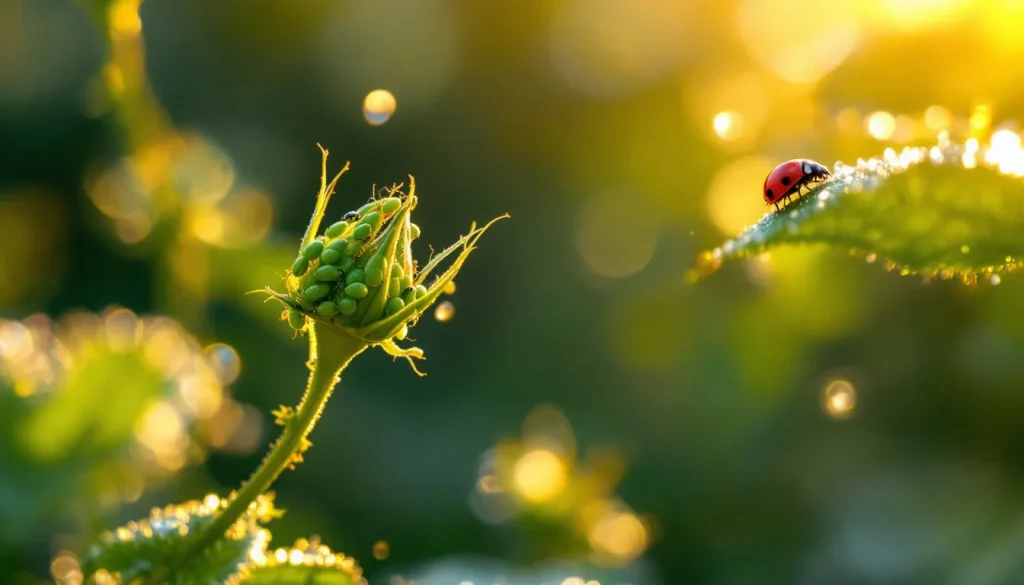
A ladybug and an aphid can sit on the same leaf. One is a pest and one is a friend. That contrast captures the whole concept: a pest is defined by harm, not by being an insect or a plant.
Other meanings of the word “pest”
Outside biology, “pest” also means an annoying or troublesome person, as in “that kid is a pest.” This everyday sense predates the pest-management use for most people and shows up in dictionaries alongside the organism definition. Both meanings share the same root idea of something unwelcome.
The word comes from the Latin “pestis,” meaning plague or a deadly, contagious disease. English adopted “pest” in the 1500s, first meaning a literal epidemic or pestilence. Over time it broadened to any destructive creature and then to any nuisance. The plague origin still echoes in related words like “pestilence” and “pesticide.”
Frequently Asked Questions
What is the simple definition of a pest?
A pest is any living thing (plant, animal, or microorganism) that causes harm or is unwanted where it lives. This includes weeds, insects, rodents, and disease-causing microbes. The two key ideas are harm and unwantedness. An organism is only a pest when it damages crops, property, health, or the environment in a place where people do not want it.
What is a pest in agriculture?
In agriculture, a pest is any organism that damages crops, livestock, or stored produce and reduces yield or quality. This covers insects like aphids, weeds that compete for water and nutrients, rodents that eat grain, and fungi that rot fruit. The FAO estimates pests and plant diseases destroy up to 40% of global crops yearly, so agriculture defines pests mainly by economic loss.
What is a pest in biology and science?
In biology and science, a pest is a species whose population conflicts with human interests, usually when its numbers grow past a level people will tolerate. Biology stresses that pest status is not a fixed trait but a relationship between a species, its population size, and human goals. The same organism can be harmless in one setting and a pest in another.
What are the main types of pests?
The four main types of pests are weeds (unwanted plants), insects and arthropods (such as aphids, termites, and mosquitoes), vertebrate animals (such as rats, mice, deer, and pigeons), and microorganisms (fungi, bacteria, viruses, and nematodes that cause disease). This grouping matters because the category usually decides the control method, from herbicides for weeds to fungicides for pathogens.
When does an organism become a pest?
An organism becomes a pest when and where it is unwanted and its population is high enough to cause real harm. Farmers use an economic threshold, the point where damage cost equals control cost. A few aphids are not a pest problem, but thousands are. Timing and location matter too: deer in a forest are wildlife, while deer eating an orchard are a pest.
What is the difference between a pest and a weed?
A weed is one type of pest: a plant growing where it is not wanted. “Pest” is the broad category that includes weeds plus insects, animals, and microbes. So every weed is a pest, but not every pest is a weed. A dandelion is a weed in a lawn, while a rat or a fungus is a pest but not a weed.
Are all insects pests?
No. Most insects are harmless or helpful, and only a small share are pests. A beneficial insect aids people, like a ladybug that eats aphids or a bee that pollinates crops. An insect becomes a pest only when it damages plants, property, or health in unwanted numbers. Killing every insect often removes the predators that were controlling the real pests.