
By the HMNDP Editorial Team, independent reporting on lawn care, landscaping, and the green-industry business.
Last reviewed: June 2026
What tilling soil means
Tilling soil is the mechanical agitation or inversion of the top layer of soil, usually 6 to 10 inches deep, to loosen it, mix in amendments, and create a planting surface. Tillage covers everything from a gas rototiller chopping a new plot to a gardener turning a bed with a spade. The goal is a softer, more workable seedbed.
The word covers two actions: breaking soil apart and inverting it (flipping lower soil up, surface debris down). A rototiller does both at once. Hand tools let you separate them, which matters for soil structure later in this guide.
What does tilling soil actually do?
Tilling loosens and aerates compacted soil, breaks up clods, kills existing weeds by uprooting them, mixes in compost or fertilizer, and produces a fine, level seedbed that small seeds can root into. The effect is immediate but temporary: aeration and weed suppression both fade within weeks as soil settles and buried weed seeds surface.
Four mechanical jobs happen when you till:
- Loosening and aeration: opens pore space so roots, water, and air move freely. A penetrometer reading drops sharply right after tilling.
- Compaction relief: shatters hardpan and the dense layer left by foot traffic or heavy equipment.
- Seedbed prep: creates the fine, crumbly texture that carrot, lettuce, and other small seeds need for good contact.
- Amendment incorporation: blends compost, lime, or granular fertilizer evenly through the root zone instead of leaving it on top.
Tilling for weed control: why it only works short term
Tilling kills the weeds growing today by slicing and burying them, which is why a freshly tilled bed looks clean. The catch: tillage also drags dormant weed seeds from deeper layers up to the surface where light triggers them to sprout. A single pass can bring thousands of buried seeds into the germination zone, so the clean look rarely lasts more than two to three weeks.
Researchers call the dormant reserve the weed seed bank. One square foot of garden topsoil can hold thousands of viable seeds. Repeated tilling becomes a cycle: each pass kills the current flush and recruits the next, which is a core reason no-till gardeners report fewer weeds after two or three seasons of leaving the seed bank buried.
How to till a garden: step by step
To till a garden, clear debris, mark the bed, confirm the soil is dry enough, break the surface, turn and incorporate amendments, then rake level. Work in straight overlapping passes at a target depth of 6 to 8 inches. The whole sequence for a typical 100 square foot bed takes 30 to 60 minutes with a tiller, longer by hand.
- Clear debris: remove rocks, sticks, large roots, and any heavy sod. Tilling thick turf under just chops the grass into rooting fragments.
- Mark the area: stake or hose-outline the bed so passes stay inside it and you do not till paths you will compact later by walking.
- Test moisture (do not skip): run the ball test below. Tilling wet soil destroys structure and creates concrete-like clods.
- Break the surface: make a first shallow pass to cut the top 2 to 3 inches, then a deeper pass to reach 6 to 8 inches.
- Turn and incorporate: spread 2 to 3 inches of compost or your amendment over the broken soil, then pass again to mix it through the root zone.
- Level and rake: rake the bed smooth, pull out surfaced rocks and root pieces, and break any remaining clods to seed size.
For incorporating organic matter, layering the amendment after the first break (not before) keeps it in the top 6 inches where most feeder roots live. See our guide to choosing and applying soil amendments for rates by amendment type.
How deep should you till a garden?
Most vegetable gardens need tilling 6 to 8 inches deep, which matches the root zone of common crops and the working depth of standard rototillers. Go to 10 to 12 inches only when breaking new ground or relieving deep compaction. Tilling deeper than 12 inches mostly buries fertile topsoil and brings up poorer subsoil with little benefit.
| Situation | Target depth | Why |
|---|---|---|
| Established bed refresh | 4 to 6 inches | Matches feeder roots, limits disturbance |
| Standard vegetable seedbed | 6 to 8 inches | Root zone for most annual crops |
| Breaking new ground | 8 to 12 inches | Removes sod layer, opens compacted subsoil |
| Severe hardpan | 12 inches (broadfork) | Fractures dense layer without inverting |
When is the best time to till soil? A signal-based decision tree
The best time to till is when three signals line up: soil is dry enough to pass the ball test, soil temperature is above 50 to 60 degrees Fahrenheit, and you are within a few weeks of planting. Most gardeners till in spring after the soil dries from winter, or in fall to incorporate cover crops and amendments. Ignore the calendar and read the soil.
Use this decision tree before every till. If any answer is “no,” stop and wait.
| Signal | Go if | Wait if |
|---|---|---|
| Moisture (ball test) | Ball crumbles when poked | Ball stays slick and holds shape |
| Soil temperature | Above 50 to 60 F at 4 inches | Still frozen or near freezing |
| Timing to planting | Within 1 to 3 weeks of seeding | Months out (weeds will reclaim it) |
| Recent rain | 2 to 3 dry days have passed | It rained in the last 24 to 48 hours |
This is the gap most tilling guides skip: they assume you should till and tell you the calendar month. The signals above matter more than the date, because tilling the right month at the wrong moisture can ruin a bed for a whole season.
Can you till wet soil? The ball test
No, do not till wet soil. Wet tilling smears and compacts clay, destroys the crumb structure you are trying to build, and dries into rock-hard clods that last all season. Test readiness with the ball test: squeeze a handful into a ball, then poke it. If it crumbles apart, till. If it stays slick and intact, wait two to three dry days.
The ball test works because soil at the right moisture (around field capacity minus a day or two) holds together loosely but shatters under light pressure. Clay soils are least forgiving and need the longest drying window after rain. Sandy soils dry fastest and rarely smear. Understanding your garden soil texture tells you how patient you need to be.
Is tilling bad for soil? Quantifying the tradeoff
Tilling is not always bad, but it carries real costs to soil structure and biology that most tiller guides ignore. Each tillage pass speeds organic matter loss, slices fungal networks and earthworms, and exposes bare soil to erosion. The damage is cumulative: occasional tilling to start a bed is minor, while annual deep tilling measurably degrades soil over years.
The specific tradeoffs, drawn from soil science research:
- Organic matter: tillage accelerates oxidation of soil carbon. Long-term conventional tillage commonly leaves topsoil with markedly lower organic matter than comparable no-till ground, because turning soil feeds microbes oxygen and they burn through carbon faster.
- Mycorrhizal fungi: tillage physically severs the fungal threads (hyphae) that connect to roots and move water and phosphorus. These networks take seasons to rebuild after each disturbance.
- Earthworms: rotary tillers kill and disrupt worm populations and collapse their vertical burrows, which are natural drainage and aeration channels.
- Erosion: bare tilled soil with no residue is far more vulnerable to wind and water erosion than soil left covered. Keeping the surface protected is the single biggest reason no-till conserves topsoil.
None of this means never till. It means count the cost and till only when the benefit is worth it. To understand what you are disturbing, see how soil structure forms over time.
Till vs no-till: which is better for a garden?
Neither wins universally. Tilling is better for breaking new ground, fixing severe compaction, and fast seedbed prep. No-till is better for long-term soil health, weed reduction over time, moisture retention, and erosion control. The honest answer most pages avoid: till once to establish a bed if you must, then switch to no-till maintenance to keep the gains.
| Factor | Tilling | No-till |
|---|---|---|
| Speed to plantable bed | Fast (same day) | Slow (weeks to season) |
| Breaking new ground or sod | Strong | Weak (needs mulch/cardboard time) |
| Severe compaction relief | Strong | Weak (broadfork helps) |
| Long-term soil structure | Degrades | Builds |
| Weeds over 2 to 3 seasons | More (seed bank churned) | Fewer (seed bank buried) |
| Organic matter and biology | Declines | Improves |
| Erosion risk | Higher (bare soil) | Lower (covered soil) |
| Upfront labor or cost | Lower per pass | Higher (compost, mulch sourcing) |
When tilling is genuinely the right call: converting lawn or pasture into a first-year garden, fracturing a hardpan that roots cannot penetrate, or incorporating large volumes of amendment into very poor soil quickly. Outside those cases, the evidence favors minimal disturbance.
How to till soil by hand without a tiller
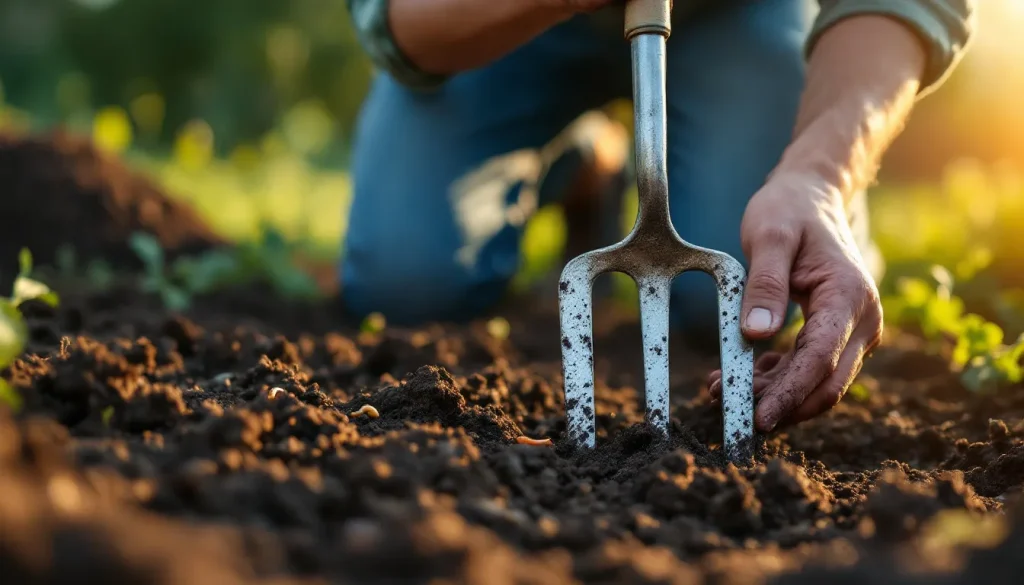
You can till soil by hand with a broadfork, garden fork, or spade, and for beds under about 200 square feet it is often faster than renting a powered tiller. Hand tilling lets you loosen soil without pulverizing structure or churning the weed seed bank, which makes it the preferred method for soil-health-minded gardeners.
Tool selection by job and bed size:
| Tool | Best for | Effort | Bed size |
|---|---|---|---|
| Broadfork | Loosening without inverting | Moderate, leg-driven | Any size, fastest per area |
| Garden (digging) fork | Turning, lifting clods | Moderate to high | Up to ~150 sq ft |
| Spade | Cutting sod, double-digging | High | Small new beds |
The broadfork method (lowest soil disturbance): step the tines in, rock the handles back to fracture the soil, lift slightly, pull out, step back 6 inches, repeat across the bed. You loosen 8 to 12 inches deep without flipping layers or chopping worms.
Double-digging (for compacted new beds): dig a trench one spade deep, loosen the trench bottom with a fork, then fill that trench with soil from the next trench while adding compost. It is heavy work but conditions a new bed deeply, one time.
Do you need to till soil every year?
No. Annual tilling is a habit, not a requirement, and yearly deep tilling is one of the faster ways to degrade garden soil. Most established beds need no tilling at all once built. Top-dress with 1 to 2 inches of compost each season, mulch to suppress weeds, and let worms and roots do the loosening that a tiller used to do.
Reserve tilling for genuine triggers: starting a brand-new bed, fixing compaction that a broadfork cannot relieve, or incorporating a large soil correction. For everything else, surface composting and mulching maintain a workable bed with steadily improving structure. Browse more in the HMNDP soil and gardening learn library.
Frequently Asked Questions
What does tilling soil actually do?
Tilling loosens and aerates compacted soil, breaks clods into a fine seedbed, uproots existing weeds, and mixes amendments like compost and fertilizer through the root zone. The benefits are immediate but short-lived: aeration settles within weeks, and tilling also surfaces buried weed seeds. It physically resets the top 6 to 8 inches of soil for planting.
Is tilling bad for soil?
Tilling carries real costs. Each pass speeds organic matter loss by oxidizing soil carbon, severs mycorrhizal fungal networks, disrupts earthworms and their burrows, and leaves bare soil exposed to wind and water erosion. Damage is cumulative, so occasional tilling to start a bed is minor while annual deep tilling measurably degrades soil structure and biology over several seasons.
When is the best time to till soil?
Till when three signals align: soil passes the ball test (crumbles when poked, not slick), soil temperature is above 50 to 60 degrees Fahrenheit at 4 inches, and you are within 1 to 3 weeks of planting. Most gardeners till in spring after winter moisture dries or in fall to incorporate cover crops. Read the soil, not the calendar.
How deep should you till a garden?
Till 6 to 8 inches deep for a standard vegetable seedbed, matching the root zone of most annual crops and the working depth of standard rototillers. Established beds need only 4 to 6 inches. Go 8 to 12 inches when breaking new ground or relieving deep compaction. Tilling past 12 inches mostly buries good topsoil and surfaces poorer subsoil.
Till vs no-till: which is better for a garden?
Neither wins outright. Tilling is better for breaking new ground, relieving severe compaction, and producing a seedbed fast. No-till is better for long-term soil structure, fewer weeds over time, moisture retention, and erosion control. A practical compromise: till once to establish a difficult new bed, then switch to no-till maintenance with compost and mulch to keep the soil-health gains.
How do you till soil by hand without a tiller?
Use a broadfork, garden fork, or spade. A broadfork loosens 8 to 12 inches deep without inverting layers: step the tines in, rock the handles back, lift, and move back 6 inches. For compacted new beds, double-dig by trenching one spade deep and loosening the bottom. For beds under 200 square feet, hand tilling is often faster than renting a powered tiller.
Can you till soil that is wet, and how do you test if soil is ready?
Do not till wet soil. Wet tilling smears and compacts clay, destroys crumb structure, and dries into rock-hard clods that last all season. Test with the ball test: squeeze a handful into a ball and poke it. If it crumbles, till. If it stays slick and holds shape, wait two to three dry days, longer for clay soils.
Do you need to till soil every year?
No. Yearly tilling is a habit, not a requirement, and annual deep tilling is among the faster ways to degrade garden soil. Established beds usually need no tilling once built. Top-dress with 1 to 2 inches of compost each season and mulch to suppress weeds. Reserve tilling for new beds, stubborn compaction, or large soil corrections.