
By the HMNDP Editorial Team, independent reporting on lawn care, landscaping, fertilizer, and the green-industry business.
Last reviewed: June 2026
What a soil test kit measures
A soil test kit measures soil pH and plant-available nutrients, primarily nitrogen (N), phosphorus (P), and potassium (K). Cheap at-home kits report a rough pH and N-P-K reading by color change. Mail-in lab kits like MySoil measure 13 nutrients plus pH using laboratory instruments and return numbers with fertilizer and lime recommendations tied to your results.
The pH number tells you whether nutrients can be absorbed at all. Most lawn grasses prefer a pH of 6.0 to 7.0, and vegetables sit near 6.2 to 6.8. Below 5.5, applied fertilizer is partly wasted because the plant cannot take it up.
N-P-K tells you what to add. Nitrogen drives green leaf growth, phosphorus supports roots and flowering, and potassium handles stress and disease resistance. A lab test also reports secondary nutrients (calcium, magnesium, sulfur) and micronutrients, which color-change kits do not.
Mail-in lab soil test kits: the recommended pro option
A mail-in lab soil test kit is the most accurate way to test soil at home. You collect a sample, mail it to a lab, and receive a digital report with exact nutrient levels and a custom fertilizer and lime plan. MySoil tests 13 nutrients plus pH; Yard Mastery offers a lawn-focused mail-in kit. Both typically return results in about 6 to 8 days.
The value is the recommendation, not just the data. Instead of a vague “low potassium” reading, a lab report states pounds per 1,000 square feet of a specific product, so you stop guessing at the fertilizer aisle.
| Lab kit | What it measures | Typical turnaround | Best for |
|---|---|---|---|
| MySoil | 13 nutrients + pH | About 6 to 8 days after lab receipt | Gardens, mixed beds, whole-yard baselines |
| Yard Mastery | pH, P, K, lime/fertilizer plan | About 7 days | Lawns and turf programs |
| State extension lab | pH, P, K, lime needs (varies by state) | 1 to 3 weeks | Lowest cost, official local data |
Turnaround clocks usually start when the lab receives the envelope, so add mailing time. Order two to three weeks before you plan to fertilize or lime.
At-home DIY soil test kits: chemical and probe types
At-home DIY soil test kits give instant, low-cost readings without mailing anything. Two types dominate Amazon and Lowe’s: chemical color-change kits (you mix soil, water, and a reagent capsule, then match the color to a chart) and probe/meter kits (a metal probe gives a pH and sometimes moisture or light reading). Most cost $10 to $25.
Color-change capsule kits, such as the long-running Rapitest line, give a usable pH ballpark and a directional N-P-K read. Their weakness is interpretation. You are matching a faded liquid to a printed color, so two people can read the same vial differently.
Cheap two-prong probe meters are the least reliable category. Many lack a battery and respond mostly to moisture, which is why a meter can swing several pH points just because the soil is wet. Use a probe meter for a quick relative check, not for a liming decision.
DIY at-home kit vs professional lab test: the real accuracy gap
The honest difference is precision and confidence. A DIY kit answers “is my soil roughly acidic, and is anything obviously low?” for about $15 in five minutes. A lab test answers “exactly how much lime and which fertilizer, in pounds per 1,000 square feet” for about $25 to $35 in roughly a week. You are paying for a decision you can act on without guessing.
| Factor | DIY at-home kit | Mail-in lab test |
|---|---|---|
| Typical price | $10 to $25 | $25 to $40 (extension labs often $10 to $20) |
| Speed | Minutes | About 6 to 8 days plus mailing |
| pH accuracy | Directional (within ~0.5 to 1.0 pH on a good color kit) | Precise (lab meter, ion-exchange chemistry) |
| Nutrients reported | N, P, K (rough) | Up to 13 nutrients plus pH |
| Recommendations | None or generic | Custom lime and fertilizer plan |
| Best use | Quick check, monitoring trends | Decision before spending on amendments |
Here is the original synthesis competitors skip: the cost of a wrong DIY reading is usually larger than the price gap to a lab. A 40 lb bag of lime or a season of the wrong fertilizer runs $20 to $60 and can take months to correct if you over-apply. Spending $15 more on a lab test to avoid liming soil that was never acidic is the cheaper mistake to prevent. The DIY kit pays off as a cheap monitoring tool after a lab has set your baseline, not as the one-time decision-maker.
Soil test kit for lawn vs garden and vegetable beds
Match the kit to the job. For a lawn, you mostly care about pH and whether to lime, plus a phosphorus and potassium read to tune fertilizer, so a turf-focused mail-in kit or a color-change kit works. For vegetable beds, the nutrient mix and micronutrients matter more, so a 13-nutrient lab test like MySoil earns its price.
Lawns are large and uniform, so one well-mixed composite sample per lawn area is usually enough. If you have a struggling patch and a healthy patch, test them separately to see what differs.
Vegetable and flower beds change fast because you amend them every season. A lab test before planting catches phosphorus buildup from years of compost, a common and invisible problem that a color kit will not flag. Pair results with our guide to choosing the right fertilizer by season once you know your numbers.
How to use a soil test kit and collect a proper sample
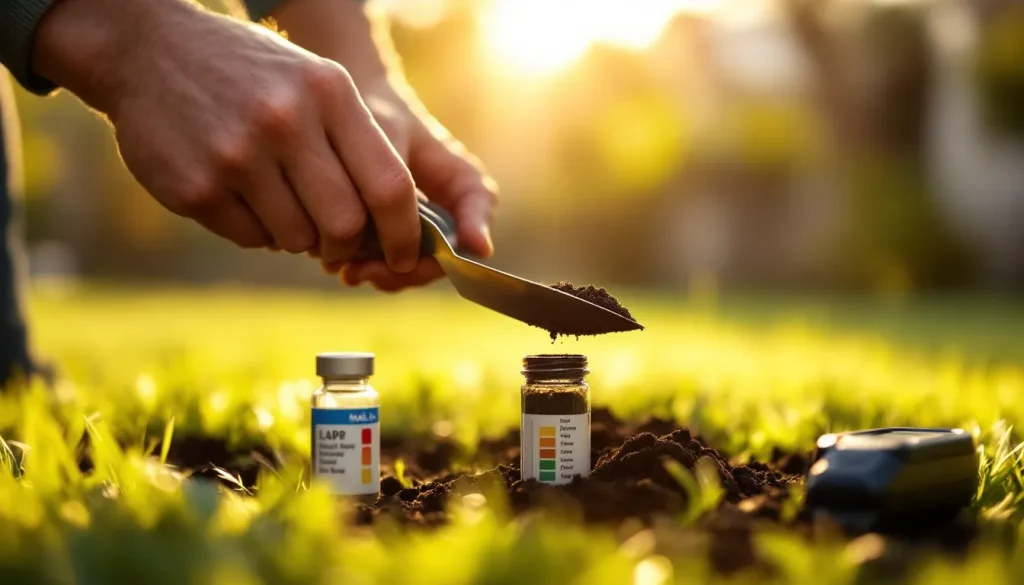
Sample quality decides accuracy more than the kit brand. Collect soil from 6 to 8 inches deep for gardens and 3 to 4 inches for lawns, pull from 6 to 10 spots across the area, mix them in a clean plastic bucket, and use that blended composite. A single scoop from one spot is the most common reason results mislead.
- Pick the zone. Test one area at a time (front lawn, back lawn, each garden bed). Do not blend lawn soil with vegetable soil.
- Dig to the right depth. Lawns: 3 to 4 inches. Beds: 6 to 8 inches. Use a stainless or clean steel trowel.
- Take 6 to 10 cores in a zigzag across the zone to average out variation.
- Mix in a clean plastic bucket. Avoid galvanized metal, which can skew zinc and micronutrient readings.
- Remove debris (roots, rocks, thatch) and let the soil air-dry before mailing or testing.
- Follow the kit steps. For lab kits, fill the sample container to the line and register the included code online.
Avoid sampling within 6 to 8 weeks of fertilizing or liming, and skip soggy soil, since both distort readings. For the pH side specifically, our walkthrough on how to test soil pH at home covers the color-chart and meter steps in detail.
How to read and act on your results
Start with pH, then nutrients. If pH is below 6.0 for a lawn, the report recommends lime to raise it; above 7.5, it may recommend sulfur to lower it. Then read N-P-K: a low number means add that nutrient, and a high or “excess” phosphorus reading means choose a fertilizer with little or no P. Apply the report’s stated rate in pounds per 1,000 square feet.
Lime and sulfur work slowly. A liming recommendation can take 3 to 6 months to fully shift pH, so test in fall to fix soil before the next growing season. Compacted soil also blocks nutrient uptake, so if your lab flags poor structure, read our notes on when and how to aerate a lawn before adding more product.
Retest every 2 to 3 years, or yearly if you are actively correcting a problem. Track the numbers so you can see lime and fertilizer actually moving them.
Where to buy and the free option most people miss
Soil test kits are sold three ways: in-store at Lowe’s and Home Depot (mostly color-change and probe kits), on Amazon (the widest selection of both DIY and mail-in kits), and direct from brands like MySoil and Yard Mastery. Before buying, check your state extension office, which often runs a soil lab for $10 to $20 or sometimes free.
Every US state has a Cooperative Extension service tied to its land-grant university, and most operate a soil testing lab. The report is official, locally calibrated, and cheaper than retail kits. Search “[your state] extension soil test” to find the form and mailing address. It is the best-value accurate option and the one product-review articles rarely mention.
For what amendments and services actually cost this season once you have your results, see the 2026 US lawn care price index, and browse more soil and turf basics in our learn library.
Frequently Asked Questions
What does a soil test kit actually measure?
A soil test kit measures soil pH (acidity or alkalinity) and plant-available nutrients, mainly nitrogen, phosphorus, and potassium (N-P-K). Basic at-home kits report a rough pH and N-P-K reading by color change. Lab-based kits such as MySoil measure up to 13 nutrients plus pH, including calcium, magnesium, sulfur, and micronutrients, and return numbers with a fertilizer and lime plan.
Are at-home soil test kits accurate, or do I need a lab test?
At-home kits are directionally accurate. A good color-change kit gets pH within about 0.5 to 1.0 point and shows whether a nutrient is clearly low. Cheap probe meters are the least reliable, often reacting to moisture. For a one-time decision about how much lime or fertilizer to apply, a mail-in lab test (about $25 to $40) is worth the extra accuracy.
What is the best soil test kit for a lawn?
For most lawns, a turf-focused mail-in kit like Yard Mastery (about $30, roughly 7-day turnaround) gives pH plus a lime and fertilizer plan sized in pounds per 1,000 square feet. If you want a quick, repeatable check between lab tests, a Rapitest-style color-change kit ($15 to $20) covers pH and basic N-P-K. Your state extension lab is the cheapest accurate option.
How do I use a soil test kit and collect a proper sample?
Sample one zone at a time. Dig 3 to 4 inches deep for lawns or 6 to 8 inches for garden beds, take 6 to 10 cores in a zigzag pattern, and mix them in a clean plastic bucket. Remove roots and rocks, let the soil air-dry, then follow the kit instructions. Do not sample within 6 to 8 weeks of fertilizing or liming.
Soil test kit vs professional lab test: which should I choose?
Choose a lab test when you are about to spend money on lime or fertilizer, since its custom pounds-per-1,000-square-feet recommendation prevents over-application that costs $20 to $60 to fix. Choose a DIY at-home kit for quick monitoring, trend-checking, or confirming a known problem. A practical plan: one lab test to set the baseline, then cheap DIY kits to track changes.
How much does a soil test cost and how long do mail-in results take?
At-home DIY kits cost $10 to $25. Mail-in lab kits such as MySoil and Yard Mastery cost about $25 to $40 and return results in roughly 6 to 8 days (Yard Mastery cites about 7 days) after the lab receives your sample, so add mailing time. State extension labs often charge $10 to $20 and may take 1 to 3 weeks.
How do I read and act on my soil test results?
Read pH first. Below 6.0 for a lawn, apply lime at the recommended rate; above 7.5, apply sulfur. Then read N-P-K: add nutrients flagged low and avoid phosphorus if it reads high or “excess.” Apply products at the stated pounds per 1,000 square feet. Lime can take 3 to 6 months to shift pH, so fall testing fixes soil before spring.
Can I get a free or cheap soil test from my state extension office?
Often, yes. Every US state has a Cooperative Extension service through its land-grant university, and most run a soil testing lab charging roughly $10 to $20, sometimes free. The report is locally calibrated and includes lime and fertilizer guidance. Search “[your state] extension soil test” for the form and mailing address. It is usually the best-value accurate option available.