
Soil conservation, defined in one line
Soil conservation is the practice of protecting soil from erosion, nutrient loss, and degradation so it stays fertile and productive for future use. It combines farming and land-management methods (crop rotation, cover crops, reduced tillage, terracing) with the goal of keeping topsoil in place, holding water, and preserving the living organisms that make soil healthy.
By HMNDP Editorial Team, independent reporting on lawn care, landscaping, and the green industry. About the author.
Last reviewed: June 2026.
Topsoil is a slow-forming resource. Common soil-science estimates put the formation of one inch of topsoil at roughly 500 years under natural conditions, and some estimates stretch to 1,000 years. That single fact reframes the whole topic: soil is effectively non-renewable on a human timescale, so conservation is less about growing new soil and more about not losing the soil you already have.
Why soil conservation matters: the numbers competitors leave out
Soil conservation matters because roughly 95% of the food humans eat depends, directly or indirectly, on soil, and that soil is eroding faster than it forms. The U.S. Department of Agriculture and United Nations bodies have documented large annual losses, real dollar costs, and measurable declines in fertility. The stakes are food security, water quality, and farm economics all at once.
Here is the quantified picture the top-ranking pages skip:
| Metric | Figure | Source / basis |
|---|---|---|
| Time to form 1 inch of topsoil | ~500 years (natural rate) | Common USDA/soil-science estimate |
| Average U.S. cropland erosion (sheet, rill, wind) | ~4.6 tons per acre per year | USDA NRCS National Resources Inventory (2017) |
| Soil-loss tolerance (“T value”) often used as a limit | ~5 tons per acre per year | NRCS planning standard |
| Global soil lost to erosion each year | ~24 billion tons (estimate) | UN-linked assessments |
| Share of global food reliant on soil | ~95% | UN Food and Agriculture Organization |
Put simply, cropland in the United States often loses soil at close to or above the rate at which it can tolerate loss, while natural replacement runs centuries behind. Conservation closes that gap.
The core problem: soil erosion
Soil erosion is the detachment and movement of topsoil by water, wind, or tillage, and it is the central problem soil conservation addresses. Water carries soil off bare or sloped fields during rain; wind lifts loose, dry, uncovered soil; and repeated plowing gradually moves soil downslope. Erosion strips the richest, uppermost layer first.
The Dust Bowl of the 1930s remains the clearest lesson. Drought plus plowed-under prairie grass let wind strip millions of acres across the U.S. Southern Plains, darkening skies as far as Washington, D.C., and directly prompting the federal government to create the Soil Conservation Service in 1935.
Scientists estimate erosion risk with the Universal Soil Loss Equation (USLE) and its update, RUSLE. The formula is A = R x K x LS x C x P, where A is annual soil loss and the factors represent rainfall (R), soil erodibility (K), slope length and steepness (LS), cover and management (C), and support practices (P). The practical takeaway: two of those factors, cover (C) and practices (P), are exactly what conservation methods change.
What soil conservation protects: water, nutrients, and living soil
Soil conservation protects three linked resources at once: water supply and quality, soil fertility, and the organisms that keep soil alive. Erosion damages all three simultaneously, which is why a single practice like a cover crop can improve water, nutrients, and biology together.
Water conservation and quality
Healthy, covered soil absorbs and stores rainfall instead of shedding it. Every 1% increase in soil organic matter can help an acre hold roughly 20,000 additional gallons of water, according to figures cited by NRCS. Covered soil also filters runoff, keeping sediment, nitrogen, and phosphorus out of streams, which reduces downstream problems like algae blooms.
Nutrient depletion and fertility
Topsoil holds most of a field’s nitrogen, phosphorus, potassium, and organic matter. When it erodes, those nutrients leave with it, forcing farmers to buy more fertilizer to compensate. Conservation keeps nutrients on-site, and practices like legume cover crops can add nitrogen naturally, lowering input costs over time.
Soil organisms and soil health
A single teaspoon of healthy soil can contain more than one billion bacteria plus fungi, protozoa, and nematodes, and a healthy field supports earthworms that build structure. These organisms cycle nutrients, bind soil particles, and create pores for water and roots. Tillage and bare ground degrade that habitat, so conservation is as much about protecting biology as protecting particles.
Main soil conservation methods (with tradeoffs)
The main soil conservation methods are crop rotation, reduced or no-till, cover cropping, contour plowing, terracing, windbreaks, buffer strips, and agroforestry. Each targets a different erosion driver, and each carries different costs and effort. The comparison below, absent from most ranking pages, shows when to use which.
| Method | What it does | Erosion type addressed | Relative cost | Relative effort | Best when |
|---|---|---|---|---|---|
| Crop rotation | Alternates crops season to season to vary root depth and nutrient demand | Water, nutrient loss | Low | Low | Any working farm or large garden |
| Reduced / no-till | Plants with minimal soil disturbance, leaving residue on top | Water, wind, tillage | Low to medium | Medium (new equipment/skills) | Erosion-prone or compacted fields |
| Cover cropping | Grows a protective crop (rye, clover, radish) between cash crops | Water, wind, nutrient loss | Low to medium | Medium | Bare-ground periods; degraded fertility |
| Contour plowing | Tills across a slope instead of up and down | Water | Low | Low | Gently sloping fields |
| Terracing | Builds level steps into steep hillsides | Water | High | High | Steep slopes with high rainfall |
| Windbreaks / shelterbelts | Rows of trees or shrubs that slow wind | Wind | Medium | Medium (years to establish) | Open, dry, wind-exposed land |
| Buffer strips | Permanent grass or trees along waterways | Water, water quality | Low to medium | Low | Field edges near streams |
| Agroforestry | Combines trees, crops, and sometimes livestock on one plot | Water, wind | Medium to high | High | Long-term diversified operations |
Crop rotation
Crop rotation means growing different crops in a planned sequence on the same land, for example corn one year and soybeans or a legume the next. Rotation breaks pest and disease cycles, varies rooting depth, and lets nitrogen-fixing legumes rebuild fertility. It is the lowest-cost, lowest-effort entry point to conservation.
Reduced tillage and no-till
Reduced tillage and no-till plant seeds with little or no plowing, leaving last season’s residue as a protective blanket. Undisturbed soil keeps its structure, organic matter, and organisms intact, and residue shields the surface from rain and wind. As of the 2017 U.S. Census of Agriculture, no-till was used on roughly 104 million acres of U.S. cropland, the most widely adopted conservation practice.
Cover cropping
Cover cropping grows a non-cash crop such as cereal rye, clover, or radish specifically to protect and feed the soil between main crops. Roots hold soil in place, foliage blocks erosive rain and wind, and the biomass adds organic matter when terminated. U.S. cover-crop acreage grew to about 15.4 million acres by 2017, still under 5% of cropland, which marks it as a major growth area.
How crop rotation, cover cropping, and reduced tillage work together
These three practices reinforce each other because each fixes a weakness the others leave open. Reduced tillage keeps soil undisturbed but can leave gaps in living cover; cover crops fill those gaps; and crop rotation prevents any single crop from draining one nutrient or feeding one pest. Used together they form the backbone of what NRCS calls soil-health management.
A field managed this way behaves differently. It absorbs heavy rain instead of gullying, needs less synthetic nitrogen because legumes supply it, and rebuilds organic matter year over year. The compounding effect is why farms adopting the full stack often report lower input costs after three to five seasons.
Contour plowing, terracing, and windbreaks explained
Contour plowing, terracing, and windbreaks are structural methods that reshape the land or block wind rather than change the crop. They handle the erosion that crop-based methods alone cannot stop, especially on slopes and open plains.
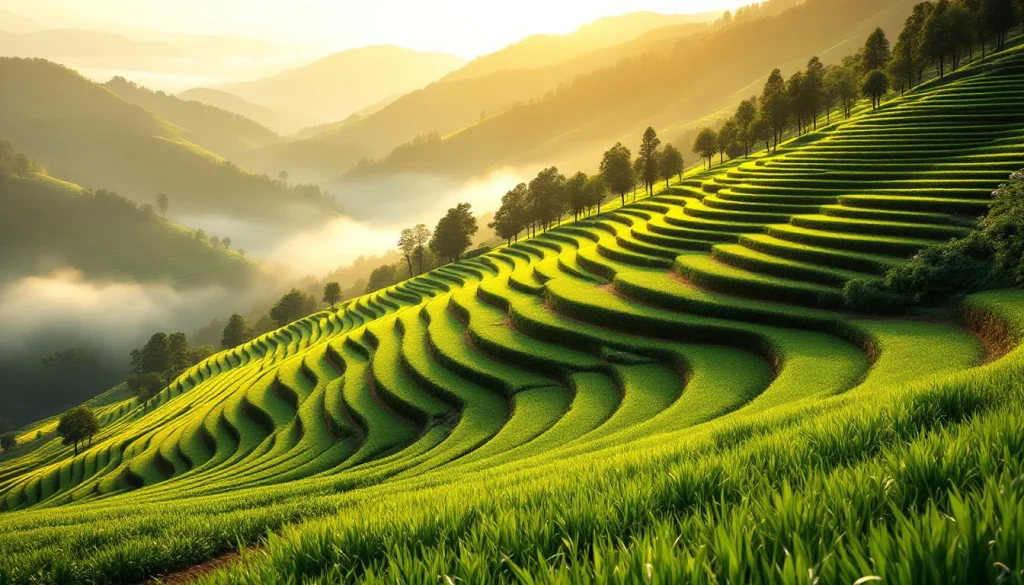
Contour plowing runs tillage lines across a slope so each furrow acts as a small dam, slowing water and cutting soil loss on gentle grades. Terracing goes further, cutting a steep hillside into level steps that stop water from ever gaining speed, which is why rice-growing regions have used terraces for centuries. Windbreaks, also called shelterbelts, are rows of trees or shrubs planted across the prevailing wind; a well-placed windbreak can protect a downwind distance of roughly 10 times its height and was a signature response to the Dust Bowl.
Soil conservation for a home garden or small yard
Home gardeners conserve soil with the same principles farms use, just scaled down: keep soil covered, disturb it as little as possible, and feed it organic matter. A backyard has erosion too, from bare beds washing out in storms to compacted lawn that sheds water instead of soaking it in.
- Mulch bare soil. A 2 to 3 inch layer of wood chips, straw, or leaves is a small-scale cover crop that stops rain splash and holds moisture.
- Skip the deep digging. No-dig or low-dig beds protect earthworms and fungal networks, mirroring farm no-till.
- Plant a cover crop. Sow crimson clover or winter rye in empty beds over the off-season.
- Build better soil. Compost and amendments raise organic matter; our guides to building a living soil mix and choosing the best potting soil walk through the ingredients.
- Match plants to your dirt. Heavy ground drains poorly and crusts over, so read our guide to working with clay soil before planting, and the notes on soil for strawberries if you grow fruit.
- Terrace a slope. On a sloped yard, low retaining walls or planted terraces do exactly what farm terraces do.
Who helps: the NRCS and conservation districts
Two institutions run most U.S. soil conservation on the ground: the federal Natural Resources Conservation Service (NRCS) and roughly 3,000 local Soil and Water Conservation Districts. The NRCS sets standards and funds practices; the districts deliver local, neighbor-to-neighbor assistance. Programs and eligibility can vary by state and by year, so landowners should confirm current terms with their local office.
The NRCS and federal conservation programs
The NRCS is the USDA agency that provides technical and financial help for conservation on private land. It began in 1935 as the Soil Conservation Service under Hugh Hammond Bennett and was renamed in 1994. It commonly administers cost-share programs such as EQIP (the Environmental Quality Incentives Program) and CSP (the Conservation Stewardship Program), which may cover part of the cost of practices like cover crops or terraces depending on the applicant and funding available.
Soil and Water Conservation Districts
A Soil and Water Conservation District is a unit of local government, usually county-based, that delivers conservation assistance to landowners in its area. Districts trace back to 1937, when the first was formed in North Carolina near Bennett’s birthplace. They often supply technical advice, native plants or seed, equipment rental, and school education programs, and they can connect landowners to NRCS funding.
Soil conservation project and poster ideas for students
Good student projects on soil conservation demonstrate erosion and a method that stops it, using simple materials. The strongest posters pair a labeled diagram with real numbers, because judges and teachers reward evidence over decoration. Below are classroom-ready ideas keyed to different grade levels.
- Rain-and-slope experiment: Fill three trays with soil (bare, mulched, and planted with grass seed), tilt them, pour equal water, and measure the runoff and sediment from each. This shows cover (the USLE “C” factor) in action.
- Wind-erosion box: Use a fan on dry soil with and without a mini “windbreak” of craft sticks to model shelterbelts.
- Contour vs. up-and-down: Shape furrows two ways on a sloped tray and compare washout to demonstrate contour plowing.
- Poster theme “500 years per inch”: A labeled cross-section diagram of soil horizons (O, A, B, C) plus the erosion-versus-formation timeline makes a high-impact one-page poster.
- Worm and organic-matter jar: Compare soil structure in a covered jar versus a bare, disturbed jar over two weeks.
For a downloadable one-page summary, students can turn the numbers table and the methods comparison table above into a single printed sheet: definition on top, methods in the middle, the “why it matters” figures at the bottom.
Frequently Asked Questions
What is soil conservation and why is it important?
Soil conservation is the practice of protecting soil from erosion and degradation so it stays fertile and productive. It matters because topsoil forms slowly (about 500 years per inch), roughly 95% of food depends on soil, and U.S. cropland loses around 4.6 tons per acre per year. Conservation keeps soil, water, and nutrients in place for future harvests.
What are the main methods of soil conservation?
The main methods are crop rotation, reduced or no-till, cover cropping, contour plowing, terracing, windbreaks, buffer strips, and agroforestry. Crop-based methods (rotation, cover crops, no-till) change how land is farmed, while structural methods (terraces, contours, windbreaks) reshape the land or block wind. Most conservation plans combine several, matched to slope, climate, and budget.
What is the difference between soil conservation and soil erosion?
Soil erosion is the problem: the loss of topsoil to water, wind, or tillage. Soil conservation is the solution: the set of practices that prevent or slow that loss. Erosion is a natural process that farming can dangerously accelerate, and conservation exists specifically to keep erosion at or below the rate soil can naturally replace itself.
How do crop rotation, cover cropping, and reduced tillage protect soil?
They protect soil in complementary ways. Crop rotation varies roots and nutrient demand and breaks pest cycles. Cover cropping keeps living roots and canopy on the field during bare periods, blocking rain and wind. Reduced tillage leaves soil undisturbed with residue on top, preserving structure and organisms. Together they cut erosion, rebuild organic matter, and lower fertilizer needs.
What are contour plowing, terracing, and windbreaks?
These are structural conservation methods. Contour plowing tills across a slope so furrows slow water. Terracing cuts steep hillsides into level steps that stop water from speeding up. Windbreaks (shelterbelts) are rows of trees or shrubs that slow wind and can protect a downwind distance of about 10 times their height, guarding open land from wind erosion.
How can I conserve soil in my home garden or small yard?
Use farm principles at small scale: keep soil covered, disturb it little, and add organic matter. Mulch bare beds 2 to 3 inches deep, try no-dig beds, sow an off-season cover crop like winter rye or clover, add compost, and terrace any slope with low walls or plantings. These steps stop washout and improve water absorption in any yard.
What is a Soil and Water Conservation District and how does the NRCS help?
A Soil and Water Conservation District is a local, usually county-level government unit (around 3,000 nationwide) that delivers conservation assistance, seed, and education. The NRCS is the federal USDA agency, founded in 1935, that sets standards and provides technical and cost-share help through programs like EQIP and CSP. Availability and terms can vary by state and funding year.
What are good soil conservation project or poster ideas for students?
Strong projects demonstrate erosion and a method that prevents it. Try a tilted-tray rain test comparing bare, mulched, and planted soil; a fan-and-windbreak wind box; or contour versus up-and-down furrows. For posters, a labeled soil-horizon cross-section paired with the “500 years to form one inch” timeline and real erosion figures makes an evidence-based, high-scoring display.