
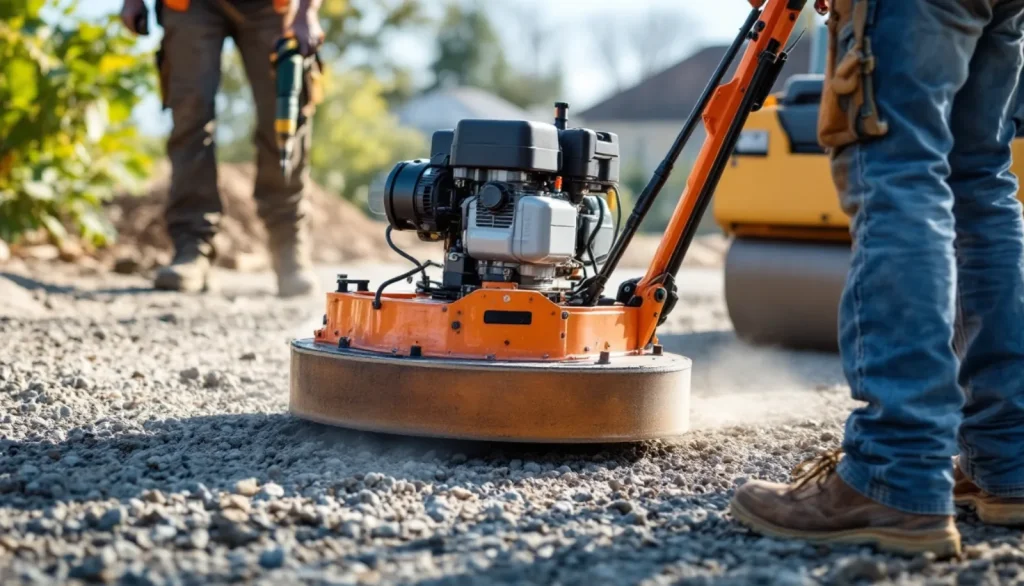
Soil Compactor Guide: Plate vs Jumping Jack vs Roller
A soil compactor is a machine that presses air and voids out of soil, gravel, or base material so the surface above it (a patio, driveway, foundation pad, or trench backfill) does not settle, crack, or heave later. The three machines most jobs come down to are the vibrating plate compactor for granular material, the rammer (jumping jack) for cohesive clay and tight trenches, and the smooth drum roller for large open areas. Picking the wrong one wastes passes and still leaves you with settlement. This guide matches the machine to the job, gives the force and size specs that actually matter, and runs the rent-versus-buy math at 2026 prices.
Which soil compactor do you need?
Match the machine to the material, not the brand. Granular material (sand, gravel, crushed stone, decomposed granite, paver base) compacts best under a vibrating plate compactor. Cohesive material (clay, silt, mixed native trench backfill) needs the high-impact blows of a rammer, also called a jumping jack or tamping rammer. Large flat areas of road base or sub-base call for a vibratory smooth drum roller. Using a plate on wet clay or a rammer on loose gravel produces weak compaction no matter how many passes you run.
| Machine | Best material | Typical weight | Compaction force | Lift depth per pass | Best for |
|---|---|---|---|---|---|
| Vibrating plate compactor (forward) | Sand, gravel, crushed stone, paver base | 100 to 200 lbs | ~3,000 to 5,000 lbf | 4 to 8 inches | Patios, walkways, paver bedding, small driveways |
| Reversible plate compactor | Gravel with or without fines, deeper base lifts | 300 to 800 lbs | ~6,000 to 10,000+ lbf | 8 to 18 inches | Driveway base, sub-slab, larger granular areas |
| Rammer (jumping jack) | Clay, silt, cohesive native backfill | 140 to 200 lbs | ~3,000 to 3,500 lbf impact | 6 to 12 inches | Trenches, around footings, confined spaces |
| Smooth drum roller (walk-behind or ride-on) | Road base, sub-base, broad granular areas | 1,000+ lbs | Drum width 24 to 84 inches | 6 to 16 inches | Parking pads, road base, large flat grades |
Specs in this table are typical equipment-class ranges drawn from rental-fleet and manufacturer figures (Beehive Rental and Sales, EquipmentShare, Sakai America); the exact numbers vary by model, so read the plate of the unit you rent. The single most useful rule: if the material is sticky and holds a shape in your hand, it is cohesive and wants a rammer; if it pours and crumbles, it is granular and wants a plate.
How do you tell granular soil from cohesive soil?
Squeeze a handful of moist soil. If it holds a ribbon or a fingerprint and feels sticky, it is cohesive (clay or silt) and wants a rammer. If it crumbles apart and feels gritty, it is granular (sand, gravel, decomposed granite) and wants a plate. Most native trench backfill is cohesive; most engineered base and bedding material is granular. This one test decides the machine before you rent anything.
The reason the distinction matters comes down to how each soil resists compaction. Cohesive soils hold air in small pockets that only deep impact blows can drive out, which is the rammer’s job. Granular soils have larger voids that high-frequency vibration shakes closed, which is the plate’s job. A plate vibrating on clay just polishes the surface while the clay below stays loose; a rammer pounding loose gravel scatters it instead of densifying it.
Mixed soils are the gray zone. Backfill that is part clay and part rock often gets the rammer for the lower cohesive lifts and a plate for any granular cap. When in doubt on a structural job, send a sample for a Proctor test so the target density and optimum moisture are known numbers rather than a guess.
Which soil compactor for your specific job?
The fastest way to choose is by the job, not the soil science. A paver patio or walkway wants a forward-plate compactor around 14 to 20 inches and 3,000 to 5,000 lbf. A utility or drainage trench wants a rammer. A driveway or sub-slab base wants a reversible plate. A large flat pad or road base wants a roller. Below 20 to 30 square feet, a hand tamper is enough.
| Your job | Machine to rent | Why |
|---|---|---|
| Paver patio or walkway | Forward plate, 14 to 20 in, ~5,000 lbf class | Granular base plus ICPI-grade paver seating with a paver pad |
| Drainage or utility trench | Rammer (jumping jack) | Narrow foot fits trench, deep impact compacts cohesive backfill |
| Driveway or sub-slab base | Reversible plate | Deeper lifts and higher force for thick granular base |
| Large flat pad or road base | Smooth drum roller | Wide drum covers broad areas in fewer passes |
| Edging, repairs, under 20 to 30 sq ft | Hand tamper | Plate is overkill and hard to maneuver in tight spots |
Plate compactor vs jumping jack vs roller
The plate compactor uses a flat steel plate and a high-frequency vibration (a rapid, shallow series of impacts) to settle granular particles. The jumping jack drives a narrow foot down with a hard, low-frequency impact that penetrates cohesive soil deeper than a plate can. The roller rides a heavy drum across the surface for broad coverage. They are complementary, not interchangeable: on a paver patio you may rammer the cohesive native soil at the trench bottom, then switch to a plate for the granular base and the paver-setting pass.
Frequency versus impact is the core difference. A plate delivers many light blows that work well near the surface of loose, free-draining material. A rammer delivers fewer, heavier blows that reach down through clay where a plate would just ride on top. That is why a rammer wins in a narrow utility trench (its plate is roughly 11 by 13 inches and fits between trench walls) and a plate wins on an open gravel pad.
Pass count depends on lift thickness, moisture, and force, but a practical starting point on a thin granular lift is two to four passes, checking density after. The construction-handbook rule is to compact in lifts no thicker than the machine can reach, then verify; if an 18-inch lift will not reach target density, drop the lift to 10 to 12 inches or add passes (per guidance compiled at TheConstructor.org). For anything structural, a soils engineer should confirm density with a field test rather than a feel.
What plate size and force do you need for pavers?
For a typical paver patio or walkway, a plate compactor in the 3,000 to 5,000 lbf range and a plate around 14 to 20 inches wide handles both the granular base and the paver-setting pass. The Interlocking Concrete Pavement Institute (ICPI) recommends roughly a 5,000-lbf-class plate for consolidating pavers and seating jointing sand; lighter machines under-seat the joints, and machines around 7,000 lbf or more can crack or chip the pavers (guidance summarized by Tomahawk Power and Pave Tool).
Two more paver-specific points that most listicles skip. First, always run a paver pad (a polyethylene mat that clamps to the plate) over finished pavers so the steel never touches the stone. Second, compact the base in lifts: a 14- to 20-inch plate compacts granular paver base well at 4 to 6 inches per lift, so build a 6- to 8-inch base in at least two passes-per-lift rather than one deep dump. Below roughly 20 to 30 square feet, a hand tamper is fine; above that, rent a plate.
- Excavate and grade the subgrade, then compact the native bottom (rammer if it is clay, plate if it is sandy).
- Add granular base in lifts of 4 to 6 inches; compact each lift with the plate before adding the next.
- Screed the bedding sand; do not compact bedding sand directly.
- Lay pavers, then make the final consolidation pass with a paver pad on a 5,000-lbf-class plate.
- Sweep in jointing sand and make a second light pass to lock the joints.
How deep and how wet should the soil be?
Compact in thin lifts at the right moisture and the machine does the work; skip either and no machine saves you. Build up base material in lifts the machine can reach (commonly 4 to 8 inches for a plate, 6 to 12 inches for a rammer) and compact each lift before adding the next. Soil also has an optimum moisture content: too dry and particles will not slide together, too wet and water fills the voids you are trying to remove.
That optimum comes from the Proctor compaction test, the lab method that pairs a soil’s moisture with its maximum dry density. Field crews aim to stay within roughly 2 to 3 percent of that optimum moisture; outside that band, hitting target density gets much harder (per the Proctor test references at Gilson and Geoengineer.org). For a homeowner, the practical version is simple: the base should be damp enough to clump but not muddy. A light mist between lifts on a dry day often makes the difference between a base that locks up and one that keeps moving.
Compacted base is also the fix for one of the most common lawn and hardscape failures: settling over poorly prepared, loose, or compacted or disturbed soil that was never properly densified before the surface went down.
Should you rent or buy a soil compactor?
Rent for a one-time project; buy only if you will use it several times a year. A vibrating plate compactor rents for roughly $60 to $100 a day or $250 to $400 a week in 2026, a rammer for a similar range, and a roller for $150 to $500 a day (rates from Beehive Rental and Sales and CountBricks 2026 regional data; your metro varies). A new entry-level plate compactor runs from a few hundred to over a thousand dollars, so the break-even is several rental days.
| Option | 2026 cost | Break-even vs renting | Best when |
|---|---|---|---|
| Rent a plate compactor | ~$60 to $100/day, $250 to $400/week | n/a | One patio, one driveway, occasional repair |
| Rent a rammer (jumping jack) | ~$60 to $100/day, $250 to $400/week | n/a | A single trench or footing job |
| Rent a roller | ~$150 to $500/day | n/a | Large flat base, road or lot prep |
| Buy a light plate compactor | ~$700 to $1,800 new | About 7 to 18 rental days | Several projects a year, or a working crew |
For most homeowners doing one paver patio or one drainage repair, renting wins clearly: you avoid storage, maintenance, and the cost of a machine that sits idle. Rent from Home Depot, United Rentals, Sunbelt, or a local equipment yard, where 14-inch and 20-inch plates are standard stock. Confirm the machine’s force rating before you load it, because a 100-lb plate and a 400-lb reversible plate are different tools for different lifts.
Common compaction mistakes
Most compaction failures trace to four errors, and all of them are avoidable. They cost more to fix after the surface is down than they ever would have cost to do right the first time, because the fix usually means tearing the surface back up.
- Wrong machine for the soil. A plate on clay or a rammer on loose gravel never reaches density; match granular to plate, cohesive to rammer.
- Lifts too thick. Dumping 12 inches of base and compacting once leaves the bottom loose; build in 4- to 8-inch lifts.
- Wrong moisture. Bone-dry or muddy base will not lock; aim for damp-clumping, within a few percent of optimum.
- Too few passes, or no verification. Run multiple passes and, for anything structural, confirm density with a field test rather than guessing.
If you are hiring this out rather than renting yourself, base prep and compaction quality is exactly the kind of detail that separates a lasting install from a callback, so it belongs on your questions list when you vet a landscaper or vet a hardscape contractor. A bid that skips proper compaction is cheaper for a reason. For the full cost picture on hardscape and lawn work, see our 2026 lawn and landscape cost guide.
Operating a soil compactor safely
A soil compactor throws vibration, exhaust, and dust, so a few habits protect both the operator and the finish. Wear hearing protection and steel-toe boots, keep both hands on the handle, and let the machine pull itself forward rather than forcing it. On dry granular material, a unit with a water tank cuts silica dust; without one, dampen the lift first. Never run a gas compactor in an enclosed trench without ventilation.
Vibration also travels into hands and arms over long sessions, so take breaks on big jobs and let the machine idle between passes. On slopes, work up and down rather than across so the unit cannot slide sideways. Keep the plate clear of utility markings: call 811 before any trench compaction so you are not pounding base over a shallow gas or water line.
Soil compactor questions answered
Short answers to the questions that come up most when people choose a soil compactor for a home project.
- Can one machine do everything? No. Plates handle granular material near the surface; rammers handle cohesive soil and tight trenches; rollers handle large flat areas. Many jobs use two machines in sequence.
- Do I need a plate compactor for a paver patio? Yes, above roughly 20 to 30 square feet. Below that a hand tamper works, but a 14- to 20-inch plate gives a far more reliable base and paver-setting pass.
- How many passes? Commonly two to four per thin lift, but it depends on lift thickness, moisture, and force. Verify density rather than counting passes alone.
For broader site prep, our guides on renovating bare and settled spots and installing drip irrigation cover the steps that come before and after you compact.
Last reviewed: June 2026
HMNDP Editorial Team, reviewed by HMNDP turf and horticulture editors.
Frequently asked questions
What kind of soil compactor do I need for pavers?
A vibrating plate compactor is the right tool for paver bases and patios. For setting the pavers themselves, ICPI-aligned guidance points to a 5,000-lbf-class plate run with a paver pad; lighter machines under-seat the joints and machines near 7,000 lbf can crack stone. Below 20 to 30 square feet, a hand tamper works fine.
What is the difference between a plate compactor and a jumping jack?
A plate compactor uses high-frequency vibration through a flat steel plate to settle granular material like sand and gravel near the surface. A jumping jack (rammer) delivers heavy, low-frequency impact through a narrow foot, reaching deep into cohesive clay and silt and fitting inside trenches. Plate equals granular, rammer equals cohesive.
How do I know if the compactor is right for my soil type?
Squeeze a moist handful. If it holds a ribbon and feels sticky it is cohesive (clay or silt) and wants a rammer. If it crumbles and feels gritty it is granular (sand, gravel, decomposed granite) and wants a plate. Most native trench backfill is cohesive; most engineered base material is granular.
How many passes does a plate compactor need?
A practical starting point is two to four passes per thin lift, but the real number depends on lift thickness, soil moisture, and machine force. Build base in 4- to 8-inch lifts and compact each before adding more. For structural work, verify density with a field test rather than counting passes alone.
Should I rent or buy a soil compactor?
Rent for a one-time project; buy only if you use it several times a year. A plate compactor rents for roughly $60 to $100 a day or $250 to $400 a week in 2026, while a new light plate runs about $700 to $1,800. That puts the break-even near 7 to 18 rental days for most homeowners.
What size plate compactor do I need?
For a paver patio or walkway, a 14- to 20-inch plate at roughly 3,000 to 5,000 lbf handles both base and paver-setting passes. Larger driveway or sub-slab base lifts call for a reversible plate in the 300- to 800-lb class with higher force and deeper reach per lift. Read the unit’s plate for its exact rating.
How deep can a soil compactor compact in one pass?
Lift depth varies by machine: a plate compactor reaches roughly 4 to 8 inches per lift, a rammer 6 to 12 inches, and a roller 6 to 16 inches. Build base up in lifts the machine can reach and compact each one before adding the next. If a thick lift will not reach density, reduce the lift or add passes.
Can one compactor do every job?
No. Plates handle granular material near the surface, rammers handle cohesive soil and tight trenches, and rollers handle large flat areas. Many real jobs use two machines in sequence, for example a rammer on the cohesive trench bottom and a plate on the granular base above it. Match the machine to the material every time.