
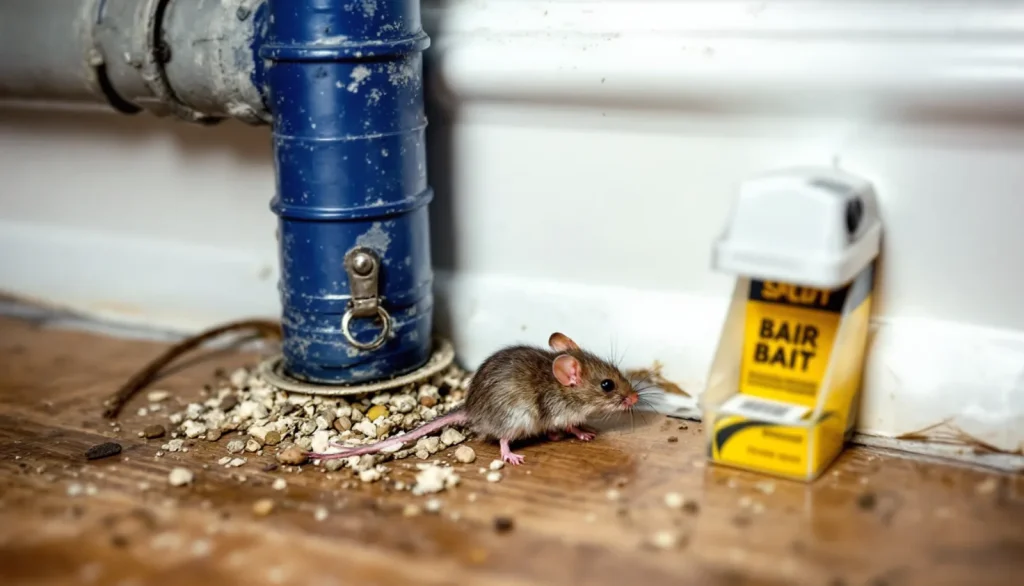
Pest Control for Mice: Seal-Up, Traps, and 2026 Bait Rules
Effective pest control for mice rests on three moves done in order: seal every gap a pencil can fit through (a mouse needs only a 1/4 inch hole, per the CDC), set multiple snap traps where droppings show, and store food in sealed containers so nothing draws the next mouse in. The species in almost every US home is the house mouse (Mus musculus), and one visible mouse usually signals several more in wall voids you cannot see. This guide gives the method-by-method comparison, the trap counts pros actually use, and the 2026 EPA rodenticide rules that quietly changed what you are allowed to buy.
How do I know it is mice and not something else?
House mice leave four signs you can confirm in a day: rod-shaped droppings about 1/8 to 1/4 inch long (often near food and along walls), a musky ammonia odor in enclosed spaces, gnaw marks on packaging or wood with paired tooth grooves, and rub marks (greasy smudges) along baseboards and pipe runs where they travel. Scratching inside walls at night points to nesting.
Mice are nocturnal and follow walls, so activity clusters in kitchens, pantries, garages, basements, and around appliance lines. A single house mouse female can produce 5 to 10 litters per year, which is why a small problem becomes a wall-void colony fast if you only catch one and stop. Confirm activity before you spend, then map where the droppings concentrate, because that map decides where traps go.
Seal the holes first: exclusion is the only permanent fix
Sealing entry points is the one step that makes every other method stick, because traps and bait only thin the population while open gaps refill it. The CDC notes a mouse can pass through a hole the width of a pencil, roughly 1/4 inch, so anything that size or larger is an entry point. Without exclusion, your timeline resets with every new mouse that walks in.
Use the right materials. The CDC recommends steel wool packed with caulk or spray foam for small holes, and lath screen, metal sheeting, cement, or 1/4 inch hardware cloth for larger openings. Steel wool alone fails because mice gnaw it loose over time, which is why pairing it with caulk matters. Skip latex, plastic, rubber, and plain wood as plugs, since mice chew straight through them.
Work a checklist of the common gaps:
- Gaps around kitchen and bathroom pipes under sinks, plus washing machine, water heater, and furnace lines.
- Floor vents, floor drains, and the gap where utility lines (electric, gas, water, sewer) enter the foundation.
- Door sweeps and weather stripping on exterior doors, and gaps under garage doors.
- Foundation cracks, crawl space vents, attic gable vents, and the base flashing where siding meets the slab.
- Around dryer vents and behind appliances pulled away from the wall.
Exclusion is also what separates a real fix from a recurring nuisance. If your problem traces back to recurring lawn or perimeter conditions (woodpiles against the house, dense ground cover, bird seed near the foundation), our guide to a year-round grass and yard maintenance schedule covers keeping the perimeter unattractive to rodents.
Snap traps vs bait stations: which method for which situation
For most homes, snap traps are the first choice: well-placed snap traps capture roughly 80 to 90 percent of mice, work indoors safely, and give an immediate, visible result with no poisoned mouse dying inside a wall. Bait stations suit larger or hard-to-reach infestations but carry the dead-in-wall odor risk and the 2026 product limits below. The two methods solve different problems, so match the tool to the situation.
| Method | Best for | Typical effectiveness | Setup time | Key drawback |
|---|---|---|---|---|
| Wood or plastic snap traps | Small to moderate indoor infestations, known runways | ~80 to 90% of visiting mice when placed well | 2 to 5 min per trap | Need to know where mice travel; must reset and clear |
| Enclosed bait stations (consumer) | Larger or uncertain infestations, garages, perimeters | ~85 to 95% once mice feed regularly | 15 to 30 min per unit | Mice can die in wall voids (odor); slower; product rules apply |
| Glue boards | Monitoring activity only | Low as a primary control; inhumane for capture | 2 to 5 min | Catches non-targets; not a population fix |
| Live catch-and-release | Single mouse, low tolerance for kill traps | Low for true infestations | 2 to 5 min | Released mice often return; one trap rarely matches the count |
Many homes do best combining both: snap traps for fast knockdown in active rooms, plus enclosed stations along the garage or perimeter for ongoing pressure. Whichever you choose, exclusion still has to happen or the catch never ends.
How many traps, and where exactly?
Use far more traps than feels necessary, and place them perpendicular to the wall with the trigger end almost touching the baseboard, since mice run with one side against a wall. Pros commonly set traps at 2 to 10 foot intervals along active walls, and for a room with heavy activity may deploy 6 to 20 traps. Most homeowners under-trap and under-count the mice, which stretches the job for weeks.
Bait the trigger with a pea-sized dab of peanut butter, hazelnut spread, or a bit of bacon, not a chunk a mouse can steal cleanly. Set traps in pairs a couple inches apart on busy runways so a mouse jumping one lands on the next. Leave them 2 to 3 days; if a spot produces nothing, move it to where fresh droppings appear, because placement matters more than trap brand.
The 2026 EPA rodenticide rules changed what you can buy
If you reach for poison, know that the consumer rodenticide market changed. The EPA no longer registers second-generation anticoagulant rodenticides (brodifacoum, bromadiolone, difenacoum, difethialone) for consumer products, leaving only bromethalin, chlorophacinone, and diphacinone available to homeowners. Loose and pelleted bait is banned for consumers, and retail products must come as ready-to-use, tamper-resistant bait stations.
Two more limits matter. Consumer refill packages are capped at one pound of bait, and consumer rodenticides are labeled for use indoors, or outdoors within 50 feet of buildings, not for broadcast across a yard. EPA 2026 mitigation also requires tamper- and weather-resistant stations for any outdoor, above-ground placement where children, pets, or wildlife may be present. These rules exist to cut secondary poisoning of pets and wildlife, so the legal, safe path is an enclosed station, never scattered bait.
| Rodenticide rule (consumer) | What it means for you |
|---|---|
| SGARs removed from consumer market | No brodifacoum, bromadiolone, difenacoum, or difethialone in homeowner products |
| Allowed active ingredients | Bromethalin, chlorophacinone, diphacinone only |
| Loose and pelleted bait banned | Must buy a pre-loaded, tamper-resistant bait station |
| One pound refill cap | Retail refill packages limited to 1 lb of bait |
| Placement label | Indoors, or outdoors within 50 feet of buildings |
Do peppermint oil and ultrasonic repellents actually work?
Treat peppermint oil and ultrasonic devices as weak prevention, not removal. Mice dislike the menthol in peppermint oil, and the scent may deter them briefly, but once mice are nesting with food and shelter inside, smell will not drive them out. Ultrasonic repellers emit high-frequency sound mice find annoying, yet mice adapt to it and furniture blocks the waves, so results are inconsistent.
Other commonly cited scents (vinegar, ammonia, cedar) have the same ceiling: they may discourage casual entry but do nothing about an established colony. The reliable formula stays the same: seal the gaps, trap the population, and store food so nothing rewards a return visit. Spend on exclusion and traps before gadgets.
What about disease? Clean up droppings safely
Mouse droppings, urine, and saliva can carry hantavirus, and rodents can contaminate food with Salmonella, so cleanup method matters as much as removal. Do not sweep or vacuum dry droppings, because that can aerosolize particles. Hantavirus, while rare, can cause severe respiratory illness, which is why the CDC ties prevention directly to exclusion and safe cleanup.
Clean up the CDC way: ventilate the space, wear gloves, spray droppings and nests with a disinfectant or a 1 part bleach to 10 parts water solution, let it soak about 5 minutes, then wipe up with paper towels and bag the waste. Wash hands afterward. This is the one part of mouse work where shortcuts carry a real health cost.
When should I call a professional, and what does it cost?
Call a pro when the infestation is large or recurring, when mice are nesting inside walls, attics, or crawl spaces, or when DIY trapping has run 2 to 3 weeks without a clear drop in activity. Professional mouse extermination commonly runs $150 to $550 for a typical job, with single visits often $150 to $500 and ongoing monthly monitoring around $75 to $150 per month, depending on home size and severity.
Expect a real program, not one spray. Most infestations take 2 to 4 visits over 1 to 3 weeks, starting with inspection and trap or station placement, then follow-ups to clear, reset, and seal entry points. A small DIY job often resolves in 2 to 4 weeks; wall-void or attic nests can take 1 to 3 months to fully clear and exclude. The same vetting logic you would use for any home trade applies here, so our checklist on how to vet a home-services contractor and a sense of current home-services pricing both transfer to choosing a pest control company. For broader yard and home maintenance reading, start at our lawn and landscape learning hub.
The fastest reliable path, in order
The fastest dependable result is sequence, not a single product: inspect and map droppings, seal every 1/4 inch gap with steel wool and caulk or hardware cloth, then flood the active areas with snap traps placed perpendicular to walls. Add an enclosed bait station only where trapping cannot reach. Clean droppings the CDC way, store food in sealed containers, and keep the perimeter clear. Small infestations clear in 2 to 4 weeks this way; skipping the sealing step is what keeps people fighting mice for months.
Last reviewed: June 2026
HMNDP Editorial Team, reviewed by HMNDP turf and horticulture editors.
Frequently asked questions
What smell will keep mice away?
Mice dislike the menthol in peppermint oil, and scents like vinegar, ammonia, and cedar may deter casual entry. None remove an active infestation. Once mice nest with food and shelter inside, smell will not drive them out. Use scents as minor prevention only; rely on sealing gaps and trapping for actual removal.
How long does it take to get rid of mice?
A small infestation usually clears in 2 to 4 weeks with sealing plus trapping. Moderate cases run 3 to 6 weeks, and nests inside walls, attics, or crawl spaces can take 1 to 3 months. Without sealing every entry point, the timeline resets each time a new mouse enters, so exclusion comes first.
What is the fastest way to get rid of mice?
Inspect and map droppings, seal every gap a 1/4 inch or larger with steel wool and caulk or hardware cloth, then set many snap traps perpendicular to walls in active areas. Add an enclosed bait station only where traps cannot reach. Clean droppings safely and store food sealed so nothing draws the next mouse.
Are snap traps or bait stations better for mice?
Snap traps capture roughly 80 to 90 percent of mice, give immediate results, and avoid a poisoned mouse dying in a wall, so they suit most indoor jobs. Enclosed bait stations (85 to 95 percent once mice feed) fit larger or hard-to-reach infestations. Many homes combine both: traps indoors, stations along the perimeter.
Can I still buy mouse poison in 2026?
Yes, but the options narrowed. The EPA removed second-generation anticoagulants (brodifacoum, bromadiolone, difenacoum, difethialone) from consumer products, leaving bromethalin, chlorophacinone, and diphacinone. Loose and pelleted bait is banned for consumers, so you must buy a pre-loaded, tamper-resistant bait station, capped at one pound of refill bait, for indoor or near-building use.
How small a hole can a mouse fit through?
A mouse can squeeze through a hole the width of a pencil, about 1/4 inch, per the CDC. That is why exclusion means sealing every gap that size or larger: pipe penetrations, door sweeps, vents, and foundation cracks. Use steel wool with caulk or 1/4 inch hardware cloth, since mice gnaw through plain steel wool, plastic, rubber, and wood.
How much does a mouse exterminator cost?
Professional mouse extermination commonly runs $150 to $550 for a typical job. Single visits often fall between $150 and $500, and ongoing monthly monitoring runs about $75 to $150 per month. Most jobs need 2 to 4 visits over 1 to 3 weeks for inspection, trap or station placement, follow-up clearing, and sealing of entry points.
Do ultrasonic mouse repellers work?
Ultrasonic repellers emit high-frequency sound mice find annoying, but results are inconsistent. Mice adapt to the noise over time, and walls and furniture block the waves, so coverage is limited. They do nothing for an established colony. Put your money into sealing entry points and snap traps before buying electronic repellent devices.