
Mulch Glue: Does It Work, and When It’s Worth It
Mulch glue is a sprayable water-based polymer binder (usually polyvinyl acetate or an acrylic emulsion) that dries into a flexible film locking the top layer of mulch, pine straw, rubber mulch, or gravel in place against wind and rain. It works, but only in narrow conditions. On a windy bed, a leaf-blower path, or a gentle slope it earns its $60 to $90 per gallon. On a flat, sheltered bed it mostly buys you nothing a clean edge and a deeper mulch layer would not. This guide covers what it actually does, where it helps versus where it wastes money, how to apply it, and a homemade recipe that costs a fraction of the bottle.
What is mulch glue and how does it work?
Mulch glue is a spray-on adhesive that bonds loose landscape material into a semi-rigid crust. The active ingredient is a water-based polymer, commonly polyvinyl acetate (the same family as white school glue) or an acrylic emulsion, suspended in water. You spray it over already-placed mulch, the water evaporates over a few hours, and the polymer cures into a flexible film that grips each piece to its neighbors and to the soil surface.
The film is not continuous. Manufacturers formulate it to bridge particles without sealing the bed, so water, air, and liquid feed still pass through the gaps to the root zone. That permeability is why the product is generally marketed as safe for established ornamentals. Most labels still advise keeping it off edible plants and out of direct contact with stems.
Named products on the US market include PetraMax, Shabebe Mulch Bond, NorthRock Landscape Loc, Black Diamond Dominator Mulch Anchor, and Vital Coat Gravel Guard. They differ mostly in cure time, color tint, and which material they grip best. Hardwood chips bond well; fine bark and loose rock are harder to hold.
Does mulch glue actually work?
Yes, within limits. In product testing by Bob Vila and hands-on reviews, glued beds held up to leaf-blower air and simulated rain with minimal shifting, and a Texas homeowner reported a bed surviving five straight days of rain. The honest qualifier is durability: the bond is not permanent. On exposed slopes it can break down after two or three hard rains, and even in easy conditions a recoat is needed every 12 to 24 months, often sooner.
What it does not do matters as much as what it does. Mulch glue does not stop weeds (it locks mulch down, it is not a pre-emergent), does not fix bad drainage, does not replace edging, and does not turn a gravel path into a walkable hard surface. It cannot take heavy foot traffic. Treat it as a stabilizer for the top layer, not a structural fix.
When mulch glue helps versus when it wastes money
Mulch glue earns its cost in three situations: gentle slopes where mulch creeps downhill, wind-exposed or open beds, and high-blow zones near driveways and walkways where leaf blowers scatter the surface. It wastes money on flat, sheltered beds, on cheap mulch you plan to refresh annually anyway, and on steep grades where it fails fast and a barrier would have worked. Match the spend to the problem.
| Situation | Glue verdict | Why / better option |
|---|---|---|
| Gentle slope, mulch creeping downhill | Worth it | Binds the top layer; recoat as it breaks down |
| Open, wind-exposed bed | Worth it | Stops surface scatter in gusts |
| High-blow zone by driveway or path | Worth it | Lets you blow leaves without moving mulch |
| Rubber mulch or pea gravel that migrates | Often worth it | Holds loose material; rock needs a rock-rated product |
| Flat, sheltered bed | Skip it | A clean edge plus 2 to 3 inches of mulch holds fine |
| Cheap mulch refreshed every spring | Skip it | You are reapplying mulch anyway; no payback |
| Steep grade, serious erosion | Skip it | Use erosion-control blanket, netting, or groundcover |
For steep, actively eroding ground, the more reliable fix is a biodegradable erosion-control blanket (coconut coir, straw, or jute) or established groundcover whose roots hold soil. Glue is a surface treatment, not slope engineering. If the underlying issue is runoff across the yard, a structural answer like a backyard rain garden manages water better than any binder. Heavy washout on a planted slope often signals a drainage problem worth solving first.
How to apply mulch glue
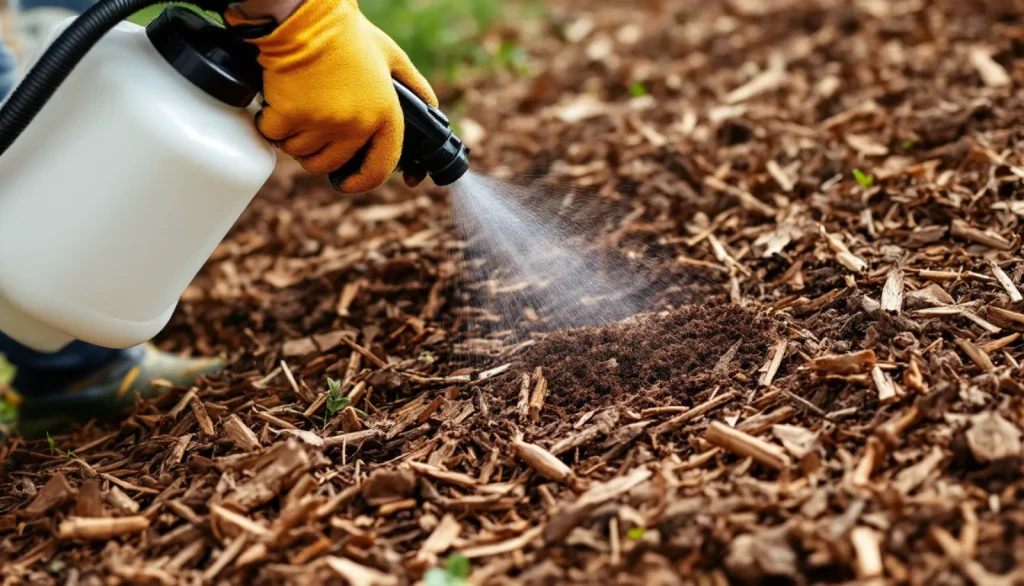
Application is simple but unforgiving of shortcuts. The glue locks in whatever you spray it on, so the bed has to look right before you start. Spread and fluff the mulch, clean the edges, and work on a dry, calm day with no rain in the forecast for the curing window. Then build the bond in thin coats, not one heavy soak.
- Prep the bed: spread mulch 2 to 3 inches deep, level it, and define a clean edge. Glue will not hide a sloppy job.
- Confirm the surface is dry. Wet mulch dilutes the polymer and weakens the bond.
- Pour the glue (or DIY mix) into a clean pump sprayer or use the product’s ready-to-spray bottle.
- Apply a light, even first coat over the whole bed. Avoid puddling.
- Wait about one hour, then apply a second light coat. Two to three thin coats hold better than one thick one.
- Allow several hours of dry time (a couple of hours to nearly a full day depending on product) before rain or watering.
- Rinse the sprayer immediately. Cured polymer ruins a nozzle.
Coverage and cost vary by brand, so check the label rate. Commercial mulch glue typically runs $60 to $90 per gallon, with manufacturer durability claims up to two years on the better products. Before you buy, it helps to measure the bed area so you order the right amount instead of guessing.
Commercial mulch glue versus DIY
You can mix a homemade binder for a fraction of the bottle price, and for light-duty flat beds it performs close to the commercial version. The trade-off is strength and weather resistance: DIY recipes are best for low-stress beds, while a slope or a high-blow zone justifies the stronger commercial polymer. Match the recipe to the demand.
| Option | Recipe / spec | Rough cost | Best for |
|---|---|---|---|
| Commercial mulch glue | Ready-to-spray polymer; up to 2-year claim | $60 to $90 / gal | Slopes, wind, high-blow zones |
| DIY white-glue mix | 1 part white school glue to 3 parts warm water, plus 1 tbsp cornstarch | A few dollars / batch | Light-duty flat beds |
| DIY flour paste | Equal parts all-purpose flour and water, boiled to a thin paste | Pennies / batch | Small touch-up areas |
One caveat on DIY: it is generally not as weather-durable as a commercial product, so plan to reapply more often. Whichever route you choose, the binder only protects what is already there. It is no substitute for the basics of a healthy bed, and pairing it with the right material matters more than the glue. Our grass and bed care fundamentals cover the inputs that move most outcomes, and homeowners weighing whether to hire this out can compare against our 2026 lawn care cost benchmarks.
The honest verdict
Mulch glue is a real tool with a narrow job. Buy it if mulch keeps migrating off a gentle slope, scattering in wind, or blowing out of beds near a driveway, and recoat it every season or two. Skip it on flat, sheltered beds and on cheap mulch you replace anyway, because a clean edge and a proper 2 to 3 inch depth do the same work for free. On steep, eroding ground, spend the money on a blanket or groundcover instead. Used in the right spot, it saves replacement mulch and cleanup time. Used everywhere, it is a recurring cost chasing a problem you may not have.
Last reviewed: June 2026
HMNDP Editorial Team, reviewed by HMNDP turf and horticulture editors.
Frequently asked questions
Does mulch glue work?
Yes, within limits. The polymer film grips the top layer of mulch so it resists wind and rain, and tested beds held up to leaf-blower air and multi-day rain. The bond is not permanent. On exposed slopes it can break down after two or three hard rains, and even easy beds need a recoat every 12 to 24 months.
What is mulch glue made of?
Mulch glue is a water-based polymer, commonly polyvinyl acetate (the white-glue family) or an acrylic emulsion, suspended in water. You spray it on, the water evaporates, and the polymer cures into a flexible film that bonds particles together. The film is gapped on purpose so water and air still reach the soil.
How long does mulch glue last?
Most commercial mulch glue lasts 12 to 24 months before it needs another coat, and the better products claim up to two years. Heavy rain, direct sun, steep slopes, and foot traffic shorten that. Many homeowners simply recoat once a year when they refresh the mulch, which keeps the bond consistent.
Is mulch glue safe for plants?
It is generally considered safe for established ornamentals because it dries to a permeable film that lets water and air pass to the roots, so it does not block drainage. The polymer is typically non-toxic to people and pets. Most labels still advise keeping it off edible plants and direct stem contact.
How much does mulch glue cost?
Commercial mulch glue typically runs $60 to $90 per gallon. A homemade mix of one part white school glue to three parts warm water (plus a tablespoon of cornstarch) costs a few dollars per batch and works for light-duty flat beds, though it is less weather-durable and needs reapplying more often than the bottled product.
Does mulch glue work on slopes?
It helps on gentle slopes where mulch slowly creeps downhill, and you recoat it as it wears. On steep, actively eroding grades it fails fast, sometimes after two or three hard rains. For those, an erosion-control blanket (coir, straw, or jute), netting, or established groundcover holds soil far more reliably than any surface binder.
How do you apply mulch glue?
Spread and level the mulch 2 to 3 inches deep and clean the edges first, since glue locks in whatever it touches. Work on a dry, calm day, then spray two to three light coats with about an hour between them. Allow several hours of dry time before rain, and rinse the sprayer immediately.
Does mulch glue stop weeds?
No. Mulch glue locks the existing mulch layer in place; it is not a pre-emergent or herbicide and does nothing to prevent weed seeds from germinating. For weed suppression you still rely on a thick mulch layer, a weed barrier, or a pre-emergent. Glue only keeps the mulch you already laid from scattering.