
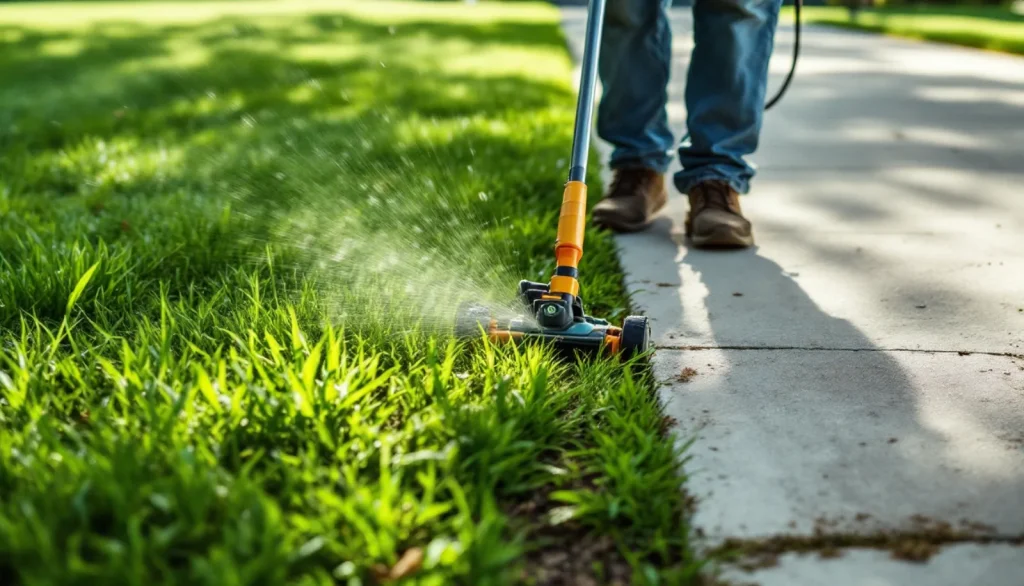
Lawn Edger Guide: Manual vs Powered, Blades, and Use
A lawn edger is a tool that cuts a clean vertical line where turf meets a hard surface or planting bed, and the right one depends on three things: how much edge you cut, how often, and what powers it. This guide covers the four edger types (manual half-moon, manual rotary, powered stick edger, walk-behind wheeled), the gas vs battery vs corded decision, blade and depth specs, and how to actually edge a lawn. It is a buying and use guide, not a store. If you are picking edging materials instead (brick, steel, plastic borders), see our companion guide on lawn edging ideas and border materials.
What does a lawn edger do, and is it different from a string trimmer?
An edger uses a rigid metal blade spinning on a vertical plane to slice a deep, straight boundary line, usually along driveways, sidewalks, and bed edges. A string trimmer uses flexible line to cut grass mowers miss. They overlap but are not the same: an edger cuts cleaner and deeper, a trimmer is more versatile. Per Greenworks and Lawn Love, a trimmer held vertically can fake an edge, but it will not match a blade edger for a crisp, lasting line.
The practical rule: if you want a sharp defined border that stays sharp for weeks, use a blade edger. If you mostly need to clean up around fences, trees, and beds, a string trimmer covers more ground. Many homeowners own both, or buy a multi-head battery system that swaps a trimmer head for an 8-inch edger attachment.
The four types of lawn edger
Lawn edgers fall into four types: two manual (half-moon spade and rotary wheel) and two powered (stick edger and walk-behind wheeled). Manual tools cost $35 to $80 and suit small yards and bed work. Powered stick edgers run $100 to $450 and handle most suburban lots. Walk-behind wheeled edgers are the heaviest and most stable, built for long driveways and pro crews. Pick by edge length and how often you cut.
| Type | Best for | Typical price | Effort and notes |
|---|---|---|---|
| Manual half-moon (spade) | Bed edges, small lawns, new trench cuts | $35 to $80 | Foot-powered; about 3.8 lbs; per Bob Vila testing, edged a 70-foot driveway in 5 minutes |
| Manual rotary (dual-wheel) | Sidewalk and driveway maintenance on small yards | $35 to $75 | Roll-and-cut star wheel; quiet; no power needed; slower on overgrowth |
| Powered stick edger | Most suburban lawns and bed lines | $100 to $450 | Handheld; 13 to 16 lbs; gas, battery, or corded; curved or straight shaft |
| Walk-behind wheeled | Long edges, large lots, professional crews | $300 and up | Most stable depth control; heaviest; usually gas |
The half-moon edger is the only tool here that does double duty: it cuts new bed trenches and re-cuts existing ones, which a stick edger does poorly. If you are shaping new borders or installing edging materials, keep a half-moon in the shed regardless of what powered tool you own.
Gas vs battery vs corded: how to choose a power source
Choose corded electric for small yards on a budget, battery for medium yards where convenience matters, and gas for large lots or daily professional use. Per Bob Vila’s 2026 testing, corded models run $35 to $150 and offer unlimited runtime on a cord, battery models run $250 to $450 with about one hour per charge, and gas models run $200 to $450 with 1.5-plus hours per tank. Modern 56V to 60V battery edgers now match gas on cutting power.
| Power source | Runtime | Power level | Cost range | Best fit |
|---|---|---|---|---|
| Corded electric (10 to 12 amp) | Unlimited (cord limited) | Light to medium; weakest of the three | $35 to $150 | Small yards near an outlet |
| Battery (56V to 60V) | About 1 hour per 2 to 5 Ah pack | Medium to high; near-gas on top models | $250 to $450 | Medium yards, low noise, no fumes |
| Gas (2-cycle or 4-cycle) | 1.5-plus hours per tank | Highest torque, unlimited refuel | $200 to $450 | Large lots, heavy roots, pro crews |
Gas adds maintenance most homeowners underestimate: 2-cycle engines need oil mixed into the fuel, and all gas tools want fresh fuel, spark plug checks, and off-season fuel stabilizer. Battery and corded tools skip all of that. For a quarter-acre lot edged twice a month, a 56V or 60V battery stick edger is the common sweet spot.
Blade types and cutting depth
Powered edgers use a flat steel blade, and the edge shape matters: a plain rectangular edge is the all-purpose default, a scoop-cut edge protects delicate bed plantings, and a star or three-point blade carves a firm hard boundary. Maintenance cuts run 0.5 to 2 inches deep; new bed trenches go 3 to 4 inches to sever spreading roots. Powered blades adjust across roughly a 2 to 6 inch range.
Depth is where most guides get vague, so here is the split by task. Cutting too deep on a maintenance pass damages turf roots and loosens soil along the pavement, a common mistake flagged by Lawn Love and Homes and Gardens.
| Task | Depth | Why |
|---|---|---|
| Routine maintenance along pavement | 0.5 to 2 inches | Enough to keep a crisp line without root or soil damage |
| Overgrown or neglected edge | About 2 inches | Re-establishes a buried line in one or two passes |
| New bed border (the “3-inch rule”) | 3 to 4 inches | Severs grass rhizomes that creep into borders; per Homes and Gardens |
| Manual half-moon new cut | 4 to 5 inches | Manual blades cut a full trench in one foot-press |
How often should you edge?
Edge about once a month during the growing season for a clean look, but frequency tracks your grass type. Cool-season grasses like tall fescue do not creep aggressively, so every two to three weeks holds the line. Aggressive warm-season runners like Bermuda and St. Augustine spread by rhizomes and stolons, and in peak summer heat may need edging every time you mow. Match the schedule to the grass, not the calendar.
This is the gap most edger guides miss: they give one frequency number for every lawn. Warm-season turf in a hot climate creeps fast, which is why a Phoenix or Dallas Bermuda lawn needs far more edging than a fescue lawn in the upper Midwest. For the full seasonal picture by grass class, see our grass maintenance schedule by warm-season vs cool-season grass, and for warm-season region tips our Phoenix lawn care guide covers Bermuda behavior in detail.
How to edge a lawn, step by step
Edge after mowing so the perimeter is visible and the cut stays clean. Work along the existing line at a steady walking pace, keep the blade shallow for maintenance, and make a second pass on curves and overgrown spots. The full sequence below follows ECHO and Lowe’s guidance and takes most homeowners under 30 minutes on an average lot.
- Mow the lawn to a uniform height so the edge line is visible.
- Clear rocks, sticks, and large clippings that could fly up or damage the blade.
- If the soil is dry and hard, water lightly so the blade cuts cleanly.
- Put on safety glasses, gloves, long pants, closed-toe shoes, and ear protection for gas models.
- Set blade depth: 0.5 to 2 inches for maintenance, deeper only for new or overgrown edges.
- Stand with firm footing, grip both handles, and keep the tool close to your body.
- Lower the blade and walk the perimeter slowly, using the pavement or bed line as your guide.
- Slow down on curves and corners; make a second pass where the line is not crisp.
- Rake up the soil and clippings, then check the line and touch up any gaps.
Should you rent or buy a lawn edger?
Buy a manual or corded edger if you edge regularly, since both are cheap enough ($35 to $150) that one season pays them off. Rent a gas walk-behind for a one-time job like cutting fresh borders around a new install, where rental commonly runs $40 to $70 per day and you avoid storing and maintaining a heavy machine. Borrow the rule of thumb from any tool: if you will use it more than a few times a year, owning wins.
For a one-off new-bed project, the cheapest path is often a $40 half-moon spade you keep forever, not a rental. Reserve rentals for powered walk-behind machines on large or hard-soil jobs. Factor edging tools into your broader budget using our 2026 lawn care cost guide, which benchmarks DIY equipment against hiring a crew.
What to check before you buy
Before buying, match the edger to your yard size, then weigh blade depth range, weight, and runtime. Lighter tools (under 14 lbs) reduce fatigue on long edges; adjustable depth handles both maintenance and new cuts; and a combo head that swaps trimmer and edger attachments saves money and storage if you need both functions.
- Yard size: small lawn, manual or corded; medium, battery; large or pro, gas or walk-behind.
- Depth adjustment: look for a 2 to 6 inch range so one tool does maintenance and new cuts.
- Weight and shaft: 13 to 16 lbs is typical for powered handhelds; a curved shaft tracks pavement edges more easily.
- Combo capability: a multi-head battery system that takes a trimmer head plus an edger attachment replaces two tools.
- Safety features: debris guard, trigger lock, and padded grip.
Whatever you buy, an edger is one tool in a complete program. Pair it with the basics in our complete lawn care guide covering mowing, feeding, watering, and weeding.
Last reviewed: June 2026
HMNDP Editorial Team, reviewed by HMNDP turf and horticulture editors.
Frequently asked questions
Is a lawn edger different from a string trimmer?
Yes. An edger uses a rigid metal blade spinning vertically to cut a deep, crisp boundary line along driveways, sidewalks, and beds. A string trimmer uses flexible line to cut grass mowers miss. A trimmer held vertical can fake an edge, but a blade edger cuts cleaner and deeper, and the line lasts longer. Trimmers are more versatile; edgers do one job better.
How deep should a lawn edger blade go?
For routine maintenance along pavement, cut 0.5 to 2 inches deep, enough for a crisp line without root or soil damage. For a new bed border, go 3 to 4 inches to sever the grass rhizomes that creep into borders, the so-called 3-inch rule. A manual half-moon cuts 4 to 5 inches in one foot-press. Cutting too deep on maintenance passes loosens soil and harms turf roots.
How often should I edge my lawn?
Edge about once a month in the growing season, but frequency tracks your grass type. Cool-season grasses like tall fescue do not creep, so every two to three weeks holds the line. Aggressive warm-season runners like Bermuda and St. Augustine spread fast in summer heat and may need edging every time you mow. Match the schedule to the grass, not the calendar.
Do I need a gas, battery, or corded edger?
Choose corded ($35 to $150) for small yards near an outlet on a budget. Choose battery ($250 to $450, about one hour per charge) for medium yards where low noise and no fumes matter; 56V to 60V models now rival gas. Choose gas ($200 to $450, 1.5-plus hours per tank) for large lots, heavy roots, or daily pro use. Gas adds fuel and engine upkeep the others skip.
Should I edge before or after mowing?
Edge after mowing. A freshly mown lawn makes the perimeter line easy to see and gives the cleanest, most consistent edge. Mowing first also keeps the grass from being torn as you cut. Some pros edge first so the mower can clean up the soil and clippings on the final pass, so either order works, but after-mowing is the simplest for most homeowners.
Should I rent or buy a lawn edger?
Buy a manual or corded edger if you edge regularly; at $35 to $150 one season pays them off. Rent a gas walk-behind ($40 to $70 per day) for a one-time job like cutting fresh borders on a new install, avoiding storage and upkeep of a heavy machine. The rule of thumb: use it more than a few times a year and owning wins. For one-off bed cuts, a $40 half-moon spade beats a rental.
What is the easiest lawn edger to use?
For small yards and bed work, a manual half-moon spade is the simplest: foot-pressure operation, about 3.8 pounds, no fuel or charging. In Bob Vila 2026 testing one edged a 70-foot driveway in five minutes. For larger lawns, a lightweight battery stick edger under 14 pounds is easiest, since it skips cords, fuel mixing, and engine maintenance while still cutting a clean line.