
By the HMNDP Editorial Team (HMNDP Landscaping editorial team, independent reporting on lawn care, landscaping, fertilizer, water, and the green-industry business).
Last reviewed: June 2026
What is humus soil?
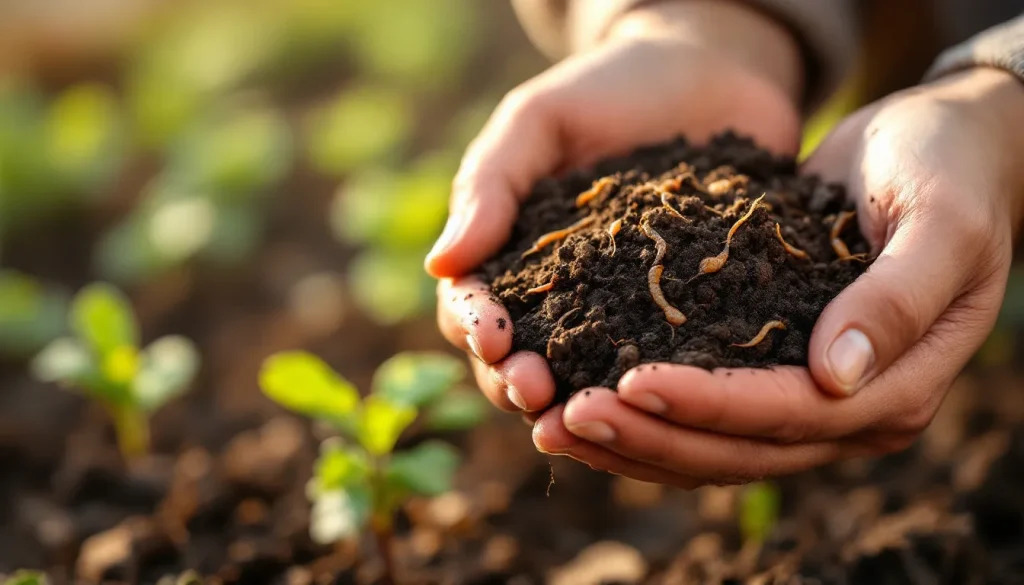
Humus soil is the dark, stable fraction of organic matter left in the ground after plant and animal material has been broken down by soil microbes to the point where it resists further decay. It is not a rock, a mineral, or a purchasable product in the strict sense. It is the finished, long-lived residue of decomposition that sits within topsoil, holds nutrients and water, and gives fertile earth its near-black color.
The word “humus” comes from the Latin for ground or earth. Note the spelling: humus (soil) has one “m”, while hummus (the chickpea dip) has two. They are unrelated.
Gardeners usually meet the term in two places: soil-science reading, where humus means the stable organic residue described above, and garden centers, where bags labeled “humus” or “humus and manure” are sold. Those bags are almost always compost or aged manure, not laboratory-grade humus. We separate the two below.
Where humus sits in the soil profile
Humus sits in the upper soil, below the loose leaf litter on the surface and within the topsoil (the A horizon). Fresh leaves and twigs form a litter layer (the O horizon) on top. As that material decays and mixes downward, the finished humus becomes part of the dark, crumbly topsoil where most plant roots feed.
A simple way to picture a soil profile from the surface down:
- O horizon (litter): fresh and partly decayed leaves, twigs, and mulch on the surface.
- A horizon (topsoil): mineral particles mixed with humus and living roots. This is where humus concentrates.
- B horizon (subsoil): clay and minerals washed down from above, low in organic matter.
- C horizon: weathered parent rock, essentially no humus.
The humus-rich, biologically active layer is usually the top 4 to 12 inches (about 10 to 30 cm). This is the zone home gardeners can realistically improve. For the bigger picture on how these layers develop, see our explainer on how soil is formed.
How is humus formed in soil? Humification explained
Humus forms through humification, the biological process in which soil organisms break down dead plant and animal matter over months and years until only stable, decay-resistant compounds remain. Easy sugars and proteins get eaten first and fast. What is left behind is dark, chemically complex, and slow to break down further. That residue is humus.
The process runs roughly in this order:
- Input: leaves, roots, dead insects, and manure land on or in the soil.
- Fragmentation: earthworms, beetles, mites, and springtails shred the material into smaller pieces, increasing surface area.
- Decomposition: bacteria and fungi consume the easy carbon (sugars, starches) and release carbon dioxide, water, and plant nutrients.
- Stabilization: the tough leftovers (partly transformed lignin, microbial byproducts, and carbon bound to clay and minerals) resist further decay and persist for years to centuries.
Warmth, moisture, and oxygen speed the process. Cold, waterlogged, or compacted soils slow it, which is why peat bogs accumulate undecayed matter instead of humus.
The role of microorganisms, fungi, and decomposers
Decomposers do the work that creates humus. Bacteria, fungi, earthworms, and countless smaller invertebrates eat dead material, and their feeding, waste, and dead bodies become the raw stock of stable organic matter. Fungi are especially important because they can break down lignin, the rigid compound in wood and stems that bacteria struggle with.
One teaspoon of healthy topsoil can hold hundreds of millions to a billion bacteria, plus yards of fungal threads (hyphae). Those fungal threads also physically bind soil particles into crumbs, which is a large part of why humus-rich soil holds structure and water.
Humus vs organic matter vs decomposing material
Humus is one specific fraction of soil organic matter, not the whole thing. Soil organic matter includes everything carbon-based in the soil: fresh residues, actively rotting material, living organisms, and the stable humus at the end of the line. Humus is only the finished, slow-cycling portion. Understanding the distinction stops a lot of confusion.
| Term | What it is | Decay stage | Lifespan in soil |
|---|---|---|---|
| Fresh organic matter | Just-fallen leaves, grass clippings, roots | Not yet decomposed | Weeks to months |
| Active / decomposing matter | Material being actively eaten by microbes | In progress | Months to a few years |
| Humus | Dark, stable residue that resists further decay | End stage | Years to centuries |
| Soil organic matter (SOM) | All of the above combined | All stages | Mixed |
Why dark color signals fertility
The near-black color of humus-rich soil comes from carbon-heavy organic compounds, and it is a reliable visual cue for fertility. Darker soil generally means more organic matter, which usually means more stored nutrients, better water holding, and more microbial life. Pale, tan, or gray subsoils are typically low in organic matter.
Color is a clue, not a lab result. Some dark soils are dark for mineral reasons, and some fertile soils in dry regions are lighter. Still, for most home gardens, a shift from pale to dark topsoil over several seasons is a good sign that organic matter is building.
What humus does for plants: nutrients, water, and structure
Humus helps plants mainly by holding and slowly releasing nutrients, retaining water, and improving soil structure. It does not feed plants quickly the way a soluble fertilizer does. Instead it acts as a slow-release reservoir and a physical conditioner that makes the whole root zone work better.
Nutrient holding and cation exchange
Humus carries a high cation exchange capacity (CEC), meaning it holds positively charged nutrients like calcium, magnesium, potassium, and ammonium and hands them to roots gradually instead of letting rain wash them away. Per unit weight, humus and clay are the two biggest contributors to a soil’s CEC, which is why sandy soils with added organic matter leach far fewer nutrients.
This slow release is why organic gardeners lean on building humus rather than only applying quick-acting inputs. It also reduces reliance on repeated chemical applications; for context on the products humus can partly offset, see our guide to what a herbicide is and how synthetic inputs work.
Water retention and soil structure
Humus can hold many times its own weight in water and helps bind mineral particles into stable crumbs, creating pore space for both water and air. In practical terms, higher organic matter means soil that drains well in rain yet stays moist in dry spells. A common field estimate is that each 1 percent increase in soil organic matter can help an acre hold roughly 20,000 additional gallons of water, though the exact figure depends on soil texture.
Better structure also means less irrigation demand and less runoff. Humus-rich soil works with, rather than against, any watering setup; see our overview of how irrigation systems work for how soil moisture and watering interact.
Humus, carbon storage, and how long it lasts
Humus is a major store of long-lived carbon, which is why soil health and climate discussions overlap. Because the stable organic fraction resists decay, carbon locked into it can stay in the ground for decades to centuries rather than returning to the air as carbon dioxide. Soils worldwide hold more carbon than the atmosphere and all vegetation combined.
Some numbers gardeners ask about:
- Soil organic matter is roughly 50 to 58 percent carbon by weight, so raising organic matter directly raises stored soil carbon.
- A typical mineral topsoil runs about 2 to 5 percent organic matter; intensively farmed or degraded soils often sit at 1 to 2 percent.
- Raising organic matter by even 1 percentage point across the top several inches represents tons of carbon per acre and usually takes several years of consistent inputs.
The modern controversy: is “humus” even a real substance?
Since 2015, soil scientists have seriously questioned the classic textbook picture of humus as a distinct class of large, stable molecules. A widely cited review by Johannes Lehmann and Markus Kleber in Nature (2015) argued that so-called humic substances are largely an artifact of the harsh alkaline extraction method chemists used for over a century, not a real fraction found intact in soil.
Under the newer view, what we call humus is better understood as a continuum of continually decomposing organic fragments of many sizes. Their long life comes less from special “humic molecules” and more from physical protection: carbon bound to clay minerals, tucked inside soil aggregates, or simply out of reach of microbes.
Why this matters for a gardener: the practical takeaways do not change. Dark, biologically active, organic-rich soil still holds water and nutrients and stores carbon. But be skeptical of products or claims that sell “humic acid” or “pure humus” as a magic distinct substance. The science underneath the label is more nuanced than most retail copy admits. Many popular sources still present only the pre-2015 model, so it is worth knowing both.
Humus vs compost vs “humus soil for sale”
This is where most confusion lives. Compost is decomposed organic material you make or buy; humus is the stable end fraction that forms after compost and other residues finish breaking down in the ground. And “humus soil” sold in bags is almost never true humus. It is usually compost, aged manure, or leaf mould, marketed with the word humus because it sounds like finished, fertile soil.
| Product / term | What it actually is | Typical use | Rough price (US, 2026) |
|---|---|---|---|
| Compost (bagged) | Decomposed food, yard, or plant waste | Soil amendment, mulch, feeding beds | $4 to $10 per 40 lb / 1 to 2 cu ft bag |
| “Humus and manure” | Aged/composted manure blended with compost | Enriching vegetable beds | $3 to $6 per 40 lb bag |
| Leaf mould / “humus” | Composted leaves | Water-holding conditioner, seed mix | $5 to $12 per bag |
| Humic acid / humate products | Extracted or mined organic compounds (often from leonardite) | Claimed soil booster (evidence varies) | $15 to $40 per bottle or bag |
| True soil humus | Stable organic residue that forms in living soil | Cannot be meaningfully bottled; you build it | Not a discrete product |
Bottom line: when you buy “humus soil,” you are almost certainly buying good compost or aged manure. That is genuinely useful, and adding it is one of the fastest ways to start building real humus in your ground. Just do not expect a bag to instantly equal centuries-old stable soil carbon.
How to add or build humus in your garden
You build humus by continually feeding your soil organic matter and disturbing it as little as possible, then letting soil life do the slow work. There is no shortcut to instant humus, but a consistent program produces measurable gains in a few seasons. The most effective methods, ranked by reliability:
- Add compost: spread 1 to 2 inches of finished compost on beds once or twice a year and let worms work it in. This is the single most dependable input.
- Mulch continuously: keep 2 to 4 inches of wood chips, straw, or shredded leaves on the surface. As it breaks down it feeds humus formation and protects the soil.
- Grow cover crops: plant clover, vetch, rye, or buckwheat in off-seasons, then cut them down and leave the residue. Their roots add organic matter deep in the profile.
- Go no-dig / no-till: stop turning the soil. Tillage burns through organic matter by exposing it to oxygen and microbes; leaving soil undisturbed preserves the humus you build.
- Use aged manure: well-composted manure adds both nutrients and organic matter. Use aged, not fresh, to avoid burning plants and importing weed seeds.
Realistic timeline: with consistent compost and mulching, many gardeners raise soil organic matter by about 0.5 to 1 percentage point over 3 to 5 years. Building the deep, stable humus that defines old prairie or forest soils takes decades to centuries in nature, so patience is part of the method.
How to test and measure soil organic matter
You measure humus indirectly by testing soil organic matter (SOM), reported as a percentage. A basic lab soil test, offered by most US university cooperative extension services for roughly $15 to $30, will report SOM along with pH and nutrients. Retesting the same beds every 2 to 3 years shows whether your organic-matter program is working.
For a quick at-home cue, compare color and crumb: darker soil that forms soft, stable crumbs and smells earthy is trending in the right direction. A lab number, though, is the only way to track real percentage change over time.
Is humus the same as topsoil or organic matter?
No. Topsoil is the whole upper soil layer (minerals, air, water, living organisms, and organic matter together), while humus is only the stable organic fraction inside it. Organic matter is the broader carbon-based category, and humus is just its finished, slow-cycling part. Good topsoil is rich in humus, but the words are not interchangeable.
Think of it as nested: topsoil contains organic matter, and organic matter contains humus at its most stable end. Building humus is how you turn ordinary or degraded topsoil into the dark, fertile kind that grows healthy lawns and gardens with less input over time. The same soil-health thinking applies whether you are amending vegetable beds or a lawn of warm-season turf like Bermuda grass.
Frequently Asked Questions
What is humus soil?
Humus soil is the dark, stable fraction of organic matter that remains in the ground after plant and animal material has decomposed to the point of resisting further decay. It sits within topsoil, holds nutrients and water, and gives fertile earth its near-black color. It is a finished product of decomposition, not a mineral, a rock, or (strictly) a bagged retail product.
How is humus formed in soil?
Humus forms through humification. Soil organisms (bacteria, fungi, earthworms, and smaller invertebrates) break down dead leaves, roots, and manure, eating the easy sugars first and releasing carbon dioxide and nutrients. What remains is a dark, chemically complex, decay-resistant residue that can persist for years to centuries. Warmth, moisture, and oxygen speed the process; cold or waterlogged soils slow it.
What is the difference between humus and compost?
Compost is decomposed organic material you make or buy, ready to add to soil. Humus is the more stable end fraction that forms after compost and other residues finish breaking down in living soil. Compost is a fast, human-managed input measured in weeks to months; humus is the slow, in-ground result measured in years to centuries. Adding compost is one of the best ways to build humus.
Is humus soil good for plants and what does it do?
Yes. Humus helps plants by holding nutrients through high cation exchange capacity and releasing them slowly, retaining large amounts of water, and binding soil particles into stable crumbs that improve drainage and aeration. It does not feed plants quickly like soluble fertilizer. Instead it acts as a long-term reservoir and conditioner that makes the whole root zone more productive with fewer inputs.
How can I add or build humus in my garden soil?
Feed the soil organic matter continuously and disturb it as little as possible. Spread 1 to 2 inches of compost once or twice a year, keep 2 to 4 inches of mulch on the surface, grow cover crops in off-seasons, use aged manure, and adopt no-dig methods so tillage does not burn off organic matter. Expect measurable gains over 3 to 5 years, not instantly.
What is “humus soil for sale” and what are you actually buying?
Bags labeled “humus,” “humus and manure,” or “humus soil” are almost always compost, aged manure, or composted leaves (leaf mould), not true laboratory humus. They typically cost $3 to $12 per bag and are genuinely useful soil amendments. Just understand the label is marketing shorthand: you are buying good compost that helps build real humus over time, not centuries-old stable soil carbon.
How long does it take for humus to form?
Stable humus forms slowly. In a managed garden, consistent composting and mulching can raise soil organic matter by roughly 0.5 to 1 percentage point over 3 to 5 years. The deep, durable humus that defines undisturbed prairie and forest soils accumulates over decades to centuries. Warm, moist, well-aerated soils build it faster; cold, compacted, or waterlogged soils build it much more slowly.
Is humus the same thing as topsoil or organic matter?
No. Topsoil is the whole upper soil layer (minerals, water, air, organisms, and organic matter combined). Organic matter is all carbon-based material in soil across every decay stage. Humus is only the stable, finished fraction of that organic matter. The three nest together: topsoil contains organic matter, which contains humus at its most stable end. Rich topsoil has abundant humus, but the terms are not interchangeable.