
By the HMNDP Editorial Team, independent reporting on lawn care, landscaping, and home exteriors.
Last reviewed: June 2026
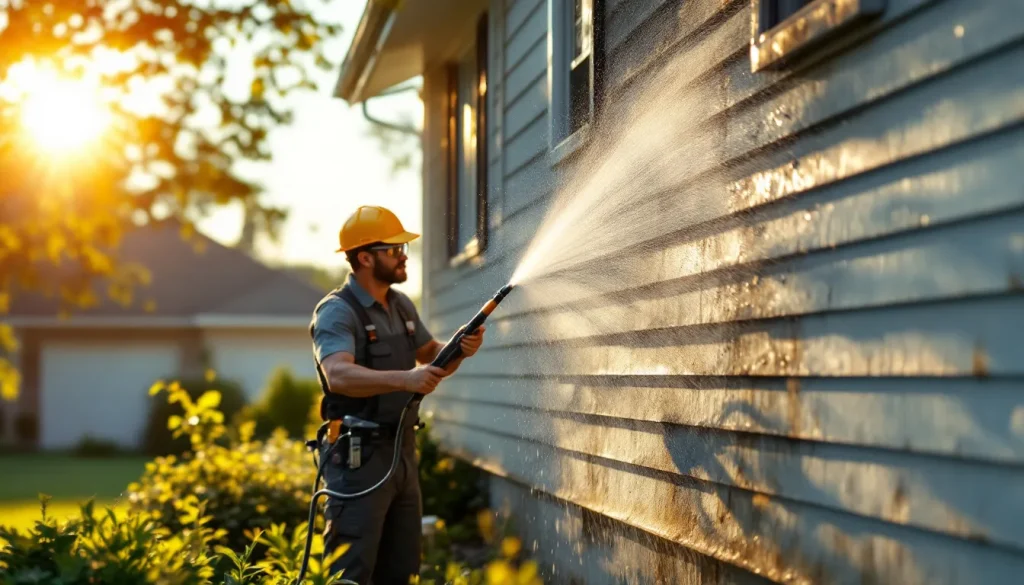
How to pressure wash a house, step by step
To pressure wash a house, wet the siding with plain water, apply a mildewcide detergent from the bottom up with a low-pressure soap tip, let it dwell 5 to 10 minutes without drying, then rinse top to bottom with a 25 or 40-degree tip held about 2 to 3 feet from the surface. Work in shade, one section at a time.
- Prep the area. Close windows, cover exterior outlets and light fixtures with plastic and tape, and move or wet down nearby plants.
- Set up the machine. Attach the wand, connect the high-pressure hose, then connect a garden hose and purge air before pulling the trigger.
- Wet the surface. Rinse a 6 to 10 foot section with plain water so detergent spreads evenly and does not streak.
- Apply detergent bottom to top. Use the soap tip (black) and coat the wet section working upward to avoid dry streaks.
- Let it dwell. Wait 5 to 10 minutes so the mildewcide kills algae and mold. Do not let it dry on the siding.
- Rinse top to bottom. Switch to a 25 or 40-degree tip and rinse downward in horizontal, side-to-side sweeps.
- Move on. Overlap each pass slightly and repeat section by section until the wall is done.
What PSI and nozzle to use by siding type
The right PSI depends entirely on your siding material. Vinyl and aluminum tolerate 1,300 to 2,000 PSI. Wood, fiber cement, and stucco need low pressure or a soft wash under 1,500 PSI. Older or painted siding and delicate stucco should not be pressure washed at all: use a soft wash so chemistry does the cleaning, not force.
This is the single biggest gap in most guides. One PSI number cannot be right for every wall. Match the machine to the material below.
| Siding material | Max PSI | Recommended nozzle | Method | Cautions |
|---|---|---|---|---|
| Vinyl | 1,300 to 2,000 | 25 to 40-degree | Pressure or soft wash | Never spray up under lap seams |
| Aluminum | 1,200 to 1,500 | 40-degree | Low pressure | Chalky paint can streak; test first |
| Fiber cement (Hardie) | 1,200 to 1,500 | 40-degree | Low pressure / soft wash | Keep 18+ inches back; avoid seams |
| Wood / cedar | 500 to 1,200 | 40-degree | Soft wash preferred | High PSI splinters and gouges grain |
| Stucco | 1,200 to 1,500 | 40-degree | Soft wash; spot-treat cracks | Do not blast cracked or old stucco |
| Brick | 1,500 to 2,000 | 25-degree | Low pressure | Skip crumbling mortar; repoint first |
When in doubt, start at the lowest pressure and widest fan angle, test a hidden corner, and increase only if needed. You can always add pressure. You cannot un-etch wood or un-crack stucco.
Pressure washer setup for beginners
Basic pressure washer setup takes three connections: attach the spray wand to the trigger gun, connect the high-pressure hose from the gun to the pump, then connect a standard garden hose from your spigot to the water inlet. Run water through the machine before starting the motor so no air is trapped in the pump.
Most consumer electric units run 1,300 to 2,000 PSI, which is plenty for siding. Gas units at 2,800 to 3,300 PSI are built for concrete and can shred vinyl, so if you rented one, dial it down or stand farther back.
Squeeze the trigger with the engine off first to release pressure, then start it. Keep both feet planted on the ground. High-pressure kickback can knock you off balance the instant you pull the trigger.
Mixing your cleaning solution
A house-wash detergent needs a surfactant plus a mildewcide to actually kill algae and mold rather than just wet the surface. In a 5-gallon bucket or the detergent tank, mix a concentrate at the label ratio, commonly 1 part cleaner to 8 or 10 parts water, and add sodium hypochlorite (bleach) only if the product calls for it.
A common DIY soft-wash mix is roughly 1 part household bleach to 4 parts water plus a squirt of surfactant so it clings. Bleach is what removes the black and green organic growth. Water alone will not.
Never mix bleach with ammonia or acid-based cleaners. The combination produces toxic gas. For weed and algae control around the foundation, the chemistry is similar to lawn treatments we cover in how to dilute vinegar to kill weeds: dilution and dwell time do the work.
Nozzle and spray tip selection
Pressure washer tips are color-coded by fan angle. Wider angles spread force over more area and are safer for siding. For house washing, use the black soap tip to apply detergent, then the white 40-degree or green 25-degree tip to rinse. Never use the red 0-degree tip on siding: it concentrates all pressure into a single damaging point.
| Tip color | Fan angle | Best for | Use on house? |
|---|---|---|---|
| Black (soap) | ~65-degree low pressure | Applying detergent | Yes, apply step |
| White | 40-degree | Rinsing siding, gentle | Yes, rinse step |
| Green | 25-degree | Tougher grime, gutters | Yes, with care |
| Yellow | 15-degree | Concrete, driveways | No |
| Red | 0-degree | Spot removal only | Never on siding |
Wash direction: bottom to top, then top to bottom
Apply detergent from the bottom up, then rinse from the top down. Applying soap upward prevents dry streaks on siding you have not wet yet. Rinsing downward lets gravity carry grime and detergent off the wall instead of pushing dirt into clean areas. Move the wand in horizontal, side-to-side sweeps, keeping the tip 2 to 3 feet away.
The critical safety rule most guides omit: never angle the spray upward into the seams of lap siding. Vinyl, aluminum, and fiber cement all overlap like shingles. Spraying up drives water behind the panels and into the wall cavity, where it can rot sheathing and grow mold you cannot see. Always aim straight on or slightly downward.
Removing mildew, mold, and algae from siding
The black streaks and green film on siding are living organisms, so mechanical pressure alone does not kill them. A mildewcide or bleach-based detergent does. Apply the cleaner, let it dwell 5 to 10 minutes so it kills the growth, then rinse. If growth remains, reapply and dwell again rather than turning up the pressure.
North-facing walls and shaded spots under trees regrow algae fastest because they stay damp. A cleaner with a mildewcide leaves a residual that slows regrowth for months. Trimming back vegetation so walls dry out faster helps, the same drying principle that matters when you prepare a landscape for drought.
Soft wash vs pressure wash for house siding
Soft washing uses low pressure (under 500 PSI, near garden-hose force) plus cleaning chemistry to kill and rinse organic growth. Pressure washing relies on high-force water. For siding, most professional cleaners recommend soft washing because it removes mold at the root without forcing water behind panels or etching the surface. Pressure washing is better suited to concrete, brick, and hardscape.
The practical rule: if the wall is siding, lean toward soft wash chemistry and low pressure. If it is a driveway, patio, or masonry, higher pressure is appropriate. Many jobs use both, soft wash for walls and higher pressure for the flatwork below.
Safety: ladders, electrical, and kickback
Pressure washing safety comes down to three hazards beginners underestimate: ladder use, electricity, and recoil. Do not operate a pressure wand from a ladder. The kickback can push you off, and consumer wands cannot reach a second story safely anyway. Use an extension wand from the ground or hire a pro for high work.
- Cover electrical. Tape plastic over GFCI outlets, exterior lights, doorbells, and the meter before you start.
- Mind the recoil. Brace before pulling the trigger; the wand jumps, especially at narrow fan angles.
- Wear protection. Closed shoes, eye protection, and never point the wand at yourself, others, or pets.
- Watch overhead lines. Keep metal wands and water streams away from service drops and power lines.
Cost to power wash a house exterior in 2026
Hiring a pro to power wash a house exterior typically costs $0.15 to $0.75 per square foot, or roughly $250 to $600 for an average single-story home in 2026. Two-story homes, heavy staining, or premium soft-wash service push jobs toward $500 to $900. DIY runs the price of detergent (about $20 to $40) plus a rental at $50 to $100 per day.
Pricing varies by region, home height, and how much organic growth has to come off. For a fuller regional breakdown and pro quote ranges, see our guide on how much pressure washing costs.
| Option | Typical 2026 cost | Best when |
|---|---|---|
| DIY, own machine | $20 to $40 (detergent) | Single-story, minor growth |
| DIY, rented washer | $70 to $140 total | One-time clean, ground-level |
| Pro soft wash | $250 to $600 | Delicate siding, heavy algae |
| Pro, two-story | $500 to $900 | Height, safety, large homes |
When to DIY versus hire a pro
Do it yourself when the home is single-story, the siding is vinyl or aluminum, and the growth is light. Hire a pro when you have a second story, delicate or older siding (wood, stucco, painted surfaces), stubborn mold, or any need to work from a ladder. Professionals carry insurance, soft-wash rigs, and the chemistry to avoid damage.
Height is the deciding factor for most homeowners. Anything above single-story reach is where injuries and water intrusion happen. If you are unsure whether your siding can take pressure at all, treat that uncertainty as a signal to soft wash or call a pro.
Post-wash steps you should not skip
After rinsing, flush surrounding plants and grass with plain water to dilute any detergent runoff, then walk the walls to check for water intrusion around windows, seams, and outlets. Uncover the electrical fixtures once everything has dried. Catching a wet spot behind siding early prevents the rot and mold that show up months later.
Detergent runoff can stress lawn and beds the way concentrated herbicide does, a reason to rinse thoroughly, the same care we recommend when treating a large area for weeds. Store the machine drained so the pump does not freeze or seize between uses.
Frequently Asked Questions
What PSI should I use to pressure wash my house siding?
Use 1,300 to 2,000 PSI for vinyl and 1,200 to 1,500 PSI for aluminum, fiber cement, and stucco. Wood and cedar need 500 to 1,200 PSI or a soft wash. Start low with a wide 40-degree tip, test a hidden spot, and increase only if the growth resists. Higher pressure damages siding faster than it cleans.
Can you pressure wash vinyl siding without damaging it?
Yes. Vinyl tolerates 1,300 to 2,000 PSI with a 25 or 40-degree tip held 2 to 3 feet away. The key is spraying straight on or slightly downward, never up under the lap seams, which drives water behind the panels into the wall. Detergent and dwell time do most of the work, not raw pressure.
Which nozzle or spray tip should I use to wash a house?
Use the black soap tip to apply detergent, then the white 40-degree tip to rinse siding gently. The green 25-degree tip handles tougher grime. Never use the red 0-degree tip on siding; it concentrates all the force into one point and gouges the surface. Wider fan angles are always safer for house exteriors.
Do you pressure wash a house top to bottom or bottom to top?
Both, in order. Apply detergent from the bottom up so soap does not streak down dry siding, then rinse from the top down so gravity carries grime and detergent off the wall. Work in horizontal, side-to-side sweeps and overlap each pass. Keep the surface wet the whole time so nothing dries and streaks.
What detergent or cleaner is best for pressure washing a house?
Use a house-wash detergent that combines a surfactant with a mildewcide, mixed at the label ratio (often 1 part cleaner to 8 or 10 parts water). A common DIY mix is 1 part bleach to 4 parts water plus a squirt of surfactant. The mildewcide kills algae and mold; plain water only rinses dirt. Never combine bleach with ammonia.
How much does it cost to power wash a house exterior?
Hiring a pro costs about $0.15 to $0.75 per square foot in 2026, roughly $250 to $600 for a single-story home and $500 to $900 for a two-story or heavily stained house. DIY runs $20 to $40 for detergent plus $50 to $100 per day for a rental. Height, staining, and region drive the final price.
How do you remove mildew and mold when pressure washing?
Apply a bleach or mildewcide-based detergent, let it dwell 5 to 10 minutes so it kills the organisms, then rinse. Mildew and mold are living growth, so pressure alone will not remove them at the root. If streaks remain, reapply and dwell again rather than turning up the pressure, which risks damaging the siding.
Is soft washing better than pressure washing for house siding?
For siding, usually yes. Soft washing uses low pressure (under 500 PSI) plus cleaning chemistry to kill and rinse algae and mold without forcing water behind panels or etching the surface. Pressure washing suits concrete, brick, and hardscape. Many pros soft wash the walls and reserve higher pressure for driveways and patios below.
When should I hire a pro instead of pressure washing myself?
Hire a pro for two-story homes, delicate or older siding (wood, stucco, painted surfaces), stubborn mold, or any job requiring a ladder. Professionals carry insurance and soft-wash equipment that avoids damage and water intrusion. DIY makes sense for single-story vinyl or aluminum with light growth that you can reach safely from the ground.