
By the HMNDP Editorial Team, independent reporting on lawn care, landscaping, and soil.
Last reviewed: June 2026
How to make soil more acidic: the short answer
To make soil more acidic, the most reliable method is working elemental sulfur into the top 6 inches of soil, which soil bacteria convert to sulfuric acid over 2 to 12 months. For faster results in weeks, use iron sulfate or aluminum sulfate. Always test your pH first, apply based on soil texture, and retest before adding more.
Acid-loving plants like blueberries, azaleas, rhododendrons, and camellias want a pH between 4.5 and 5.5. Most garden soils sit at 6.5 to 7.5. The methods below close that gap, ranked by how well they work. The last three are popular myths that waste your time.
Why lower soil pH, and what acid-loving plants need
Lowering soil pH unlocks nutrients that alkaline soil locks away, especially iron. Acid-loving plants (blueberries, azaleas, rhododendrons, camellias, and blue-flowering hydrangeas) evolved in acidic woodland soils. Above pH 6.0, they cannot pull enough iron from the ground, causing yellow leaves with green veins, a condition called iron chlorosis. The target range is pH 4.5 to 5.5 for most of these plants.
Soil pH runs on a logarithmic scale from 0 to 14, where 7 is neutral. Each full point is a tenfold change in acidity. Dropping soil from pH 7.0 to 6.0 makes it ten times more acidic, which is why moving pH takes real amendment and real time.
| Plant | Ideal pH | Symptom of too-high pH |
|---|---|---|
| Blueberries | 4.5 to 5.5 | Yellow leaves, poor fruit set |
| Azaleas / Rhododendrons | 4.5 to 6.0 | Chlorosis, stunted growth |
| Camellias | 5.0 to 6.5 | Pale foliage, bud drop |
| Hydrangeas (for blue blooms) | 5.0 to 5.5 | Pink or purple flowers instead of blue |
1. Elemental sulfur: the best long-term amendment
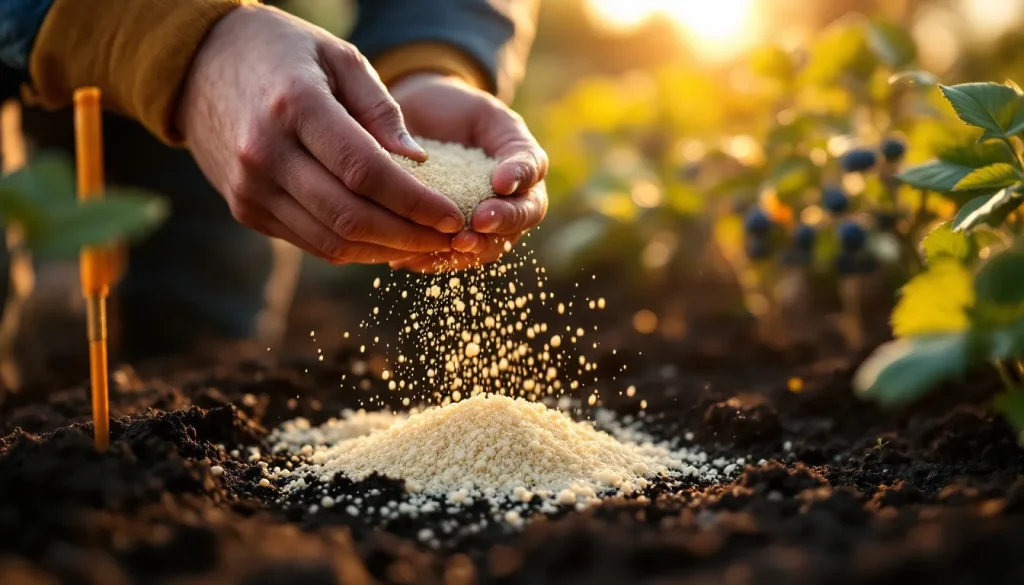
Elemental sulfur is the safest and most cost-effective way to make soil more acidic for the long term. Sold as sulfur chips, powder, or prills (called “sulphur” or “flowers of sulphur” in the UK), it relies on soil bacteria to oxidize it into sulfuric acid. This takes weeks to months, but the pH change lasts for years and carries no toxicity risk for edibles.
Apply it in spring or fall when soil is warm and moist, because the bacteria (mostly Thiobacillus species) only work above roughly 55°F (13°C). Work it into the top 6 inches of soil, water in, and wait. The colder your soil, the slower the reaction.
2. The sulfur math no one gives you: rate by pH gap and soil texture
How much sulfur you need depends on three things: your current pH, your target pH, and your soil texture. Sandy soil has little buffering capacity and shifts fast. Clay and loam resist change and need roughly two to three times more sulfur. The table below gives elemental sulfur rates in pounds per 100 square feet to lower pH, based on published agricultural extension guidance.
| pH change wanted | Sandy soil (lbs/100 sq ft) | Loam (lbs/100 sq ft) | Clay (lbs/100 sq ft) |
|---|---|---|---|
| 7.5 to 6.5 (1.0 down) | 1.2 | 3.5 | 4.6 |
| 7.0 to 6.0 (1.0 down) | 1.0 | 2.5 | 3.7 |
| 6.5 to 5.5 (1.0 down) | 0.9 | 2.4 | 3.5 |
| 7.0 to 5.0 (2.0 down) | 2.3 | 6.9 | 10.1 |
A worked example: you have loam at pH 7.0 and want blueberry soil at pH 5.0. That is a 2-point drop, so you need about 6.9 lbs of elemental sulfur per 100 square feet. Do not apply it all at once. Split it into two applications 6 months apart and retest between them to avoid overshooting.
Cap any single application at 2 lbs per 100 square feet on established plantings to protect roots. On sandy soil you may hit your target with one dose; on clay, plan for a full season or two. If you are unsure how deep to incorporate amendments, our guide on how to amend soil covers mixing depth and technique.
3. Iron sulfate and aluminum sulfate: the fast-acting alternatives
Iron sulfate and aluminum sulfate acidify soil in weeks rather than months because they react chemically without waiting on bacteria. The Royal Horticultural Society (RHS) recommends iron sulfate as a quicker fix than elemental sulfur. Iron sulfate needs roughly 6 to 8 times more product than elemental sulfur for the same pH drop, so it costs more per result.
Aluminum sulfate works even faster and is the classic trick for turning hydrangeas blue. But it carries a real risk: it dumps aluminum into the soil, which is toxic to many plants at low pH and can build up over repeated use. Use aluminum sulfate only on ornamentals like hydrangeas, never on blueberries or other edibles.
| Amendment | Speed | Relative amount needed | Best for | Watch out for |
|---|---|---|---|---|
| Elemental sulfur | 2 to 12 months | Baseline (lowest) | Whole beds, edibles, long-term | Slow in cold soil |
| Iron sulfate | 3 to 4 weeks | ~6 to 8x sulfur | Quick correction, all plants | Can stain paving |
| Aluminum sulfate | 1 to 2 weeks | ~6x sulfur | Hydrangeas, ornamentals | Aluminum toxicity; never on edibles |
4. Sphagnum peat moss: an acidifying organic amendment
Sphagnum peat moss lowers pH mildly while improving soil structure, making it useful when planting acid-lovers in a hole or raised bed. It runs pH 3.5 to 4.5 and works best mixed into the planting zone rather than spread on top. The Spruce and other horticultural sources list it as a standard acidifying organic amendment.
Peat has a downside worth naming: harvesting it damages peat bogs, and the UK is phasing out peat for amateur gardeners. Coir, composted pine bark, or leaf mold from oak or pine are more sustainable, though they acidify more gently. For raised beds, factor peat into your volume when you calculate how much soil you need.
5. Acidifying fertilizers: ammonium-based feeds
Ammonium-based fertilizers acidify soil gradually as plants take up the nitrogen, releasing hydrogen ions that lower pH. Ammonium sulfate is the strongest acidifier of the group and doubles as a nitrogen feed. Products labeled for “ericaceous” plants (a UK term for acid-lovers) or “azalea, camellia, rhododendron” food are formulated to maintain low pH.
These fertilizers maintain acidity better than they create it. Use them alongside sulfur, not instead of it, if you are correcting a soil that is well above target. Ammonium sulfate applied at labeled rates gives a slow, steady acidifying nudge each season.
6. Container and small-batch acidification
Potted acid-lovers are easier to acidify than open ground because you control the whole soil volume. Start with an ericaceous or acidic potting mix (peat- or coir-based, pre-acidified to pH 4.5 to 5.5) instead of correcting standard mix. Then maintain it, because pot soil drifts back toward neutral as you water.
Tap water in hard-water regions is alkaline and slowly raises container pH. Water potted blueberries and azaleas with collected rainwater where possible, or use a diluted acidifying feed. In containers, a small dose of sulfur goes a long way, so scale the bed rates above down to the pot volume and retest often.
7. Test before, test after: monitoring soil pH
Testing pH before and after amending is the step most gardeners skip, and it is why so many overshoot or undershoot. Take a soil sample, mix it with distilled water, and read it with a calibrated meter or a lab test. A cheap probe meter can drift, so a mail-in soil test (often $10 to $25 through a university extension service) gives a more trustworthy number.
Sample 4 to 6 spots across a bed and blend them, because pH varies within a single garden. Retest 3 to 6 months after applying sulfur, or 3 to 4 weeks after iron sulfate, before deciding whether to add more. Amending blind is how people accidentally push soil down to pH 4.0 and stunt the plants they meant to help.
What does NOT work: 3 popular myths
Coffee grounds, vinegar, and pine needles are the three most repeated soil-acidifying tips online, and all three range from near-useless to harmful. Here is what actually happens, with specifics, so you stop wasting effort on them.
Coffee grounds barely move pH
Used coffee grounds are close to pH-neutral (roughly 6.5 to 6.8) because brewing washes most of the acid into the cup. Fresh, unbrewed grounds are more acidic but are not something most people have in volume. Grounds are a fine nitrogen-rich compost input, but they will not meaningfully lower garden pH. Studies from Oregon State and Washington State extension found no reliable acidifying effect on soil.
Vinegar is a temporary, risky quick fix
Household vinegar (about 5% acetic acid) drops soil pH for a few hours, then the acid breaks down and pH rebounds. It can scorch roots and kill soil microbes if used repeatedly or strong. It is a decent one-off tweak for a single potted plant’s water, but it is not a soil amendment. Never treat a bed with vinegar expecting a lasting change.
Pine needles do not acidify established soil
Fresh pine needles are mildly acidic, but as they break down their pH neutralizes, and they do almost nothing to the mineral soil beneath. They make a good moisture-retaining mulch for acid-lovers, and that is their real value, not pH change. If your soil is alkaline, pine mulch will not fix it.
How to make soil more acidic naturally
The most effective “natural” acidifier is elemental sulfur, which is a mined mineral, not a synthetic chemical. Beyond that, organic matter that acidifies gently includes composted pine or oak leaf mold, sphagnum peat or coir, and composted pine bark. These lower pH slowly and improve soil life at the same time.
Natural methods suit gardeners who want to nudge soil over one or two seasons rather than force a fast change. Combine acidic organic mulch on top with sulfur worked into the root zone for the best of both. For structural drainage issues that often accompany heavy alkaline clay, see our guide on how to build a French drain. Gardeners running this as a service should also read our breakdown of what landscape business owners make.
Frequently Asked Questions
How do I make my soil more acidic naturally?
The most effective natural method is working elemental sulfur (a mined mineral) into the top 6 inches of soil, where bacteria convert it to acid over 2 to 12 months. Add acidifying organic matter like composted pine or oak leaf mold, sphagnum peat, or coir. These lower pH slowly while feeding soil life. Test before and after so you do not overshoot.
How much sulfur do I need to lower soil pH by 1 point?
It depends on soil texture. To drop pH by 1 point, sandy soil needs about 1 lb of elemental sulfur per 100 square feet, loam needs about 2.5 lbs, and clay needs about 3.5 to 4.6 lbs. Clay and loam buffer pH heavily, so they need two to three times more than sand. Split large amounts across two applications and retest between them.
How long does it take for sulfur to acidify soil?
Elemental sulfur takes 2 to 12 months because soil bacteria must oxidize it into sulfuric acid, and those bacteria only work in warm, moist soil above about 55°F (13°C). Cold soil stalls the process. Iron sulfate and aluminum sulfate act far faster, in roughly 1 to 4 weeks, because they react chemically without waiting on bacteria.
What is the fastest way to make soil acidic?
Aluminum sulfate is the fastest, lowering pH in 1 to 2 weeks, followed by iron sulfate at 3 to 4 weeks. Both react chemically instead of relying on bacteria like elemental sulfur does. Use aluminum sulfate only on ornamentals such as hydrangeas, never on edibles like blueberries, because it can cause aluminum toxicity. Iron sulfate is the safer fast option for most plants.
Do coffee grounds make soil more acidic?
No, not meaningfully. Used coffee grounds are close to pH-neutral (about 6.5 to 6.8) because brewing washes the acids into the cup. Oregon State and Washington State extension trials found no reliable acidifying effect on soil. Grounds are a useful nitrogen source for compost, but they will not lower garden pH. Use elemental sulfur if you need a real change.
What is the best fertilizer to make soil more acidic for plants?
Ammonium sulfate is the strongest acidifying fertilizer, lowering pH as plants take up its nitrogen while also feeding them. Products labeled ericaceous, or for azaleas, camellias, and rhododendrons, are formulated to maintain low pH. These fertilizers maintain acidity better than they create it, so pair them with elemental sulfur if your soil starts well above your target range.
Will vinegar acidify my soil safely?
No. Household vinegar (about 5% acetic acid) drops soil pH for only a few hours before the acid breaks down and pH rebounds. Repeated or strong applications can scorch roots and kill beneficial soil microbes. It is a risky, temporary trick at best for a single potted plant’s water, and it is never a substitute for a proper soil amendment like sulfur.
How do I make soil acidic for blueberries, hydrangeas, or azaleas?
Target pH 4.5 to 5.5 and use elemental sulfur worked into the root zone, applied a season ahead of planting when possible. For blueberries and other edibles, avoid aluminum sulfate because of aluminum toxicity. For blue hydrangeas, aluminum sulfate is acceptable and fast. Mix in sphagnum peat or coir at planting, water with rainwater in hard-water areas, and retest each season.