
Ground Cover Flowers: Best Picks by Sun, Shade, and Zone
Ground cover flowers are low-growing perennials that spread to form a living carpet, suppress weeds, and bloom across a defined season. The right pick depends on three things most plant lists skip: how much sun the site gets, your USDA hardiness zone, and how fast you need the area to fill in. This guide ranks the proven options by those specs, flags the ones that turn invasive in much of the United States (creeping Jenny, vinca, English ivy), and gives you a single comparison table so you can match a plant to your site in one pass.
What counts as a ground cover flower?
A ground cover flower is a spreading perennial under about 12 inches tall that blooms and knits together into a dense mat over one to three growing seasons. The mat shades soil, blocks weed germination, and cuts the area you have to mow or mulch. Creeping thyme, creeping phlox, and bugleweed (Ajuga) are the most-planted examples in US gardens.
These plants earn their keep in spots where turf struggles: between flagstone, on slopes, under high tree canopy, or along a hot south-facing strip. Iowa State University Extension recommends them as a turf alternative for sites that are too shaded, too steep, or too narrow to mow safely.
Which ground cover flowers handle sun versus shade?
Light is the first filter, because a sun-loving mat will thin out and a shade plant will scorch if you swap them. Full-sun ground cover flowers include creeping thyme, creeping phlox (Phlox subulata), candytuft, hardy ice plant (Delosperma), and dianthus. Shade and part-shade performers include bugleweed, foamflower (Tiarella), barrenwort (Epimedium), sweet woodruff, and spotted deadnettle (Lamium).
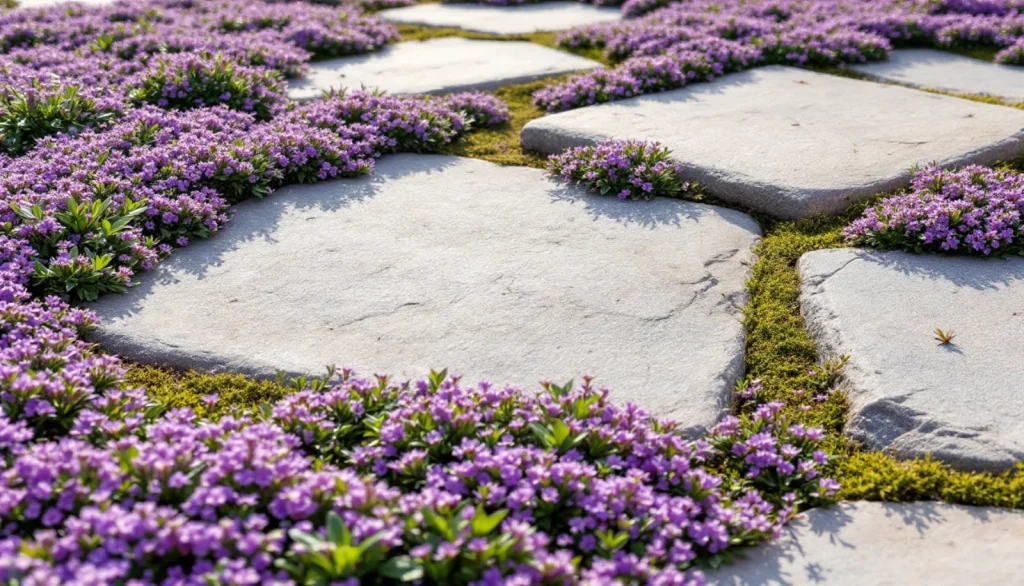
For sun, creeping thyme (Thymus species) forms a scented mat in USDA zones 4 to 9, blooms pink to purple in late spring through early summer, and is the one common option that tolerates light foot traffic. Garden Design and Iowa State Extension both single it out as the filler for stepping stone gaps.
For shade, bugleweed (Ajuga reptans) is the workhorse: zones 3 to 10, violet-blue spikes in late spring, and a tolerance for full shade to part sun. It spreads fast enough that you may need to edge it to keep it out of the lawn, a point Garden Design flags directly.
If your problem is bare ground under trees or on a north slope where grass fails, our guide to growing grass in deep shade covers when to stop fighting turf and switch to a shade ground cover instead.
Comparison table: flowering ground covers by site, zone, and spread
This table is the part most lists leave out: every plant scored on the four specs that decide whether it works on your site, plus a spread rate and an invasive flag. Spread rate reflects how fast a plug fills its allotted space under good conditions. Zones follow USDA hardiness designations. Foot-traffic ratings indicate tolerance to occasional walking, not a path replacement.
| Plant | Light | USDA zones | Mature spread | Spread rate | Foot traffic | Bloom season | Invasive flag |
|---|---|---|---|---|---|---|---|
| Creeping thyme (Thymus spp.) | Full sun | 4 to 9 | Up to 18 in | Fast (1 to 2 seasons) | Light traffic OK | Late spring to early summer | None |
| Creeping phlox (Phlox subulata) | Full sun | 3 to 9 | 18 to 24 in | Slow (2 to 3 years) | No | Early to mid spring | None (US native) |
| Candytuft (Iberis sempervirens) | Full sun | 4 to 9 | Up to 12 in | Moderate | No | Mid to late spring | None |
| Hardy ice plant (Delosperma cooperi) | Full sun | 6 to 10 | Up to 24 in | Moderate | No | Early summer to fall | None |
| Bugleweed (Ajuga reptans) | Part shade to sun | 3 to 10 | 24 in plus | Fast | No | Late spring to early summer | Aggressive; edge to contain |
| Foamflower (Tiarella spp.) | Part to full shade | 4 to 9 | 16 to 19 in | Moderate | No | Late spring to early summer | None (US native) |
| Barrenwort (Epimedium spp.) | Part to full shade | 5 to 9 | 12 to 36 in | Slow | No | Early to mid spring | None |
| Spotted deadnettle (Lamium maculatum) | Part shade to sun | 4 to 9 | 36 in plus | Fast | No | Late spring to early summer | Aggressive; contain |
| Creeping Jenny (Lysimachia nummularia) | Sun to part shade | 3 to 9 | Indefinite | Very fast | No | Early summer | Invasive in many US states |
| Periwinkle / vinca (Vinca minor) | Shade to part sun | 4 to 9 | Indefinite | Very fast | No | Early to mid spring | Invasive; smothers woodland natives |
Which ground cover flowers are invasive (and what to plant instead)?
Creeping Jenny (Lysimachia nummularia), common periwinkle (Vinca minor and Vinca major), bishop’s weed (Aegopodium podagraria), and wintercreeper (Euonymus fortunei) are widely flagged as invasive across much of the United States. They root wherever a stem touches soil, escape beds into woodlands, and form dense carpets that smother native seedlings and the plants pollinators and seed-eating birds depend on, according to reporting in Homes and Gardens and the South Carolina Native Plant Society.
Invasive status varies by state, so check your local listing before planting. The USDA-supported Invasive Plant Atlas of the United States (invasiveplantatlas.org) and your state extension service track which species are regulated or discouraged in your area.
Safer swaps that fill the same niche:
- Instead of vinca in shade: native foamflower (Tiarella), wild ginger (Asarum canadense, zones 4 to 6), or bearberry (Arctostaphylos uva-ursi, zones 2 to 6).
- Instead of creeping Jenny in sun to part shade: common blue violet (Viola sororia, zones 4 to 8) or creeping phlox (native across much of the eastern US).
- Instead of bishop’s weed in the Northeast: Canadian wild ginger (Asarum canadense), a recommendation from the South Carolina Native Plant Society.
If you are converting turf to a low-water planted area rather than picking a single ground cover, our breakdown of drought-tolerant lawn alternatives covers the conversion math and any state rebates that may apply.
How do you plant and establish a ground cover that actually fills in?
Spacing and weed control during year one decide whether a ground cover knits into a solid mat or stays patchy. Plant on the correct center spacing for the species, mulch the gaps, and keep weeds out until the plants touch. Most spreaders close in over one to three growing seasons depending on the plant and the spacing.
- Test the site: confirm sun hours and drainage. Creeping thyme, sedum, and ice plant fail in wet soil; foamflower and bugleweed want moisture and shade.
- Kill or remove existing weeds and grass first. A ground cover cannot outcompete established perennial weeds during establishment.
- Space by spread rate. Plant creeping phlox 12 to 18 inches apart for full cover in two seasons; space faster spreaders like thyme and bugleweed a bit wider since they close gaps quickly.
- Mulch the open soil between plants 1 to 2 inches deep to block weed germination while the mat fills.
- Water consistently through the first growing season so roots establish before the plants are left to spread on their own.
- Edge aggressive spreaders (bugleweed, deadnettle) once a year to keep them out of the lawn and adjacent beds.
For larger renovation work where bare or failed areas need rebuilding before you plant, the same prep logic in our bare-spot renovation guide applies: clear, amend, then plant into clean soil.
How much does a ground cover area cost?
Cost depends on plant size, spacing, and area. Buying small plugs and spacing them on the wider end of the range cuts the plant count and the upfront bill, at the trade-off of a longer fill-in time. Faster spreaders like creeping thyme need fewer plants per square foot than slow growers like barrenwort.
Before you size an order, measure the bed accurately. Our walkthrough on measuring square footage gives you the number you need to calculate plant count from a spacing chart, and for broader project budgeting our 2026 lawn care cost guide sets the regional baselines.
Bottom line: matching a ground cover flower to your site
Pick light first, then zone, then decide how fast you need coverage and whether the spot sees foot traffic. For a sunny stepping-stone gap, creeping thyme is the one tested foot-traffic option. For dry shade, barrenwort. For fast shade cover, bugleweed with annual edging. Skip creeping Jenny and vinca in most of the US and use a native equivalent instead.
Last reviewed: June 2026
HMNDP Editorial Team, reviewed by HMNDP turf and horticulture editors.
Frequently asked questions
What is the best ground cover flower for sun?
Creeping thyme (Thymus species) is the most-recommended sunny ground cover flower. It thrives in USDA zones 4 to 9, blooms pink to purple from late spring into early summer, and is the one common option that tolerates light foot traffic, which makes it the standard filler for gaps between stepping stones and flagstone paths.
What is the best flowering ground cover for shade?
Bugleweed (Ajuga reptans) is the workhorse shade ground cover, hardy in zones 3 to 10 with violet-blue flower spikes in late spring. For drier shade, barrenwort (Epimedium) works in zones 5 to 9. Native foamflower (Tiarella) suits moist, part to full shade in zones 4 to 9 and supports pollinators.
Is creeping Jenny invasive?
Yes. Creeping Jenny (Lysimachia nummularia) is flagged as invasive across many US states. It roots wherever a stem touches soil, spreads indefinitely, and forms dense carpets that smother native seedlings. Check the Invasive Plant Atlas of the United States or your state extension before planting, and consider native violet or creeping phlox instead.
Is vinca (periwinkle) a good ground cover?
Vinca minor spreads fast in shade and looks tidy, but it is classified as invasive in much of the US and escapes into woodlands where it outcompetes native plants. Safer shade swaps that fill the same niche include foamflower, wild ginger (Asarum canadense), and bearberry (Arctostaphylos uva-ursi).
How fast do ground cover flowers spread?
Spread rate depends on the species. Creeping thyme and bugleweed fill their space in one to two growing seasons. Creeping phlox is slower, taking two to three years to reach its full 18 to 24 inch width. Wider spacing cuts plant count but lengthens the time to full coverage.
Can you walk on ground cover flowers?
Most flowering ground covers do not tolerate regular foot traffic. Creeping thyme is the main exception: it handles light, occasional walking and is used as a filler between stepping stones. For an actual walking path, keep a stone or gravel surface and use the ground cover only in the gaps.
How do you plant ground cover so it fills in without weeds?
Remove existing weeds and grass first, space plugs by the species spread rate, then mulch the open soil 1 to 2 inches deep to block weed germination while the plants knit together. Water through the first growing season. Most spreaders close gaps over one to three seasons.