
By the HMNDP Editorial Team (independent lawn and landscaping reporting). Last reviewed: June 2026.
French drain repair starts with matching the symptom to the cause
French drain repair means restoring water flow to a buried perforated pipe that has clogged, crushed, or lost its slope. Most fixes fall into two buckets: clearing a blockage (often a DIY job costing under $100 in tools) or fixing structural damage like a crushed pipe or lost pitch (usually a pro job running $50 to $150 per linear foot). Diagnose first, then decide.
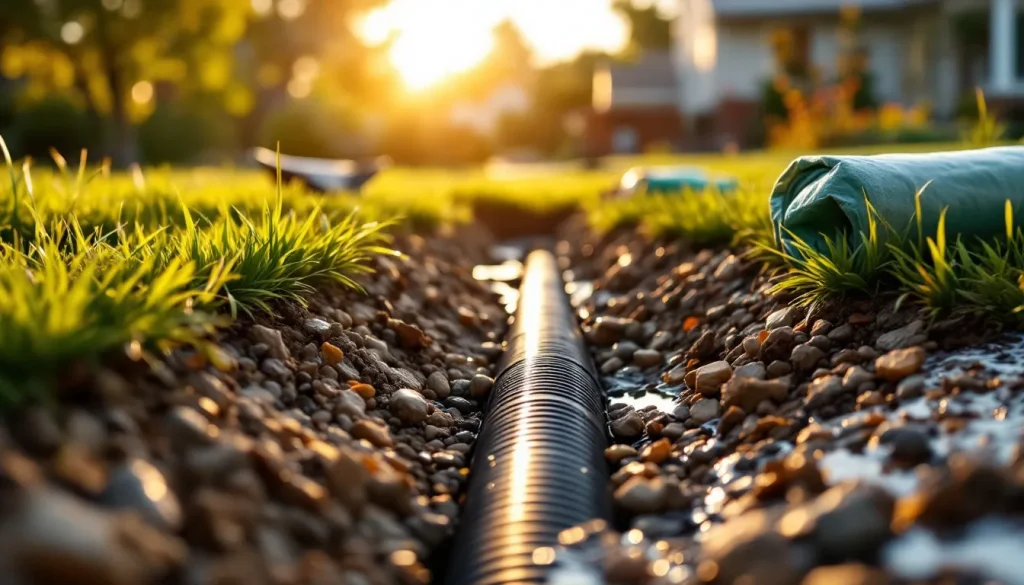
A French drain is a gravel-filled trench holding a perforated pipe wrapped in filter fabric. Water seeps through the gravel, enters the pipe holes, and travels downhill to a daylight outlet, dry well, or storm connection. When any layer fails, water backs up into your yard, basement, or foundation.
The rest of this guide diagnoses the failure, prices each repair, and tells you honestly when to grab a shovel versus when to call a contractor.
Signs your French drain is failing
A failing French drain shows itself above ground before you dig. The four clearest signs are standing water over the trench line, a soggy or spongy lawn that never dries, water draining slower than it used to after rain, and water reappearing in a basement or crawl space the drain was installed to protect. Any one of these means the system has stopped moving water.
- Standing water on the trench line: pooling directly above the buried pipe, usually within a day of rain.
- Soggy, spongy lawn: turf that squelches underfoot weeks after the last storm, sometimes with moss or algae.
- Slow drainage: puddles that used to clear in hours now linger for days.
- Water returning indoors: a wet basement, damp foundation wall, or musty smell after rain, meaning the drain no longer intercepts groundwater.
Common causes of French drain failure
French drains fail for five main reasons, and the cause dictates the cost. Silt and debris clogging is the most common and the cheapest to fix. Crushed or collapsed pipe, lost slope, clogged filter fabric, and root intrusion are structural problems that usually require excavation. Knowing which one you have prevents overpaying for the wrong repair.
| Cause | What happens | Typical fix |
|---|---|---|
| Silt / debris clog | Fine sediment and leaves pack the pipe and gravel | Flush, snake, or hydro-jet (often DIY) |
| Crushed / collapsed pipe | Vehicle traffic, settling, or age deforms the pipe | Excavate and replace the section (pro) |
| Lost or improper slope | Soil settling flattens the 1% pitch, water sits | Re-excavate and regrade (pro) |
| Clogged filter fabric | Sediment blinds the fabric so water cannot enter | Excavate, replace fabric and gravel (pro) |
| Root intrusion | Tree roots enter joints and holes, blocking flow | Snake/jet then reroute or root barrier |
Diagnostic decision tree: symptom to cause to fix
Use where the water shows up to narrow the cause before you dig. Standing water at the outlet points to a blockage near the exit or a buried outlet. Water pooling mid-run points to a clog or crushed section under that spot. No flow at the outlet at all points to a full blockage, a collapsed pipe, or lost slope. This table maps each pattern to its likely fix.
| What you observe | Most likely cause | First action | DIY or pro |
|---|---|---|---|
| Water pools at or near the outlet; outlet trickles or is buried | Outlet clog, crushed end, or animal nest | Clear the outlet, flush from the top | DIY |
| Water pools over one spot mid-run; outlet still flows | Localized clog or crushed section at that point | Snake from nearest access, then excavate if it stops there | DIY to locate, pro if crushed |
| Outlet is bone dry after heavy rain; water backs up everywhere | Full blockage, collapsed pipe, or lost slope | Camera-scope the line | Pro |
| Water returns in basement/foundation | Drain no longer intercepts groundwater; slope or fabric failure | Full inspection | Pro |
How to find your buried French drain and the problem section
Locate the drain by starting at its two known ends: the daylight outlet where water exits, and the highest point it protects. Walk the straight line between them, probe with a metal rod every few feet to hit gravel or pipe, and mark the path with flags. The failing section is usually directly under the wettest surface spot or between a flowing point and a blocked one.
- Find the outlet (a pipe or grate at the low edge of the yard) and the inlet or catch basin.
- Push a thin steel probe rod every 3 to 4 feet along the line; gravel feels different from soil.
- Mark each hit with a landscape flag to reveal the pipe’s route.
- Rent or hire a sewer camera ($100 to $250 per visit) to see the exact clog or break and measure how far in it sits.
Clearing a clogged French drain (flushing, snaking, hydro-jetting)
Clearing a clog is the most common French drain repair and the most DIY-friendly. Start with the least invasive method and escalate. Flushing with a garden hose costs nothing extra. A drain snake or auger costs $30 to $150 to buy. Professional hydro-jetting, which blasts sediment out with high-pressure water, runs about $250 to $600 and clears silt that snaking cannot.
| Method | What it clears | Cost | Best for |
|---|---|---|---|
| Hose flush | Loose leaves, light silt | $0 (own hose) | First attempt, mild clogs |
| Drain snake / auger | Packed debris, small roots | $30 to $150 to buy; ~$100 to rent | Solid blockages you can reach |
| Hydro-jetting (pro) | Heavy silt, grease, root mats | $250 to $600 | Long or stubborn clogs, no digging |
Insert the hose or snake through the outlet or a cleanout and work toward the blockage. If flow returns, you have solved it without excavation. If the tool stops hard at a fixed point and water still will not pass, suspect a crush or collapse at that spot.
How to unclog a French drain without digging
You can often clear a French drain without excavation using three no-dig methods: high-pressure hose flushing, mechanical snaking or augering, and professional hydro-jetting. These work when the pipe is intact but blocked by silt, leaves, or minor roots. They fail only when the pipe itself is crushed or collapsed, which no flushing can fix. Try no-dig first every time.
A so-called “French drain repair kit” is usually a cleanout riser plus fittings that let you flush the line in future without digging. Adding a cleanout at each end during any repair turns future clog clearing into a 10-minute hose job.
Repairing or replacing a damaged pipe section
A crushed or collapsed pipe cannot be flushed clean; it must be dug up and replaced. Excavate the failed section, remove the old pipe and contaminated gravel, lay new perforated pipe on fresh washed gravel wrapped in filter fabric, and confirm the slope before backfilling. A short spot repair is doable DIY over a weekend; long runs are pro work.
- Excavate over the damaged section, exposing 1 to 2 feet of good pipe on each side.
- Cut out the crushed length and remove silt-fouled gravel.
- Line the trench with new landscape/filter fabric.
- Add 2 to 3 inches of washed gravel, then lay new perforated pipe (holes down for interception drains).
- Couple to the existing pipe, check slope with a level, then cover with gravel and wrap the fabric over the top.
Regrading to restore proper slope
A French drain needs a fall of about 1%, roughly 1 inch of drop per 8 to 10 feet, so gravity moves the water. When soil settles, the pipe flattens or reverses and water sits. Fixing it means re-excavating the flat section, resetting the pipe on a graded gravel bed, and verifying the pitch with a line level before backfilling. This is the failure most often misdiagnosed as a simple clog.
If your whole yard sits low or holds water broadly, the drain may be fighting a grading problem, not a pipe problem. Our guide on how to level a yard covers correcting surface pitch so a repaired drain is not overwhelmed.
Root intrusion and how to address it
Tree roots enter perforated pipe through the same holes that let water in, then grow into mats that block flow. Snaking or hydro-jetting clears the current root mass, but roots regrow unless you address the source. Reroute the drain away from the tree, install a solid-wall pipe past the root zone, or set a physical root barrier along the trench edge.
Suspect roots when clogs return every season near a mature tree and the removed debris looks fibrous rather than muddy. A camera scope confirms roots at pipe joints.
French drain repair cost breakdown (2026)
French drain repair cost ranges from under $100 for a DIY clog clear to several thousand dollars for full replacement. Clearing a clog professionally runs $150 to $600. Replacing a damaged section costs roughly $50 to $150 per linear foot installed. Full replacement of a residential drain typically lands between $2,000 and $6,000 depending on length, depth, and access. DIY materials for a spot repair often total $150 to $400.
| Repair type | Typical cost (2026) | Notes |
|---|---|---|
| DIY clog clear (hose, rented snake) | $0 to $150 | Own tools or a one-day rental |
| Pro clog clear / hydro-jet | $150 to $600 | Includes camera scope on some jobs |
| Camera inspection alone | $100 to $250 | Diagnoses hidden breaks |
| Section pipe replacement (pro) | $50 to $150 per linear foot | Excavation, pipe, gravel, fabric |
| DIY materials (spot repair) | $150 to $400 | Pipe, gravel, fabric, couplings |
| Full drain replacement | $2,000 to $6,000+ | Length, depth, and access drive price |
Prices vary by region and access. Deep drains near foundations, rocky soil, or hardscape to cut through push costs to the top of each range.
Tools and materials you need
A DIY French drain repair needs perforated pipe, washed drainage gravel, non-woven landscape/filter fabric, and a shovel, plus a drain snake for clogs. Match the pipe diameter (usually 4 inch) to what is already buried, and buy fabric rated for drainage rather than weed cloth, which blinds faster.
- 4-inch perforated drain pipe (rigid PVC or corrugated) to match the existing line.
- Washed drainage gravel or 3/4-inch clean stone.
- Non-woven filter/landscape fabric.
- Pipe couplings and, ideally, a cleanout riser.
- Trenching shovel, mattock, wheelbarrow, and a line level to check slope.
- Drain snake or auger for clog clearing.
DIY vs hiring a professional: the honest rule
Repair it yourself when the problem is a clog and the pipe is intact: flushing, snaking, and clearing an outlet are homeowner jobs. Hire a professional when the pipe is crushed or collapsed, when slope has been lost, or when water is reaching a basement or foundation. Those failures involve excavation, grading accuracy, and structural risk that reward experience.
| Situation | Recommendation |
|---|---|
| Clog cleared by hose or snake, flow returns | DIY |
| Localized crush you can reach in a shallow trench | DIY if comfortable, else pro |
| Lost slope over a long run | Pro |
| Collapsed pipe or unknown break location | Pro (camera scope first) |
| Water entering basement or foundation | Pro |
Prevention and maintenance
You avoid most French drain repairs by adding cleanouts, flushing the line yearly, and keeping sediment out. A cleanout riser at each end lets you run a hose through the pipe every spring in minutes. Non-woven filter fabric on a fresh install resists blinding longer than cheap weed cloth. Keep the outlet clear of grass, mulch, and animal nests.
Healthy, dense turf over the trench also slows silt migration. Our guides on overseeding a lawn and preparing your yard for drought help keep the surface soil stable and less prone to washing fines into the pipe. If you are planning a new run alongside a repair, see our walkthrough on how to build a French drain the right way.
Local and professional repair services
French drain installation and repair companies operate in most metros, including high-demand clay-soil markets like Dallas, Houston, and Atlanta where foundation water is common. Look for contractors who camera-scope before quoting, itemize excavation separately from materials, and warranty slope work. Get at least two quotes, since per-linear-foot pricing varies widely by soil and access.
Frequently Asked Questions
How much does French drain repair cost?
French drain repair costs range from under $150 for a DIY or professional clog clear to $50 to $150 per linear foot for section pipe replacement in 2026. A camera inspection runs $100 to $250, hydro-jetting $250 to $600, and full replacement of a residential drain typically $2,000 to $6,000 depending on length, depth, soil, and access. Clogs are cheap; structural fixes cost most.
Can I repair a French drain myself or do I need a professional?
You can DIY a French drain repair when the problem is a clog and the pipe is intact, using a hose, drain snake, or auger for under $150. Hire a professional when the pipe is crushed or collapsed, when slope has been lost, or when water is reaching a basement or foundation, since those failures need excavation, precise regrading, and carry structural risk.
How do I know if my French drain is clogged or broken?
Run a drain snake or hose from the outlet. If it passes freely and flushing restores flow, the drain was clogged. If the tool stops hard at a fixed point and water still will not pass, the pipe is likely crushed or collapsed there. A sewer camera ($100 to $250) confirms the difference and pinpoints the location before you dig.
How do you unclog a French drain without digging?
Clear a French drain without digging using three escalating no-dig methods: flush with a high-pressure garden hose through the outlet or cleanout, run a drain snake or auger to break up packed debris, or hire hydro-jetting ($250 to $600) to blast out heavy silt. These work whenever the pipe is intact; only a crushed or collapsed pipe requires excavation.
Why is my French drain not draining or still flooding?
A French drain that still floods usually has one of four problems: a silt or root clog blocking flow, a crushed pipe section, lost slope from settled soil, or a clogged filter fabric that stops water from entering. Check the outlet first. A dry outlet after heavy rain points to a full blockage or collapse, while a trickling outlet points to partial clogging.
Can a crushed French drain pipe be repaired without full replacement?
Yes, a crushed or collapsed French drain section can often be spot-repaired without replacing the whole line. Excavate just the damaged length, cut it out, and couple in new perforated pipe on fresh gravel and fabric, confirming slope before backfilling. Full replacement is only needed when damage or clogging is spread across most of the run or slope is lost throughout.
How do I find where my buried French drain is failing?
Start at the two known ends: the daylight outlet and the highest point the drain protects. Walk the straight line between them and probe with a steel rod every 3 to 4 feet to feel gravel, flagging each hit. The failure usually sits under the wettest surface spot or between a flowing point and a blocked one. A camera scope confirms the exact location.
How long does a French drain last before it needs repair?
A well-built French drain with quality non-woven filter fabric and clean gravel commonly lasts 30 to 40 years, though poorly installed or fabric-starved systems can clog within 8 to 10 years. Lifespan depends on soil silt content, root pressure, and maintenance. Annual flushing through a cleanout and keeping the outlet clear extend it substantially and prevent most premature repairs.