
By the HMNDP Editorial Team, independent reporting on lawn care, landscaping, water, and the green-industry business. Last reviewed: June 2026.
What a drip irrigation emitter is
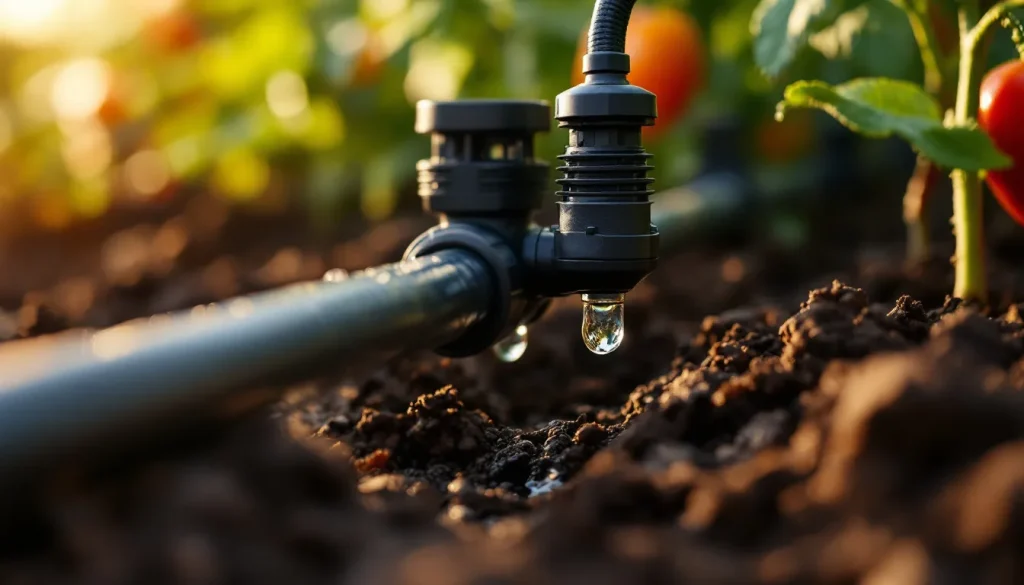
A drip irrigation emitter is the small device that meters water out of a pressurized tube and releases it slowly at one point in the root zone, usually measured in gallons per hour (GPH). Emitters (also called drippers) are the business end of any drip system: the tubing carries water, and the emitter controls how much lands where. Get the emitter choice right and the rest of the system mostly takes care of itself.
Each emitter has a rated flow, a connection type, and a pressure behavior. Those three traits decide whether your tomatoes get 1 gallon a day or drown, and whether the far end of a 50-foot row gets the same water as the first plant.
If you are building from scratch, pair this with our walkthroughs on the full drip irrigation system layout and, for beds, drip irrigation for raised beds.
The main types of drip irrigation emitters
There are four core emitter families: single-outlet drippers, multi-outlet (multi-port) emitters, micro-spray/micro-sprinklers, and bubblers. Single-outlet drippers deliver one slow stream to one plant. Multi-port emitters split one connection into 4 to 6 feeder lines. Micro-sprays cover a wider circle for ground cover. Bubblers flood a small basin fast, which trees and large containers like.
| Emitter type | How it waters | Typical flow | Best for |
|---|---|---|---|
| Single-outlet dripper | One slow drip at one spot | 0.5 to 4 GPH | Individual plants, containers, shrubs, tomatoes |
| Multi-outlet / multi-port | One inlet feeds 4 to 6 thin 1/4″ lines | 0.5 to 2 GPH per port | Container clusters, hanging baskets, spread-out pots |
| Micro-spray / micro-sprinkler | Fine spray over a 2 to 12 ft circle | 5 to 30+ GPH | Ground cover, seedbeds, dense annual beds |
| Bubbler / micro-bubbler | Umbrella or flood into a basin | 10 to 40 GPH | Trees, large shrubs, big containers |
Micro-sprays and bubblers push far more water than drippers, so never mix wildly different flows on the same zone without planning for it. A single micro-spray can move as much water as ten 2-GPH drippers.
Pressure-compensating vs non-pressure-compensating emitters
Pressure-compensating (PC) emitters hold a steady flow across a pressure range (commonly 10 to 50 PSI), so every plant gets the same water no matter its position. Non-pressure-compensating emitters flow faster where pressure is higher and slower where it drops, which means the first plants on a line get more than the last. PC costs a little more per emitter and solves the most common uneven-watering complaint.
Use PC emitters when any of these are true, because non-PC will water unevenly:
- Your yard slopes or the beds sit at different elevations (gravity changes pressure along the line).
- A single run is longer than about 30 feet, where friction drops pressure toward the end.
- Terrain is uneven or the layout has many branches and turns.
- You want repeatable, dial-it-in watering and plan to expand the system later.
Non-PC emitters are fine on short, flat runs (think a level raised bed under 20 feet) and they cost less. On slopes or long rows, PC is effectively mandatory if you want the last plant to match the first.
Adjustable-flow vs fixed-flow emitters
Fixed-flow emitters are rated at one GPH value and cannot be changed. Adjustable emitters have a dial that opens from a trickle to a small stream, letting one part serve many plant sizes. Adjustable emitters are convenient but drift out of calibration, clog more (the open path collects grit), and are almost never pressure-compensating, so pros lean on fixed PC emitters for reliability.
| Trait | Fixed-flow | Adjustable-flow |
|---|---|---|
| Flow accuracy | Consistent, rated GPH | Varies, hard to repeat |
| Clog resistance | Better | Worse (open orifice) |
| Pressure-compensating | Often available | Rarely |
| Best use | Set-and-forget zones | Mixed pots you tweak by hand |
Drip emitter flow rates and the color code, decoded
Drip emitters come in standard flow rates of 0.5, 1, 2, and 4 GPH, and many are color-coded so you can identify flow at a glance. The catch that catalog pages skip: colors are not an industry standard. Rain Bird, DIG, Netafim, and store-brand emitters each use their own scheme, so the color only means something within one product line. Always confirm the printed GPH on the emitter or package.
That said, some conventions repeat often enough to be worth a starting chart. Treat this as a “commonly seen” guide, not a rule:
| Flow rate | Commonly seen colors | Water per hour |
|---|---|---|
| 0.5 GPH | Red, tan, or beige | Half a gallon |
| 1.0 GPH | Black (very common default) | One gallon |
| 2.0 GPH | Green or brown | Two gallons |
| 4.0 GPH | Blue | Four gallons |
The one reliable habit: buy all your emitters from a single brand and keep the packaging. Then the color code becomes a real shortcut on your bench instead of a guess.
What GPH to use: plant and soil sizing table
Match flow rate to plant size first, then adjust for soil. Small plants and containers want low flow (0.5 to 1 GPH); shrubs and vegetables want 1 to 2 GPH; trees want multiple higher-flow emitters. Soil then shifts the answer: sandy soil drains fast and needs higher flow or more emitters placed close together, while clay holds water and needs lower flow to avoid runoff.
| Plant | Emitters per plant | GPH each |
|---|---|---|
| Small annual / seedling | 1 | 0.5 to 1 |
| Vegetable (tomato, pepper) | 1 to 2 | 1 |
| Small shrub | 1 | 1 to 2 |
| Large shrub | 2 | 2 |
| Container (up to 12″) | 1 | 0.5 |
| Large container / patio pot | 1 to 2 | 1 |
| Row crops | Inline dripline | 0.5 to 1 per outlet |
Soil rule of thumb: on sand, bump flow up or add emitters because water sinks straight down. On clay, drop flow so the surface has time to absorb it. Loam sits in the middle and forgives most choices.
Inline dripline vs on-line (punch-in) emitters
Inline (in-line) emitters are pre-installed inside dripline tubing at fixed spacing, so you just roll out the hose and every outlet is set. On-line (punch-in) emitters are separate parts you punch into plain tubing wherever a plant sits. Inline wins for evenly spaced rows and beds; on-line wins for scattered plants, pots, and custom layouts.
Most home systems use both: inline drip irrigation hose for row crops and beds, plus punch-in emitters on 1/4″ branch lines for the odd tree or planter. Inline dripline commonly ships with emitters spaced every 6, 9, 12, or 18 inches.
How emitters connect: barbs and tubing
On-line emitters attach with a barbed inlet that pushes into a hole you punch in the tubing. The barb grips the tubing wall to hold pressure. Emitters press directly into 1/2″ mainline tubing, or feed a 1/4″ micro-line: barb into the 1/2″ line, run 1/4″ tube to the plant, and cap it with the emitter at the far end.
Use the punch tool made for drip tubing, not a nail or screwdriver, so the hole seals around the barb. A ragged or oversized hole is the most common cause of leaks and blowouts at the emitter.
Emitter spacing basics
Emitter spacing depends on soil and plant, not preference. Water spreads sideways more in clay and sinks more vertically in sand, so sandy soil needs emitters closer together to avoid dry gaps between wet spots. As a baseline: sandy soil 8 to 12 inches, loam 12 to 18 inches, clay 18 to 24 inches.
| Soil type | Emitter spacing | Why |
|---|---|---|
| Sandy | 8 to 12 in | Water sinks fast, spreads little |
| Loam | 12 to 18 in | Balanced spread |
| Clay | 18 to 24 in | Water spreads wide and slow |
Emitters for trees: more flow, more heads
Trees need several emitters, not one, because roots spread out near the drip line of the canopy rather than at the trunk. Ring 3 to 6 emitters around each tree at 2 GPH, placed 12 to 24 inches from the trunk and out toward the canopy edge. Young trees can start with 2 to 3 emitters; mature or large trees may need 6 or more, or a pair of bubblers in a basin.
Move emitters outward every year or two as the canopy widens, so water keeps landing over the active feeder roots instead of the old planting hole.
How to stop drip emitters from clogging
Clogging is the number one reason home drip systems fail, and it is almost always avoidable. The fix is a filter plus flushing: install a screen or disc filter (150 to 200 mesh is standard) at the head of the system, and flush the lines by opening the end caps a few times a season. Hard water, well water, and fertilizer injection all raise the clog risk.
- Add a 150 to 200 mesh filter right after the pressure regulator, and clean it monthly.
- Flush the mainline and each branch by removing end caps until water runs clear, at startup and mid-season.
- On hard water, watch for mineral scale at the orifice; soak clogged emitters in vinegar or replace them (they are cheap).
- Choose PC emitters with a self-flushing or turbulent-flow path, which resist grit better than open adjustable emitters.
Emitters are consumable parts. When one clogs and will not clear, pull it and press in a new one rather than fighting it. Keeping a bag of spares in the matching flow rate is cheaper than a dead plant.
Where to buy: Rain Bird, DIG, DripWorks, and Home Depot
Rain Bird and DIG are the two most widely stocked emitter brands for homeowners, sold at Home Depot, Lowe’s, and irrigation specialists. DripWorks is a drip-focused online retailer with deeper technical selection and kits. For beginners, a matched brand kit avoids fitting-size mismatches between emitters, tubing, and connectors.
Sticking to one brand’s ecosystem keeps barb sizes, tubing diameters, and color codes consistent. If you are starting out, a complete drip irrigation kit bundles compatible emitters, tubing, filter, and regulator so nothing fights.
Frequently Asked Questions
What are the different types of drip irrigation emitters?
The four main types are single-outlet drippers (one slow stream per plant), multi-outlet or multi-port emitters (one inlet feeding 4 to 6 thin lines), micro-sprays or micro-sprinklers (a fine spray over a wider circle), and bubblers (a fast flood into a basin for trees and big pots). Within those, emitters are further split by flow rate, pressure-compensating behavior, and fixed versus adjustable flow.
What does the drip emitter color code mean?
Color usually signals flow rate in GPH, but there is no industry-wide standard, so colors only mean something within one brand’s product line. Common conventions: 0.5 GPH is often red or tan, 1 GPH is often black, 2 GPH is often green or brown, and 4 GPH is often blue. Always confirm the printed GPH on the emitter or package rather than trusting color alone.
What is the difference between pressure-compensating and non-pressure-compensating emitters?
Pressure-compensating (PC) emitters hold a steady flow across a range of pressures (commonly 10 to 50 PSI), so every plant gets equal water regardless of position. Non-PC emitters flow faster at higher pressure and slower at lower pressure, so the first plants on a line out-water the last. Use PC on slopes, on runs longer than about 30 feet, and on uneven terrain.
What GPH emitter should I use for my plants, trees, or vegetables?
Match flow to plant size, then adjust for soil. Use 0.5 to 1 GPH for seedlings and small containers, 1 GPH for vegetables like tomatoes, 1 to 2 GPH for shrubs, and multiple 2 GPH emitters for trees. On sandy soil, raise flow or add emitters; on clay, lower flow to prevent runoff and let the surface absorb the water.
How many drip emitters do I need per plant or per tree?
Small plants, vegetables, and containers usually need one emitter (large pots may want two). Shrubs take one or two depending on size. Trees need several because roots spread toward the canopy edge: start young trees with 2 to 3 emitters and give mature or large trees 4 to 6, arranged in a ring 12 to 24 inches out from the trunk.
What is the best drip irrigation emitter for beginners?
A 1 GPH fixed-flow pressure-compensating single-outlet dripper is the best beginner default. It waters most plants well, stays calibrated (unlike adjustable emitters), resists clogging better than open designs, and delivers even flow across the whole line. Buy a matched-brand kit from Rain Bird or DIG so barbs, tubing sizes, and connectors all fit together without adapters.
How do I stop drip emitters from clogging?
Install a 150 to 200 mesh screen or disc filter after the pressure regulator and clean it monthly. Flush the mainline and branch lines by opening the end caps at startup and mid-season until water runs clear. On hard or well water, soak clogged emitters in vinegar or just replace them. Choosing self-flushing PC emitters over open adjustable ones also cuts clogging.
Should I use adjustable or fixed-flow drip emitters?
Use fixed-flow emitters for almost every zone: they hold their rated GPH, clog less, and are available as pressure-compensating for even watering. Reserve adjustable emitters for a handful of mixed containers you want to tune by hand, and accept that they drift out of calibration and clog more because of their open orifice. Most reliable systems run fixed PC emitters throughout.