
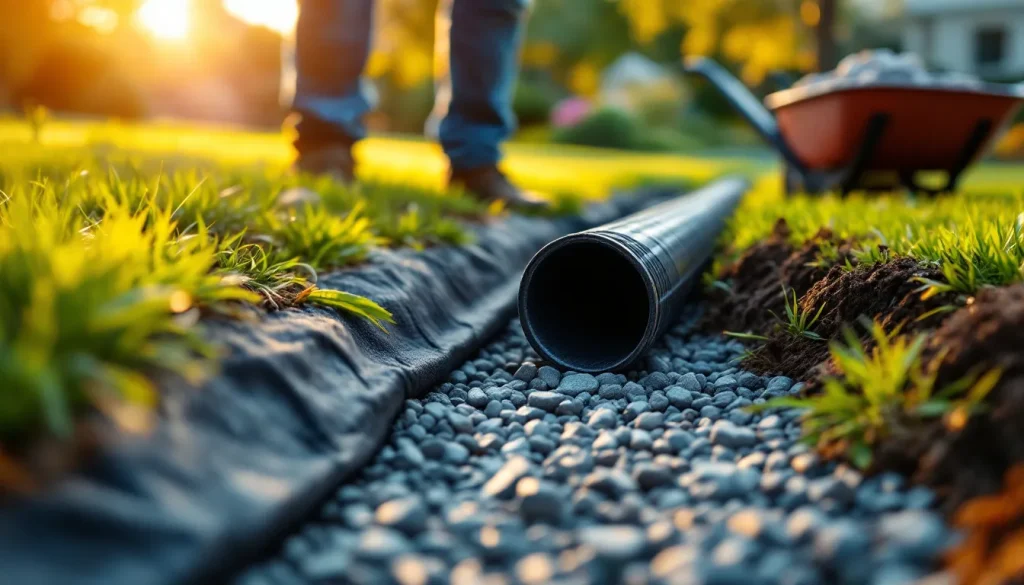
DIY French drain: the short version
A DIY French drain is a gravel-filled trench with a perforated pipe at the bottom that collects standing water and carries it downhill to a lower outlet. A confident homeowner can build one in a weekend for roughly $10 to $25 per linear foot in materials, versus $30 to $80 per linear foot installed by a contractor.
The project is DIY-friendly when it drains a soggy lawn or a low spot in the yard. It is not a good DIY project when it sits against a foundation, ties into a storm sewer, or crosses buried utilities. Those cases carry code, permit, and liability exposure covered lower down.
By the HMNDP Editorial Team. Independent reporting on lawn care, landscaping, water, and the green-industry business. Last reviewed: June 2026.
What a French drain is and how it works
A French drain is a sloped trench filled with washed gravel around a perforated pipe. Water in saturated soil follows the path of least resistance, seeps into the gravel, drops into the pipe, and flows downhill to an outlet such as a dry well, a daylight opening on a slope, or a rain garden. There is no pump and no power. Gravity does the work.
The name comes from Henry French, a Massachusetts farmer and judge who described the method in an 1859 book on farm drainage. The design has barely changed: a channel that gives water an easier route than sitting on your lawn.
It works only if two things are true. Water can reach the pipe (that is the gravel and fabric), and water can leave at a point lower than where it entered (that is the slope and the outlet). Break either one and you have dug an expensive gravel ditch that holds water instead of moving it.
Can a homeowner DIY a French drain?
Yes, most homeowners can DIY a French drain for a wet yard or lawn drainage problem. The skills required are digging a sloped trench, checking fall with a string level, and layering fabric, gravel, and pipe in order. The hard parts are physical (moving tons of gravel) and precision (holding a consistent 1 percent slope), not technical.
The realistic time cost is one to two weekends for a 40 to 60 foot run, faster if you rent a trencher. The realistic barrier is not skill. It is where the drain goes. A yard drain is DIY. A drain against a foundation or into a municipal storm system is a different job, and we draw that line clearly in the decision section below.
For the full installation mechanics with soil-by-soil adjustments, our companion guide on how to make a French drain covers depth ranges and frost-line detail beyond the scope here.
DIY French drain cost breakdown (2026 prices)
A 50-foot DIY French drain costs roughly $500 to $1,250 in materials in 2026, or about $10 to $25 per linear foot. The same job installed by a contractor typically runs $1,500 to $4,000. The savings come from your labor and from renting rather than owning equipment. The table below itemizes a standard 50-foot, 18-inch-deep exterior run.
| Item | Spec | Qty for 50 ft | 2026 unit price | Line total |
|---|---|---|---|---|
| Perforated pipe | 4 in corrugated, sock optional | 50 ft | $0.80–$1.40/ft | $40–$70 |
| Washed drainage gravel | 3/4 to 1-1/2 in angular, clean | ~2.5 cu yd | $40–$70/cu yd | $100–$175 |
| Nonwoven filter fabric | 4–6 oz, 3 ft wide | ~110 ft | $0.30–$0.60/ft | $35–$65 |
| Outlet fitting / pop-up emitter | 4 in | 1 | $12–$30 | $12–$30 |
| Gravel delivery | Local haul | 1 load | $60–$120 | $60–$120 |
| Trencher rental | Walk-behind, half day | 1 | $110–$180 | $110–$180 |
| Consumables | Landscape staples, spray paint, couplers | — | $25–$50 | $25–$50 |
| DIY total | — | — | — | $382–$690 |
Dig by hand instead of renting a trencher and you drop the low end under $400, trading roughly $150 for a much sorer back. Add a dry well or a long buried outlet run and costs climb toward the top. Either way, a DIY French drain lands well under the $1,000 to $5,000 contractor range, which is the whole reason to build one yourself. For the broader trade-off, see our breakdown of lawn repair service versus DIY.
Materials list for a DIY French drain
A standard exterior French drain needs seven material categories: perforated pipe, washed angular gravel, nonwoven filter fabric, an outlet fitting, couplers, landscape staples, and marking paint. Buy gravel by cubic yard, not by bag, once a run passes about 20 feet. Bagged gravel costs three to four times more per volume.
- Perforated pipe: 4-inch corrugated HDPE or rigid PVC. Corrugated is cheaper and flexible; rigid PVC is easier to clean later.
- Gravel: 3/4 to 1-1/2 inch washed, angular, clean stone. Not pea gravel, not crusher run with fines.
- Filter fabric: nonwoven geotextile, 4 to 6 oz per square yard. Not the thin woven weed barrier.
- Outlet: a daylight opening, a pop-up emitter, or a dry well kit.
- Small parts: couplers, landscape staples to hold fabric, and marking paint for the 811 utility locate.
Tools list for a DIY French drain
The core tool set is a trenching shovel, a wheelbarrow, a string line with a line level or a laser level, a tape measure, and gloves. A rented walk-behind trencher is optional but cuts a 50-foot dig from a full day to under an hour. Add a hand tamper and a utility knife for fabric.
- Trenching shovel and/or rented walk-behind trencher
- Wheelbarrow (moving 2 to 3 cubic yards of gravel)
- String line plus line level, or a laser level, to set and check slope
- Tape measure, stakes, marking paint
- Utility knife, work gloves, hand tamper
Step-by-step: how to install a DIY French drain
Installing a French drain follows eight ordered steps: call 811, mark the route, dig on slope, line with fabric, add a gravel base, lay the pipe, cover with gravel, then wrap and backfill. Order matters. Fabric and gravel go in before the pipe, and the pipe sits on a gravel bed, never on bare dirt.
- Call 811 first. In the United States, dial 811 or file online at least a few business days before digging. Utilities mark buried lines free. Skipping this can be illegal and dangerous.
- Mark the route from the wet source to a lower outlet with marking paint. Confirm the outlet is lower than the inlet.
- Dig the trench 12 to 24 inches deep and about 6 to 12 inches wide, holding a steady downhill fall (see slope section).
- Line the trench with nonwoven fabric, leaving 12 or more inches of overhang on each side to fold over later.
- Add a 2 to 3 inch gravel base so the pipe never rests on soil.
- Lay the perforated pipe on the gravel bed with holes oriented correctly (see the orientation section).
- Cover the pipe with gravel to within about 3 to 6 inches of the surface.
- Fold the fabric over the top of the gravel, then backfill with soil or top with sod, mulch, or a grate.
Trench routing: from water source to outlet
Route a French drain from the wettest point (the inlet) continuously downhill to a legal, lower outlet. The inlet sits where water collects: a soggy lawn area, the base of a slope, or a downspout zone. The outlet is any lower point that can safely release water, such as a daylight opening on a hillside, a dry well, or a rain garden.
Keep the run as straight and continuous as terrain allows, since every low spot or reverse grade becomes a place water pools inside the pipe. Never aim the outlet toward a neighbor’s property or a public right-of-way without checking local rules. Water you redirect onto someone else’s land can create a legal dispute depending on your state and municipality.
Required slope: the 1 percent rule
A French drain needs a minimum slope of 1 percent, which is 1 inch of drop for every 10 feet of run, or roughly 1/8 inch per foot. This is the single most common failure point. Too flat and water sits; a little steeper (up to about 2 percent) drains faster and is fine.
Check slope with a string line and a line level, not by eye. Tie a string tight between two stakes, level it, then measure the growing gap to the trench bottom as you move downhill. Over 30 feet you should see at least 3 inches of fall. If you cannot get natural fall to an outlet, the site may need a pump-based solution instead, which is a different project.
Perforated pipe: do the holes point up or down?
This is genuinely disputed, so here is the ruling. For a true French drain that lowers a high water table or drains saturated soil, orient the perforations DOWN (roughly the 4 and 8 o’clock positions). For a surface trench drain built mainly to catch water falling from above, holes UP lets water enter faster. The disagreement online is really two different drains wearing the same name.
The physics: a true French drain intercepts groundwater rising from below and moving sideways through the gravel. Holes down let that water enter at the lowest point and keep the pipe emptying as the water table drops. Holes up would leave a reservoir of standing water beneath the perforations. Home Depot and many manufacturers recommend holes down for this reason, and that is the correct call for the wet-soil and foundation drainage problems most homeowners are solving.
| Your goal | Drain type | Hole orientation |
|---|---|---|
| Lower a high water table, drain soggy soil, protect a footing | True French / footing drain | Holes DOWN (4 and 8 o’clock) |
| Catch surface runoff falling from above into a gravel channel | Surface trench drain | Holes UP |
When in doubt, point them down. Most homeowners searching this question have a groundwater problem, not a surface-collection problem.
Filter fabric: why it prevents clogging
Nonwoven filter fabric (geotextile) wraps the gravel to keep soil fines and silt from washing in and clogging the drain. Without it, fine particles migrate into the gravel over a few seasons, fill the voids, and the drain slowly stops working. Fabric is cheap insurance that roughly doubles the working life of the system.
Line the trench so the fabric cups the gravel like a taco, then fold the flaps over the top before backfilling. Use nonwoven geotextile rated 4 to 6 oz per square yard, not thin woven weed barrier, which clogs and blocks flow. One critical warning about how you wrap it appears in the mistakes section below.
Gravel and aggregate specs
Use washed, angular, clean stone sized 3/4 to 1-1/2 inches. Angular stone locks together and leaves large voids for water to move through. Washed and clean means no sand or fines mixed in, since fines defeat the whole drain. Avoid pea gravel (too round and small, packs tight) and crusher run or roadbase (full of fines that cement up).
A 50-foot trench 18 inches deep and 8 inches wide needs roughly 2 to 2.5 cubic yards of gravel. Order 10 percent extra. Running short mid-project means a second delivery fee.
Inlet versus outlet placement
The inlet is the high, wet end where water enters the system; the outlet is the low end where it leaves. The inlet must sit at or slightly below the problem area so water flows into the gravel. The outlet must sit lower than the inlet and terminate at grade or above, never buried below the surrounding soil line.
Terminating the outlet below grade is a classic mistake: the pipe fills, backs up, and the whole drain fails. Give the outlet a visible daylight opening, a pop-up emitter, or a properly sized dry well so water has a real exit.
The DIY French drain mistakes that cause failures
Most failed French drains fail for one of six reasons: no slope, holes pointing the wrong way, fabric wrapped as a “burrito,” the wrong gravel, an undersized pipe, or an outlet buried below grade. Each has a specific, avoidable fix. This is the section competitors skip, and it is where most weekend projects go wrong.
| Mistake | Why it fails | The fix |
|---|---|---|
| No or reverse slope | Water sits in the pipe instead of draining | Hold at least 1 inch of fall per 10 ft; verify with a string level |
| Holes pointing up (on a true French drain) | Leaves a standing reservoir under the perforations | Point holes down at 4 and 8 o’clock for groundwater drainage |
| Fabric “burrito” wrap around the pipe | Silt cakes on the fabric skin and clogs it fast | Wrap the fabric around the whole gravel envelope, not tight around the pipe |
| Wrong gravel (pea gravel or crusher run) | Small or fine-laden stone packs and blocks flow | Use 3/4 to 1-1/2 in washed angular clean stone |
| Undersized pipe | Small pipe overwhelmed in heavy rain | Use 4 in pipe for most yards; upsize for large catchment areas |
| Outlet terminated below grade | Pipe backs up with nowhere to release | Daylight the outlet at or above grade, or use a dry well |
The burrito mistake deserves emphasis because it looks tidy and is completely wrong. Wrapping fabric snugly around just the pipe (a “pipe sock burrito”) lets silt build a skin directly on the fabric and choke the perforations. The fabric belongs around the outside of the gravel, so the gravel envelope, not the pipe surface, does the filtering.
When NOT to DIY: the decision framework
Skip the DIY French drain and call a licensed professional when the drain sits against a foundation, ties into a storm sewer, needs a permit, or crosses marked utilities. These situations carry structural, legal, or safety exposure that a weekend project should not absorb. A yard or lawn drain is DIY. The four cases below are not.
| Situation | Why it changes the calculus | DIY? |
|---|---|---|
| Drain within a few feet of a foundation or basement wall | Wrong depth or backfill can misdirect water toward the footing and worsen seepage or cause structural damage | Get a pro |
| Tying into a municipal storm sewer | Often requires permits and inspection; illegal connections can bring fines depending on your city | Get a pro |
| Any dig where 811 marks utilities in the path | Hitting gas, electric, or water lines is dangerous and can carry liability | Reassess or get a pro |
| Discharge that crosses a property line or public right-of-way | Redirecting water onto neighbors can trigger disputes depending on state law | Check rules first |
Two rules are non-negotiable regardless of who does the work. Call 811 (or file online) before you dig; it is free and, in most states, legally required. And check whether your municipality requires a permit for drainage work, especially near foundations or storm systems. These vary by state and city, so confirm locally before breaking ground. For ongoing coverage of drainage and green-industry topics, see the HMNDP learn hub and news section.
Frequently Asked Questions
How much does it cost to build a French drain yourself?
A DIY French drain costs about $10 to $25 per linear foot in materials in 2026, so a typical 50-foot run lands around $400 to $700 with a rented trencher. Digging by hand drops the low end under $400. Contractors charge roughly $30 to $80 per linear foot installed, or $1,500 to $4,000 for the same job, so DIY saves the most on labor.
Do the holes in a French drain pipe point up or down?
For a true French drain that drains soggy soil or lowers a high water table, point the holes down at the 4 and 8 o’clock positions so water enters at the lowest point and the pipe keeps emptying. Holes up only make sense for a surface trench drain catching water from above. When in doubt, point them down.
What slope does a French drain need?
A French drain needs at least a 1 percent slope, which is 1 inch of fall for every 10 feet, or about 1/8 inch per foot. Steeper (up to roughly 2 percent) drains faster and is fine. Check it with a string line and a line level, not by eye, since too little fall is the single most common reason a French drain fails.
Do I need landscape fabric for a French drain?
Yes, use nonwoven filter fabric rated 4 to 6 oz per square yard to keep soil fines from clogging the gravel. Line the trench so the fabric wraps the whole gravel envelope, then fold it over the top before backfilling. Do not wrap it tightly around just the pipe, and avoid thin woven weed barrier, which blocks flow.
What gravel size is best for a French drain?
Use washed, angular, clean stone sized 3/4 to 1-1/2 inches. Angular stone locks together and leaves large voids for water to move. Avoid pea gravel, which is too round and packs tight, and avoid crusher run or roadbase, which contains fines that clog the drain. Clean and washed matters as much as size.
How deep should a French drain be?
A yard French drain is usually 12 to 24 inches deep and 6 to 12 inches wide. Drains protecting a foundation footing often go deeper, 24 to 48 inches, and cold climates dig below the frost line. Depth also depends on how deep the water problem sits, so trench to reach the saturated layer you are trying to relieve.
What are the most common French drain mistakes to avoid?
The six most common French drain mistakes are: no or reverse slope, holes pointing up on a true French drain, wrapping fabric as a tight “burrito” around the pipe, using pea gravel or fine-laden crusher run, undersizing the pipe, and terminating the outlet below grade so water backs up. Each is avoidable with correct slope, orientation, fabric placement, gravel, and a daylighted outlet.
Can I install a French drain without a perforated pipe?
You can build a pipe-free “French drain” as a gravel-only trench, and it will move some water for short runs. But a perforated pipe adds capacity, drains faster in heavy rain, and clogs less over time. For anything longer than a short run or in clay soil, include a 4-inch perforated pipe. It costs under $1.40 per foot and is worth it.