
By the HMNDP Editorial Team, independent reporting on lawn care, landscaping, and fertilizer.
Last reviewed: June 2026
How to fertilize plants: the short version
To fertilize plants, pick a fertilizer whose N-P-K numbers match your goal, apply it around the base of the plant out to the drip line (not against the stem), and water it in so nutrients reach the roots. Feed during active growth, use less than you think, and never apply to bone-dry soil. Those five moves prevent almost every beginner mistake.
- Read the three N-P-K numbers on the bag and match them to your plant’s stage.
- Measure the dose. When unsure, use half the label rate.
- Water the soil first if it is dry.
- Spread granules around the base out to the drip line, or apply diluted liquid feed.
- Water again to move the fertilizer down to the roots.
The rest of this guide covers each step with exact ratios, doses, and the fixes for over-feeding. For product-level picks, see our roundup of the best plant fertilizers for 2026.
What N-P-K means and how to read the label
N-P-K is the three-number code on every fertilizer label, listed as percentages by weight. N is nitrogen (leaf and stem growth), P is phosphorus (roots, flowers, and fruit), and K is potassium (overall vigor and stress tolerance). A 10-10-10 bag is 10 percent nitrogen, 10 percent phosphorus, and 10 percent potassium. The rest is filler and micronutrients.
The numbers tell you what the fertilizer pushes. A high first number (like 24-8-16) drives green leafy growth and is common in lawn feeds. A high middle number (like 5-10-10) supports roots and blooms. When the three numbers are equal, it is called a balanced or all-purpose fertilizer.
Ratio matters more than the raw numbers. A 10-10-10 and a 5-5-5 both have a 1:1:1 ratio, so they feed the same balance of nutrients. The higher numbers simply mean more concentrated product, so you apply less of it.
N-P-K ratios for specific uses
Match the N-P-K ratio to what the plant is doing right now. Leafy plants want nitrogen. New transplants and root systems want relatively more phosphorus, often a 1:2:2 or 1:2:1 ratio. Flowering and fruiting plants want phosphorus and potassium. The table below maps common goals to example products so you can shop with confidence.
| Goal / plant stage | Target ratio | Example N-P-K | Why |
|---|---|---|---|
| New transplants, seedlings, root establishment | 1:2:2 or 1:2:1 | 5-10-10, 10-20-10 | Extra phosphorus builds roots before top growth |
| Leafy greens (lettuce, spinach, kale) | 3:1:2 or high N | 24-8-16, 21-0-0 | Nitrogen fuels fast leaf production |
| Flowering annuals and perennials | 1:2:1 or 1:2:2 | 5-10-5, 10-20-20 | Phosphorus and potassium drive blooms |
| Fruiting vegetables (tomatoes, peppers) | 1:2:2 | 5-10-10, 4-6-8 | Too much nitrogen gives leaves, not fruit |
| General vegetable garden, mixed beds | 1:1:1 balanced | 10-10-10, 5-5-5 | Safe all-purpose choice for beginners |
| Houseplants (foliage) | 1:1:1, diluted | 20-20-20 at half strength | Steady, gentle feeding avoids salt buildup |
If you only buy one product, a balanced 10-10-10 will not steer any plant wrong. It is the reliable default while you learn what each crop prefers. For crop-specific guidance, our editors compared products in the best fertilizer for a vegetable garden.
How to physically apply fertilizer around the base to the drip line
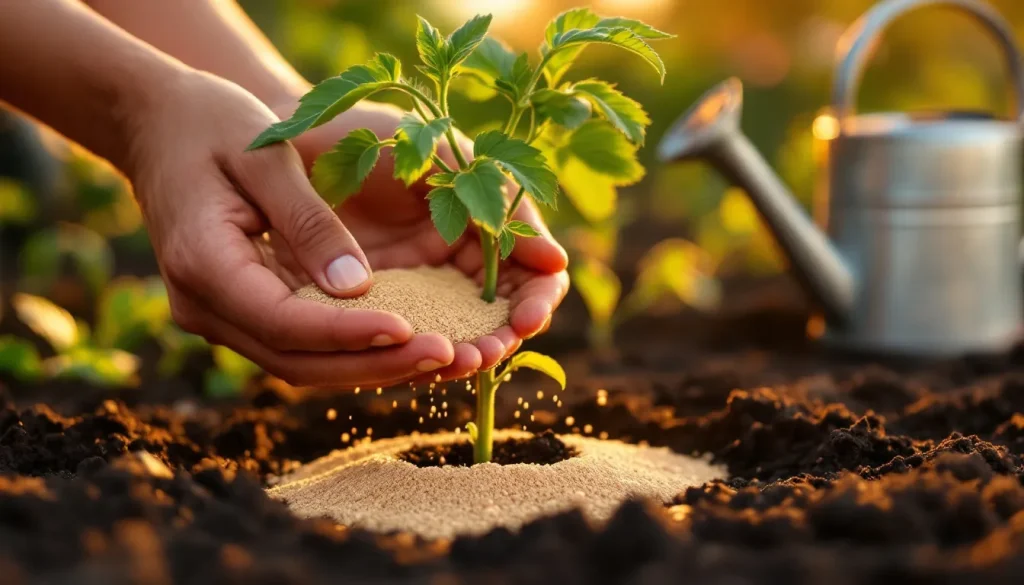
Spread fertilizer in a ring around the plant, starting a few inches from the stem and extending out to the drip line (the circle of soil directly under the outermost leaves). Feeder roots live near the drip line, not against the trunk. Applying fertilizer tight against the stem is the most common way beginners cause chemical burn.
- Find the drip line: look straight down from the widest leaves and mark that circle on the soil.
- Keep granules 3 to 6 inches away from the stem or trunk to protect the crown.
- Scatter the measured dose evenly in the ring, not in a single pile.
- For established shrubs and trees, work granules lightly into the top inch of soil.
- Water thoroughly so the fertilizer dissolves and moves down to the roots.
For liquid feeds, skip the ring and pour the diluted solution over the root zone as you would when watering. Liquid reaches roots immediately, which is why it is the fastest option for a hungry-looking plant.
Why watering and fertilizing go together
Fertilizer only works dissolved in water, and applying it to dry roots is what actually burns plants. Concentrated salts pull moisture out of dry root cells. Always make sure the soil is moist before feeding, then water again afterward to carry nutrients down. If the ground is dry, water first, wait until it soaks in, then fertilize.
The safe order for granular feed is: moist soil, apply, water in. For liquid feed, the dilution already provides the water, but you should still avoid feeding a wilted, dry plant. Rehydrate it first, then feed at the next watering.
During hot, dry spells plants take up nutrients less efficiently and burn risk climbs. Our guide to fertilizing during drought covers how to adjust doses when water is scarce.
Fertilizing vegetables vs flowers vs transplants
Vegetables, flowers, and transplants each want a different nutrient balance and schedule. Vegetables are heavy feeders that need regular nitrogen and potassium through the season. Flowers want phosphorus for blooms. Transplants need gentle, phosphorus-forward feeding to grow roots before you push top growth. The table below sets a starting schedule for each.
| Plant type | Best ratio | How often | Beginner tip |
|---|---|---|---|
| Leafy vegetables | High N (24-8-16) | Every 3 to 4 weeks | Stop feeding 2 weeks before harvest |
| Fruiting vegetables | 1:2:2 (5-10-10) | At planting, then every 4 weeks once fruit sets | Ease off nitrogen once flowers appear |
| Flowering annuals | 1:2:1 (5-10-5) | Every 2 to 4 weeks in bloom | Deadhead spent flowers between feeds |
| New transplants | 1:2:2 (10-20-20) | Once at transplanting, diluted to half | Wait 2 to 3 weeks before the next feed |
Transplants deserve special caution. A plant recovering from root disturbance is easy to burn. Use a starter fertilizer at half the label rate at planting, then hold off until it shows new growth.
Liquid vs granular vs slow-release fertilizer
The three formats differ in speed and duration. Liquid feeds act within days but wash out fast, so you reapply often. Granular is cheaper and lasts weeks. Slow-release coated granules meter nutrients out over 2 to 6 months, which makes them the most forgiving choice for beginners worried about over-feeding.
| Type | Speed | Lasts | Best for | Burn risk |
|---|---|---|---|---|
| Liquid (water-soluble) | 1 to 3 days | 1 to 2 weeks | Containers, quick fixes, houseplants | Moderate if undiluted |
| Granular (quick-release) | 1 to 2 weeks | 4 to 6 weeks | Garden beds, vegetables | Higher if piled or dry |
| Slow-release (coated) | 2 to 4 weeks | 2 to 6 months | Beginners, low-maintenance beds, pots | Lowest |
If you are nervous about killing a plant, start with slow-release granules. They release nutrients gradually as soil warms and moisture rises, which sharply reduces the salt spikes that cause burn.
The four things beginners actually fear (answered with numbers)
Most guides stop at N-P-K and leave beginners guessing on the four questions that cause real anxiety: how much to use, how to spot and fix burn, when to feed, and whether to water first. Here are direct, numeric answers to all four. This is the section competitors skip, and it is where most plants are saved or lost.
1. How much fertilizer per plant
The honest rule: use half of what the label says until you know the plant tolerates more. Under-feeding is nearly harmless and reversible. Over-feeding burns roots. As a starting baseline, the doses below cover common situations and err on the safe side.
| Situation | Safe starting dose |
|---|---|
| Small annual or vegetable transplant | 1 tablespoon granular 10-10-10 worked into the planting hole soil |
| Established garden bed | 1 to 2 pounds of 10-10-10 per 100 square feet |
| Container plant (liquid) | Half the label dilution, every 2 weeks |
| Houseplant | Quarter to half strength, monthly in spring and summer |
When in doubt, feed less, more often. A plant fed weakly every two weeks is far safer than one hit with a full dose once.
2. Signs of over-fertilizing (fertilizer burn) and how to fix it
Fertilizer burn shows up as yellowing followed by brown, crispy leaf edges and tips, wilting even in moist soil, a white crusty salt layer on the soil surface, and stunted or dropped leaves. It is caused by excess mineral salts pulling water out of roots. Caught early, most plants recover with a thorough soil flush.
- Remove any visible granules or crust from the soil surface.
- Flush the root zone with clean water: for pots, run water through until it equals about 2 to 3 times the pot volume.
- For garden beds, water deeply for several minutes to leach salts below the roots.
- Trim off badly burned leaves so the plant stops spending energy on them.
- Do not fertilize again for 3 to 4 weeks, then resume at half strength.
Flushing (also called leaching) dissolves and carries away the excess salts. It is the single most reliable rescue for an over-fed plant and works for both containers and beds.
3. When to fertilize plants
Feed plants during active growth, which for most gardens means spring through late summer. Stop feeding perennials, trees, and shrubs 6 to 8 weeks before your first expected fall frost, because late nitrogen pushes tender growth that winter kills. Houseplants follow daylight: feed spring and summer, pause or reduce sharply in fall and winter.
Vegetables are the exception that keep eating. Feed them on a rolling 3 to 4 week schedule across the whole growing season, since harvesting removes nutrients the plant needs to replace.
4. Should you water before or after applying fertilizer
Both, in the right order. If the soil is dry, water first so roots are hydrated and cannot be burned. Apply the fertilizer, then water again to dissolve granules and move nutrients to the root zone. The rule to remember: never apply fertilizer to dry roots, and always water it in afterward. Liquid feeds already carry their own water, but the plant should still be hydrated before you feed.
How to fertilize indoor plants and use natural options
Indoor plants need weaker, less frequent feeding than garden plants because they grow slowly and salts build up in pots with no rain to flush them. Use a balanced liquid fertilizer (such as 20-20-20) diluted to a quarter or half strength, applied monthly in spring and summer only. Flush the pot with plain water every few months to clear salt buildup.
For natural feeding, compost is the foundation: a 1 to 2 inch top-dressing releases nutrients slowly and feeds soil life. Other organic options include worm castings, fish emulsion (roughly 5-1-1), diluted seaweed extract, and well-rotted manure. Organic sources release nutrients more gently than synthetics, which makes fertilizer burn much less likely, though they act slower.
Whether you feed synthetic or organic, the core rules do not change: match the ratio to the goal, keep product off the stem, water it in, and start with less. Master those and you can feed any vegetable, flower, transplant, or houseplant with confidence.
Frequently Asked Questions
What does N-P-K mean on a fertilizer label?
N-P-K is the three-number code showing the percentage by weight of nitrogen (N), phosphorus (P), and potassium (K). Nitrogen drives leaf and stem growth, phosphorus supports roots and flowers, and potassium boosts overall vigor. A 10-10-10 bag contains 10 percent of each nutrient. The remaining weight is filler and trace minerals.
How often should you fertilize plants?
It depends on the plant and format. Vegetables need feeding every 3 to 4 weeks during the growing season. Flowering annuals want feeding every 2 to 4 weeks while in bloom. Houseplants take monthly feeding in spring and summer only. Slow-release granules feed for 2 to 6 months from a single application, so you apply them far less often.
How much fertilizer should I use per plant?
Start with half the label rate until you know the plant tolerates more. A small transplant needs about 1 tablespoon of granular 10-10-10 mixed into the planting soil. Established beds take 1 to 2 pounds of 10-10-10 per 100 square feet. Container and houseplants do best on quarter to half-strength liquid feed. Under-feeding is far safer than over-feeding.
What are the signs of over-fertilizing and how do you fix it?
Fertilizer burn appears as brown, crispy leaf edges, yellowing, wilting in moist soil, and a white salt crust on the surface. To fix it, remove visible granules, then flush the root zone with clean water (2 to 3 times the pot volume for containers, a long deep soak for beds). Trim burned leaves and wait 3 to 4 weeks before feeding again at half strength.
When is the best time of year to fertilize plants?
Feed during active growth, generally spring through late summer. Stop feeding trees, shrubs, and perennials 6 to 8 weeks before the first fall frost so late growth does not get winter-killed. Houseplants should be fed only in spring and summer, then paused in fall and winter. Vegetables are fed continuously every 3 to 4 weeks through the season.
Should I water before or after applying fertilizer?
Do both. If the soil is dry, water first so roots stay hydrated and safe, then apply fertilizer, then water again to carry nutrients to the roots. The essential rule is never to apply fertilizer to dry roots, because concentrated salts pull moisture from dry root cells and cause burn. Liquid feeds supply their own water but still need a hydrated plant.
How do you fertilize plants naturally?
Use organic sources that release nutrients slowly. Compost applied as a 1 to 2 inch top-dressing is the foundation. Worm castings, fish emulsion (about 5-1-1), diluted seaweed extract, and well-rotted manure all work well. Organic feeds are gentler than synthetics and rarely burn plants, though they act more slowly because soil microbes must break them down first.
What is the difference between liquid, granular, and slow-release fertilizer?
Liquid fertilizer acts in 1 to 3 days but lasts only 1 to 2 weeks, so you reapply often. Granular is cheaper and lasts 4 to 6 weeks. Slow-release coated granules meter nutrients over 2 to 6 months and carry the lowest burn risk, which makes them the most forgiving option for beginners worried about over-feeding.