
By the HMNDP Editorial Team. Last reviewed: June 2026.
What is spray irrigation and how does it work?
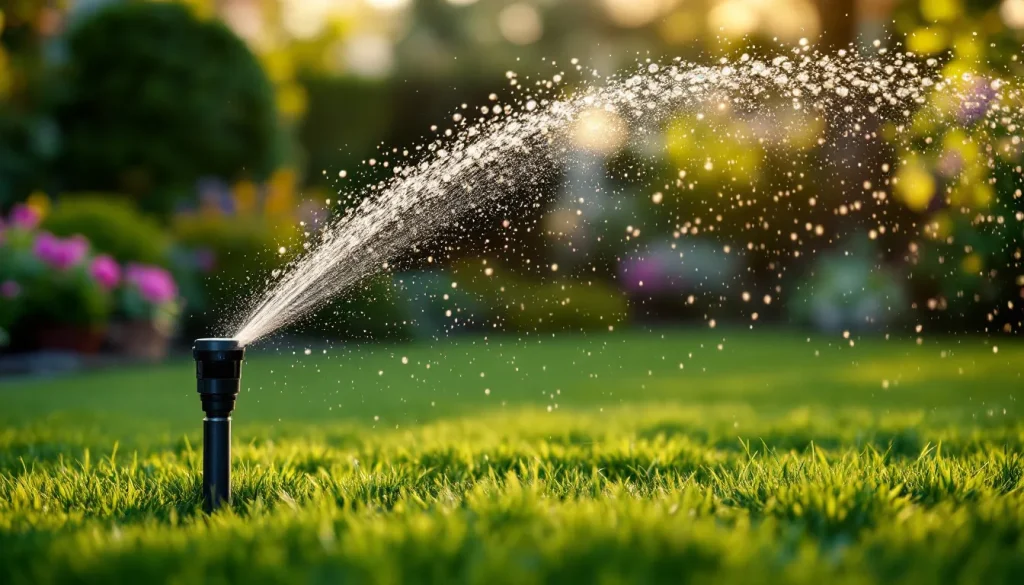
Spray irrigation applies water through pressurized heads that break the flow into droplets and throw them over soil, lawns, or crops to mimic rainfall. A pump or mains pressure pushes water through buried or surface pipes, up through risers, and out of spray or sprinkler heads. It wets a wide area quickly, which makes it the default choice for turf and dense plantings.
The method is also called sprinkler irrigation. The two terms describe the same principle: convert steady pipe pressure into an overhead pattern of droplets.
Spray irrigation covers everything from a $40 micro-spray kit on a raised bed to a center-pivot machine watering 130 acres of corn. The physics is identical at both ends of that range.
How spray irrigation works mechanically
A spray irrigation system moves water in five stages: a pressure source (pump or municipal mains), a mainline pipe, lateral pipes with valves, vertical risers, and the spray heads themselves. Pressure at the head, usually 20 to 40 psi for residential gear, determines how far and how evenly water throws. Too little pressure and the pattern collapses; too much and it atomizes into drift.
Residential systems typically run PVC or polyethylene laterals underground, with pop-up heads that rise when the zone is charged and retract when it shuts off. A controller opens electric valves zone by zone so each area gets full pressure.
Agricultural systems scale the same parts up: bigger pumps, aluminum or PVC mainlines, and impact or gear-driven sprinklers on solid-set, wheel-line, or center-pivot frames. Matched precipitation rate, the goal of applying water evenly across a zone, is the design target at every scale.
Spray head types: pop-up, fixed riser, and micro-spray
Spray irrigation uses three common head families. Pop-up heads sit flush with the lawn and rise under pressure, ideal for turf. Fixed-riser heads sit on a permanent standpipe above ground cover, common in shrub beds. Micro-spray heads and micro-sprinklers deliver a fine, low-volume pattern to individual plants, containers, and raised beds off small-diameter tubing.
| Head type | Typical flow | Best use | Approx. price each |
|---|---|---|---|
| Pop-up spray head | 0.5 to 4 GPM | Lawns, open turf | $3 to $12 |
| Fixed riser head | 1 to 4 GPM | Shrub and flower beds | $2 to $8 |
| Rotor head | 1 to 8 GPM | Large lawns, long throw | $8 to $25 |
| Micro-spray / micro-sprinkler | 5 to 30 GPH | Raised beds, containers, orchards | $1 to $4 |
Micro-spray sits on the border between spray and drip. It sprays like sprinkler gear but at drip-scale volumes, which is why kits from brands like Rain Bird, Orbit, and Mister Landscaper market it for garden beds.
Spray irrigation vs drip irrigation
Spray irrigation wets a wide area fast through overhead droplets and suits lawns and dense beds. Drip irrigation delivers water slowly to the root zone through emitters and suits rows, shrubs, and containers. Spray is cheaper to install and easier to visualize; drip loses far less water to evaporation. The right pick depends on plant layout, water cost, and climate.
| Factor | Spray irrigation | Drip irrigation |
|---|---|---|
| Application efficiency | 65 to 75% | 90 to 95% |
| Coverage | Wide, uniform, fast | Point-source, slow |
| Best plantings | Turf, ground cover | Rows, shrubs, pots |
| Evaporation loss | High (20 to 30%) | Low (under 5%) |
| Clogging risk | Low | Higher (needs filtration) |
| Install cost (residential) | Moderate to high | Low to moderate |
For root-zone efficiency on beds and rows, our guides on drip irrigation for raised beds and choosing a drip irrigation hose walk through the alternative in detail.
How much does spray irrigation cost, including cost per acre?
Spray irrigation costs range widely by scale. A DIY micro-spray kit runs $30 to $100. A professionally installed residential lawn system costs about $0.20 to $1.00 per square foot, or roughly $2,500 to $5,500 for a quarter-acre yard. Farm-scale sprinkler systems run about $500 to $1,500 per acre for solid-set and $600 to $1,200 per acre for center pivot, before water and energy.
Top-ranking pages skip these numbers entirely, so here is a consolidated range built from typical 2025 to 2026 US installed pricing.
| System scale | Typical cost | Cost basis |
|---|---|---|
| Micro-spray kit (DIY) | $30 to $100 | Per kit, 1 bed to 1 patio |
| Residential in-ground | $2,500 to $5,500 | Per quarter-acre lawn |
| Residential (per unit) | $0.20 to $1.00 | Per square foot installed |
| Solid-set / portable (farm) | $500 to $1,500 | Per acre, hardware only |
| Center pivot (farm) | $600 to $1,200 | Per acre, machine + install |
| Traveling gun (farm) | $300 to $700 | Per acre, hardware only |
Operating cost adds up separately. Pumping pressurized spray commonly costs more in energy than low-pressure drip, and the 20 to 30% of water lost to evaporation is water you still pay for.
Is spray irrigation efficient, or does it waste water?
Spray irrigation typically reaches 65 to 75% application efficiency, meaning about a quarter to a third of pumped water never reaches the root zone. Losses come from evaporation off droplets and leaves, plus wind drift that carries spray off target. Drip, by contrast, runs 90 to 95% efficient. Timing, head choice, and weather move spray efficiency more than any other factor.
Three levers close the gap. Water at dawn, when wind is calm and evaporation is low, and you recover much of the 20 to 30% typical loss. Use low-angle nozzles or rotors that throw larger droplets, which drift less than fine mist. Space heads for head-to-head coverage so no dry rings force overwatering.
Smart controllers help too. Weather-based and soil-moisture controllers cut spray waste by skipping cycles after rain. Our 2026 smart irrigation adoption report tracks how fast homeowners and growers are adding these controls and what savings they report.
Spray irrigation pros and cons
Spray irrigation trades efficiency for coverage and simplicity. It waters wide turf and dense beds fast, costs little to design, and rarely clogs. The tradeoffs are real: it loses 20 to 30% of water to evaporation and wind, wets foliage in ways that can invite fungal disease, and needs steady pressure to stay uniform. Here is the honest ledger.
| Pros | Cons |
|---|---|
| Covers large areas quickly and evenly | 65 to 75% efficient; 20 to 30% lost to evaporation and wind |
| Ideal for lawns and ground cover | Wet foliage can encourage fungal disease |
| Low clogging risk vs drip emitters | Needs consistent 20 to 40 psi pressure |
| Simple to design and visualize | Higher energy cost to pressurize |
| Cheap DIY entry via micro-spray kits | Runoff risk on slopes and clay soils |
Which spray irrigation type for which situation
Match the system to the planting and the scale. Pop-up spray or rotor heads fit open lawns. Fixed risers or micro-spray fit shrub and flower beds. Micro-spray kits fit raised beds and containers. At farm scale, solid-set suits high-value orchards, center pivot suits large field crops, and traveling guns suit irregular or rented ground. Use drip instead when rows are widely spaced or water is expensive.
| Situation | Recommended spray type |
|---|---|
| Open lawn, small to medium | Pop-up spray heads |
| Large lawn or sports turf | Rotor heads |
| Shrub and flower beds | Fixed risers or micro-spray |
| Raised beds and containers | Micro-spray kit |
| Orchard or vineyard | Micro-sprinklers or solid-set |
| Large field crops | Center pivot |
| Irregular or rented fields | Traveling gun |
How to install a micro-spray irrigation kit
A micro-spray kit installs in under an hour with no digging. Most kits from Rain Bird, Orbit, or Mister Landscaper include a faucet connector, backflow preventer, pressure regulator, filter, half-inch supply tubing, quarter-inch feeder tubing, micro-spray heads, and stakes. You lay tubing on the surface, punch in feeders, and stake heads where plants need water.
- Connect the backflow preventer, filter, and pressure regulator to an outdoor faucet in that order.
- Attach the half-inch supply tubing and run it along the bed edge, securing it with stakes.
- Punch holes in the supply tubing where each plant cluster sits.
- Insert quarter-inch feeder tubing into each hole and route it to a plant.
- Push a micro-spray head onto each feeder line and mount it on a stake at plant height.
- Cap the open end of the supply tubing, then turn on the water and check every head.
- Adjust spray radius and add or move heads until coverage is even, then set a timer.
Flush the line before capping it so debris does not reach the heads. Micro-spray heads are cheap to swap if one delivers the wrong pattern.
Frequently Asked Questions
What is spray irrigation and how does it work?
Spray irrigation applies water through pressurized heads that break it into droplets thrown over soil or plants to mimic rainfall. A pump or mains pressure sends water through pipes, up risers, and out of spray heads. It wets wide areas fast, which is why it is the standard method for lawns, ground cover, and dense garden beds.
What is the difference between spray irrigation and drip irrigation?
Spray irrigation throws water overhead across a wide area and runs 65 to 75% efficient. Drip irrigation drops water slowly at each plant’s roots and runs 90 to 95% efficient. Spray suits lawns and ground cover; drip suits rows, shrubs, and containers. Spray costs less to design but loses more water to evaporation and wind than drip.
What are the pros and cons of spray irrigation?
Pros: spray irrigation covers large areas fast, suits lawns, rarely clogs, and starts cheap with DIY kits. Cons: it runs only 65 to 75% efficient, losing 20 to 30% of water to evaporation and wind, wets foliage in ways that can spread fungal disease, needs steady 20 to 40 psi pressure, and can cause runoff on slopes.
How much does spray irrigation cost, including cost per acre?
A DIY micro-spray kit costs $30 to $100. A professional residential lawn system runs about $0.20 to $1.00 per square foot, or roughly $2,500 to $5,500 for a quarter-acre. At farm scale, solid-set systems cost about $500 to $1,500 per acre and center pivots about $600 to $1,200 per acre, before water and energy.
What are the different types of spray irrigation heads?
Three families dominate. Pop-up heads sit flush with turf and rise under pressure, best for lawns. Fixed-riser heads sit on a permanent standpipe above ground cover, common in shrub beds. Micro-spray heads and micro-sprinklers deliver low, fine patterns to raised beds, containers, and orchards. Rotor heads add long throw for large lawns and sports turf.
Is spray irrigation efficient, or does it waste water?
Spray irrigation is moderately efficient at 65 to 75%, losing 20 to 30% of pumped water to evaporation and wind drift. You recover much of that by watering at dawn when wind and evaporation are low, using low-angle large-droplet nozzles, spacing heads head-to-head, and adding weather-based or soil-moisture smart controllers that skip cycles after rain.
When should you use spray irrigation instead of drip?
Use spray irrigation for open lawns, ground cover, and densely planted beds where you need wide, even coverage fast. Choose drip instead for widely spaced rows, individual shrubs, containers, or where water is expensive and evaporation losses matter. Micro-spray bridges the two for raised beds, delivering drip-scale volume in a sprinkler pattern.
How do you install a spray or micro-spray irrigation kit?
Connect a backflow preventer, filter, and pressure regulator to a faucet, then run half-inch supply tubing along the bed. Punch feeder holes, insert quarter-inch tubing, and stake a micro-spray head at each plant. Cap the line, turn on the water, and adjust each head for even coverage. Most kits install in under an hour with no digging.