
By the HMNDP Editorial Team, independent reporting on lawn care, landscaping, water, and the green-industry business.
Last reviewed: June 2026
What a drip irrigation hose actually is (and the terms sellers mix up)
A drip irrigation hose is flexible polyethylene tubing that delivers water slowly to plant roots through small emitters or holes, instead of spraying it overhead. Retailers use “tubing,” “hose,” “dripline,” and “drip line” interchangeably, which confuses buyers. They are not all the same product. The type you pick decides your fittings, run length, and whether plants get even water.
Overhead sprinklers lose water to wind, runoff, and evaporation. Drip systems put water at the soil surface, which is why manufacturers such as Orbit and Rain Bird cite up to 70% less water use versus traditional spray irrigation. That efficiency claim depends on correct sizing, so start with the type.
Drip irrigation hose types compared: which one you need
There are five products buyers conflate. Blank 1/2 inch mainline carries water but has no holes. Micro-tubing (1/4 inch) branches off it to individual plants. Pre-punched dripline has emitters spaced inside the wall. Drip tape is thin-walled and disposable for rows. Soaker hose weeps along its whole length. Match the type to your bed shape below.
| Type | Diameter | How it waters | Best for | Typical price |
|---|---|---|---|---|
| Mainline / blank tubing | 1/2 in | No emitters; feeds the system | Backbone line around beds and rows | $0.20-$0.40 per ft |
| Micro-tubing | 1/4 in | Feeds single emitters or plants | Containers, individual shrubs, spot watering | $0.10-$0.25 per ft |
| Pre-punched dripline (emitter tubing) | 1/2 or 1/4 in | Built-in emitters every 6, 12, or 18 in | Raised beds, hedges, evenly spaced plants | $0.35-$0.70 per ft |
| Drip tape | 5/8 in flat | Slit or emitter outlets, thin wall | Vegetable rows, seasonal or annual crops | $0.05-$0.15 per ft |
| Soaker hose | 1/2 or 5/8 in | Weeps water along entire length | Short flower beds, low-effort setups | $9-$40 per roll |
For most home gardeners, pre-punched 1/2 inch dripline is the simplest choice for a raised bed layout because emitters are already spaced and no punching is needed. Soaker hose is the adjacent budget option but delivers water less evenly and clogs faster in hard water.
What size drip irrigation hose do you need, and how far it runs
Size is set by flow, not guesswork. A 1/2 inch mainline handles roughly 200 to 240 gallons per hour and runs up to about 200 feet before pressure drops noticeably. A 1/4 inch line carries only 20 to 30 GPH and should stay under 30 feet. Exceed those lengths and emitters at the far end starve.
Emitter output matters too. Common emitters flow 0.5, 1.0, or 2.0 GPH each. To size a run, add up every emitter’s GPH and keep the total under the line’s capacity. A 100-foot 1/2 inch dripline with emitters every 12 inches has 100 emitters; at 1.0 GPH that is 100 GPH, well within a 1/2 inch line’s limit.
| Hose size | Approx. flow capacity | Max recommended run | Rough coverage |
|---|---|---|---|
| 1/4 in micro-tubing | 20-30 GPH | ~30 ft | Up to ~15-20 emitters |
| 1/2 in mainline / dripline | 200-240 GPH | ~200 ft | One 4×8 bed to a full border |
| 3/4 in mainline | 480 GPH | ~400 ft | Large landscape or multiple zones |
Emitter spacing: 6, 12, or 18 inches
Emitter spacing should match how far water spreads in your soil and how close your plants sit. Use 6 inch spacing in sandy soil or for dense plantings like lettuce and carrots. Use 12 inch spacing as the all-purpose default for most vegetables and perennials. Use 18 inch spacing in clay soil or for widely spaced shrubs and tomatoes.
Sandy soil drains straight down, so closer emitters prevent dry gaps. Clay spreads water sideways, so wider spacing still covers the root zone. When unsure, 12 inch dripline is the safest single choice for a mixed bed.
Connectors, fittings, and whether you need a pressure regulator and filter
A drip irrigation hose off a garden spigot needs four things at the tap before the tubing: a backflow preventer, a filter (150-200 mesh), a pressure regulator, and a hose-thread adapter. Skip the regulator and household pressure (40-80 psi) can blow emitters off a system rated for 15-30 psi. The filter stops grit from clogging emitters.
Down the line you connect tubing with barbed or compression fittings: tees, elbows, couplers, and 1/4 inch connectors that tap micro-tubing into the mainline. Every open end needs an end cap or figure-8 closure so the line holds pressure. A pre-matched drip irrigation kit bundles these parts and removes the guesswork for a first build. Our full step-by-step install walkthrough covers layout and connection order.
- Attach backflow preventer, filter, then pressure regulator to the spigot.
- Run 1/2 inch mainline along the bed edge and secure with stakes.
- Add dripline or punch 1/4 inch emitters at each plant.
- Cap every open end and flush before first full run.
Maintenance, clog prevention, and winterizing
A drip irrigation hose lasts 3 to 10 seasons only if you keep it clean and drain it before freezes. Flush the lines by opening the end caps and running water for 30 to 60 seconds two or three times per season. Clean the filter monthly. Both steps clear the sediment that causes most emitter clogs.
In climates that freeze, water left inside splits the tubing. Before the first hard frost, shut off the supply, open all end caps, and let the lines drain fully; use compressed air at low pressure for buried or long runs. Surface driplines can stay in place if drained. This routine, part of any lasting drip irrigation system, prevents the cracking that ends most first-year setups.
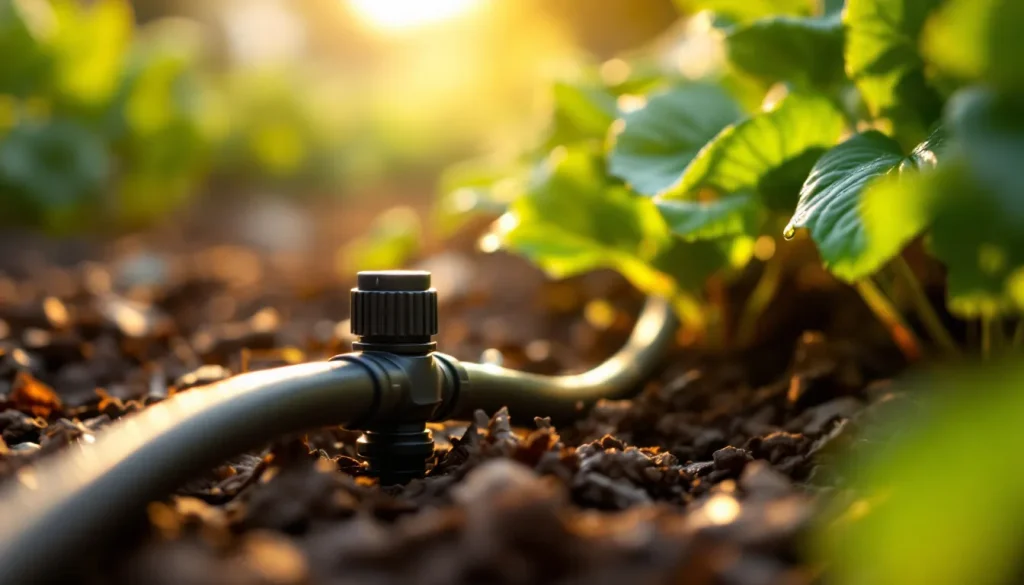
You can bury 1/2 inch dripline 2 to 6 inches deep or under mulch to hide it and cut evaporation, but subsurface lines clog unseen and are harder to inspect. Most home gardeners get better results leaving the hose on the surface under mulch.
Frequently Asked Questions
What is the difference between a drip irrigation hose, dripline, drip tape, and a soaker hose?
A drip irrigation hose is the general term for tubing that drips water at the roots. Dripline is tubing with emitters spaced inside it. Drip tape is thin, flat, low-cost tubing for annual rows. Soaker hose weeps water along its entire porous length. Driplines and drip tape deliver measured, even output; soaker hose is cheaper but less precise and clogs faster.
What size drip irrigation hose do I need, 1/4 inch or 1/2 inch?
Use 1/2 inch tubing as the mainline for any bed, row, or border; it carries 200 to 240 gallons per hour and runs up to about 200 feet. Use 1/4 inch micro-tubing only for short branches to individual plants or containers, keeping those under 30 feet. Most gardens use 1/2 inch as the backbone with 1/4 inch feeders.
How long can a single drip irrigation hose run be before pressure drops?
A 1/2 inch line runs up to about 200 feet before emitters at the far end lose pressure and output. A 1/4 inch line should stay under 30 feet. The real limit is total flow: add up every emitter’s GPH and keep it under the line’s capacity. Split long layouts into multiple zones fed from the same mainline.
What connectors and fittings do I need to set up a drip irrigation hose?
You need a hose-thread adapter, tees, elbows, and couplers to route the mainline, plus 1/4 inch barbed connectors to tap micro-tubing into it, and end caps or figure-8 closures to seal every open end. At the spigot, add a backflow preventer, filter, and pressure regulator. Barbed and compression fittings both work; match them to your tubing’s outer diameter.
Does a drip irrigation hose need a pressure regulator and filter off a garden spigot?
Yes, in almost every case. Household water runs 40 to 80 psi, while drip emitters are rated for 15 to 30 psi, so a pressure regulator prevents blown fittings. A 150 to 200 mesh filter keeps grit and mineral particles from clogging emitters. Both are inexpensive, install at the tap, and are the parts most likely to save a system.
What emitter spacing should I choose (6, 12, or 18 inches)?
Choose 6 inch spacing for sandy soil or closely planted crops like lettuce and carrots, 12 inch spacing as the all-purpose default for most vegetables and perennials, and 18 inch spacing for clay soil or widely spaced shrubs and tomatoes. Sandy soil needs closer emitters because water drains straight down; clay spreads water sideways, so wider spacing still covers roots.
Can you bury a drip irrigation hose or does it have to sit on the surface?
You can bury 1/2 inch dripline 2 to 6 inches deep or run it under mulch to hide it and reduce evaporation. Buried lines clog unseen and are harder to inspect or flush, so many gardeners lay the hose on the surface under mulch instead. Subsurface tubing with root-resistant emitters works best for permanent plantings.
Do I need to drain or winterize drip irrigation hose in cold climates?
Yes. Water left inside tubing freezes and splits it. Before the first hard frost, shut off the supply, open all end caps to drain, and blow long or buried lines clear with low-pressure compressed air. Surface driplines can stay in place once drained. Skipping this step is the most common reason a drip system fails after one season.