
By the HMNDP Editorial Team, independent reporting on lawn care, landscaping, and the green industry.
Last reviewed: June 2026
Low maintenance front yard landscaping ideas with rocks and mulch: the fast answer
Low maintenance front yard landscaping ideas with rocks and mulch usually combine three moves: rock for permanent zones (borders, dry creek beds, foundation strips), organic mulch for planting beds, and a short list of drought-tolerant plants. A 300 square foot front yard runs roughly $600 to $2,500 in materials for a DIY install. None of it is truly zero maintenance.
Rock lasts 15 or more years but bakes plant roots and is hard to remove later. Mulch improves soil but decomposes and needs topping off every 1 to 2 years. The best designs use both, each where it belongs. Below are 12 copyable ideas, real cost math, and the mistakes that ruin most first-time installs.
The rock vs mulch tradeoff (read this before you buy anything)
Rock and mulch solve different problems. Rock is a permanent, low-refresh surface that suppresses evaporation and never blows away, but it stores heat, can raise soil temperature around roots, and is miserable to dig out once installed. Organic mulch feeds soil as it breaks down, keeps roots cooler, and is cheap to refresh, but it decomposes and must be replaced.
| Factor | Decorative rock | Organic mulch (wood/bark) |
|---|---|---|
| Typical upfront cost | $45 to $135 per ton (delivered) | $25 to $45 per cubic yard bulk, $3 to $6 per 2 cu ft bag |
| Lifespan before refresh | 15+ years (occasional rinse/blow) | 1 to 2 years before re-mulching |
| Effect on soil | None; can raise soil temp, reflect heat | Adds organic matter, cools roots, retains moisture |
| Weed behavior | Traps blown-in dirt; weeds root in the gaps over time | Suppresses weeds well when 3 in deep, then thins as it breaks down |
| Best used for | Borders, paths, dry creeks, foundation strips, hot full-sun zones | Planting beds, around shrubs, shade beds, anywhere near living roots |
| Removal difficulty | High (heavy, embeds into soil) | Low (decomposes or rakes out) |
The honest rule: put rock where you never want to plant, and mulch where things grow. Rock next to heat-sensitive plants in a hot climate can stress them, which is why xeriscape pros keep true rock mulch to succulents, agave, and gravel-loving natives.
1. Rock-and-mulch combined beds (the workhorse layout)
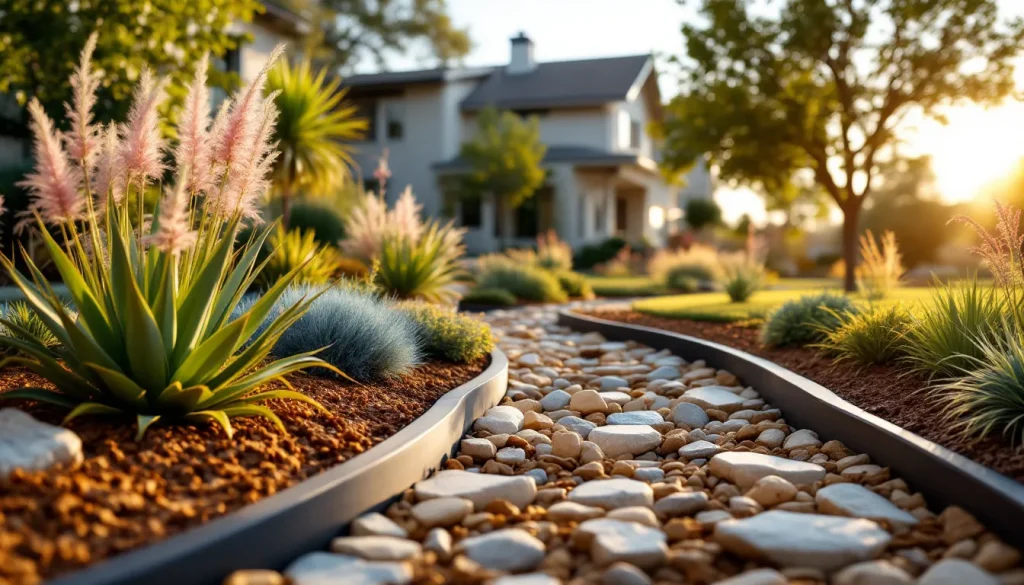
A combined bed uses a rock border or river-rock apron on the outside and organic mulch in the planting core. This gives you a clean, permanent edge that never needs re-mulching, while the plants sit in soil-building mulch. It is the single most copied low maintenance front yard design because it splits the job between the two materials.
Run a 12 to 18 inch band of river rock along the bed edge and against the house foundation, then mulch the interior 3 inches deep around the plants. Separate the two materials with steel or aluminum edging so the rock does not migrate into the mulch. Our guide on how many cubic feet are in a yard of mulch helps you size the mulch core before you order.
2. Decorative rock borders and edging
A rock border frames beds and separates surfaces so materials stay put and weeds have fewer entry points. Larger cobble (3 to 8 inch) makes a bold permanent edge; pea gravel or crushed stone makes a tidy walkable strip. Borders are the highest-impact, lowest-skill upgrade for curb appeal.
Set a physical edge first. Steel edging (about $2 to $4 per linear foot), poly edging ($1 to $2 per foot), or a dug spade-edge trench all stop rock and mulch from mixing. Without an edge, every rain and every mow pushes rock into the lawn and mulch into the rock, which is the number one reason these yards look messy within a year.
3. Choosing rock types: river rock, pea gravel, lava rock, and gravel
Rock type changes cost, look, and how the yard behaves underfoot. River rock is smooth and decorative but rolls; pea gravel is walkable and cheap; lava rock is lightweight and drains fast but breaks down and floats in heavy rain; crushed gravel compacts into firm paths.
| Rock type | Size | Typical cost | Best for | Watch out for |
|---|---|---|---|---|
| River rock | 1 to 3 in | $70 to $135/ton | Borders, dry creeks, foundation strips | Rolls; not great for walking |
| Pea gravel | 3/8 in | $45 to $75/ton | Paths, patios, fill | Migrates without hard edging |
| Lava rock | 1/2 to 1 in | $80 to $120/ton | Hot dry beds, xeriscape accents | Fades, crumbles, floats in downpours |
| Crushed gravel (3/4 in) | 3/4 in | $30 to $60/ton | Compacted paths, base layers | Sharp edges, industrial look |
| Decomposed granite | Fines | $40 to $80/ton | Natural walkways, southwest look | Tracks indoors, needs stabilizer |
One ton of rock covers roughly 70 to 100 square feet at 2 inches deep. For most 1 to 3 inch decorative rock, budget one ton per 80 square feet and add 10 percent for waste.
4. Mulch types and colors
Mulch choice affects lifespan, color retention, and soil health. Hardwood and bark mulches last longest and feed soil; dyed mulches hold color 2 to 3 times longer but add nothing nutritionally; rubber mulch never decomposes but does not improve soil and can leach in heat. Match the color to your house, not the trend.
- Shredded hardwood: $25 to $40/yard, knits together on slopes, decomposes in about a year.
- Bark nuggets: $30 to $45/yard, slower to break down, floats in heavy rain.
- Dyed brown/black: $30 to $40/yard, color lasts a full season or two.
- Cedar/cypress: $35 to $50/yard, natural insect resistance, ages to silver-gray.
Color logic: black mulch reads modern against light or gray houses but shows fading fast; brown is the safest all-purpose choice; red can look artificial against brick. To budget bulk delivery accurately, check current mulch cost per yard and confirm delivery minimums.
5. Landscape fabric weed barrier (the honest version)
Landscape fabric is a woven or non-woven sheet laid over soil to block weeds before rock or mulch goes on top. It works well under rock for the first few years, but it is not permanent and it is not the miracle most product listings imply.
Under rock, fabric is defensible: it keeps stones from sinking into soil and slows weeds. Under organic mulch, most pros skip it, because mulch that decomposes creates a dirt layer on top of the fabric where weeds root anyway, and the fabric blocks the mulch from feeding the soil. Expect any fabric to start failing in 3 to 5 years as UV, roots, and blown-in soil defeat it. Use commercial-grade woven fabric (3 to 5 oz), not the thin rolls sold in big-box garden aisles.
6. Weed control that actually holds (the fabric-under-mulch debate)
Weeds come from two directions: existing roots below and seeds blown in above. Fabric only addresses the first. The durable fix is depth plus edging plus occasional spot-pulling, not a single barrier layer.
- Kill existing weeds and grass first (sheet mulching with cardboard, or a labeled herbicide per directions), then wait the required interval.
- Lay cardboard or commercial fabric only where it fits the material above (fabric under rock, cardboard under mulch).
- Apply rock or mulch at full depth: 3 inches of mulch, 2 to 3 inches of rock.
- Install a hard edge so blown seeds have less soil to root in.
- Reapply a pre-emergent per label in early spring, and spot-pull the survivors.
Anyone who tells you rock plus fabric equals zero weeds forever is selling something. Blown-in dust settles between stones and becomes a seedbed within a few seasons.
7. Xeriscaping and no-grass lawn replacement
Xeriscaping replaces thirsty turf with rock, mulch, and drought-tolerant plants to cut water use and mowing to near zero. In hot dry regions it can reduce landscape water use significantly, and many Western US water utilities pay turf-removal rebates (often $1 to $5 per square foot; check your local provider).
A no-grass front yard typically layers zones: gravel or decomposed granite for the open ground plane, mulched planting islands, boulders as anchors, and a dry creek for drainage and visual movement. The design stays interesting because of contrast and shape, not because of a green lawn. If you want to offload the build or the seasonal upkeep, our landscape maintenance services overview explains what crews typically handle versus DIY.
8. Drought-tolerant, low-maintenance plants (paired by sun and zone)
The right plant list is what separates a designed yard from a gravel parking pad. Choose species matched to your USDA zone and to the specific sun exposure of the bed, then group them so watering needs match. Below are dependable, low-fuss pairings.
| Condition | Reliable plants | Best zones |
|---|---|---|
| Full sun, hot/dry (SW, CA) | Agave, red yucca, lantana, autumn sage, blue fescue | 7 to 10 |
| Full sun, cold winters | Russian sage, coneflower, sedum, catmint, yarrow | 4 to 8 |
| Part shade | Coral bells, hostas (with mulch, not rock), liriope, hellebore | 4 to 9 |
| Dry shade under trees | Barrenwort, carex, ferns, vinca | 4 to 8 |
| Structural/evergreen anchors | Dwarf yaupon holly, boxwood, juniper, dwarf mugo pine | 4 to 9 |
Pair heat-lovers (agave, yucca, sedum) with rock, and pair anything with softer foliage (coral bells, hostas, ferns) with mulch, since rock reflects heat that can scorch tender leaves.
9. Dry creek bed feature
A dry creek bed is a shallow rock-lined channel that handles runoff and adds a natural line through the yard. It solves drainage and looks intentional, which is why it appears in most high-end low maintenance designs. It is also one of the few features that is genuinely close to no-upkeep.
Dig a gentle curving trench 4 to 8 inches deep and 2 to 3 feet wide, line it with fabric, set larger boulders along the banks, and fill with a mix of 1 to 3 inch river rock and a few 6 to 12 inch stones for realism. Curves and varied stone sizes read natural; a straight, single-size channel reads like a drain. Aim it where water already flows during storms.
10. Rock and mulch around trees, walkways, and the foundation
Placement around structures has real rules. Get the depth and the trunk gap right and these zones become the lowest-maintenance parts of the yard. Get them wrong and you invite rot, pests, and dead trees.
- Around trees: Mulch in a 3 inch layer in a ring, but keep a 3 to 6 inch gap around the trunk. The “mulch volcano” (mulch piled against bark) traps moisture and kills trees slowly. Never mound rock against a trunk either; it holds heat and hides pests.
- Along walkways: Use compacted crushed gravel or pea gravel with hard edging so stones do not spill onto the path.
- Against the foundation: Run a 12 to 24 inch rock strip (not mulch) directly against the house. Rock does not hold moisture against the foundation and does not attract termites the way wood mulch can. Keep the grade sloping away for drainage.
11. Small front yard ideas
Small yards reward restraint. Fewer materials, bigger shapes, and one focal point read as designed; too many little zones read as clutter. A small front yard is also the cheapest to convert, which makes it the best place for a first DIY rock-and-mulch project.
Pick one main rock, one mulch color, and three to five plant species repeated in groups. Use a single sweeping bed shape instead of many islands, add one anchor (a boulder, a specimen agave, or a small dry creek), and let negative space do the work. A 200 to 400 square foot conversion is a realistic weekend job for two people.
12. Curb appeal and property value
Well-executed low maintenance landscaping reads as “cared for,” which supports curb appeal and can help a home show better. Real estate and landscape industry surveys have long linked quality landscaping to buyer perception, though actual value impact varies by market, region, and how tidy the install looks.
The value comes from crisp edges, healthy plants, and clean material separation, not from the amount of rock. A gravel-only “moonscape” with no plants can read as cheap or neglected and may hurt appeal. Keep 30 to 50 percent of beds planted so the yard looks intentional rather than paved over.
The real cost math (the part competitors skip)
Here is honest budgeting for a 300 square foot front yard conversion using both materials, DIY. Numbers are 2026 US material ranges and exclude your labor; hiring a pro typically adds $2 to $6 per square foot on top.
| Item | Quantity (300 sq ft) | Cost range |
|---|---|---|
| Decorative rock (2 in deep, ~180 sq ft) | ~2.5 tons | $180 to $340 |
| Organic mulch (3 in deep, ~120 sq ft) | ~1.1 yards | $30 to $55 |
| Steel/poly edging | ~60 linear ft | $70 to $240 |
| Woven fabric (under rock only) | ~200 sq ft | $40 to $90 |
| Drought-tolerant plants | 12 to 20 plants | $150 to $500 |
| Boulders/accent stone (optional) | 2 to 4 stones | $60 to $250 |
| Delivery | 1 to 2 drops | $50 to $150 |
| DIY total | ~$580 to $1,625 |
Ongoing cost is where rock wins. Re-mulching the mulched portion every 1 to 2 years costs roughly $30 to $60 in materials; the rock zones cost near zero for 15+ years beyond an occasional rinse and leaf-blow. Rock weight matters for delivery and hauling, so if you are moving material yourself, our breakdown of how much a yard of mulch weighs helps you gauge how many trips a pickup truck can handle.
How deep to layer rock and mulch
Depth controls weed suppression and appearance. Too shallow and weeds punch through and soil shows; too deep wastes money and, for mulch, can suffocate roots. These are the field-standard depths.
- Organic mulch: 3 inches over beds; refresh to maintain that depth, do not keep piling on top.
- Decorative rock: 2 to 3 inches over fabric; 3 to 4 inches for larger cobble so soil does not show.
- Pea gravel paths: 2 inches over a compacted base.
- Never exceed 4 inches of mulch around plants, and keep all material off trunks and stems.
Common mistakes that ruin low maintenance yards
Most failures are avoidable and predictable. Nearly every neglected-looking rock-and-mulch yard traces back to the same short list of shortcuts taken at install.
- No hard edge: materials migrate and mix within a season.
- Mulch volcanoes: mulch piled on trunks rots bark and kills trees.
- Rock near heat-sensitive plants: reflected heat scorches soft foliage.
- Relying on fabric forever: it fails in 3 to 5 years; plan for spot weeding.
- Gravel-only “moonscape”: no plants means no curb appeal.
- Skipping the weed kill: covering live grass just delays the problem.
Frequently Asked Questions
Is it better to use rock or mulch in a front yard?
Neither is universally better; they do different jobs. Rock lasts 15+ years and suits borders, paths, foundation strips, and hot full-sun zones, but it bakes roots and is hard to remove. Organic mulch improves soil and cools roots but decomposes and needs refreshing every 1 to 2 years. The best front yards use rock in permanent zones and mulch in planting beds.
How much does it cost to landscape a front yard with rocks and mulch?
A DIY 300 square foot front yard using both materials typically runs about $580 to $1,625 in 2026, including rock, mulch, edging, fabric, plants, and delivery. Hiring a pro usually adds $2 to $6 per square foot in labor. Decorative rock runs $45 to $135 per ton; bulk mulch runs $25 to $45 per cubic yard. Small yards cost far less.
Can you put rock and mulch together in the same landscaping bed?
Yes, and it is one of the most reliable low maintenance layouts. Use a rock border or apron on the bed edge and against the foundation, then organic mulch in the planting core around the plants. Separate the two with steel or poly edging so the materials do not migrate and mix. This gives permanent edges plus soil-building mulch where things grow.
Do you need landscape fabric under rocks and mulch?
Under rock, fabric helps: it slows weeds and keeps stones from sinking into soil, though it starts failing in 3 to 5 years. Under organic mulch, most pros skip it, because decomposing mulch creates a soil layer on top where weeds root anyway, and the fabric blocks mulch from feeding the soil. Use commercial-grade woven fabric, not thin big-box rolls.
What are the best low-maintenance plants to pair with rocks and mulch?
Match plants to sun and USDA zone. For hot full sun, use agave, red yucca, lantana, and blue fescue with rock. For cold-winter sun, use Russian sage, coneflower, sedum, and yarrow. For shade, use coral bells, hostas, and ferns with mulch, not rock. Pair heat-lovers with rock and soft-foliage plants with mulch to avoid heat scorch.
How do you keep weeds from growing through rocks and mulch?
Kill existing grass and weeds first, then apply full depth (3 inches mulch, 2 to 3 inches rock), install hard edging, and apply a labeled pre-emergent each spring. Fabric under rock helps early on but fails in a few years. Blown-in dust becomes a seedbed between stones, so plan on occasional spot-pulling. No rock yard stays weed-free forever.
What is the cheapest way to landscape a small front yard with no grass?
Convert a small 200 to 400 square foot yard yourself using bulk pea gravel or crushed gravel ($30 to $75 per ton) as the ground plane, a few mulched planting islands, and a handful of repeated drought-tolerant plants. Kill the grass with cardboard sheet mulching instead of paid herbicide, and check your water utility for turf-removal rebates that offset material cost.
How deep should rock and mulch be layered in a landscaping bed?
Apply organic mulch 3 inches deep over beds and never exceed 4 inches around plants. Apply decorative rock 2 to 3 inches deep over fabric, or 3 to 4 inches for larger cobble so soil does not show. Pea gravel paths need about 2 inches over a compacted base. Keep all material 3 to 6 inches off tree trunks and plant stems.