
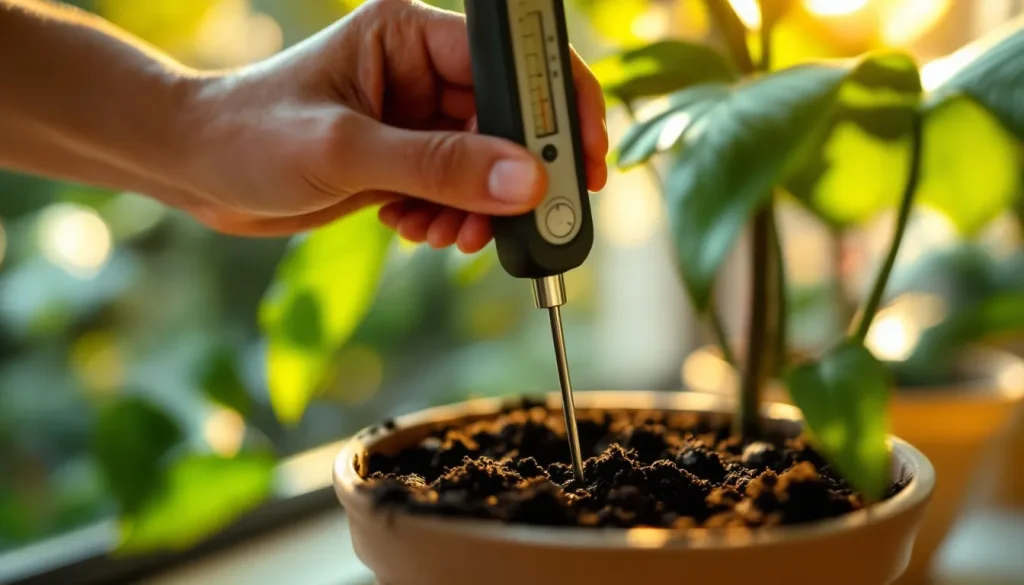
What a soil moisture meter is and what it measures
A soil moisture meter is a probe you push into soil to estimate how wet it is, usually shown as a number from 1 (bone dry) to 10 (saturated) or as a dry/moist/wet band. Most consumer meters do not report true volumetric water content (the percent of soil volume that is water). They report a relative, uncalibrated moisture scale meant for comparison, not lab precision.
The distinction matters when you shop. A $60,000 research probe using TDR (time-domain reflectometry) or a good capacitive sensor can output volumetric water content as a real percentage. A $10 dial meter cannot. It gives you a directional signal: wetter than yesterday, or drier than the plant likes.
Byline: HMNDP Editorial Team. See our editorial team.
Last reviewed: June 2026.
How the cheap analog probe actually works (and why it drifts)
The classic $8 to $15 analog dial soil moisture meter has no battery. It works as a galvanic cell: the two dissimilar metal probes plus wet soil act like a weak battery, and that tiny current swings the needle. More water and dissolved salts mean more current and a higher reading. This is the honest limitation buyers are rarely told.
Because the reading depends on dissolved salts, the number is not a pure moisture measurement. Fertilized soil, hard tap water, or salty potting mix push the needle higher even when the soil is not that wet. Fresh distilled water can read low. That is why two identical meters can disagree in the same pot.
These probes also corrode. The bare metal sits in wet, salty soil, oxidizes over weeks, and the readings drift. If you leave one in the pot permanently, expect it to lose accuracy within a season. Clean, dry, and store the probe between uses to slow this.
Analog vs. capacitive digital vs. smart WiFi meters compared
The SERP is full of product pages but no side-by-side type comparison. Here is the one buyers need. Analog battery-free meters are cheapest and roughest. Capacitive digital meters resist corrosion and read more consistently. Smart WiFi sensors log data and can trigger automated watering.
| Type | How it senses | Typical price | Strengths | Weaknesses |
|---|---|---|---|---|
| Analog dial (battery-free) | Galvanic current between two metal probes | $8 to $18 | No battery, instant, cheap, fine for spot checks | Relative reading, salt-sensitive, corrodes and drifts |
| Capacitive digital | Measures dielectric change from water; probe is coated, not bare metal | $15 to $40 | Corrosion-resistant, steadier readings, digital display | Needs a battery, still affected by very salty soil |
| 3-in-1 meter (moisture + light + pH) | Usually galvanic moisture plus light sensor and pH strip | $10 to $25 | Three checks in one tool, popular for houseplants | The pH and light readings are rough; moisture is still relative |
| Smart WiFi soil sensor | Capacitive sensor plus radio to a hub or app | $25 to $90 per sensor | Logs history, alerts, can run automated irrigation | Needs hub or WiFi, batteries, higher cost per zone |
For most indoor growers, a capacitive digital meter is the sweet spot. For a raised bed or lawn zone you want to automate, a smart sensor paired with an irrigation hub earns its price. For a quick “should I water” check on a windowsill, the analog probe is genuinely enough.
Named products worth knowing: XLUX and RainPoint
Two names dominate this category. The XLUX moisture meter is the widely reviewed budget analog probe. The RainPoint smart hub represents the WiFi sensor tier tied to automated watering. Knowing what each does prevents overpaying for features you will not use.
The XLUX meter is a battery-free analog dial with a 5.5-inch (roughly 14 cm) single probe. That long probe is its main selling point: it reaches the root zone in a deep pot instead of only sampling dry surface soil. Insert it at a slight angle in a large container so the tip lands near the roots, not against the pot wall.
The RainPoint smart soil sensor sends capacitive moisture readings to a hub or app, and in an irrigation setup it can hold a valve closed while soil stays wet enough. This is the practical version of “smart watering”: the sensor supplies the number, the hub decides whether to run the drip line. Expect roughly $25 to $50 per sensor plus the hub.
How to actually read the 1-10 scale and act on it
Push the probe two-thirds of the way into the root zone, wait 30 to 60 seconds for the needle to settle, and read the number. On a 1-10 scale, 1-3 is dry, 4-7 is moist, and 8-10 is wet. What you do with that number depends entirely on the plant, which is the step every product page skips.
- Insert the probe slowly to avoid a “dry pocket” false reading against an air gap or a root.
- Wait for the needle to stop moving, usually under a minute.
- Read the number, then take a second reading a few inches away and compare.
- Compare against the target range for that specific plant (table below).
- Water only if the reading sits below the plant’s dry threshold.
| Plant group | Water when reading hits | Keep it around |
|---|---|---|
| Succulents and cacti | 1-2 (let it dry fully) | Dry between waterings |
| Most houseplants (pothos, monstera) | 3-4 | 4-7 moist, not soggy |
| Ferns and calatheas | 4-5 | Consistently 5-7 |
| Raised-bed vegetables | 4-5 | 5-7 through the growing season |
| Seedlings and seed starting | 4-5 | Evenly moist, never dry |
Correct depth is the other half. Sample where the roots are: about 2 to 4 inches deep for houseplants, and 4 to 6 inches for beds, lawns, and vegetables. Surface soil dries first and will fool you into overwatering. Matching a meter reading to a good soil mix that holds and drains water well is what actually prevents root rot.
Do soil moisture meters actually work, and their failure modes
Yes, for the job they are built for. A meter reliably tells you whether soil is drier or wetter than it was, which stops the two most common killers: chronic overwatering and letting a plant crisp. What they do not do is give a lab-grade percentage. Treat the number as a trend, not gospel, and cross-check.
Watch for four failure modes. Corroded probes on cheap analog meters drift over weeks. Dry-pocket false lows happen when the tip hits an air gap. Salty or heavily fertilized soil skews any electrical meter high. And a probe jammed against the pot wall or a rock reads nothing useful.
When your reading looks wrong, fall back on the finger test: push a finger two inches into the soil. If it comes out with damp soil clinging, wait. You can also lift the pot; a light pot is a dry pot. These free checks catch a lying meter every time and are worth doing before you trust a new one.
When you do not need a meter, and where to spend
Skip the meter if you have a handful of plants and a reliable finger. The finger test and the pot-lift test cost nothing and outperform a corroded probe. Buy a meter when you have many plants, dislike guessing, want to automate irrigation, or keep killing things by overwatering. Spend up only when logging or automation pays you back.
Price logic in one line: a $12 analog probe is fine for spot checks, a $25 to $40 capacitive meter is the best all-round buy, and $50-plus per smart sensor only makes sense when you are automating a bed, lawn, or greenhouse. Expensive is not automatically more accurate; a well-placed cheap probe beats a badly placed pricey one.
Watering is one input. Feeding and soil condition are the others. Pair your readings with the right plant fertilizer for the season, and if you garden on heavy ground, understand how clay soil holds water so a “wet” reading does not trick you into skipping drainage fixes. For lawns, meter readings also help you time seeding, which we cover in our guide to the best time to plant grass seed.
Frequently Asked Questions
Do soil moisture meters actually work and are they accurate?
They work for their purpose: telling you whether soil is drier or wetter than the plant wants. Cheap analog meters give a relative, uncalibrated 1-10 reading, not a true water percentage, and salts or corrosion can skew them. Treat the number as a trend and cross-check with the finger test. Capacitive digital meters read more consistently and resist drift.
What is the best soil moisture meter for indoor plants?
A capacitive digital meter in the $15 to $40 range is the best all-round pick for houseplants because it resists corrosion and reads steadily. Budget analog probes like XLUX (around $12) work fine for quick spot checks and reach deep pots with a 5.5-inch probe. Pick capacitive if you check often; pick analog if you only spot-check occasionally.
How do you read a soil moisture meter and what do 1-10 mean?
Insert the probe two-thirds into the root zone, wait 30 to 60 seconds, and read the needle. On a 1-10 scale, 1-3 means dry, 4-7 means moist, and 8-10 means wet or saturated. Water only when the reading drops below your specific plant’s dry threshold. Take a second reading nearby to confirm and avoid dry-pocket false lows.
What is a good moisture level reading for potted plants?
For most houseplants, keep readings in the 4-7 moist band and water when they fall to 3-4. Succulents and cacti want 1-2 (fully dry) before watering. Ferns and calatheas prefer a steady 5-7. Seedlings and raised-bed vegetables do best evenly moist at 4-7. Match the target to the plant, not a single universal number.
What is the difference between analog and digital capacitive meters?
Analog battery-free meters use galvanic current between two bare metal probes, which makes them cheap but salt-sensitive and prone to corrosion and drift. Capacitive digital meters measure the dielectric change water causes, using a coated probe that resists corrosion and reads more consistently. Analog costs $8 to $18; capacitive costs $15 to $40 and needs a battery. Capacitive is the steadier long-term choice.
How deep should you insert a soil moisture probe?
Insert to where the roots actually live. For houseplants, sample about 2 to 4 inches deep. For raised beds, vegetables, and lawns, go 4 to 6 inches. In deep pots, angle a long probe (like the XLUX 5.5-inch) so the tip reaches the root zone rather than the dry surface. Surface-only readings cause overwatering because the top layer dries first.
Can you leave a soil moisture meter in the soil permanently?
Not a cheap analog probe. Its bare metal corrodes in wet, salty soil and readings drift within a season, so remove, clean, and dry it between checks. Capacitive and purpose-built smart WiFi sensors are designed to stay in the soil and log data continuously. If you want a “leave it in” sensor, choose a capacitive or smart model, not a galvanic dial.
How much should a soil moisture meter cost and are expensive ones worth it?
Budget analog probes run $8 to $18, capacitive digital meters $15 to $40, and smart WiFi sensors $25 to $90 per unit plus a hub. Expensive does not automatically mean more accurate. A well-placed $12 probe beats a badly placed pricey one. Pay up only for logging and automated irrigation, where a smart sensor that runs your drip line earns its cost.