
By the HMNDP Editorial Team | Last reviewed: June 2026
How to choose irrigation pipe: the short answer
Choosing irrigation pipe comes down to matching material to job: rigid PVC Schedule 40 for buried mainlines, flexible black poly (polyethylene) for sprinkler laterals, and 1/2 inch or 1/4 inch tubing for drip. Size the diameter to your flow, roughly 3/4 inch up to 8 GPM and 1 inch up to 13 GPM. Then pick fittings that match the pipe: barbed for poly, slip for PVC, threaded at valves.
The rest of this guide gives you the sizing table, the material comparison, and the fitting rules so you buy once and avoid leaks.
Types of irrigation pipe (PVC, poly, drip, PEX, galvanized)
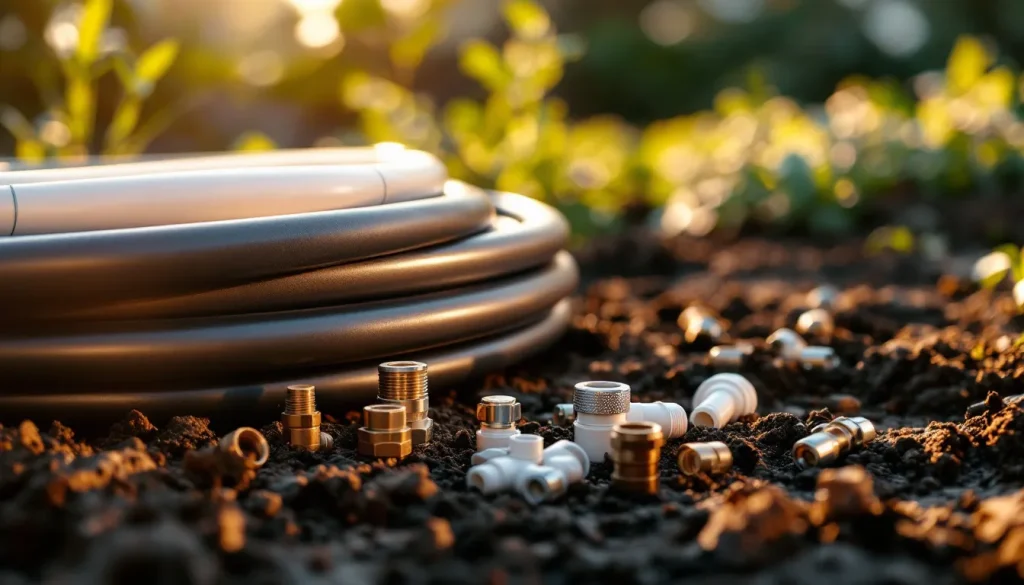
Five materials cover nearly every home and small-acreage irrigation job. PVC is rigid and cheap for buried mains. Polyethylene (poly) is flexible for sprinkler laterals. Drip tubing distributes low-volume water to plants. PEX handles freeze-prone runs. Galvanized steel appears mostly in older or high-pressure agricultural setups. Most residential systems combine PVC or poly for delivery with drip tubing at the plant.
- PVC (Schedule 40/80): rigid white pipe, glued joints, buried pressure mainlines.
- Polyethylene (poly): flexible black pipe, barbed fittings, sprinkler laterals.
- Drip tubing: 1/2 inch supply and 1/4 inch micro-tubing for emitters.
- PEX: cross-linked flexible pipe, tolerant of freezing, used for cold-climate supply lines.
- Galvanized/metal: steel pipe for legacy ag systems and high-pressure risers.
PVC irrigation pipe (Schedule 40 mainlines)
PVC irrigation pipe is rigid white plastic used for pressurized underground mainlines. Schedule 40 is the standard residential choice, rated near 200 to 480 PSI depending on diameter, and it joins with solvent-weld (slip) fittings and PVC cement. Schedule 80 has thicker walls for higher pressure. PVC is inexpensive and long-lived underground but becomes brittle in sunlight, so it should stay buried.
Use PVC for the trunk line from your valve manifold out to sprinkler zones on flat, freeze-managed ground. Bury it below the local frost line, and blow it out before winter in cold regions since rigid PVC cracks when trapped water freezes.
Poly pipe / polyethylene tubing (flexible laterals)
Poly pipe is flexible black polyethylene used for sprinkler laterals and pop-up feed lines. It comes in 1/2 inch, 3/4 inch, and 1 inch sizes, typically rated around 80 to 125 PSI, and it connects with barbed insert fittings secured by clamps. Its flexibility lets it curve around beds and absorb minor ground freeze without cracking, which is why cold-climate installers often prefer it over PVC.
Poly is the workhorse for do-it-yourself sprinkler zones. It handles gentle curves without elbows, cuts with a knife, and forgives small burial-depth mistakes. Brands like Orbit and Rain Bird sell it in 100-foot and 500-foot coils.
Drip irrigation tubing and micro-tubing (1/2 in and 1/4 in)
Drip tubing is low-pressure polyethylene that delivers water slowly to plant roots. The two common sizes are 1/2 inch (0.700 inch OD) mainline tubing that carries water along a bed, and 1/4 inch micro-tubing that branches off to individual emitters or plants. Drip runs at low pressure, usually 15 to 30 PSI, and needs a pressure regulator downstream of the valve.
Drip is the most water-efficient option, cutting evaporation loss compared with spray. For garden and container layouts, see our guides on drip irrigation for raised beds and choosing a drip irrigation kit. For full builds, our how to install drip irrigation walkthrough covers layout and pressure.
What size irrigation pipe do I need? Diameter and GPM sizing
Pipe diameter is set by flow, not guesswork. Undersized pipe starves sprinkler heads and drops pressure; oversized pipe wastes money. Match the diameter to the gallons per minute (GPM) the run must carry, keeping water velocity near 5 feet per second to limit friction loss and water hammer. The table below gives safe maximum flow for common sizes.
| Pipe diameter | Safe max flow (GPM) | Typical use |
|---|---|---|
| 1/2 in | ~4 GPM | Drip zones, single small sprinkler laterals |
| 3/4 in | ~8 GPM | Sprinkler laterals, small residential zones |
| 1 in | ~13 GPM | Residential mainlines, multi-head zones |
| 1-1/4 in | ~22 GPM | Large yards, long mainline runs |
| 1-1/2 in | ~30 GPM | Property mains, light ag laterals |
| 2 in | ~50 GPM | Small-acreage ag, pump feeds |
| 3 in | ~110 GPM | Agricultural mainlines, gated pipe |
To find your GPM, run a hose into a 5-gallon bucket and time the fill. If it fills in 30 seconds, you have 10 GPM available, which points you to 1 inch pipe. Always size the mainline for total system flow and each lateral for its own zone flow.
Material vs application: the comparison competitors skip
The fastest way to pick pipe is a side-by-side read on pressure rating, burial depth, freeze and UV tolerance, and cost. Product pages list one material at a time; the table below puts all five together so you can match pipe to application in one glance. This is the decision layer missing from listing pages and videos.
| Material | Pressure rating | Typical burial | Freeze tolerance | UV / above ground | Relative cost | Best use |
|---|---|---|---|---|---|---|
| PVC Sch 40 | ~200-480 PSI | Below frost line | Poor (cracks) | No, degrades in sun | Low | Buried mainlines |
| Poly (PE) | ~80-125 PSI | 8-12 in | Good (flexes) | Fair (black resists UV) | Low-medium | Sprinkler laterals |
| Drip tubing | ~15-30 PSI | Surface or mulched | Good | Fair, mulch extends life | Low | Beds, rows, containers |
| PEX | ~80-160 PSI | Below frost line | Excellent (expands) | Poor, needs cover | Medium-high | Cold-climate supply lines |
| Galvanized | ~150+ PSI | Below frost line | Good | Excellent | High | Legacy ag, high-pressure risers |
Read it this way: if the run is buried and pressurized, use PVC. If it flexes around beds, use poly. If it freezes hard every winter, PEX survives best. If plants need slow water, use drip. Galvanized only makes sense on legacy ag systems or exposed risers where UV and impact resistance matter.
Fittings and connectors: barbed vs slip vs threaded
Most irrigation leaks trace back to a fitting mismatched to the pipe. Each material uses a specific connector: barbed inserts for poly, solvent-weld slip for PVC, compression or barbed for drip, and threaded joints at valves and metal. Matching the fitting to the pipe is what prevents leaks, so confirm compatibility before you buy couplers, elbows, and tees.
| Pipe | Fitting type | How it seals |
|---|---|---|
| PVC | Slip (solvent-weld) | Primer + PVC cement, permanent |
| Poly | Barbed insert | Push in, secure with clamp |
| Drip 1/2 in | Barbed or compression | Push-fit friction seal |
| Drip 1/4 in | Barbed micro-fitting | Push into punched hole |
| PEX | Crimp or push-to-connect | Ring crimp or O-ring grip |
| Metal/valves | Threaded (NPT) | Thread tape or dope |
Couplers join two straight runs, elbows turn 90 degrees, and tees split flow. Use threaded transition fittings anywhere you move between materials, for example a threaded PVC-to-poly adapter at a valve. Never glue poly or thread PVC slip fittings.
Agricultural irrigation pipe applications
Agricultural irrigation pipe carries higher volumes over longer distances than home systems. Common ag pipe includes 2 inch and 3 inch PVC or PE mainlines, aluminum or PVC gated pipe for surface flood irrigation, and layflat hose for temporary runs. Ag systems prioritize flow capacity (often 50 to 110+ GPM) and durability over the tidy aesthetics of residential builds.
For small-acreage growers, a 2 inch buried PVC main feeding 3/4 inch or 1 inch poly or drip laterals covers most row-crop and orchard layouts. Size the main for the whole property flow, then step down to laterals per block.
UV resistance: above ground vs buried use
Sunlight is the main enemy of exposed plastic pipe. White PVC and clear PEX degrade and crack under UV within a few seasons, so they belong underground or under cover. Black poly and drip tubing carry carbon black that resists UV far better, which is why they tolerate above-ground and surface runs. Galvanized steel is fully UV-stable.
If pipe must sit exposed, choose black poly, paint PVC with a UV-rated latex, or cover runs with mulch. Buried lines avoid UV entirely, and burial also protects against mowers, freeze, and foot traffic.
How deep should irrigation pipe be buried?
Burial depth depends on climate and pipe role. Pressurized PVC mainlines commonly sit 12 to 18 inches deep, and in cold regions they should go below the local frost line, which can reach 36 to 48 inches in northern states. Poly laterals run shallower at 8 to 12 inches. Drip tubing usually stays on the surface under mulch. Check your local frost depth before trenching.
Best pipe for a home sprinkler system vs drip irrigation
For a home sprinkler system, use buried PVC Schedule 40 for the mainline and flexible poly for the laterals feeding pop-up heads. For drip irrigation, use 1/2 inch poly supply tubing with 1/4 inch micro-tubing to emitters, run at low pressure through a regulator. Sprinklers cover lawns at higher flow; drip targets beds and rows with slow, efficient watering.
Many properties run both: sprinklers for turf and drip for beds, sharing the same valve manifold. Our drip irrigation system guide covers combining zones on one controller.
Where to buy irrigation pipe and brands
Irrigation pipe is sold at home centers, irrigation supply houses, and online marketplaces. Orbit and Rain Bird are the dominant residential brands for poly pipe, fittings, and drip components, widely stocked at Home Depot, Lowe’s, and Amazon. Specialty distributors like Reinders and SprinklerWarehouse carry ag-grade and bulk pipe. Buy pipe, fittings, and clamps together to confirm size and thread compatibility.
Estimate quantity by measuring your runs, adding 10 percent for cuts and slack, and counting fittings at every turn and split. A typical residential zone uses one 100-foot poly coil plus 8 to 12 fittings, so budgeting materials before the trip avoids repeat runs to the store.
Frequently Asked Questions
What are the different types of irrigation pipe?
The main types are PVC (rigid, for buried pressure mainlines), polyethylene poly pipe (flexible, for sprinkler laterals), drip tubing (1/2 inch and 1/4 inch, for low-volume watering), PEX (freeze-tolerant supply lines), and galvanized steel (legacy agricultural and high-pressure risers). Most home systems combine PVC or poly for delivery with drip tubing at the plants.
What size irrigation pipe do I need for my system?
Size by flow in gallons per minute. As a rule, 1/2 inch handles about 4 GPM, 3/4 inch about 8 GPM, 1 inch about 13 GPM, and 3 inch about 110 GPM. Measure your available GPM by timing how fast a hose fills a 5-gallon bucket, then pick the diameter that carries that flow without excess velocity.
Is PVC or poly pipe better for irrigation?
It depends on the run. PVC is cheaper, rigid, and best for buried pressurized mainlines on freeze-managed ground. Poly is flexible, curves around beds, and tolerates minor ground freeze without cracking, which suits sprinkler laterals and cold climates. Many systems use both: PVC for the main trunk and poly for the laterals feeding heads.
What is the difference between drip tubing and irrigation pipe?
Drip tubing is a low-pressure form of irrigation pipe, typically 1/2 inch or 1/4 inch polyethylene running at 15 to 30 PSI to deliver water slowly to roots. Standard irrigation pipe like PVC or poly carries higher pressure (80 to 480 PSI) to feed sprinklers. Drip needs a pressure regulator; pressurized pipe does not.
How deep should irrigation pipe be buried?
Pressurized PVC mainlines commonly sit 12 to 18 inches deep, and below the local frost line in cold regions, which can reach 36 to 48 inches in northern states. Poly laterals run shallower at 8 to 12 inches, and drip tubing usually stays on the surface under mulch. Always confirm your local frost depth before trenching.
Can irrigation pipe be left above ground and is it UV resistant?
Black poly pipe and drip tubing contain carbon black that resists UV and tolerate above-ground use, especially under mulch. White PVC and clear PEX degrade and crack in sunlight within a few seasons, so they should stay buried or covered. Galvanized steel is fully UV-stable. To expose PVC, paint it with UV-rated latex.
What is the best pipe for a home sprinkler system versus drip irrigation?
For a home sprinkler system, use buried PVC Schedule 40 mainlines with flexible poly laterals to the pop-up heads. For drip irrigation, use 1/2 inch poly supply tubing with 1/4 inch micro-tubing to emitters, run through a low-pressure regulator. Sprinklers deliver higher flow across lawns; drip targets beds and rows efficiently.
What fittings do I need to connect irrigation pipe?
Match the fitting to the pipe: barbed insert fittings with clamps for poly, solvent-weld slip fittings and cement for PVC, barbed or compression fittings for drip, crimp or push-to-connect for PEX, and threaded NPT joints at valves and metal. Use couplers for straight joins, elbows for turns, and tees to split flow.