
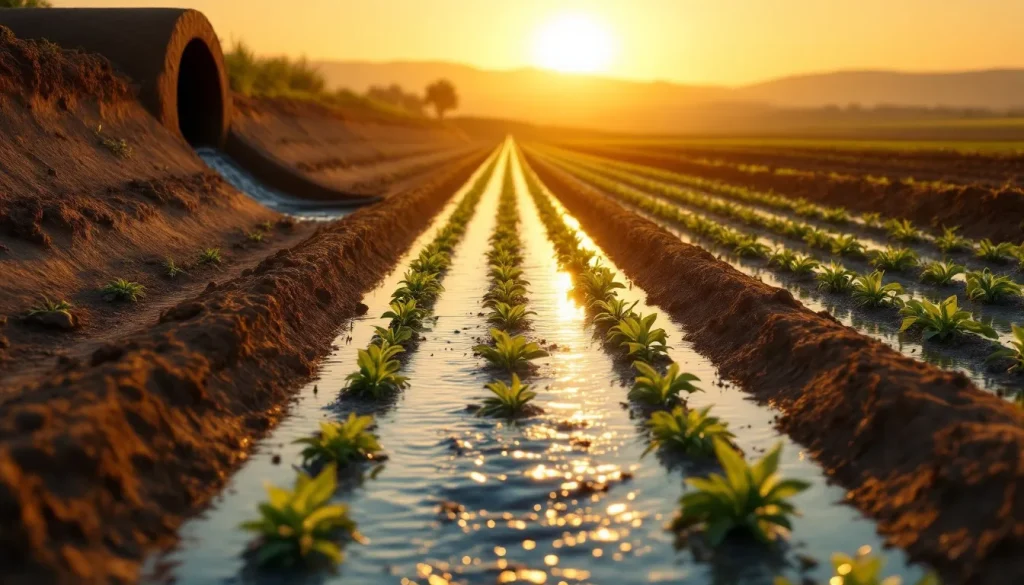
What is flood irrigation?
Flood irrigation is a conventional surface irrigation method in which water is applied across the whole field and moves over the soil surface by gravity, soaking in as it flows. Water is diverted from a river, canal, or well and released across the ground so it spreads over the field and infiltrates. It is one of the oldest ways to water crops and is still used on most of the world’s irrigated land.
By the HMNDP Editorial Team, independent reporting on lawn care, landscaping, water, and the green-industry business.
Last reviewed: June 2026
The United States Geological Survey (USGS) groups this method as “furrow or flood” irrigation, which signals that furrow watering is treated as a close relative rather than a separate category. The defining trait is simple: gravity does the distribution work, not pumps or emitters. That keeps the equipment cheap and the operating know-how low, which is why the method has survived for thousands of years.
Flood irrigation is a subset of surface irrigation, the broadest of the three main families. The other two are sprinkler (pressurized overhead) and drip (localized low-flow). Surface irrigation, mostly flood and furrow, still covers roughly 85 to 90 percent of irrigated area worldwide, according to figures published by the UN Food and Agriculture Organization (FAO).
Flood irrigation in simple terms (for students)
In simple terms, flood irrigation means letting water run across a field so it covers the ground like a shallow, temporary lake and then sinks into the soil. Farmers open a gate or channel, water flows from a canal onto the field by gravity, and the soil absorbs it. No sprinklers, no drip lines, no pressure. Just water moving downhill over dirt.
Think of tipping a bucket of water onto flat garden soil and watching it spread and disappear. Flood irrigation is that same idea scaled up to acres, using canals and field channels instead of a bucket. It is sometimes described as being “as old as the bucket method” because it relies on the same basic physics: gravity plus infiltration.
Because it waters the entire soil surface (not just the plant root zone), flood irrigation is easy to picture and easy to explain, which is part of why students meet it first when learning how irrigation systems distribute water.
How flood irrigation works: the water path
Flood irrigation works by diverting surface water from a river or reservoir into a canal system, then routing it through smaller channels onto a leveled or gently sloped field where gravity spreads it. Water enters at the high end, flows across the surface, infiltrates as it advances, and any excess drains off the low end. The grower controls timing, flow rate, and how long the water runs.
The conveyance path is a chain of decreasing channel size. Here is the typical sequence from source to root zone.
- Source: a river, stream, reservoir, or well supplies the water.
- Diversion: a dam, weir, or headgate pulls water off the source into a main canal.
- Canal system: in the western United States, mutual “canal companies” or irrigation districts own and schedule delivery through main and lateral canals.
- Field channels: ditches, gated pipe, or siphon tubes move water from the lateral to the field edge.
- The field: water is released across basins, borders, or furrows and flows over the soil by gravity.
- Tailwater: runoff that reaches the low end drains to a ditch or a recovery pond.
Delivery is often scheduled by the canal company as a “water right” measured in a flow rate over a set number of hours. The grower’s job is to match the field’s intake rate so water reaches the far end before too much soaks in near the inlet. Get that balance wrong and either the top of the field drowns or the bottom stays dry. This is the same distribution challenge that defines any irrigation system that moves water from a source to a root zone.
Types of flood and surface irrigation
Flood irrigation is not one technique but a family of four. They differ by how the field is shaped and how tightly the water is controlled. Basin and border methods flood broad areas; furrow sends water down channels between crop rows; wild flooding uses no field shaping at all. Choosing the right one depends on crop, slope, and soil intake rate.
| Type | How it works | Best for | Control level |
|---|---|---|---|
| Basin | Field divided into level, diked squares or rectangles that fill and pond, then drain in | Rice, orchards, close-growing crops on flat land | High |
| Border | Long, gently sloped strips separated by low ridges; a sheet of water advances down each strip | Alfalfa, pasture, small grains | Medium to high |
| Furrow | Water runs in small parallel channels between raised crop rows, wetting the ridge from the side | Row crops: corn, cotton, tomatoes, sugar beets | Medium |
| Wild (uncontrolled) flooding | Water is turned loose across unshaped land and allowed to spread wherever gravity takes it | Rough pasture, low-value forage | Low |
Furrow irrigation deserves special note because the USGS pairs it directly with flood. In furrow systems only the channels hold water, so about 20 to 50 percent of the surface stays dry. That cuts evaporation compared with full basin flooding and lets the grower drive equipment on dry ridges. It is the most common flood-family method for row crops in the United States.
Wild flooding sits at the opposite end. With no leveling and no dikes, distribution is uneven and losses are highest, so it survives mainly on cheap land, cheap water, and low-value forage where labor and leveling cannot be justified.
What percent of water is lost in flood irrigation?
Traditional flood irrigation typically operates at 40 to 60 percent application efficiency, meaning roughly 40 to 60 percent of applied water is lost before it benefits the crop. A common planning figure is about 50 percent efficiency, so about half the water is lost to deep percolation below the root zone, surface runoff (tailwater), and evaporation. Well-managed, laser-leveled fields can reach 70 to 80 percent.
The losses come from three places, and naming them explains why the number lands near half.
- Deep percolation: water that sinks past the root zone, usually the largest loss, driven by long soak times near the inlet end.
- Surface runoff (tailwater): water that reaches the low end of the field and drains off before it can infiltrate.
- Evaporation: loss from the wetted surface and ponded water, higher in hot, dry, windy conditions.
For comparison, sprinkler systems commonly run 70 to 85 percent application efficiency and well-designed drip runs 90 to 95 percent, per figures used by the FAO and by university extension programs such as those at Colorado State and the University of Arizona. So on the same 100 units of water delivered, flood might put 50 units in the root zone where drip puts 90. That gap is the entire reason flood irrigation is called inefficient, and it is the single number most competing pages leave out.
The loss is not always wasted in a watershed sense. Deep percolation often recharges the aquifer, and tailwater can return to a stream for a downstream user. But on the farm’s own water bill and pumping cost, that water is gone.
Pros and cons of flood irrigation
Flood irrigation’s main advantages are low cost, simple equipment, and minimal energy use, since gravity moves the water. Its main drawbacks are low water efficiency (about 50 percent), high labor, uneven distribution, and salt and waterlogging risk on poorly drained soils. The method wins on capital cost and loses on water and labor cost, which is the core trade-off every grower weighs.
| Pros | Cons |
|---|---|
| Low upfront cost, often under $200 per acre to set up on existing ditched land | Low application efficiency, roughly 40 to 60 percent |
| Little or no pumping energy; gravity does the work | High labor to open gates, set siphons, and monitor advance |
| Simple, durable equipment with few moving parts | Uneven watering: inlet end over-soaked, far end under-watered |
| No pressure or filtration needed; tolerates silty water | Runoff can carry nutrients and sediment off-field |
| Deep percolation can recharge groundwater | Waterlogging and salt buildup on poorly drained soils |
| Well suited to rice and other flood-tolerant crops | Needs fairly flat, well-leveled land to work well |
One under-discussed con: because flood irrigation wets the entire surface, it can spread weed seed and encourage broadleaf and grassy weeds across the whole field, which raises the stakes for a sound herbicide and weed-control program compared with drip that keeps the between-row soil dry.
Flood irrigation vs furrow, sprinkler, and drip
Flood irrigation floods the entire soil surface, furrow waters only channels between rows, sprinkler applies pressurized water overhead, and drip delivers low-flow water directly to each plant’s root zone. Efficiency rises across that sequence, from about 50 percent for basin flood up to 90 to 95 percent for drip, while upfront cost and system complexity rise the same way.
| Method | Family | Application efficiency | Typical setup cost/acre | Energy need |
|---|---|---|---|---|
| Flood (basin/border) | Surface | ~40 to 60% | $50 to $200 | Very low (gravity) |
| Furrow | Surface | ~45 to 65% | $100 to $300 | Low |
| Sprinkler (center pivot) | Pressurized overhead | ~70 to 85% | $800 to $1,500 | Moderate to high |
| Drip / micro | Localized low-flow | ~90 to 95% | $1,000 to $3,000 | Moderate |
The difference between flood and furrow is degree, not kind. Both are gravity surface methods, but furrow leaves the ridge tops dry, so it uses somewhat less water and suits row crops. Basin and border flood the full surface, which suits rice, pasture, and orchards where full wetting is acceptable or desired.
Sprinkler and drip trade capital and energy for water savings. Cost figures above are planning-level ranges from university extension budgets and vary widely by field size, water source, and region; treat them as order-of-magnitude, not quotes.
Is flood irrigation better than drip? When flood still wins
Drip irrigation is more water-efficient than flood (about 90 to 95 percent versus 50 percent), but flood is not automatically worse. Flood irrigation can be the economically correct choice when water is cheap and plentiful, land is already leveled and ditched, the crop tolerates flooding (rice, pasture, alfalfa), water carries silt that would clog drip emitters, or the field recharges a valued aquifer. The right answer depends on water price and crop value.
The decision usually turns on four questions. Original synthesis of extension budgets and water-market data points to this framework.
- How much does water cost? Where surface water rights are cheap (a few dollars per acre-foot from a canal company), the value of saved water may not repay a $2,000-per-acre drip install. Where water is pumped from deep wells or bought on a market, drip pays back fast.
- What is the crop worth? High-value vegetables and permanent crops justify drip. Low-margin forage and rice often do not.
- What tolerates flooding? Rice actively needs standing water. Alfalfa and pasture handle it well. Many vegetables prefer drip’s dry surface.
- What is the water quality? Silty or hard water that clogs drip emitters runs fine through open flood channels.
So “better” is the wrong frame. Drip is more efficient; flood is more economical under specific, common conditions. A rice grower in the Sacramento Valley and a tomato grower in San Diego County can each be making the right call with opposite methods.
Modern upgrades that make flood irrigation more efficient
Growers can raise flood irrigation efficiency from about 50 percent toward 80 percent without switching to drip by adding three upgrades: laser land leveling, surge-flow valves, and tailwater recovery. Each attacks a specific loss (uneven distribution, deep percolation, and runoff) and together they can cut water use 20 to 40 percent while keeping flood’s low energy cost. Most competing guides omit these entirely.
- Laser land leveling: a laser-guided grader creates a precise, uniform slope so water advances evenly and no low spots over-soak. Studies from Punjab and California report water savings of 15 to 30 percent and yield gains from more uniform watering. It is the single highest-impact flood upgrade.
- Surge flow: instead of a steady stream, a surge valve pulses water down the furrow in on-off cycles. Early pulses seal the soil surface, so later pulses advance faster with less deep percolation. Extension trials show application-efficiency gains of 10 to 40 percent over continuous furrow flow.
- Tailwater recovery: a low-end ditch collects runoff into a pond, and a pump returns it to the top of the field or the next set. This can reclaim 10 to 30 percent of applied water that would otherwise leave the farm.
These upgrades change the economics of the flood-versus-drip choice. A grower can often reach 75 to 80 percent efficiency with leveling plus surge for a fraction of drip’s per-acre cost, which is why many western districts fund leveling before they fund conversion to drip. Soil health matters here too: uniform intake depends on stable, well-structured soil that absorbs water evenly across the field.
What crops suit flood irrigation best?
Flood irrigation suits crops that tolerate or require saturated soil and are grown at scale on flat land: rice, alfalfa, pasture and forage grasses, small grains like wheat and barley, and tree and vine crops in leveled basins. Rice is the standout because it is grown in standing water by design. Water-sensitive, high-value vegetables generally do better under drip.
Rice is the classic flood crop because paddies rely on continuous ponding to control weeds and support the plant. Alfalfa and pasture handle periodic flooding well and are low-margin enough that drip rarely pays. Small grains and orchards work in basins where full-surface wetting is fine.
Turf and lawn grasses are a niche case. Large sod farms and some warm-season Bermuda grass production fields use flood or furrow where water is cheap, though most residential and sports turf uses sprinklers for even coverage and easier scheduling.
Frequently Asked Questions
What is flood irrigation in simple terms?
Flood irrigation means letting water run across a whole field so it covers the ground and soaks into the soil by gravity. A farmer opens a gate or channel, water flows from a canal onto leveled land, and the soil absorbs it. There are no sprinklers or drip lines. It is like tipping a bucket of water onto flat soil, scaled up to acres.
How does flood irrigation work?
Water is diverted from a river or reservoir into a canal system, routed through smaller channels to a field edge, then released across basins, borders, or furrows. Gravity spreads it over the soil surface, and it infiltrates as it advances from the high end to the low end. Any excess drains off the far end as tailwater. The grower controls flow rate and how long the water runs.
What percent of water is lost in flood irrigation?
Traditional flood irrigation loses roughly 40 to 60 percent of applied water, so a common planning figure is about 50 percent lost. The losses split among deep percolation below the root zone, surface runoff, and evaporation. Well-managed, laser-leveled fields can cut losses so efficiency reaches 70 to 80 percent. By comparison, drip irrigation loses only about 5 to 10 percent.
What are the pros and cons of flood irrigation?
Pros: low upfront cost (often under $200 per acre), little pumping energy, simple durable equipment, tolerance of silty water, and good fit for rice and pasture. Cons: low water efficiency near 50 percent, high labor, uneven watering, nutrient runoff, and waterlogging or salt buildup on poorly drained soils. In short, flood wins on capital cost and loses on water and labor cost.
What is the difference between flood irrigation and furrow irrigation?
Both are gravity surface methods, and the USGS pairs them as “furrow or flood.” Full flood (basin or border) wets the entire soil surface. Furrow runs water only in small channels between raised crop rows, leaving ridge tops dry. Furrow therefore uses somewhat less water, reduces evaporation, and suits row crops like corn and cotton, while basin flood suits rice, pasture, and orchards.
Is flood irrigation better than drip irrigation?
Drip is far more water-efficient (about 90 to 95 percent versus 50 percent), but flood can be more economical. Flood wins when water is cheap and plentiful, land is already leveled, the crop tolerates flooding (rice, alfalfa, pasture), or water is silty enough to clog drip emitters. Neither is universally better; the right choice depends on water price, crop value, and water quality.
How much does flood irrigation cost per acre?
Setup for flood irrigation on existing ditched, leveled land often runs $50 to $200 per acre, far below sprinkler ($800 to $1,500) or drip ($1,000 to $3,000). Adding upgrades raises that: laser leveling can add several hundred dollars per acre. Ongoing costs are mostly labor and water rather than energy. Figures are planning-level extension estimates and vary by region and field size.
What crops are best suited to flood irrigation?
Rice suits flood irrigation best because it is grown in standing water by design. Alfalfa, pasture and forage grasses, and small grains like wheat and barley also tolerate periodic flooding and are low-margin enough that drip rarely pays. Tree and vine crops work in leveled basins. High-value, water-sensitive vegetables generally perform better under drip, which keeps the surface dry.