
By the HMNDP Editorial Team, independent reporting on lawn care, fertilizer, and the green industry.
Last reviewed: June 2026
What grass fertilizer is and why lawns need feeding
Grass fertilizer is a blend of plant nutrients, mainly nitrogen, phosphorus, and potassium, that replaces what turf uses up as it grows. Lawns are unnaturally dense stands of grass that you mow, bag, and stress all season. Feeding replaces nitrogen lost to clippings, leaching, and rain, keeping the lawn green, thick, and able to crowd out weeds.
Bare, unfed soil rarely holds enough available nitrogen to keep turf dense. Thin lawns invite crabgrass and broadleaf weeds into the open space. A fed lawn with a full canopy shades the soil and blocks most weed seeds from ever sprouting.
Fertilizer is not a cure for every problem. Compaction, drought, and poor mowing height cause more thin lawns than nutrient shortage does. For dry-season strategy, see our guide to the best garden fertilizer during drought.
NPK ratio explained: what the three numbers mean
Every grass fertilizer bag shows three numbers, like 24-0-4 or 10-10-10. This is the NPK ratio: the percentage by weight of nitrogen (N), phosphorus (P), and potassium (K). A 50-pound bag of 24-0-4 contains 12 pounds of nitrogen, 0 phosphorus, and 2 pounds of potassium. The rest is filler and carrier material.
- Nitrogen (N): drives leaf growth and green color. The number lawns care about most.
- Phosphorus (P): supports root development and seedling establishment. Often set to 0 for established lawns, and restricted by law in many US states except when seeding.
- Potassium (K): improves stress, drought, and cold tolerance. The quiet workhorse.
A high middle number is usually a starter fertilizer for new seed. A high first number with a low or zero middle is a maintenance lawn food.
Nitrogen: the main driver of grass growth and color
Nitrogen is the nutrient that turns a lawn green and pushes new blades. Grass pulls more nitrogen than any other nutrient, which is why maintenance fertilizers lead with a high first number (often 20 to 32). If your lawn looks pale or grows slowly, nitrogen is almost always the missing input, assuming water and mowing are correct.
Because nitrogen washes out of soil quickly, it is the nutrient you reapply on a schedule. Phosphorus and potassium stay in the soil far longer, which a soil test can confirm.
Slow-release vs quick-release nitrogen
Quick-release nitrogen greens the lawn in a few days but burns easily and fades in three to four weeks. Slow-release nitrogen (labeled as coated urea, sulfur-coated, or water-insoluble nitrogen) feeds for 8 to 12 weeks, resists burning, and produces steadier growth. Most quality lawn foods list a percentage of slow-release nitrogen on the bag; higher is gentler.
| Type | Greening speed | Feeds for | Burn risk | Best for |
|---|---|---|---|---|
| Quick-release (soluble) | 2 to 5 days | 3 to 4 weeks | High | Fast fix, cool weather |
| Slow-release (coated/organic) | 1 to 2 weeks | 8 to 12 weeks | Low | Even growth, summer feeding |
Synthetic vs natural (organic) grass fertilizer
Synthetic grass fertilizer is manufactured, high in concentrated nitrogen, cheap per pound, and fast to green a lawn. Natural or organic fertilizer comes from plant, animal, or mineral sources, releases nutrients slowly as soil microbes break it down, and improves soil over time. Neither is universally better. The right choice depends on your budget, patience, and burn tolerance.
| Factor | Synthetic | Natural / organic |
|---|---|---|
| Typical cost per 1,000 sq ft (per feeding) | $3 to $8 | $8 to $18 |
| Greening speed | Fast (days) | Slow (2 to 4 weeks) |
| Burn risk if over-applied | High | Very low |
| Soil improvement | Minimal | Builds organic matter |
| Odor | None | Sometimes (manure-based) |
A common middle path: use organic feedings in spring and summer for soil health, and one synthetic or blended feeding in fall for a fast pre-winter nitrogen boost.
Named natural options: Milorganite, compost, composted cow manure
Three natural options carry most DIY lawns. Each is slow-release and nearly impossible to burn with, which makes them forgiving for beginners.
- Milorganite (roughly 6-4-0): a heat-dried biosolid from Milwaukee, sold since 1926. Its iron content greens turf without a nitrogen surge. Apply about 32 pounds per 2,500 sq ft.
- Finished compost: spread as a 1/4-inch topdressing. Low, gentle nutrient content plus real soil-building benefit.
- Composted cow manure: mild NPK (around 1-1-1), best used composted, not fresh, to avoid weed seeds and odor.
For product-specific picks, compare our roundups of the best fertilizer for grass and the best fertilizer for green grass.
How much nitrogen to apply (lbs of N per 1,000 sq ft)
The standard target is 1 pound of actual nitrogen per 1,000 square feet per feeding, and roughly 2 to 4 pounds total per year for most lawns. To find the product amount, divide 1 by the nitrogen percentage (as a decimal). A 24-0-4 fertilizer: 1 divided by 0.24 equals about 4.2 pounds of product per 1,000 sq ft.
Slow-release products can push slightly higher per feeding without burning. Never exceed the bag’s stated rate. More nitrogen does not mean a better lawn, it means faster growth, more mowing, and higher burn risk.
Reading the bag: a worked example for your lawn
Here is how to translate label numbers into a buying decision for one specific lawn. Say you have a 5,000 sq ft established cool-season lawn (fescue), a recent soil test showing adequate phosphorus, and you want an easy fall feeding.
- Skip phosphorus: your test shows enough, so a 0 middle number (like 24-0-6) is correct and often legally required.
- Pick nitrogen: a first number of 20 to 28 with 50%+ slow-release for even growth.
- Do the math: 24-0-6 needs about 4.2 lbs per 1,000 sq ft, so 5,000 sq ft needs roughly 21 pounds. A 40-pound bag covers two feedings.
- Check potassium: a small K number (4 to 6) helps winter hardiness heading into cold months.
Match the bag to your grass, your soil test, and the season. That single habit prevents most wasted money at the garden center.
When to fertilize: seasonal timing
Timing depends entirely on grass type. Cool-season grasses (fescue, ryegrass, Kentucky bluegrass) grow hardest in spring and fall, so those are the feeding windows. Warm-season grasses (Bermuda, Zoysia, St. Augustine, centipede) grow in summer heat, so late spring through summer is their window. Feeding at the wrong time wastes fertilizer and can weaken the lawn.
Feeding calendar by grass type (the month-by-month map)
This is the calendar most guides leave out. Use it as a starting template, then shift by a few weeks for your local climate. Cool-season lawns get their heaviest feeding in fall; warm-season lawns get theirs in mid-summer.
| Month | Cool-season (fescue, bluegrass, rye) | Warm-season (Bermuda, Zoysia, St. Augustine) |
|---|---|---|
| March | Soil test; light feed if pale | Wait (still dormant) |
| April | Light spring feeding (0.5 to 1 lb N) | Soil test; wait for full green-up |
| May | Optional organic feed | First feeding (1 lb N) |
| June | Skip (heat stress) | Feeding (1 lb N) |
| July | Skip or organic only | Feeding (1 lb N) |
| August | Resume light feed late month | Final summer feeding (1 lb N) |
| September | Heaviest feeding (1 to 1.5 lb N) | Stop feeding by early month |
| October / November | Late-fall (winterizer) feeding | No feeding (heading to dormancy) |
How many feedings per year
Most established lawns need 2 to 4 feedings per year. A low-maintenance approach uses 2 (spring and fall for cool-season). A lush, high-input lawn uses 4, spaced 6 to 8 weeks apart during the active growing season. Track your local first and last frost dates to anchor the schedule.
Should you fertilize before winter?
For cool-season lawns, yes: a late-fall feeding is the single most valuable application of the year. Applied 2 to 3 weeks before the ground freezes (often late October or November), this winterizer feeding pushes root growth and stores energy for a faster, greener spring. Warm-season lawns should not be fed in fall, since late nitrogen makes them vulnerable to cold damage.
Granular vs liquid (spray) fertilizer
Granular fertilizer is dry pellets spread with a spreader; liquid fertilizer is a concentrate mixed with water and sprayed. Granular is cheaper, easier to slow-release, and better for large lawns and season-long feeding. Liquid greens fast and spreads evenly, but feeds for a shorter time and suits small lawns or a quick correction. Most homeowners get better value from granular.
| Form | Best for | Feeds for | Even coverage |
|---|---|---|---|
| Granular | Large lawns, season feeding | 4 to 12 weeks | Depends on spreader |
| Liquid / spray | Small lawns, fast greening | 2 to 4 weeks | Very even |
How to apply fertilizer without burning your lawn
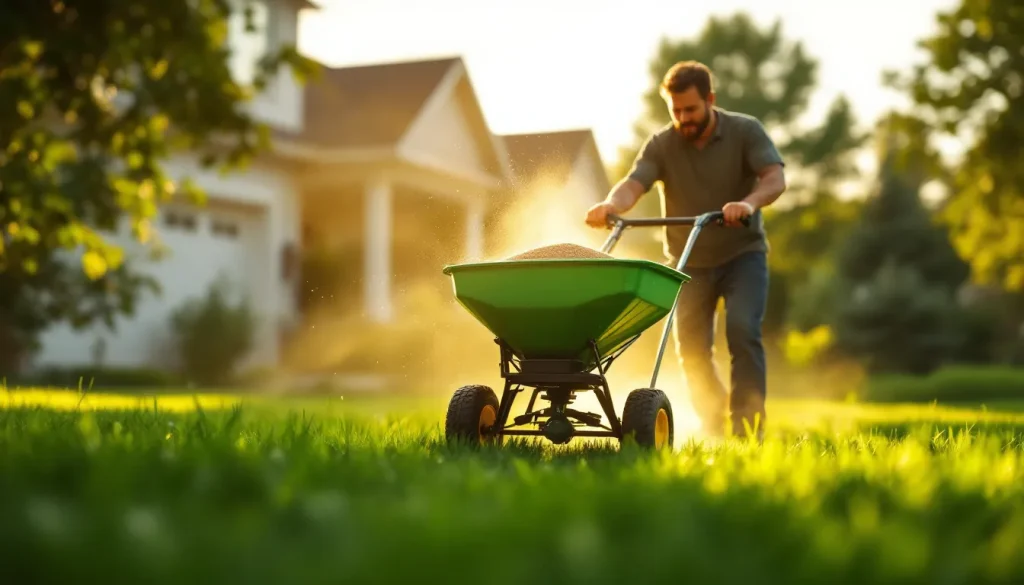
Applying grass fertilizer correctly is mostly about even coverage and watering in. Uneven spreading causes striping (dark green streaks next to pale ones), and skipping the water-in step is the top cause of fertilizer burn (yellow or brown scorch marks). Follow these steps for a safe, even feeding.
- Mow first and calibrate your spreader to the bag’s setting for that product.
- Fill on a hard surface, not on the lawn, so spills do not concentrate and burn.
- Apply in two passes, half the rate each way in a crosshatch pattern, for even coverage.
- Keep edges tidy with the spreader’s edge guard to avoid feeding sidewalks and beds.
- Water in with about 1/4 inch of water within 24 hours (skip this only for weed-and-feed, which needs to stick to leaves first).
- Sweep granules off pavement back onto turf to prevent runoff into storm drains.
Homemade natural grass fertilizer recipes (with quantities)
DIY lawn feeds work as gentle, low-cost supplements, not as full replacements for a balanced feeding program. They add small amounts of nitrogen and micronutrients and carry almost no burn risk. Here are three tested recipes with real quantities per 1 gallon of water, applied with a hose-end or watering can over roughly 250 sq ft.
- Grass tonic: 1 gallon water, 1 can (12 oz) cheap beer, 1 cup ammonia-free liquid dish soap, 1 cup household ammonia (mild nitrogen). Apply monthly to damp lawn, then water in.
- Compost tea: steep 2 cups finished compost in 1 gallon water for 48 hours, strain, then spray. Adds microbes and trace nutrients.
- Epsom salt greener: 2 tablespoons Epsom salt per 1 gallon water for a magnesium and sulfur boost that deepens color. Use only if a soil test shows low magnesium.
Treat these as supplements between real feedings. For soil-building beyond the lawn, see our notes on the best mulch for a vegetable garden.
Test your soil before you buy anything
A soil test is the cheapest, highest-return step in lawn care, usually $10 to $25 through a state university extension lab. It tells you your pH and existing phosphorus and potassium, so you stop buying nutrients you already have. Most US lawns need only nitrogen, and a test confirms that before you spend on a balanced bag you do not need.
Test every 2 to 3 years, ideally in early spring or fall. Correcting pH (lime for acidic soil) often does more for color than any fertilizer, because grass cannot use nutrients when pH is off.
Frequently Asked Questions
What is the best fertilizer for grass?
The best grass fertilizer is a slow-release, high-nitrogen lawn food matched to your grass type, usually a first number of 20 to 32 with 50% or more slow-release nitrogen and little or no phosphorus. For beginners, a gentle organic like Milorganite (about 6-4-0) is hard to misuse. Always confirm with a soil test first.
What do the numbers (NPK) on a grass fertilizer bag mean?
The three numbers are the NPK ratio: percent nitrogen, phosphorus, and potassium by weight. A 50-pound bag of 24-0-4 holds 12 pounds of nitrogen, 0 phosphorus, and 2 pounds of potassium. Nitrogen (first number) drives green growth, phosphorus (middle) builds roots, and potassium (last) aids stress tolerance. Lawns usually want a high first number.
What is the best natural or homemade grass fertilizer?
Milorganite, finished compost, and composted cow manure are the most reliable natural options, all slow-release and nearly burn-proof. A simple homemade recipe is compost tea: steep 2 cups finished compost in 1 gallon of water for 48 hours, strain, and spray. Use homemade tonics as supplements between real feedings, not as full replacements.
When should I fertilize my lawn?
Timing depends on grass type. Cool-season grasses (fescue, bluegrass, ryegrass) feed best in spring and fall, with the heaviest feeding in September and a winterizer in late fall. Warm-season grasses (Bermuda, Zoysia, St. Augustine) feed from late spring through summer and should not be fed in fall. Avoid feeding during summer heat stress on cool-season lawns.
Should I use synthetic or organic grass fertilizer?
Synthetic fertilizer is cheaper ($3 to $8 per 1,000 sq ft) and greens fast but burns easily. Organic fertilizer costs more ($8 to $18), greens slowly, resists burning, and builds soil over time. A practical hybrid is organic feedings in spring and summer plus one synthetic or blended feeding in fall for a quick pre-winter nitrogen boost.
How often should I fertilize my grass each year?
Most established lawns need 2 to 4 feedings per year, spaced 6 to 8 weeks apart during active growth. A low-maintenance lawn does well on 2 feedings (spring and fall for cool-season grass). A lush, high-input lawn uses 4. Aim for roughly 2 to 4 pounds of actual nitrogen per 1,000 square feet across the whole year.
Is liquid grass fertilizer spray better than granular?
Not usually. Liquid spray greens fast and covers evenly but feeds for only 2 to 4 weeks, suiting small lawns or quick fixes. Granular fertilizer costs less, offers slow-release formulas, and feeds for 4 to 12 weeks, making it the better value for large lawns and season-long feeding. Most homeowners get more from granular.
Should I fertilize my lawn before winter?
For cool-season lawns, yes. A late-fall winterizer feeding, applied 2 to 3 weeks before the ground freezes (often late October or November), is the most valuable application of the year. It strengthens roots and stores energy for a faster spring green-up. Warm-season lawns should not be fed in fall, since late nitrogen invites cold damage.