
By the HMNDP Editorial Team, independent reporting on lawn care, landscaping, and water management.
Last reviewed: June 2026
How to fix sloped yard drainage: the short answer
Sloped yard drainage is solved by measuring your slope percentage, diagnosing where the water comes from, then matching a solution to both. Slopes under about 10 percent usually take a swale or French drain. Slopes of 15 to 33 percent often need terracing or a retaining wall. Every fix should move water away from the foundation first.
The mistake that keeps sloped yards wet is treating drainage as one product instead of a system. A real sloped lot almost always needs two or three coordinated pieces: something to intercept incoming water, something to carry it, and something to hold the soil.
Before you buy a single foot of pipe, do two measurements. They decide everything that follows.
Step 1: Measure your slope (the number that picks your solution)
Slope percentage is the vertical drop divided by horizontal distance, times 100. Drive two stakes 10 feet apart down the hill, run a level string from the top stake, and measure the gap to the ground at the bottom stake. A 2-foot gap over 10 feet is a 20 percent slope. This single number narrows your options fast.
| Slope % | Rise per 100 ft | Character | Typical drainage fit |
|---|---|---|---|
| 2 to 5% | 2 to 5 ft | Gentle | Swale, regrading, downspout extensions |
| 5 to 10% | 5 to 10 ft | Moderate | French drain, swale, dry creek bed |
| 10 to 15% | 10 to 15 ft | Steep | French drain plus ground cover, low terraces |
| 15 to 33% | 15 to 33 ft | Very steep | Terracing, retaining wall, engineered swale |
| Over 33% (3:1) | Over 33 ft | Extreme | Engineered retaining wall, professional design |
The 33 percent (3:1) line matters. Above it, most soil will not hold vegetation reliably and turf mowers become unsafe, so you move from planting toward structural walls and a professional grading plan.
Step 2: Diagnose your water source before choosing anything
The right fix depends on where the water starts, not just how wet the yard is. Walk the lot during or right after a hard rain and trace the flow. There are four common sources on a sloped lot, and each points to a different primary solution.
- Surface runoff from higher ground or a neighbor: water sheets across the property line. Intercept it at the top edge with a swale or curtain drain.
- Roof and downspout water: concentrated at the base of the house. Extend and channel it away.
- Negative grade toward the house: the ground tilts back toward the foundation. Regrade the first 6 to 10 feet.
- Subsurface saturation: the soil stays soggy with no visible flow. A French drain relieves it.
If you match a French drain to a surface-runoff problem, or a swale to a subsurface problem, you will spend money and stay wet. Diagnosis first, always.
French drains: the workhorse for saturated soil and moderate slopes
A French drain is a gravel-filled trench with a perforated pipe that collects subsurface water and carries it downhill by gravity. It suits moderate slopes (roughly 5 to 15 percent) and soggy soil. Standard build: a trench 12 to 24 inches deep and about 12 inches wide, a 4-inch perforated pipe, and washed gravel around it.
Sizing specifics competitors leave out. Use a 4-inch corrugated or PVC perforated pipe for a residential yard, and 6-inch only for large catchment areas. Wrap the pipe or line the trench with non-woven landscape fabric to keep silt out. Maintain a minimum slope of 1 percent (about 1 inch of drop per 8 feet) so water actually moves. Set perforations facing down for subsurface collection.
Use 3/4-inch to 1-1/2-inch washed drainage gravel, not sand or crusher fines, which clog. Backfill so gravel surrounds the pipe on all sides. A poorly sloped or fabric-free French drain silts up within a few seasons, which is the most common DIY failure. See our deeper walkthrough of yard drainage methods for trench layout details.
Swales and drainage ditches: redirecting surface runoff
A swale is a shallow, wide, vegetated channel that catches surface runoff and steers it around or away from a problem area. It handles gentle to moderate slopes (about 2 to 10 percent) and is the cheapest way to move sheet flow. Depth is typically 6 to 18 inches with gently sloped, planted sides.
Swales work best across the slope, not straight down it. Running a channel straight downhill accelerates water and causes erosion, so a swale should cut diagonally to slow flow and shed it sideways. On steeper ground, above roughly 10 to 15 percent, an unlined swale erodes and you need a lined channel, rock armoring, or terracing instead.
Dry creek beds: drainage that looks intentional
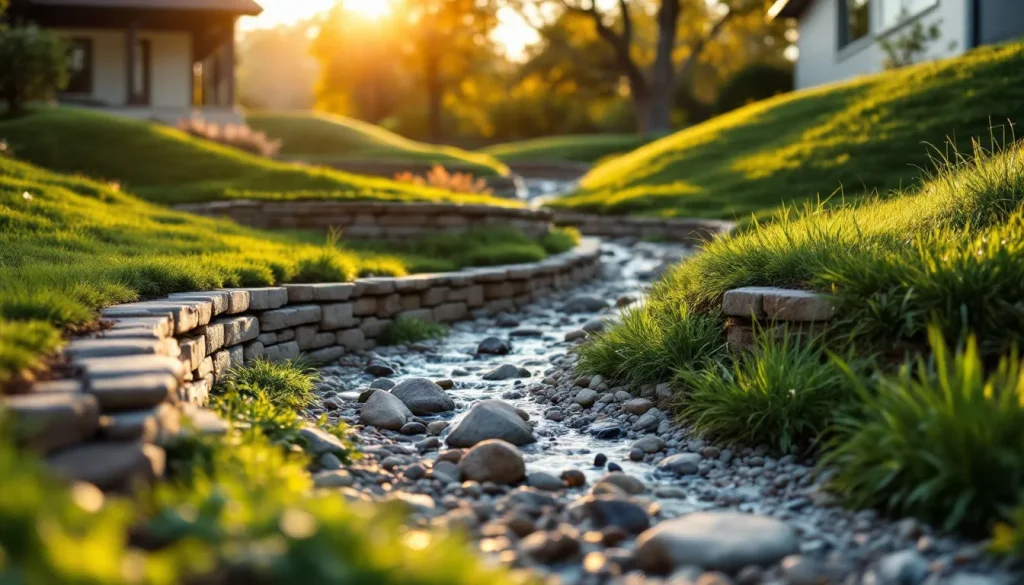
A dry creek bed is a rock-lined channel that carries and slows runoff while looking like a landscape feature. It is essentially a decorative swale, well suited to visible parts of a yard on gentle to moderate slopes. Line the channel with landscape fabric, then layer larger boulders on the edges and rounded river rock (2 to 5 inches) in the center.
Because a dry creek bed is both function and finish, it is popular for the front-of-house runoff path. Width of 2 to 4 feet handles most residential flow. For more decorative drainage ideas that double as landscaping, see our roundup of backyard drainage solutions.
Catch basins and drain inlets: capturing pooling water
A catch basin is a boxed inlet set at a low point that captures pooled surface water and feeds it into a solid drainage pipe. Use it where water collects in a bowl, at the bottom of a slope, or where a swale terminates. A 9-inch or 12-inch square grate basin is standard for residential yards.
Connect the basin outlet to a solid (non-perforated) 4-inch pipe running at 1 to 2 percent slope to a safe daylight exit or storm connection. Catch basins pair naturally with French drains and downspout lines, acting as the collection point for a combined system rather than a standalone fix.
Regrading and fixing negative slope toward the house
Regrading reshapes the soil so the ground falls away from the foundation. The target grade is a drop of about 6 inches over the first 10 feet from the house, roughly a 5 percent slope. A yard that tilts back toward the structure (negative grade) is the leading cause of basement and foundation water and should be corrected first.
For minor negative grade, add and compact soil against the foundation to build a positive slope, keeping soil at least 6 inches below siding and weep holes. Larger corrections may require moving significant soil volume, which is where regrading crosses into professional earthwork. Directing water away from the foundation is the single highest-priority job on any sloped lot.
Downspout extensions and roof water
Downspout extensions carry concentrated roof water past the foundation and into the yard’s drainage path. A single downspout can discharge hundreds of gallons in one storm, so releasing it at the base of a slope is a common hidden cause of erosion and pooling. Extend discharge at least 4 to 6 feet from the foundation, farther on a slope.
On a hill, tie downspouts into a solid pipe that daylights well downslope, or route them into a dry creek bed or catch basin. Splash blocks alone are not enough on a grade because the water simply re-concentrates and cuts a channel.
Retaining walls and terracing for steep slopes
Retaining walls and terraces convert a steep, eroding slope into stepped, level benches that slow water and hold soil. They become the primary tool once a slope exceeds roughly 15 percent, where swales erode and turf struggles. Terracing breaks one long slope into several short ones, cutting the water’s speed and energy dramatically.
Engineering thresholds matter here. Many jurisdictions require an engineered design and a permit for retaining walls over 3 to 4 feet tall, and walls must include drainage behind them (gravel backfill plus a perforated drain pipe) or water pressure will push them over. A wall without proper backfill drainage is a wall that fails. This is the point where most homeowners should bring in a pro.
Erosion control on steep slopes
Erosion control holds soil in place while water passes, using ground cover, rock, matting, or terraces. On slopes up to about 33 percent, deep-rooted ground covers and erosion-control blankets stabilize the surface; steeper than that, structural terracing or rock is usually required. Bare soil on a slope is the enemy, so cover it fast.
- Ground cover plants: creeping juniper, vinca, or native grasses knit the topsoil with roots.
- Erosion-control blankets: biodegradable jute or coir netting holds seed and soil until roots establish.
- Riprap and rock: larger stone armors high-flow channels and drain outlets.
- Terracing: the most durable option for very steep, actively eroding ground.
Comparison: matching the solution to your slope, cost, and skill
This table ranks the core sloped yard drainage solutions by the slope they suit, effectiveness, cost, and DIY difficulty. Costs are typical U.S. installed ranges as of 2026 and vary widely by region, soil, and access. Use it to build a short list, then combine two or three items into one system.
| Solution | Best slope | Fixes | Effectiveness | Typical cost | DIY difficulty |
|---|---|---|---|---|---|
| Downspout extension | Any | Roof water | Medium | $10 to $150 each | Easy |
| Swale | 2 to 10% | Surface runoff | Medium to high | $1,500 to $5,000 | Moderate |
| Dry creek bed | 2 to 10% | Runoff plus looks | Medium | $1,500 to $5,000 | Moderate |
| French drain | 5 to 15% | Saturated soil | High | $1,500 to $6,000 | Moderate to hard |
| Catch basin system | Any low point | Pooling | High | $400 to $2,000 | Moderate |
| Regrading | Near house | Negative grade | High | $1,000 to $5,000 | Hard |
| Terracing | 15 to 33% | Erosion plus water | Very high | $3,000 to $15,000 | Hard |
| Retaining wall | Over 15% | Steep erosion | Very high | $4,000 to $12,000+ | Pro |
Materials volume drives cost on the DIY jobs. If you are ordering gravel, rock, or soil, estimating loads accurately matters, and our guides on cubic feet in a yard and how much a yard weighs help you size delivery and avoid overpaying.
The uphill neighbor problem: cross-property runoff and the law (the gap nobody fills)
Water flowing onto your lot from a higher neighbor is the most common and most frustrating sloped yard problem, and it is the one every ranking forum thread complains about but none actually answers. The fix is part engineering and part law: intercept the water at your top boundary, and understand what your neighbor is and is not obligated to do.
Engineering side. Install an interceptor along the high edge of your property: a curtain drain (a deep French drain along the boundary) or a swale that catches sheet flow before it spreads across your yard and diverts it around the house to a safe outlet. This is often the single most effective move on a lot that receives cross-property water.
Legal side (general, not legal advice). U.S. states apply different water-runoff doctrines, and which one governs depends on your jurisdiction:
- Natural flow / civil law rule: the upper owner may generally let water drain naturally, and the lower owner must accept it. Common in many eastern states.
- Common enemy rule: each owner may defend against surface water, though modern versions limit unreasonable harm to neighbors.
- Reasonable use rule: the growing modern standard, where a court weighs whether an owner’s drainage changes were reasonable.
A neighbor who regrades, paves, or builds and thereby concentrates or increases the water hitting your lot may be liable in many states, especially under reasonable-use jurisdictions. A recorded drainage easement can also give one property the legal right to drain across another, so check your deed and plat before assuming. If real damage is occurring, document it with dated photos and consult a local attorney or your county stormwater office, because outcomes depend heavily on state law and local ordinances.
DIY vs. professional: where to draw the line
DIY is realistic for downspout extensions, small swales, dry creek beds, catch basins, and shorter French drains on moderate slopes. Bring in a pro for major regrading, retaining walls over 3 to 4 feet, engineered terracing, and any job requiring permits, machinery, or buried utility work. The dividing line is roughly the 15 percent slope mark and the 3-foot wall height.
Two practical gates before you DIY. First, call 811 to mark buried utilities at least a few days before digging; it is free and legally required in most of the U.S. Second, confirm your drainage outlet is legal, because you cannot simply pipe concentrated water onto a neighbor’s lot. When a slope is steep, a wall is tall, or a permit is involved, professional design usually costs less than fixing a failed DIY system twice.
Frequently Asked Questions
What is the best drainage system for a sloped backyard?
There is no single best system; the right one depends on your slope percentage and water source. For saturated soil on a 5 to 15 percent slope, a French drain works best. For surface runoff on gentler ground, use a swale or dry creek bed. Slopes over 15 percent usually need terracing or a retaining wall. Most sloped yards need two or three combined.
How do you stop water from a higher-ground neighbor’s yard from flooding yours?
Intercept the water at your top property line with a curtain drain (a deep boundary French drain) or a swale that diverts sheet flow around your house to a safe outlet. Legally, a neighbor who regrades or paves and concentrates extra water onto you may be liable in many states under the reasonable-use rule. Document damage with dated photos and check your deed for drainage easements.
How do I fix a yard that slopes toward the house (negative grade)?
Regrade so the ground falls away from the foundation, aiming for about 6 inches of drop over the first 10 feet (roughly 5 percent). For minor cases, add and compact soil against the foundation, keeping it at least 6 inches below siding. Larger corrections need earthmoving and often a pro. Fixing negative grade is the top priority because it drives foundation and basement water.
How much does sloped yard drainage cost to install?
Costs vary by solution and region as of 2026. Downspout extensions run $10 to $150 each, a French drain $1,500 to $6,000, a swale or dry creek bed $1,500 to $5,000, catch basins $400 to $2,000, regrading $1,000 to $5,000, and retaining walls $4,000 to $12,000 or more. A full multi-part system on a steep lot commonly totals $5,000 to $20,000.
Can I install a French drain on a slope myself (DIY)?
Yes, a French drain is DIY-friendly on moderate slopes. Dig a trench 12 to 24 inches deep at a minimum 1 percent slope (1 inch of drop per 8 feet), line it with non-woven fabric, lay 4-inch perforated pipe with holes down, and surround it with 3/4 to 1-1/2 inch washed gravel. Call 811 first. The common failure is too little slope or skipping fabric.
What is the difference between a French drain, a swale, and a dry creek bed?
A French drain is a buried gravel trench with perforated pipe that collects subsurface water. A swale is a shallow, wide, vegetated surface channel that redirects runoff across a slope. A dry creek bed is a rock-lined surface channel that carries runoff while looking decorative. French drains handle underground saturation; swales and dry creek beds handle visible surface flow.
When do I need a retaining wall instead of a swale or French drain for drainage?
Move to a retaining wall or terracing once the slope exceeds roughly 15 percent, where swales erode and turf struggles to hold. Walls over 3 to 4 feet typically require an engineered design and a permit, plus gravel backfill and a perforated drain behind them or water pressure will topple them. Below 15 percent, a swale or French drain usually solves the problem.
How do I control erosion on a steeply sloped yard?
Cover bare soil fast. On slopes up to about 33 percent, deep-rooted ground covers (creeping juniper, vinca), erosion-control blankets of jute or coir, and riprap in channels stabilize the surface. Steeper than 33 percent (a 3:1 slope), structural terracing or retaining walls are usually required because vegetation alone will not hold. Pair erosion control with a drainage path so water has somewhere to go.