
By the HMNDP Editorial Team. Last reviewed: June 2026.
What a pressure washing trailer is and its core components
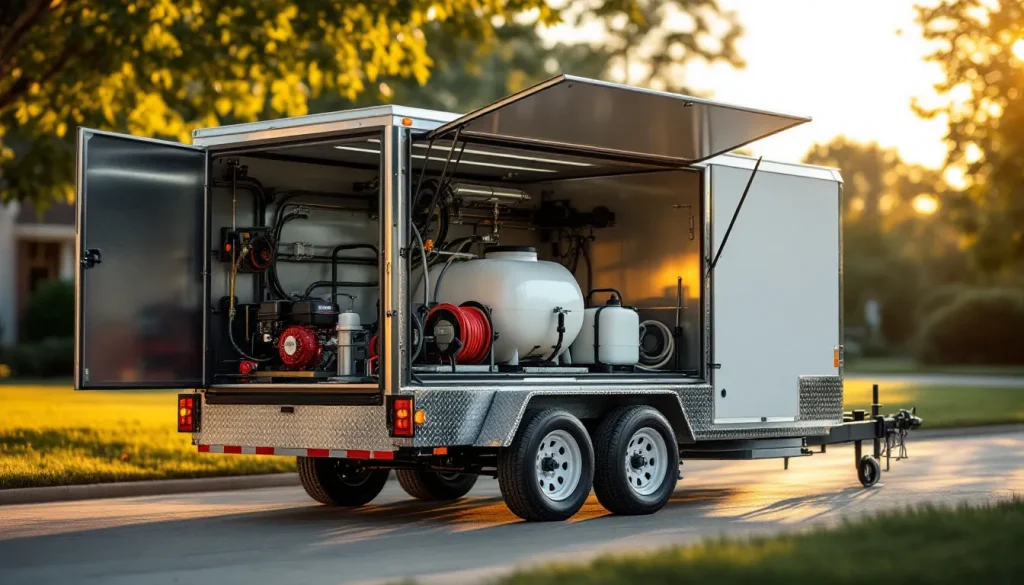
A pressure washing trailer is a towable rig that carries a pressure washer, a water buffer tank, hose reels, and a power source so a mobile cleaning business can work jobs without relying on the customer’s water pressure. The core components are the pressure washer pump, a gas or diesel engine, a buffer tank (usually 100 to 525 gallons), pressure hose on reels, a wand and nozzles, and often a soft-wash injection system. Everything mounts to an enclosed or open utility trailer.
The buffer tank is the piece beginners underestimate. Residential spigots deliver only 4 to 8 gallons per minute (GPM), and many machines draw more than that. The tank stores water so the pump never starves. A 12V soft-wash pump, a downstream chemical injector, and a 100-gallon fresh-water tank for detergent round out a full setup.
For the business side of buying equipment, our guide to starting a pressure washing business covers licensing, insurance, and pricing that pairs with the rig decisions below.
Pressure washer specs: PSI and GPM you actually need
For a commercial pressure washing rig, target 4 GPM at 4,000 PSI as the workhorse spec, because GPM (flow) removes debris faster than PSI (force) on most residential and commercial surfaces. Solo operators often run 4 to 5.5 GPM; multi-gun crews run 8 GPM twin-lance systems. PSI matters for concrete and stripping; GPM matters for rinse speed and daily production.
| Job type | Recommended GPM | Recommended PSI |
|---|---|---|
| Soft wash (siding, roofs) | Low-pressure 12V pump | Under 500 PSI at surface |
| Residential flatwork, driveways | 4 GPM | 3,500 to 4,000 PSI |
| Commercial concrete, fleet | 5.5 to 8 GPM | 4,000 PSI |
| Kitchen exhaust, grease | 4 to 5.5 GPM (hot water) | 3,000 to 4,000 PSI |
Rule of thumb from working operators: buy the highest GPM your buffer tank and engine can support before chasing higher PSI. An 8 GPM machine cleans roughly twice as fast as a 4 GPM machine at the same PSI.
Engine and power source
Most pressure washing trailers run a Honda GX390 (13 HP) for 4 GPM systems or a Honda GX630/GX690 V-twin for 5.5 to 8 GPM systems, because these gas engines are the industry default for parts availability and belt-drive pump pairing. Belt-drive pumps run cooler and last longer than direct-drive. Diesel appears mainly on hot-water burners, not the pump engine itself.
A 4 GPM Honda GX390 belt-drive setup is the reliable starting point. Larger GX690 builds power 8 GPM twin systems but demand a bigger buffer tank and heavier trailer axle rating.
Hot water vs cold water pressure washing systems
Cold water rigs handle 90% of residential exterior cleaning (house washing, driveways, decks) and cost far less. Hot water systems add a diesel-fired burner that heats water to 180 to 200 degrees Fahrenheit, which is required for grease, oil, gum, and commercial kitchen work. The burner adds roughly $2,500 to $5,000 to a build.
| Factor | Cold water | Hot water |
|---|---|---|
| Best for | Houses, concrete, decks, fences | Grease, oil, gum, industrial, fleet |
| Added cost | Baseline | +$2,500 to $5,000 (burner + coil) |
| Complexity | Low | Higher (diesel tank, burner service) |
| Beginner need | Usually sufficient | Add later when contracts require it |
Most solo operators start cold water and add hot water once commercial contracts justify it. See our overview of power washing service types to match your rig to the jobs you plan to sell.
Softwash vs pressure washing capability
Soft washing applies low-pressure chemistry (sodium hypochlorite and surfactant) at under 500 PSI at the surface to kill algae and mold on roofs and siding, while pressure washing uses high mechanical force for hard surfaces. A complete rig should do both: the high-pressure pump plus a separate 12V soft-wash system and downstream injector. Roofs and painted siding must never take high pressure.
A dual-capable rig wins more jobs. Add a 12V soft-wash pump (around $150 to $400) and a dedicated chemical tank so you can quote house washes and roof cleaning without swapping equipment.
What size water tank do I need? (the formula competitors skip)
Your buffer tank must refill faster than your pump empties it, or the pump cavitates (sucks air) and fails. The math: your tank’s fill source must supply more GPM than your pump draws. A garden hose feeds 4 to 8 GPM, so if your pump draws 4 GPM and the hose refills at 5 GPM, a 100-gallon tank never runs dry. If the pump draws 8 GPM and the hose only refills at 5 GPM, the tank drains at 3 GPM.
Size the tank so it holds enough buffer for the drain gap over your working window. Formula: (pump GPM minus fill GPM) times minutes of continuous spraying = gallons needed as buffer. An 8 GPM pump with a 5 GPM feed drains 3 GPM, so 30 minutes of continuous spraying needs a 90-gallon working buffer, meaning a 100-gallon tank is the floor and 225 gallons is safer.
| Pump draw | Fill rate | Recommended tank |
|---|---|---|
| 4 GPM | 5 to 8 GPM hose | 65 to 100 gallons |
| 5.5 GPM | 5 GPM hose | 100 to 225 gallons |
| 8 GPM twin | 5 GPM hose | 225 to 525 gallons |
Never plumb the pump directly to a spigot. Always draw from the buffer tank so brief pressure drops or a kinked feed line cannot starve the pump.
Trailer vs skid: a decision framework
A skid is the pump-tank-engine assembly mounted on a frame that drops into a truck bed or existing trailer; a full trailer is that skid on its own dedicated towable chassis. Choose a skid if you already own a truck and want the lowest entry cost and flexibility. Choose a trailer if you want a dedicated branded rig, enclosed storage, and no daily loading.
| Factor | Skid | Trailer |
|---|---|---|
| Entry cost | Lower ($1,500 to $6,000) | Higher ($5,000 to $25,000) |
| Needs a truck bed | Yes | No (any tow vehicle) |
| Daily loading | Load/unload or leave in bed | Hitch and go |
| Storage/security | Exposed unless in cap | Enclosed option, lockable |
| Branding surface | Minimal | Large wrap area (rolling ad) |
| Best for | Solo starter, tight budget | Established operator, crews |
Decision rule: if your budget is under $6,000 and you own a pickup, start with a skid. If you can invest $8,000-plus and want the marketing value of an enclosed wrapped rig, buy the trailer. Many operators start skid, then graduate to a trailer in year two.
DIY build vs pre-built package: the itemized cost breakdown
A DIY pressure washing trailer build runs roughly $6,000 to $10,000 for a solid 4 to 5.5 GPM cold-water rig, while a comparable pre-built package runs $9,000 to $18,000. DIY saves 25 to 40 percent but costs 20 to 40 hours of plumbing, wiring, and mounting labor. Below is a real line-item breakdown for a mid-tier cold-water build.
| Component | DIY cost | In pre-built package |
|---|---|---|
| Utility/enclosed trailer (6×12) | $2,500 to $5,500 | Included |
| 5.5 GPM belt-drive pump + Honda GX690 | $1,800 to $2,600 | Included |
| Buffer tank (225 gal) + plumbing | $350 to $700 | Included |
| Hose reels + 200 ft pressure hose | $500 to $900 | Included |
| 12V soft-wash system + chem tank | $300 to $600 | Included |
| Fittings, wiring, mounts, valves | $400 to $800 | Included |
| Your labor (20 to 40 hrs) | Your time | Included |
| Total | $6,350 to $11,100 | $9,000 to $18,000 |
Buy pre-built if you value warranty, single-vendor support, and speed to first job. Build DIY if you have mechanical skill and want to learn the system you will maintain. The pre-built premium buys a tested rig and a phone number to call when something leaks.
Best pressure washing trailer setup for a beginner (minimum viable build)
The minimum viable beginner rig is a 4 GPM at 4,000 PSI belt-drive skid on a Honda GX390, feeding from a 100-gallon buffer tank, with a 12V soft-wash system, for a total of roughly $3,500 to $6,000. This starter tier cleans houses, driveways, decks, and fences (the highest-volume residential jobs) without hot water. Add hot water and higher GPM once revenue justifies it.
- Honda GX390 belt-drive pump, 4 GPM at 4,000 PSI ($1,200 to $1,800).
- 100-gallon buffer tank plumbed to the pump inlet, never to the spigot ($150 to $300).
- 12V soft-wash pump and 50-gallon chemical tank for house and roof washing ($250 to $500).
- 150 to 200 ft of pressure hose on a reel plus soft-wash hose ($400 to $700).
- Mount on a skid in your existing pickup, or a used 5×8 utility trailer ($1,000 to $2,500).
Start cold water, start with a skid or small trailer, and reinvest early profit into a second gun and hot water. Budget separately for insurance and marketing, which our guide on pressure washing costs and pricing breaks down, so your equipment spend does not leave you underfunded on customer acquisition.
Use cases: residential, commercial, and fleet
Match the rig to the work. Residential (house washing, driveways, decks) runs fine on a 4 GPM cold-water starter. Commercial (storefronts, sidewalks, flatwork) benefits from 5.5 to 8 GPM for production speed. Fleet and industrial (trucks, equipment, kitchens) usually require hot water plus reclaim compliance for wastewater capture.
- Residential: 4 GPM cold water, soft-wash for siding and roofs. Lowest barrier to entry.
- Commercial: 5.5 to 8 GPM, larger buffer tank, faster turnaround on big flatwork.
- Fleet/industrial: hot water burner, water reclaim mats, higher insurance, contract-driven.
For more foundational tutorials on equipment and green-industry business operations, browse the HMNDP Learn hub.
Frequently Asked Questions
How much does it cost to set up a pressure washing trailer?
A complete pressure washing trailer setup costs $3,500 to $25,000 depending on form factor and features. A beginner skid runs $3,500 to $6,000. A mid-tier DIY cold-water trailer runs $6,000 to $11,000. A comparable pre-built package runs $9,000 to $18,000. Hot water burners add $2,500 to $5,000. Solo operators commonly start near $5,000 and scale up.
Should I buy a pre-built pressure washing trailer or build my own?
Build your own if you have mechanical skill and want to save 25 to 40 percent (roughly $3,000 to $6,000) and learn the system you will maintain. Buy pre-built if you value warranty, single-vendor support, and getting to your first paid job in days instead of weeks. A DIY build takes 20 to 40 hours of plumbing, wiring, and mounting labor.
What is the difference between a pressure washing skid and a trailer?
A skid is the pump, engine, and tank assembly on a frame that drops into a truck bed or existing trailer. A trailer is that assembly on its own dedicated towable chassis. Skids cost less ($1,500 to $6,000) and need a pickup. Trailers cost more ($5,000 to $25,000) but offer enclosed storage, hitch-and-go convenience, and a large surface for branding.
What size water tank do I need for a pressure washing trailer?
Size the buffer tank so its fill rate exceeds the pump draw, or the pump cavitates. A 4 GPM pump fed by a 5 to 8 GPM hose needs only 65 to 100 gallons. A 5.5 GPM pump needs 100 to 225 gallons. An 8 GPM twin-gun system needs 225 to 525 gallons. Always draw from the tank, never directly from the spigot.
What PSI and GPM do I need for a commercial pressure washing rig?
Target 4 GPM at 4,000 PSI as the commercial workhorse spec. GPM (flow) removes debris and rinses faster, so prioritize it over PSI on most surfaces. Solo operators run 4 to 5.5 GPM. Multi-gun crews run 8 GPM twin systems for production speed. Reserve very high PSI for concrete stripping and stubborn flatwork.
Do I need a hot water pressure washer for my trailer?
Not to start. Cold water handles about 90 percent of residential work: house washing, driveways, decks, and fences. Add a hot water burner (180 to 200 degrees Fahrenheit) when you take on grease, oil, gum, commercial kitchens, or fleet cleaning. The burner adds $2,500 to $5,000, so most solo operators add it in year two once contracts justify it.
What is the best pressure washing trailer setup for a beginner?
The best beginner setup is a 4 GPM at 4,000 PSI belt-drive skid on a Honda GX390, a 100-gallon buffer tank, and a 12V soft-wash system, for roughly $3,500 to $6,000. This handles the highest-volume residential jobs (houses, driveways, decks) without hot water. Start with a skid in your existing truck, then upgrade to a trailer and hot water as revenue grows.
What are the essential components of a pressure washing rig?
The essentials are a pressure washer pump, a gas engine (commonly a Honda GX390 or GX690), a water buffer tank (100 to 525 gallons), pressure hose on a reel, a wand and nozzle set, and a downstream chemical injector. A 12V soft-wash system and separate chemical tank let one rig do both pressure washing and low-pressure soft washing.