
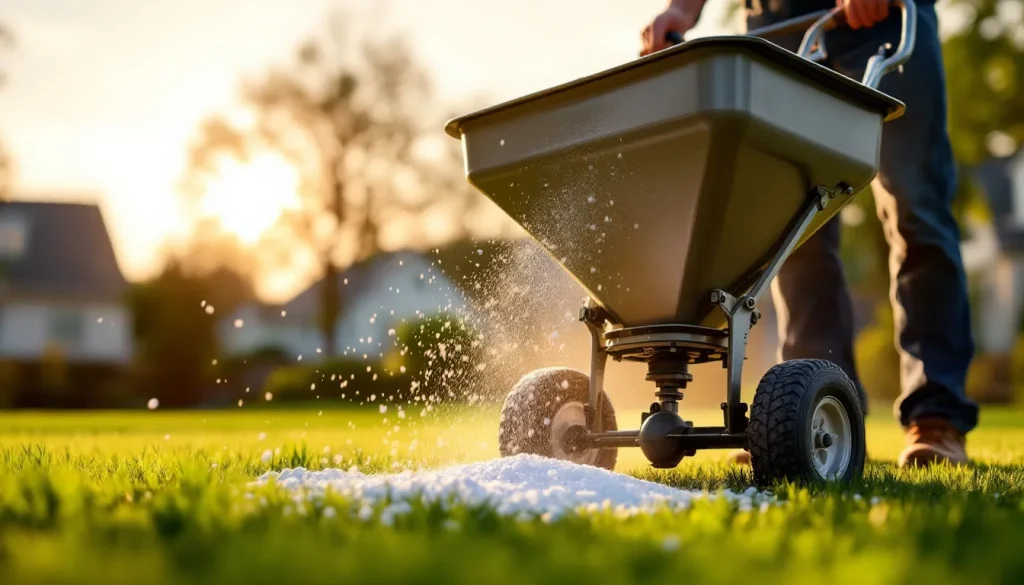
What lawn lime actually does
Lawn lime raises soil pH to reduce acidity, and it does that by adding calcium (and magnesium, in dolomitic forms) that neutralize hydrogen ions in the soil. The result is better nutrient availability, so the fertilizer you already apply works harder. Lime does not feed grass directly and it does not kill weeds or moss.
By HMNDP Editorial Team. Last reviewed: June 2026.
Most home lawns perform best between pH 6.0 and 7.0. Below about 6.0, nutrients like nitrogen, phosphorus, and potassium get chemically locked up even when they are present in the soil. Lime shifts the balance so roots can take those nutrients up.
Lime delivers four things to an acidic lawn:
- Raises pH: neutralizes acidity so the soil moves toward the 6.0 to 7.0 range grass prefers.
- Adds calcium and magnesium: calcitic lime supplies calcium; dolomitic lime supplies both calcium and magnesium.
- Improves nutrient uptake: at pH 6.5, roughly 6 of the 6.5 units of applied nitrogen stay available, versus far less at pH 5.5.
- Improves soil structure: calcium helps clay particles flocculate, which loosens tight soil and improves drainage over time.
Signs your lawn needs lime
Signs a lawn may need lime include grass that stays thin and pale despite regular fertilizing, spreading moss in shaded or damp areas, and increasing broadleaf weeds like plantain and dandelion. These are symptoms of low soil pH, not proof of it. The only way to confirm acidity is a soil test, because the same symptoms can come from compaction, drought, or shade.
Watch for these acid-soil indicators:
- Poor fertilizer response: you fertilize on schedule but color and density barely improve.
- Moss taking over: moss tolerates acidic, compacted, shaded ground where grass struggles.
- Certain weeds thriving: plantain, sorrel, and knotweed favor low-pH soil.
- History of acid inputs: years of ammonium-based nitrogen fertilizer, or pine and oak leaf litter, gradually push pH down.
None of these confirm the need for lime on their own. Confirm with a test before you spend money or spread product.
Test your soil before applying lime
A soil test is mandatory before liming because lime is slow to correct and hard to reverse. Over-liming pushes pH above 7.0 and locks up iron and manganese, causing yellowing that mimics the very problem you were solving. A test tells you your current pH, your target, and whether magnesium is low, which decides the lime type.
Pull samples 3 to 4 inches deep from 8 to 10 spots across the lawn, mix them, and send the composite to your state cooperative extension lab or a private lab. Most charge $10 to $25 and return results in 1 to 2 weeks. A good report lists pH plus a buffer pH or lime requirement, which is the number that actually drives your rate. See our guide on how to test soil pH for step-by-step sampling.
Retest every 3 to 4 years, or one year after liming to confirm the correction held.
How much lime per 1,000 sq ft (rates by soil type and pH)
To raise pH by one full point, sandy soil needs roughly 25 pounds of ground limestone per 1,000 sq ft, loam needs about 40 to 50 pounds, and clay needs 55 to 70 pounds. Clay and organic soils resist pH change (high buffering), so they need more lime and more patience. Split any application over 50 pounds per 1,000 sq ft into two passes.
These are approximate rates using standard pulverized or pelletized calcitic limestone. Your soil test buffer pH is more accurate than any chart, so use these figures only when you do not have a lab lime-requirement number.
| Soil type | Raise pH 0.5 point | Raise pH 1.0 point (5.5 to 6.5) | Notes |
|---|---|---|---|
| Sandy | ~15 lb / 1,000 sq ft | ~25 lb / 1,000 sq ft | Low buffering, changes fast, re-acidifies fastest |
| Loam / sandy loam | ~25 lb / 1,000 sq ft | ~40 to 50 lb / 1,000 sq ft | Moderate buffering, most common home lawn soil |
| Clay / clay loam | ~35 lb / 1,000 sq ft | ~55 to 70 lb / 1,000 sq ft | High buffering, split into two applications |
Do not apply more than 50 pounds per 1,000 sq ft at once. If your test calls for more, apply half now and the rest in 6 to 12 months, retesting before the second dose.
Calcitic vs dolomitic lime: which to use
Use calcitic lime by default, and choose dolomitic lime only when your soil test shows magnesium is also low. Calcitic lime is mostly calcium carbonate. Dolomitic lime adds magnesium carbonate. Applying dolomitic lime to soil that already has adequate magnesium can build up excess magnesium, which competes with calcium and potassium uptake and can degrade soil structure over years.
| Type | Supplies | Use when | Watch out for |
|---|---|---|---|
| Calcitic lime | Calcium (calcium carbonate) | pH is low, magnesium is adequate or high | Will not fix a magnesium deficiency |
| Dolomitic lime | Calcium and magnesium | pH is low AND magnesium is low on the test | Excess magnesium if soil Mg is already fine |
Both raise pH by similar amounts pound for pound. The decision is about magnesium, not acidity, and your soil report is the only reliable way to make it.
Pelletized vs powdered lime and how long each takes
Pelletized lime is powdered limestone bound into pellets that spread cleanly through a rotary or drop spreader and start adjusting pH within a few weeks. Pulverized (powdered) lime is cheaper per pound but dusty and messy. So-called fast-acting lime is finely ground and pelletized for quicker reaction, but no lime fully corrects pH overnight; full correction takes months regardless of form.
| Form | Speed to full effect | Ease of application | Best for |
|---|---|---|---|
| Pelletized limestone | 2 to 6 months | Easy, low dust, spreader-friendly | Most home lawns |
| Pulverized (powdered) | 3 to 6 months | Dusty, drifts in wind | Budget large-area jobs |
| Fast-acting / prilled | 2 to 4 weeks to start, months to finish | Very easy, lower rate per bag | Quick partial correction, maintenance |
Fast-acting bags cover more area per pound because they use a lower application rate, so read the label and do not assume one bag equals another.
When and how to apply lawn lime
Apply lime in fall or early spring when grass is not heat-stressed, ideally around aeration or before overseeding so it works into the root zone. Fall is often best because winter freeze-thaw cycles help move lime into the soil. Never lime a dormant, drought-stressed, or newly seeded-but-ungerminated lawn heavily.
Follow this sequence:
- Test and calculate: get your soil pH and lime requirement, then set your rate from the chart above.
- Aerate if compacted: core aeration lets lime reach the root zone faster.
- Spread evenly: use a calibrated rotary or drop spreader, applying half the lime in one direction and half perpendicular for even coverage.
- Water in: a light watering settles the lime and starts the reaction.
- Wait to fertilize: keep lime and fertilizer applications a few weeks apart. Coordinate timing with our guide on when to fertilize your lawn.
Lime is one of several corrective inputs. For the bigger picture on calcium, sulfur, gypsum, and compost, see our overview of soil amendments.
Target pH by grass type (and the over-liming warning)
Cool-season grasses like Kentucky bluegrass and tall fescue prefer pH 6.0 to 7.0, while most warm-season grasses like bermuda and zoysia do well at 6.0 to 6.5. Acid-loving centipedegrass is the exception: it prefers 5.0 to 6.0 and can be damaged by liming. Match your target to your grass before you spread anything.
| Grass type | Season | Target pH |
|---|---|---|
| Kentucky bluegrass, ryegrass | Cool | 6.0 to 7.0 |
| Tall fescue, fine fescue | Cool | 5.8 to 6.5 |
| Bermudagrass, zoysiagrass | Warm | 6.0 to 6.5 |
| St. Augustinegrass | Warm | 6.0 to 7.0 |
| Centipedegrass | Warm (acid-loving) | 5.0 to 6.0 (do not over-lime) |
Over-liming is a real risk. Pushing pH above 7.0 to 7.5 locks up iron and manganese and causes yellowing that looks like a nutrient shortage. Unlike fertilizer, lime cannot be flushed out. Bringing an over-limed lawn back down takes elemental sulfur and often a full growing season.
Does lime kill weeds or moss? And lime vs gypsum
Lime does not kill weeds or moss. Moss thrives in acidic, shaded, compacted, damp soil, and lime only removes the acidity part of that equation. If shade, poor drainage, and compaction remain, moss comes back even after liming. To clear moss, correct pH plus improve drainage, reduce shade, and aerate, then rake the dead moss out.
Gypsum (calcium sulfate) is often confused with lime but does a different job. Gypsum adds calcium and sulfur without changing soil pH, so it is used to displace sodium in salt-damaged or coastal soils, not to correct acidity. Choosing gypsum to raise pH is a common and costly mistake.
| Product | Changes pH? | Supplies | Use for |
|---|---|---|---|
| Lime (calcitic/dolomitic) | Yes, raises pH | Calcium (+ magnesium) | Correcting acidic soil |
| Gypsum (calcium sulfate) | No, pH-neutral | Calcium and sulfur | Sodic/salty soil, calcium without pH change |
Want the fundamentals in one place? Start with the HMNDP lawn care learning hub for testing, fertilizing, and amendment guides.
Frequently Asked Questions
What does lime do for grass?
Lime raises soil pH to reduce acidity, which unlocks nutrients that were chemically tied up in acidic soil. It adds calcium (and magnesium in dolomitic forms) and improves soil structure over time. Lime does not feed grass directly like fertilizer. Instead, it makes the fertilizer and nutrients you already have available to grass roots.
When should you apply lime to your lawn?
Apply lime in fall or early spring when grass is actively growing but not heat-stressed. Fall is often ideal because winter freeze-thaw cycles work lime into the soil. Timing it with core aeration or before overseeding helps lime reach the root zone. Avoid liming dormant, drought-stressed, or freshly seeded lawns until grass is established.
How much lime do I need per 1,000 sq ft?
To raise pH one full point, sandy soil needs about 25 pounds per 1,000 sq ft, loam about 40 to 50 pounds, and clay 55 to 70 pounds. Clay resists change and needs more. Never apply over 50 pounds at once; split larger amounts across two applications months apart. A soil test buffer pH gives the exact number.
How do I know if my lawn needs lime?
Common signs include thin pale grass despite fertilizing, spreading moss, and acid-loving weeds like plantain and sorrel. These point to possible low pH but do not confirm it, since shade and compaction cause similar symptoms. The only reliable way to know is a soil test from a cooperative extension or private lab, typically $10 to $25.
Does lime kill weeds or moss in a lawn?
No. Lime does not kill weeds or moss. Moss favors acidic, shaded, damp, compacted soil, and lime only corrects the acidity. If shade, drainage, and compaction stay the same, moss returns even after liming. To remove moss, correct pH, improve drainage and airflow, aerate to relieve compaction, then rake out the dead growth.
What is the difference between lime and gypsum for lawns?
Lime raises soil pH to correct acidity and supplies calcium (plus magnesium if dolomitic). Gypsum (calcium sulfate) is pH-neutral: it adds calcium and sulfur without changing pH and is mainly used to displace sodium in salty or sodic soils. Using gypsum to fix acidic soil is a common mistake, since gypsum will not raise your pH.
Calcitic vs dolomitic lime: which should I use?
Use calcitic lime by default. Choose dolomitic lime only when your soil test shows magnesium is low, because dolomitic lime supplies both calcium and magnesium. Applying dolomitic lime when magnesium is already adequate can build up excess magnesium, which competes with calcium and potassium uptake. Both types raise pH similarly, so magnesium status decides the choice, not acidity.
How long does lime take to work and how often should I apply it?
Pelletized lime begins adjusting pH within a few weeks, but full correction takes 2 to 6 months. Fast-acting prilled forms start in 2 to 4 weeks yet still finish over months. Retest soil every 3 to 4 years, or one year after liming. Sandy soils re-acidify fastest and may need reapplication sooner than clay.
Can you apply too much lime and damage your lawn?
Yes. Over-liming pushes pH above 7.0 to 7.5, which locks up iron and manganese and causes yellowing that mimics a nutrient deficiency. Unlike fertilizer, lime cannot be flushed out quickly. Correcting an over-limed lawn requires elemental sulfur and often a full growing season. Always follow soil-test rates and never apply more than 50 pounds per 1,000 sq ft at once.