
By the HMNDP Editorial Team. Last reviewed: June 2026.
When to fertilize lawn, in one answer
The best time to fertilize lawn depends on one variable: your grass type. Cool-season grasses (Kentucky bluegrass, fescue, ryegrass) get their biggest feeding in fall, roughly August through November, with a lighter spring feeding once soil hits 55F. Warm-season grasses (Bermuda, Zoysia, St. Augustine) feed from late spring through summer, starting when soil reaches 65F or higher. Soil temperature, not the calendar, is the real trigger.
Most lawns need 2 to 4 feedings per year spaced 6 to 8 weeks apart. The rest of this guide tells you which schedule is yours, how to read soil temperature for free, and the timing mistakes that waste fertilizer or burn the lawn.
Step 1: Identify your grass type and climate zone first
Dates mean nothing until you know whether your grass is cool-season or warm-season, because the two run on opposite schedules. Cool-season grass grows hardest in spring and fall and goes semi-dormant in summer heat. Warm-season grass does the reverse: it sleeps in winter and grows fastest in summer. Your US region is the fastest clue.
| Clue | Cool-season lawn | Warm-season lawn |
|---|---|---|
| US region | North, Midwest, Northeast, Pacific Northwest, upper transition zone | South, Southeast, Gulf Coast, Texas, Southern California, Southwest |
| Common grasses | Kentucky bluegrass, tall fescue, fine fescue, perennial ryegrass | Bermuda, Zoysia, St. Augustine, Centipede, Bahia |
| Greenest in | Spring and fall (60-75F air) | Summer (80-95F air) |
| Brown/dormant in | Mid-summer heat and hard winter | Winter (often tan until spring) |
| Peak feeding season | Fall | Late spring through summer |
If you live in the transition zone (a band from Kansas through Tennessee to Virginia), you may have either type, or both. When unsure, check the color in January: if the lawn is green, it is cool-season; if it is tan and goes green only in late spring, it is warm-season.
Step 2: Use soil temperature, not the date on the calendar
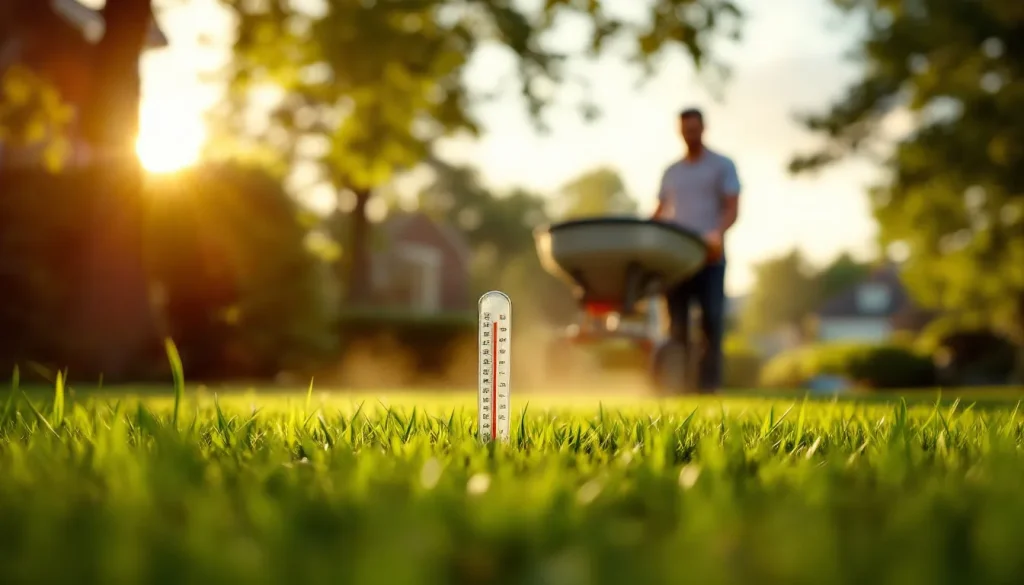
Soil temperature is the single most accurate signal for when to fertilize lawn, because grass roots wake and grow based on ground warmth, not air temperature or the month. A warm March in Georgia and a cold March in Ohio are different worlds. Feeding when the soil is at the right temperature puts nutrients into roots that are actually ready to use them.
| Trigger | Soil temperature (4-inch depth) | What it signals |
|---|---|---|
| Cool-season spring green-up | ~55F and rising | Roots active; time for a light spring feed |
| Cool-season fall feeding | Below ~70F, dropping | Best window of the year for the main feed |
| Warm-season green-up | ~65F and rising | Grass leaving dormancy; start feeding |
| Crabgrass germination | ~55F sustained | Pre-emergent window for cool-season lawns |
You can measure soil temperature two ways. Buy a soil thermometer (often $8 to $15 at any garden store), push it 3 to 4 inches into the lawn mid-morning, and read it. Or check a free regional map: the USDA NRCS and many state universities (Greencast by Syngenta, and Michigan State, for example) publish daily soil-temperature maps online by ZIP code.
When to fertilize a cool-season lawn (the full schedule)
For cool-season lawns, fall is the most important feeding of the year, applied roughly August through November and finishing 6 to 8 weeks before your first hard frost. A light spring feeding once soil reaches 55F supports green-up. Skip heavy summer feeding: the grass is stressed by heat and you would push weak top growth.
- Early spring (soil at 55F): one light feeding to support green-up, often paired with a crabgrass pre-emergent. This is usually mid-March to April in the North.
- Late spring (late May): optional light feed if the lawn looks pale; otherwise skip.
- Summer: do not fertilize during heat and drought stress. Feeding now invites disease and burn. Water and mow high instead.
- Early fall (Aug to mid-Sept): the main feeding. Roots recover and store energy as the soil cools.
- Late fall (Oct to Nov, 6-8 weeks before frost): a final “winterizer” feed that builds root reserves for next spring.
That is typically 3 to 4 applications per year, weighted toward fall. For product picks, see our guide to the best fall lawn fertilizer.
When to fertilize a warm-season lawn (the full schedule)
Warm-season lawns feed during their active growing season, late spring through late summer, starting only after the grass has fully greened up and soil holds at 65F or higher. In the warm-season South like Texas, that usually means starting in late March or April. Feeding while the grass is still dormant in winter wastes nutrients and can feed weeds.
- Late spring (after full green-up, soil 65F+): first feeding. In Texas and the Gulf Coast this is often late March to April; further north in the warm zone, May.
- Early summer (June): second feeding as growth accelerates.
- Mid to late summer (July to August): third feeding during peak growth.
- Early fall: one optional final feed 6 to 8 weeks before the lawn goes dormant. Stop fertilizing nitrogen as dormancy nears so you do not push tender growth into frost.
That is typically 3 to 4 feedings spaced 6 to 8 weeks apart, all inside the warm growing months.
How often to fertilize and how to match the product
Space feedings 6 to 8 weeks apart during the growing season, landing at 2 to 4 applications per year for most homeowners depending on grass type, soil test results, and whether you mulch clippings. More is not better: over-fertilizing burns roots, pushes disease, and pollutes runoff.
Match the fertilizer to what the grass is doing. The first number on the bag is nitrogen (the N in N-P-K), which drives leaf and shoot growth. The middle (phosphorus) supports roots and is restricted in some states. The last (potassium) builds stress and cold tolerance.
| Growth stage | What the grass is doing | Fertilizer to favor |
|---|---|---|
| Spring green-up | Waking up, light top growth | Moderate, slow-release nitrogen |
| Peak growing season | Active blade growth | Higher nitrogen, slow-release to avoid surge and burn |
| Late fall (cool-season) / pre-dormancy (warm-season) | Storing energy in roots | Higher potassium “winterizer” to build root reserves |
The principle to remember: feed for roots going into dormancy and for blades during peak season. Our roundup of the best lawn fertilizer for 2026 breaks down N-P-K choices by lawn type.
What not to do: the timing mistakes that waste fertilizer
The fastest way to harm a lawn is feeding it at the wrong moment, and these errors are the ones competitor guides skip. Avoid summer feeding on cool-season grass, fertilizing right before heavy rain or onto dry soil, applying too late before frost, and treating new sod or overseeded lawns on the same schedule as an established lawn.
- Do not feed cool-season grass in mid-summer. The grass is heat-stressed and semi-dormant. Nitrogen now forces weak growth, invites brown patch disease, and can scorch the lawn.
- Do not fertilize right before a heavy storm. Hard rain washes granules off before roots absorb them, sending nitrogen and phosphorus into storm drains and waterways. A light rain or watering after application is good; a downpour is waste.
- Do not fertilize bone-dry, dormant grass. Apply to a lightly moist lawn, then water in with about a quarter inch unless light rain is expected.
- Do not feed too late before frost. For cool-season lawns, finish 6 to 8 weeks before the first hard frost so growth hardens off. For warm-season lawns, stop nitrogen as dormancy approaches.
- Do not feed new sod immediately. Wait until roots knit (usually 4 to 6 weeks), then start a gentle starter fertilizer. Treating new sod like established turf can burn shallow roots.
When to fertilize after overseeding or laying new sod
New seed and new sod need a starter fertilizer (higher phosphorus to drive roots) at or just after installation, not the regular nitrogen schedule. For overseeding, apply a starter feed at seeding, then a follow-up about 4 to 6 weeks later. For sod, wait until it roots down (about 4 to 6 weeks, when it resists a gentle tug) before the first feeding.
Cool-season lawns are best overseeded in early fall, which lines up perfectly with the main fall feeding window. See our walkthrough on how to overseed a lawn for seed rates and timing. For more seasonal lawn-care guides, browse the HMNDP learn hub.
Frequently Asked Questions
How do I know if I have cool-season or warm-season grass?
Check your region and winter color. Cool-season grasses (fescue, Kentucky bluegrass, ryegrass) dominate the North and stay green or semi-green in winter. Warm-season grasses (Bermuda, Zoysia, St. Augustine) dominate the South and turn tan in winter, greening up only in late spring. If your lawn is green in January, it is cool-season.
When should I fertilize my lawn in spring?
For cool-season grass, apply a light spring feeding once soil reaches about 55F, often mid-March to April in the North. For warm-season grass, wait until the lawn has fully greened up and soil holds at 65F or higher, frequently late March to May depending on how far south you are. Soil temperature beats the calendar.
When should I apply fall lawn fertilizer?
Fall feeding is mainly for cool-season lawns. Apply an early-fall feeding in August to mid-September as soil cools below 70F, then a final winterizer feeding in October or November, finishing 6 to 8 weeks before the first hard frost. This builds root reserves for a stronger spring. Warm-season lawns need at most one light pre-dormancy feed.
Should I fertilize my lawn before or after rain?
Fertilize before a light rain or water it in afterward, but never right before a heavy storm. A quarter inch of water moves granules into the soil so roots absorb the nutrients. A downpour washes fertilizer off the surface into storm drains and waterways, wasting product and causing pollution. Avoid applying to bone-dry grass.
When should I fertilize my lawn after winter?
Wait for active growth, not the first warm day. Cool-season lawns are ready for a light feed once soil reaches about 55F (often April). Warm-season lawns should be fully green with soil at 65F or higher, usually late spring. Feeding dormant or barely-waking grass wastes nitrogen and can feed early weeds instead of your lawn.
How often should I fertilize my lawn per year?
Most lawns need 2 to 4 feedings per year, spaced 6 to 8 weeks apart during the growing season. Cool-season lawns are weighted toward fall; warm-season lawns feed across late spring and summer. Exact frequency depends on your soil test, grass type, and whether you mulch clippings back into the lawn. More than four feedings rarely helps.
What soil temperature should I fertilize at?
Cool-season grass greens up and is ready for a light feed at about 55F soil temperature, measured 4 inches deep. Warm-season grass needs roughly 65F or higher before its first feeding. Measure with an $8 to $15 soil thermometer mid-morning, or check a free regional soil-temperature map from the USDA NRCS or a state university extension.
When should I fertilize after overseeding or laying new sod?
Apply a starter fertilizer (higher phosphorus for roots) at the time of overseeding, then a follow-up feed about 4 to 6 weeks later. For new sod, wait until it roots down, about 4 to 6 weeks, before the first feeding. Do not put new seed or sod on the established lawn’s nitrogen schedule; it can burn shallow roots.