
By the HMNDP Editorial Team. Last reviewed: June 2026.
How to grow grass, start to finish
To grow grass, match a seed type to your climate, seed in the right season, then loosen and rake the soil, spread seed at 5 to 7 pounds per 1,000 square feet, cover it lightly, apply starter fertilizer, and keep the top inch of soil moist until it sprouts. Cool-season grass germinates in 5 to 30 days depending on type. Get the grass type and timing right first, because those two choices sink more lawns than any sowing mistake.
- Pick a grass type that suits your region (cool-season or warm-season).
- Seed in the correct season (early fall for cool-season, late spring for warm-season).
- Prep the soil: clear debris, loosen the top 2 to 3 inches, grade, and rake smooth.
- Test and amend the soil if the pH is off.
- Spread seed evenly at 5 to 7 pounds per 1,000 square feet.
- Rake in or topdress with 1/4 inch of soil or compost.
- Apply a starter fertilizer.
- Water to soak 4 to 6 inches deep, then keep it moist daily.
- Wait for germination, then make a first mow once blades reach the target height.
Step 1: Choose the right grass type for your climate
Grass type is the first decision, and picking wrong is the top cause of a lawn that never fills in. Cool-season grasses (Kentucky bluegrass, tall fescue, perennial ryegrass) suit the northern U.S. Warm-season grasses (Bermuda, Zoysia, St. Augustine, centipede) suit the South. Check your USDA hardiness zone, then match seed to it before you buy anything.
A rough dividing line runs through the transition zone (roughly Kansas to Virginia), where both types struggle and tall fescue is often the safest pick. Buy a named cultivar suited to your zone rather than a generic “sun and shade” bag, and read the label for the fine fescue or bluegrass percentage.
| Grass type | Climate | Germination time | Best for |
|---|---|---|---|
| Perennial ryegrass | Cool-season (North) | 5 to 10 days | Fast green, quick patch repair |
| Tall fescue | Cool-season / transition | 7 to 14 days | Heat and drought tolerance |
| Kentucky bluegrass | Cool-season (North) | 14 to 30 days | Dense, self-repairing turf |
| Bermuda | Warm-season (South) | 7 to 21 days | Full sun, heat, foot traffic |
| Zoysia | Warm-season (South) | 14 to 21 days | Dense, low-water lawns |
For a deeper breakdown of what to buy, see our guide to choosing grass seed by type and region.
Step 2: Seed in the right season
Season matters as much as grass type, and wrong-season seeding is a leading reason lawns fail. Cool-season grass is best seeded in early fall (roughly late August to early October), when soil is warm and weeds are fading. Warm-season grass is best seeded in late spring to early summer (May to June), once soil temperature holds above 65 to 70 degrees Fahrenheit.
Spring is the fallback window for cool-season grass, but new seedlings then face summer heat and crabgrass before their roots are deep. Avoid seeding right before a hard frost or a heat wave. For exact windows by region, see our breakdown of the best time to plant grass seed.
Step 3: Prepare the soil
Good soil prep is where a new lawn is won. Clear rocks, sticks, and old debris, then loosen the top 2 to 3 inches with a rake, tiller, or garden fork so roots can push down. Grade the surface away from the house for drainage, break up clumps, and rake it level. Seed needs firm, crumbly soil, not a hard crust or loose fluff.
On bare ground, remove existing weeds first and rake until the surface is fine and even. On compacted or hard soil, loosen it deeper (3 to 4 inches) and mix in 1 to 2 inches of compost, because seed sown on hardpan tends to wash away or dry out before rooting.
Step 4: Test and amend the soil
A soil test tells you whether the ground can actually grow grass before you spend on seed. Most grasses want a pH of 6.0 to 7.0. A home test kit or a state extension lab test (often $10 to $20) reports pH and nutrient levels. Add lime to raise a low pH or elemental sulfur to lower a high one, following the test’s rate.
Working 1 to 2 inches of compost into the top few inches improves almost any soil: it loosens clay, helps sand hold water, and feeds the seedlings. Amend before you seed, not after, so the correction is where the roots will grow.
Step 5: Spread the seed evenly
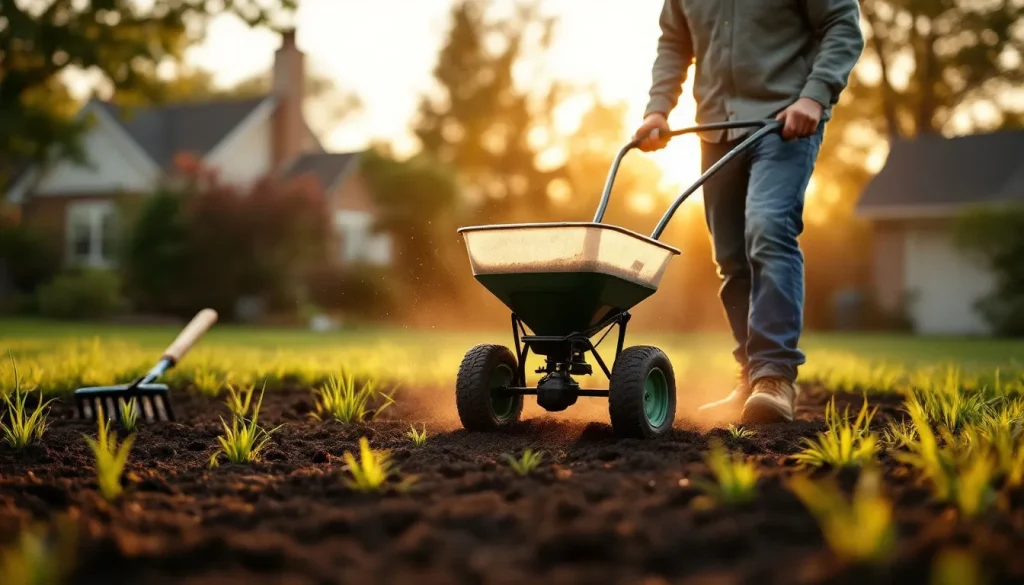
Even coverage at the right rate gives you thick turf without wasting seed. For most new lawns, spread 5 to 7 pounds of seed per 1,000 square feet (check the bag, since rates vary by species). Use a broadcast or drop spreader set to the label rate, and split the seed into two passes at right angles for even coverage.
Set the spreader to half the recommended rate and walk the lawn north to south, then east to west with the second half. Hand-sowing works for small patches but tends to clump. Overseeding a thin existing lawn uses a lighter rate, roughly 3 to 4 pounds per 1,000 square feet.
Step 6: Cover the seed and apply starter fertilizer
Covering seed lightly protects it from birds, wind, and drying out, which speeds germination. Rake the seed in so it sits about 1/4 inch deep, or topdress with a thin 1/4 inch layer of compost or fine soil. Do not bury it deeper than 1/4 inch, because seed under too much soil will not reach light and rot.
Apply a starter fertilizer at seeding. Starter blends are high in phosphorus (the middle number, such as 18-24-6) to drive root growth. Spread it with the seed or right after, following the bag rate, and water it in. A thin layer of straw mulch on slopes helps hold seed and moisture.
Step 7: Water correctly (the make-or-break step)
Watering is where most first-time lawns die, so treat it as the critical step. Right after seeding, soak the soil 4 to 6 inches deep once. After that, keep the top inch consistently moist, never soggy and never dry, with light watering 2 to 3 times a day until seedlings appear. A dried-out seed that has started to swell will die.
Once grass is up and 1 inch tall, cut back to once a day, then to deeper, less frequent watering (about 1 inch per week) as roots establish. Water early in the morning to cut evaporation and disease. In hot or windy weather, check the surface midday and add a light misting if it has crusted over.
How long does grass take to grow, and how to speed it up
Grass takes 5 to 30 days to sprout depending on type, then 6 to 10 weeks before it is thick enough to treat like an established lawn. Perennial ryegrass shows green in 5 to 10 days, tall fescue in 7 to 14, and Kentucky bluegrass in 14 to 30. To grow grass fast, pick a quick species, seed in the right season, and never let the soil dry out.
The single biggest speed lever is consistent moisture, followed by soil temperature in the right range for your seed. Fast-germinating ryegrass gives the quickest green, and some homeowners mix a little ryegrass into a bluegrass blend for early cover while the slower grass fills in. For a fuller timeline, see how long grass seed takes to grow.
How to grow grass on bare dirt or an existing lawn
Bare dirt and thin existing lawns need different starting steps, though both finish the same way. On bare dirt, the work is soil prep: loosen the top 2 to 3 inches, mix in compost, grade, rake fine, then seed at the full 5 to 7 pounds per 1,000 square feet. Hard, compacted dirt must be loosened first or seed will wash off.
To grow grass on an existing lawn (overseeding), mow low (about 1.5 inches), rake out thatch and dead grass to expose soil, then spread seed at roughly 3 to 4 pounds per 1,000 square feet. Seed needs soil contact, so raking to bare earth in the thin spots matters more than the seed rate. Keep both moist the same way, daily until germination.
First mow: timing and height
The first mow comes later than most people expect. Wait until new grass reaches about 3 to 4 inches tall, usually 3 to 6 weeks after germination, then cut no more than the top third off. Mowing too early or too short tears out shallow-rooted seedlings before they anchor.
Make sure the mower blade is sharp so it cuts rather than pulls, and mow when the grass is dry. Keep cool-season grass around 2.5 to 3.5 inches and warm-season grass shorter, near 1 to 2 inches, once the lawn is established.
Why grass seed sometimes will not grow
When seed does not sprout, the cause is almost always moisture, timing, or seed depth. Soil that dried out for even a day after seeds swelled, seed buried deeper than 1/4 inch, wrong-season seeding, old or low-quality seed, or a hard crust the sprouts cannot break through are the usual culprits. Check these before reseeding.
- Dried out: the top inch went dry once during germination. Fix with lighter, more frequent watering.
- Too deep: seed buried over 1/4 inch. Rake lightly next time.
- Wrong season or temperature: soil too cold or too hot for the species. Reseed in the correct window.
- Old seed: viability drops after 2 to 3 years. Buy fresh, dated bags.
- Poor soil contact: seed sat on thatch or hardpan. Rake to bare soil first.
For more beginner lawn guides, browse the HMNDP learn hub.
Frequently Asked Questions
How long does grass take to grow from seed?
Grass sprouts in 5 to 30 days depending on the type. Perennial ryegrass shows green in 5 to 10 days, tall fescue in 7 to 14, and Kentucky bluegrass in 14 to 30. After sprouting, the lawn needs about 6 to 10 weeks of growth and 2 to 3 mows before it is thick and established enough for normal use.
What is the best time of year to plant grass seed?
Cool-season grasses (bluegrass, fescue, ryegrass) do best seeded in early fall, roughly late August to early October, when soil is warm and weeds fade. Warm-season grasses (Bermuda, Zoysia) do best in late spring to early summer, once soil holds above 65 to 70 degrees Fahrenheit. Spring is a workable fallback for cool-season grass, but summer heat stresses young seedlings.
How much grass seed do I need per square foot?
Most new lawns need 5 to 7 pounds of seed per 1,000 square feet, which is roughly 15 to 20 seeds per square inch. Overseeding a thin existing lawn uses less, about 3 to 4 pounds per 1,000 square feet. Rates vary by species, so check the bag. Splitting the seed into two crossing passes gives the most even coverage.
How do I grow grass fast on dirt or bare soil?
Loosen the top 2 to 3 inches of dirt, mix in 1 to 2 inches of compost, grade and rake it fine, then seed at 5 to 7 pounds per 1,000 square feet. Choose a fast species like perennial ryegrass, seed in the right season, cover lightly, and keep the top inch of soil moist 2 to 3 times daily. Hard soil must be loosened first or seed washes away.
How do I plant grass seed on an existing lawn (overseeding)?
Mow low to about 1.5 inches, rake out thatch and dead grass so seed reaches bare soil, then spread new seed at 3 to 4 pounds per 1,000 square feet. Apply a light starter fertilizer and keep the area moist daily until seedlings appear. Soil contact matters most, so rake the thin and bare spots down to soil before seeding.
How often should I water new grass seed?
Water new grass seed lightly 2 to 3 times a day to keep the top inch of soil consistently moist until it sprouts, which takes 5 to 30 days. Do the first watering deep, soaking 4 to 6 inches down. Once seedlings reach about 1 inch tall, shift to once daily, then to deeper watering of roughly 1 inch per week as roots establish.
Do I need to cover grass seed after planting?
Yes, cover grass seed lightly. Rake it in so it sits about 1/4 inch deep, or topdress with a thin 1/4 inch layer of compost or fine soil. Light covering protects seed from birds and wind and keeps it moist, which speeds germination. Do not bury it deeper than 1/4 inch, since seed too deep cannot reach light and may rot instead of sprouting.
Why is my grass seed not growing?
The usual causes are the soil drying out during germination, seed buried deeper than 1/4 inch, seeding in the wrong season, old or low-quality seed, or poor seed-to-soil contact on thatch or hardpan. Check moisture first, since a swollen seed that dries out once will die. Keep the top inch moist, rake seed to bare soil, and reseed in the correct window with fresh seed.