
By the HMNDP Editorial Team, independent reporting on lawn care, fertilizer, and the green industry.
Last reviewed: June 2026
The short answer on lawn fertilization
Lawn fertilization means feeding your grass nitrogen (the N in the N-P-K number on the bag) at the right time and the right rate. The single hard rule: never apply more than about 0.9 lb of nitrogen per 1,000 square feet in one application. Cool-season grasses like fescue feed best in fall. Warm-season grasses like Bermuda feed in summer. Calculate your product amount from the bag, water it in, and you will not burn the lawn.
Everything else below is the detail that makes those four sentences work: when, how much, how to do the math, and how to apply it cleanly.
When to fertilize your lawn: spring green-up vs fall feeding
Timing depends on whether your grass grows fastest in cool weather or hot weather. Cool-season lawns (fescue, Kentucky bluegrass, ryegrass) want their biggest feeding in fall, roughly September through early November, with a lighter spring application. Warm-season lawns (Bermuda, zoysia, St. Augustine, centipede) want feeding in late spring through summer, roughly May through August, when they are actively growing.
The rule that prevents most mistakes: fertilize when the grass is growing, not when it is dormant or stressed. Feeding a cool-season lawn heavily in July pushes tender growth into heat and disease. Feeding a warm-season lawn in October feeds nothing because the grass is shutting down.
Match the feeding to the growth curve, and you avoid the two most common DIY errors. For a deeper regional breakdown, see our guide on when to fertilize your lawn.
Cool-season vs warm-season: a 10-second decision step
Not sure which camp you are in? Use location and grass habit. If you live in the northern half of the United States (roughly the Transition Zone northward: New England, the Midwest, Pacific Northwest) and your lawn stays green into late fall, you have cool-season grass. If you live in the South or lower Transition Zone and your lawn turns brown and goes dormant after the first frost, you have warm-season grass.
| If this is true | You likely have | Primary feeding window |
|---|---|---|
| Stays green through cold fall; common in North | Cool-season (fescue, bluegrass, rye) | Fall (Sept–Nov) |
| Browns out after frost; common in South | Warm-season (Bermuda, zoysia, St. Augustine) | Late spring–summer (May–Aug) |
How much nitrogen does a lawn need per 1,000 sq ft?
Cap any single application at about 0.9 lb of actual nitrogen per 1,000 square feet. Many extension programs round this to “no more than 1 lb N per 1,000 sq ft per application.” This ceiling exists because nitrogen is a salt, and too much at once pulls water out of grass roots and burns the blades. Stay at or under 0.9 lb and burn risk drops sharply, especially with quick-release products.
That 0.9 lb figure is per application, not per year. Your lawn needs several applications across the season to hit its annual total, spaced 4 to 8 weeks apart depending on the product.
Annual total nitrogen needs by grass type
Your yearly nitrogen target depends on grass type and how lush you want the lawn. The numbers below are pounds of actual nitrogen per 1,000 square feet per year, drawn from typical university extension ranges. Lower end is low-maintenance; higher end is a dense, frequently mowed lawn.
| Grass type | Season | Annual N (lb per 1,000 sq ft/yr) |
|---|---|---|
| Tall fescue | Cool | 2–4 |
| Kentucky bluegrass | Cool | 3–5 |
| Perennial ryegrass | Cool | 2–4 |
| Bermuda | Warm | 3–6 |
| Zoysia | Warm | 2–4 |
| St. Augustine | Warm | 2–5 |
| Centipede | Warm | 1–2 |
Divide the annual total by 0.9 to estimate how many applications you need. A tall fescue lawn targeting 3 lb N per year needs roughly three to four feedings, weighted toward fall.
How to calculate how much fertilizer to buy from the N-P-K number
This is the step that trips up most homeowners, so here is the full arithmetic. The three numbers on every bag (the N-P-K) are percentages by weight: nitrogen, phosphorus, potassium. A 50 lb bag of 24-0-4 is 24 percent nitrogen. To hit 0.9 lb of actual nitrogen per 1,000 sq ft, you divide your target N by the bag’s N percentage.
- Find the N percentage. First number on the bag. 24-0-4 means 24 percent N, written as 0.24.
- Divide target N by that percentage. 0.9 lb N divided by 0.24 = 3.75 lb of product per 1,000 sq ft.
- Multiply by your lawn size. A 5,000 sq ft lawn needs 3.75 x 5 = 18.75 lb of product per application.
- Check the bag covers it. A 50 lb bag of 24-0-4 supplies enough for about 13,000 sq ft at this rate.
Worked example with a different bag: a 30-0-4 product is 30 percent N. 0.9 divided by 0.30 = 3 lb of product per 1,000 sq ft. For the same 5,000 sq ft lawn, that is 15 lb per application. Higher-nitrogen bags mean you spread less product to hit the same nitrogen target.
You cannot do any of this without knowing your lawn’s square footage. Measure it before you buy anything, using our walkthrough on how to measure lawn square footage. Sketch the yard, break it into rectangles and circles, calculate each, and subtract the house, driveway, and beds.
Quick-release vs slow-release nitrogen: why it changes everything
Nitrogen comes in two forms, and the difference drives your rate, frequency, and burn risk. Quick-release (water-soluble, like urea and ammonium sulfate) greens the lawn in days but burns easily and washes out fast. Slow-release (coated or organic, like sulfur-coated urea, polymer-coated urea, or biosolids) feeds over 6 to 12 weeks, rarely burns, and needs fewer applications.
| Factor | Quick-release N | Slow-release N |
|---|---|---|
| Green-up speed | 3–7 days | 2–3 weeks |
| Feeding duration | 2–4 weeks | 6–12 weeks |
| Burn risk | Higher | Low |
| Safe single-app rate | Keep at/below 0.9 lb N | Can approach 1 lb N safely |
| Applications per season | More frequent | Fewer |
Check the bag’s guaranteed analysis for “slow-release” or “water-insoluble nitrogen” (WIN). A product listing 50 percent of its nitrogen as slow-release is forgiving for beginners and the safer first choice.
Best lawn fertilizer schedule by season
A simple month-by-month plan beats guesswork. The schedules below assume a slow-release product applied at roughly 0.9 lb N per 1,000 sq ft each round. Adjust the number of rounds to hit your grass type’s annual total. Skip any application during drought or dormancy.
Cool-season schedule (fescue, bluegrass, ryegrass)
- Early September: first fall feeding, 0.9 lb N. The most important application of the year.
- Late October to early November: second fall feeding, 0.9 lb N. Builds roots for next spring.
- Mid to late spring (April–May): light feeding, 0.5 to 0.9 lb N, only if the lawn looks thin.
Fall is the priority for cool-season lawns. Our breakdown of the best fall lawn fertilizer covers product picks for these two key rounds.
Warm-season schedule (Bermuda, zoysia, St. Augustine)
- Late spring (May), after full green-up: first feeding, 0.9 lb N.
- Midsummer (June–July): second feeding, 0.9 lb N.
- Late summer (August): final feeding, 0.9 lb N. Stop 6 to 8 weeks before first frost.
Why fall is best for fescue and cool-season lawns
Fall feeding is the highest-payoff move for cool-season grass. As air temperatures cool but soil stays warm, fescue and bluegrass shift energy into roots and crowns rather than top growth. Nitrogen applied in September and October thickens the turf, stores energy for winter, and produces an early, dense green-up the following spring without the disease pressure that spring nitrogen invites.
How to fertilize a lawn: the application process
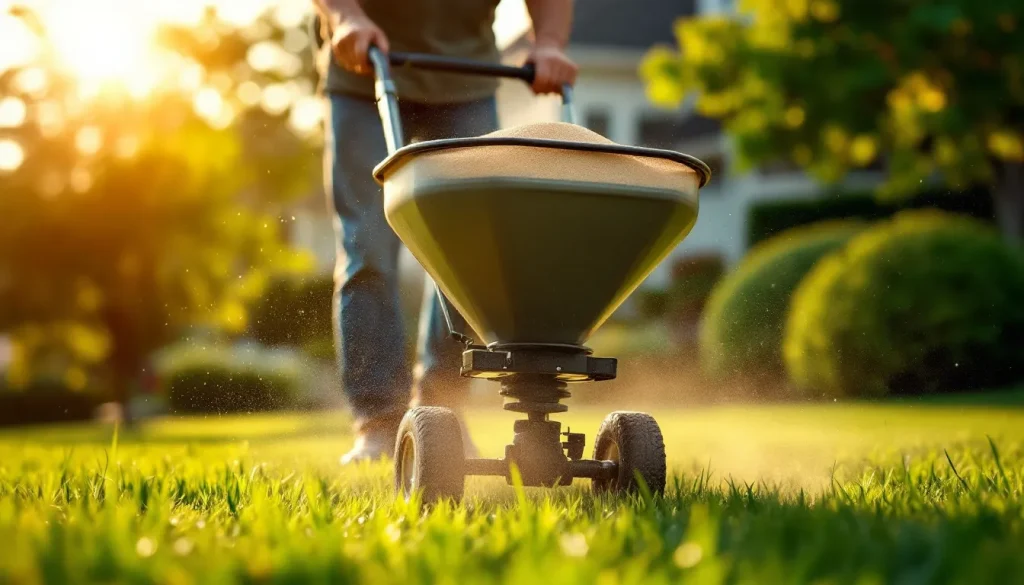
Applying fertilizer correctly is mostly about even coverage and the right machine. Use a broadcast (rotary) spreader for lawns over a few thousand square feet and a drop spreader for small or oddly shaped yards. Calibrate to the bag’s setting chart, apply on a calm day to dry grass, and water it in afterward.
- Set the spreader rate. The bag lists settings by spreader brand. Set slightly low if unsure; you can make a second pass.
- Apply at half rate in two directions. Spread half your product walking north-south, the other half east-west. This prevents striping and skipped strips.
- Keep a steady pace. Open the hopper only while moving and close it when you stop, so you do not dump a concentrated pile that burns.
- Stay off hard surfaces. Sweep granules off driveways and sidewalks back onto the lawn to keep phosphorus and nitrogen out of storm drains.
- Water it in. Apply 0.25 to 0.5 inch of water within 24 hours to move nitrogen into the soil and rinse granules off the blades. This is the most important burn-prevention step.
How to fertilize without burning the lawn
Burn happens when nitrogen salts pull moisture from grass and roots faster than the plant can recover. Four habits prevent it: stay at or below 0.9 lb N per 1,000 sq ft per application, favor slow-release nitrogen, never apply to wet or heat-stressed grass, and always water in within a day. Avoid feeding when daytime highs top about 85 F for cool-season lawns.
Avoiding striping and missed strips
Striping (dark green bands with pale gaps) comes from uneven spreader passes. The fix is the half-rate, two-direction pattern: apply half the calculated product in parallel rows one way, then the second half perpendicular. Slightly overlap the wheel tracks rather than the spread edges, and the result is uniform color with no zebra pattern.
Do I need a soil test before fertilizing?
A soil test is the cheapest way to avoid wasting money and over-applying. For roughly 10 to 25 dollars through a state university extension lab, a test reports your soil pH and phosphorus and potassium levels. This tells you whether you even need the P and K in a complete fertilizer, or whether a nitrogen-only product is smarter and cheaper.
Nitrogen is the one nutrient grass uses up every season and the one a soil test cannot reliably predict, so you fertilize N on a schedule regardless. Phosphorus and potassium, by contrast, build up in soil. Many lawns already have plenty, and several states restrict phosphorus application without a test showing a deficiency. Test every 2 to 3 years.
Established vs new lawns: different nutrient needs
New and establishing lawns need phosphorus for root development, while established lawns mainly need nitrogen. When seeding or sodding, a starter fertilizer with a higher middle number (phosphorus), such as a 12-12-12 or a labeled starter product, supports root growth, where state rules allow it. Once the lawn is mature and dense, switch to a high-nitrogen, low-phosphorus product.
| Lawn stage | Nutrient focus | Typical product type |
|---|---|---|
| New seed or sod (first 6–8 weeks) | Phosphorus for roots | Starter fertilizer (higher middle number) |
| Established (mature turf) | Nitrogen for color and density | High-N, low-P (e.g. 24-0-4) |
One free nutrient source applies at every stage: grass clippings. Leaving clippings on the lawn (grasscycling) returns up to about 1 lb of nitrogen per 1,000 sq ft per year, letting you cut one application from your schedule. Clippings do not cause thatch when you mow regularly.
For more homeowner lawn-care walkthroughs, browse the HMNDP learn hub.
Frequently Asked Questions
When should I fertilize my lawn, spring or fall?
It depends on grass type. Cool-season lawns (fescue, bluegrass, ryegrass) should be fertilized mainly in fall, September through early November, with a light spring application if needed. Warm-season lawns (Bermuda, zoysia, St. Augustine) should be fertilized in late spring through summer, May through August, when they grow fastest. Fertilize when grass is actively growing, never when dormant or heat-stressed.
How much nitrogen does a lawn need per 1,000 sq ft?
Apply no more than about 0.9 lb of actual nitrogen per 1,000 square feet in a single application to avoid burning the grass. Annual totals vary by grass type: 2 to 4 lb per 1,000 sq ft per year for tall fescue, 3 to 6 lb for Bermuda, and as little as 1 to 2 lb for low-maintenance centipede. Spread the annual total across multiple feedings.
How do I calculate how much fertilizer to buy from the N-P-K number on the bag?
Take your target nitrogen (0.9 lb per 1,000 sq ft) and divide it by the bag’s first number as a decimal. A 24-0-4 product is 24 percent N, so 0.9 divided by 0.24 equals 3.75 lb of product per 1,000 sq ft. Multiply by your lawn size in thousands of square feet. A 5,000 sq ft lawn needs 18.75 lb per application.
What is the best lawn fertilizer schedule by season?
For cool-season lawns: feed in early September and late October (the priority rounds), plus a light spring feeding. For warm-season lawns: feed in May, midsummer, and August, stopping 6 to 8 weeks before first frost. Apply about 0.9 lb N per 1,000 sq ft each round using slow-release product, and skip any feeding during drought or dormancy.
Is it better to fertilize fescue and other cool-season lawns in the fall?
Yes. Fall is the highest-payoff time to feed fescue and other cool-season grasses. As air cools and soil stays warm, the grass directs energy to roots and crowns. Nitrogen applied in September and October thickens turf, stores winter energy, and produces a dense, early spring green-up without the disease pressure that heavy spring nitrogen often causes.
What is the difference between quick-release and slow-release nitrogen?
Quick-release nitrogen (urea, ammonium sulfate) greens the lawn within 3 to 7 days but burns easily and washes out within 2 to 4 weeks. Slow-release nitrogen (coated or organic) greens up over 2 to 3 weeks but feeds for 6 to 12 weeks, rarely burns, and needs fewer applications. Beginners should choose products listing 50 percent or more slow-release nitrogen.
How do I fertilize a lawn without burning it?
Four habits prevent fertilizer burn: keep each application at or below 0.9 lb nitrogen per 1,000 sq ft, choose slow-release nitrogen, never apply to wet or heat-stressed grass, and water in 0.25 to 0.5 inch within 24 hours. Avoid feeding cool-season lawns when daytime highs exceed about 85 F, and close the spreader hopper whenever you stop walking.
Do I need a soil test before fertilizing my lawn?
A soil test is recommended every 2 to 3 years and costs about 10 to 25 dollars through a state university extension lab. It reports pH plus phosphorus and potassium levels, showing whether you need a complete fertilizer or just nitrogen. Several states restrict phosphorus unless a test confirms a deficiency. Nitrogen still gets applied on schedule because grass depletes it each season.